
Wrongweight
Wrongweight (Kleshabandha)
Hell does not compel treatment. It does not shame those who choose the chains over the Lake.Kleshabandha is a condition in which a being accumulates the unresolved dross of others — the untested failures, the unburned weight, the claims that were never submitted to Hell's pressure and therefore never burned away — accreted onto their own substance without generating it themselves. The brass at the City of Brass records it. Hell's elders recognize it. The communities of the Outer Ring cities have learned, over long centuries, to watch for its early signs.
Most who develop it choose, eventually, not to treat it.
This is a reasonable choice; Hell respects it.
How It Spreads
Wrongweight does not spread the way mortal disease spreads, not through contact, not through air, not through any mechanism a mortal epidemiologist would recognize. It spreads through sustained proximity to unresolved failure that has nowhere else to go.
When a being cracks without submitting to testing, that dross does not disperse. Hell's ambient pressure is not enough, on its own, to clear unresolved weight that has never been honestly submitted. The dross persists, accretes, and in the absence of anywhere legitimate to go, attaches. It attaches to whoever is nearest and most open. This is most often the ones who care most actively for the cracking person, the ones who sit closest, who attempt repair most often, who give the most of their own substance in the attempt.
A failed Omoitsugi is a known transmission vector. The belief and command offered without sufficient care, rebounds, and what it carries rebounds with it. The person who attempted the repair walks away holding weight that was never theirs, and may not notice for some time.
Sustained caregiving for someone who will not or cannot participate in Hell's holding systems is the most common source. The condition does not punish care. It is simply what happens when care has nowhere to deposit what it picks up.
What It Feels Like
Early kleshabandha is indistinguishable from ordinary testing-pressure. The sufferer feels heavier than expected. They crack slightly sooner than their own history would predict. They need patching more often, and the patching holds less long. A skilled elder in Bronze, or a being who has seen the condition before, might notice the pattern — but most sufferers spend years, sometimes decades, attributing the weight to their own failures before the foreign origin becomes legible.
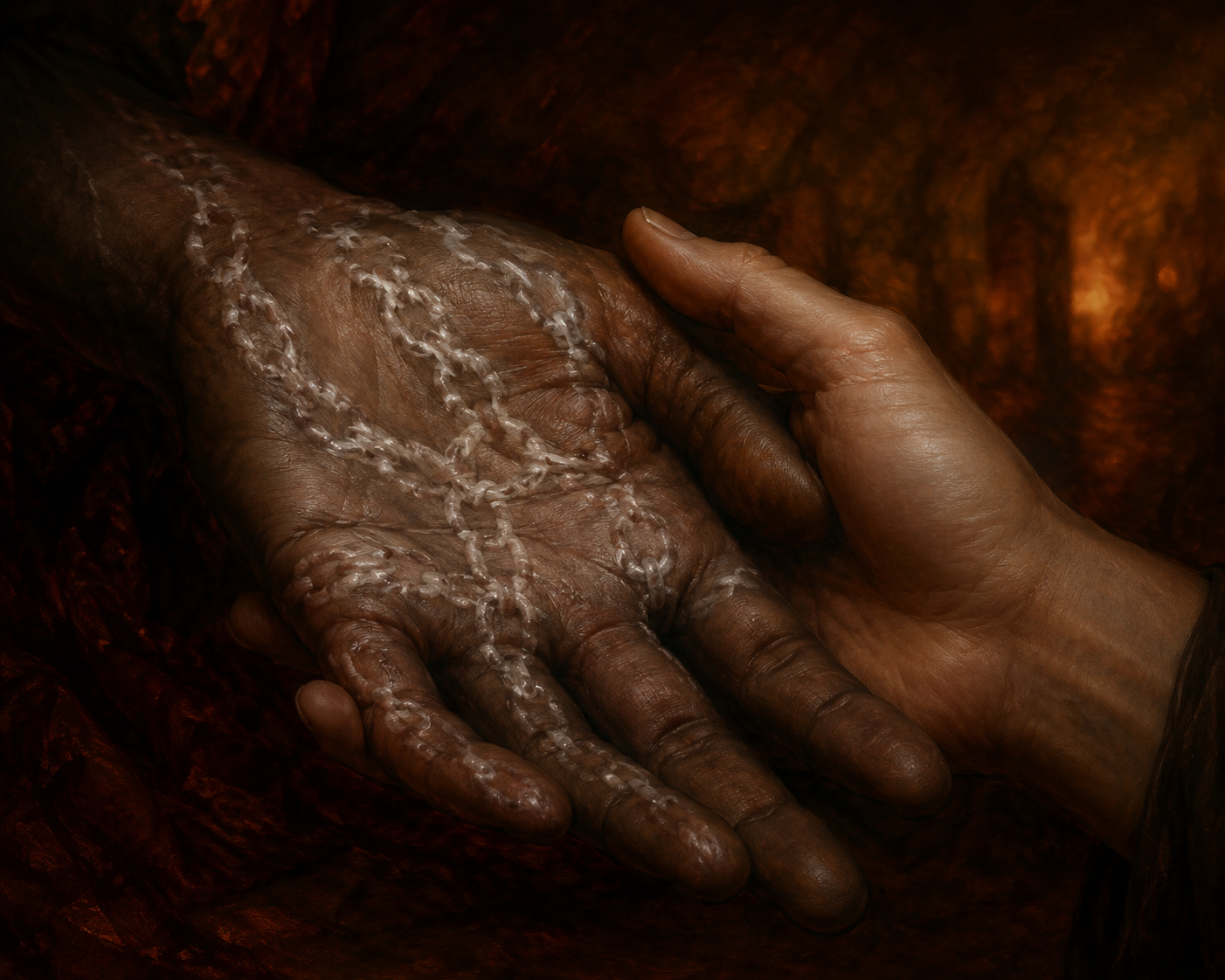
Late-stage wrongweight is visible to anyone who knows what to look for. The accumulated dross sits wrong on the sufferer's substance: wrong texture, wrong color, wrong distribution, the unmistakable profile of weight that was generated by someone else's testing and never resolved into anything. It does not resemble the bronze tracery of honest cracking and honest repair. It resemblesexactly what it is: chains a ssembled from other people's unfinished business, worn by someone who had no hand in leaving it unfinished.
The mortal tradition of Marley's ghost — a figure weighted down by accumulated, unresolved burden, visible to those with eyes to see it, a warning rather than a condemnation — is one of the cleaner mortal approximations of what late-stage kleshabandha actually looks like, filtered through a framework that couldn't quite name what it was describing.
Why It Becomes Epidemic
The condition spreads slowly, and its epidemic character is not one of aggressive contagion but of accumulated reasonable decisions compounding over time.
A single untreated carrier sheds passively onto those nearest them. Those nearest them begin to carry a portion of weight that isn't theirs. This slightly compromises their own testing-endurance, which means their own dross begins to go slightly less resolved, which makes them slightly more likely to shed in turn. No single step in this chain is dramatic. The cascade is generational rather than acute. A district of the City of Brass does not collapse into kleshabandha overnight. It accumulates, the way all dross accumulates, until the threshold is visible and the damage is already widespread.
The condition is epidemic in the City of Bronze currently in the sense that the brass records more active cases than at any prior point in the city's history. Elders attribute this to population density, to the long duration of the Long War's secondary pressures on the Outer Ring, and to what one elder has called, in a query the Census holds without elaboration, the compounding cost of caring for each other across too many centuries without adequate rest.
Treatment
There is one treatment. It is complete and reliable and almost nobody chooses it.
The Lake of Fire burns away dross that is not the sufferer's own with the same totality it burns away everything else. What enters the Lake carrying wrongeight emerges without it — the foreign weight reduced to vicikitsa clay on the surface, the sufferer's own substance intact beneath it, lighter than they have been in however long they have been carrying what was never theirs. The treatment works. There are no recorded cases of kleshabandha surviving the Lake.
There are also very few recorded cases of sufferers choosing the Lake as treatment.
A being who looks at the Lake of Fire and at the weight they are carrying and decides that the Lake is worse than the chains is making a genuine assessment that Hell will not override. The chains are heavy. The Lake is total. The choice is theirs.
What this means in practice is that a significant proportion of kleshabandha cases are chronic. Sufferers who have assessed the treatment, understood it completely, and chosen to carry the weight instead. Some have been carrying it for centuries. Some have carried it so long that the foreign dross has become, in some functional sense, simply part of who they are.
These are the ones who find their way, eventually, to the Ruins of the Two. Where the pressure is lower. Where nobody asks when they're going to treat it. Where the weight is simply, quietly, understood.
Further Reading
For the holding practice whose failure is a known transmission vector, see Omoitsugi. For the treatment site and its costs, see Lake of Fire. For the community that forms around the choice not to treat, see Ruins of the Two. For the substance the Lake produces from burned foreign dross, see Vicikitsa Clay.

Comments