
Kethavel
The Kethavel
A herd that cannot agree where it is going, and goes anyway, forever.The kethavel are the only living things that endure in the City of Electrum, and they are not, in any sense that matters, alive.
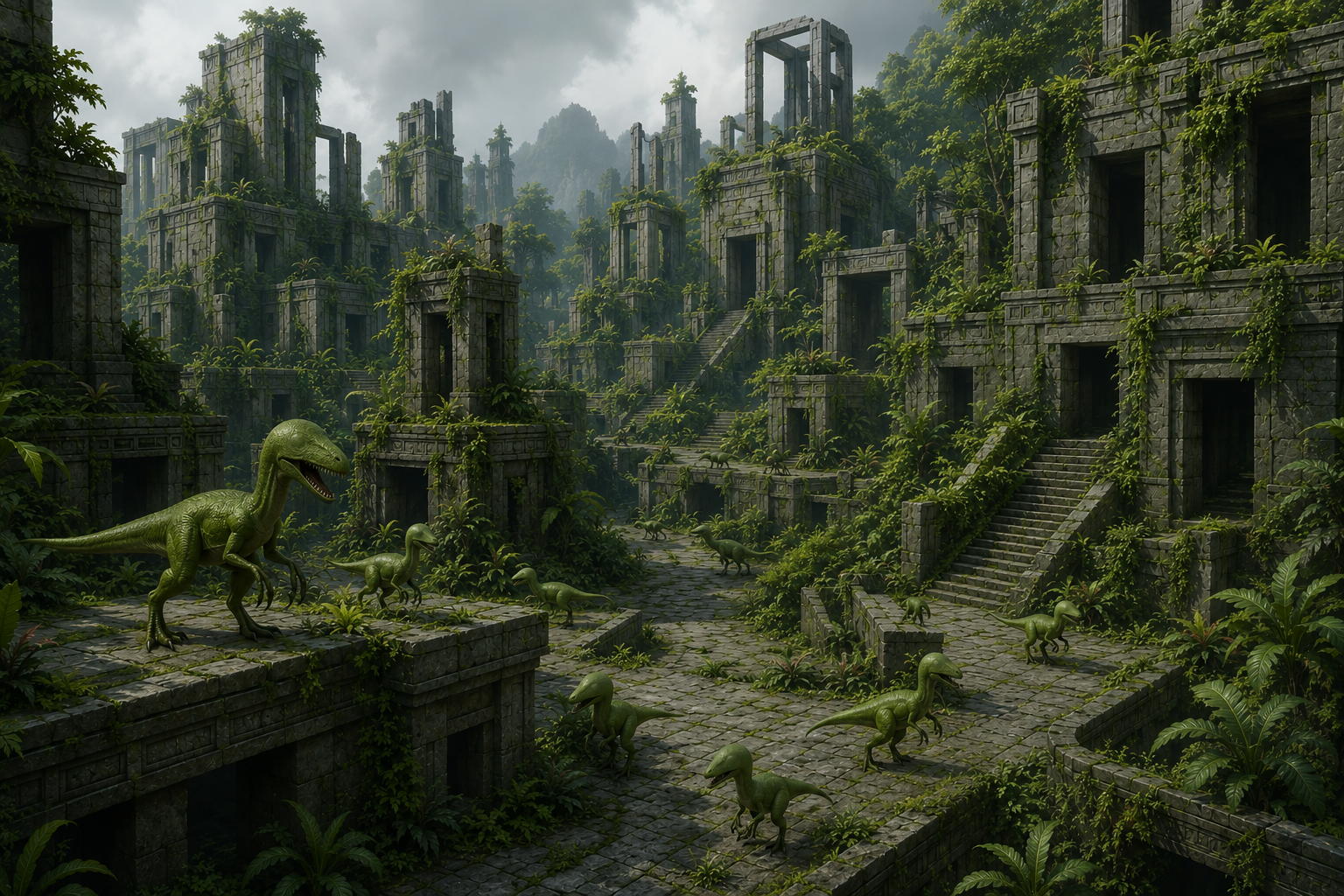
Occasionally referred to as 'pendings' in that they do not resolve into a completed Contract clause, the kethavel roam Electrum. They are small green creatures, something like raptors and not quite — lean, quick, low to the ground, moving in restless herds through the unfinished streets at the Ruskenn–Arcadia border of Hell. They bicker. They cluster and scatter and re-cluster. Their voices produce a constant overlapping murmur that sounds, to anyone who hears it, exactly like a negotiation conducted through a wall: the cadence of debate without the content, the shape of speech with nothing being said. They move with the urgent purpose of beings going somewhere that matters. They are not going anywhere. Where they are going has not yet been agreed upon, and it never will be, because the kethavel are what was left when two ontologies tried to agree and could not.
They are not a species. They were never born and they do not breed. They are a precipitate — the condensed residue of a failed synthesis, ontological energy that did not dissipate when the City of Electrum failed to cohere but instead settled into form. They have been herding and squabbling and almost-deciding since before mortal language existed. They will continue until the cosmos ends or until Ruskenn and Arcadia find common ground on the nature of selfhood, whichever comes first. The smart wager is the cosmos.
Redline! Redline!
Origin
To understand the kethavel, one must understand the failure that produced them. (For the full account, see The Ruins of the Two and The City of Electrum.)
Hell attempted, at one of its borders, to alloy the ontology of Ruskenn — the Hive, a gestalt of trillions of cytes sharing perception and propagating thought toward an emergent Psyche — with the ontology of Arcadia, whose reality is built on Contracts: bilateral agreements between separate, bounded agents, binding because both parties recognize each other as distinct. The synthesis was impossible at the foundation. Arcadia requires a signatory; the Hive offers only a process. A process cannot shake hands. Contracts in the nascent city achieved binding force for instants and then dissolved as the Hive-side of each agreement lapsed back into collective reconsideration. The architecture never stabilized. The Contracts never broke — they simply never finished being made.
But the energy of that endless almost-agreement did not vanish when the city failed. It condensed. Where the synthesis collapsed into permanent irresolution, the ontological force of the collapse took on shape — and the shape it took was a herd of creatures running Arcadian negotiation protocols on Hive-mind architecture, generating neither agreement nor consensus, only the eternal motion of trying. They are the failure of Electrum made into bodies. They are what an unresolvable argument looks like when it has been pressed into flesh and left to run forever.
Nature
The kethavel are not intelligent, though they look as though they might be. Intelligence requires enough coherence to process information and reach a conclusion. The kethavel process endlessly and conclude never. They debate without ever crossing the threshold where debate produces understanding. What they perform resembles thought the way a recording resembles a voice — the surface is there, the substance is absent. They are instinct-driven, pattern-following, and entirely incapable of reflecting on the process they repeat without pause. They cannot notice that they are arguing. They cannot notice that they never finish. They cannot notice anything, because noticing would require a vantage point outside the argument, and the kethavel are made entirely of the argument.
Their defining trait — the thing that marks them as Electrum's children and nothing else's — is the instability of their Titles. In the cosmos's ontological grammar, a Title is what a being is: the settled answer to who is this. A kethavel's Title will not settle. It flickers between I and we without ever resolving to either — a single creature that is, moment to moment, a self and then a collective and then a self again, never landing, because the two ontologies that made it never agreed on which it should be. Ruskenn says we. Arcadia says I. The kethavel says both, forever, and means neither.
In the structure of their paradox they approach Nyxalothian territory — the Realm at the edge of incoherence, where contradiction is the native state. But the kethavel are not true paradox. True paradox, as Nyxaloth demonstrates, resolves: the collapse of coherence produces something genuinely new. The kethavel never produce anything. They are stuck in the state just before paradox — permanent discord, permanent argument, permanently on the verge of becoming something without ever arriving. They are the almost. They are the moment before resolution, held open forever, and never allowed to close.
Behavior
A herd of kethavel is in constant motion and constant disagreement. They gather as if to decide something; the gathering breaks apart before anything is decided; the fragments re-gather elsewhere on different terms; those terms dissolve in turn. An observer watching long enough begins to perceive the structure of it — proposals advanced, objections raised, coalitions formed and abandoned, the whole apparatus of collective decision-making running at speed — and then begins to perceive that none of it ever lands, that the proposals reference nothing, that the coalitions are not about anything, that it is debate-shaped motion with a hollow where the subject should be.
They appear to be going somewhere. This is the most unsettling thing about them. Each individual moves with evident purpose, threading the unfinished streets with the brisk certainty of a creature on an errand. But the herd as a whole has no destination, because a destination would require agreement on where to go, and agreement is the one thing the kethavel ontologically cannot reach. So they hurry, urgently, toward a consensus that will never form, and the hurry never resolves into arrival, and the creatures never tire, because they are not expending energy in any sense entropy would recognize. They are simply the failure, perpetuating itself, dressed as a herd with somewhere to be.
They do not appear to be aggressive, though prolonged proximity to them is hazardous to certain kinds of mind (see below). They do not hunt; they do not eat in any ordinary sense; they do not rest. They argue. It is the only thing they do and the only thing they are.
Endurance
Hellfire burns through the ruins of Electrum, testing what remains there as it tests everything in Hell. It tests the kethavel too — and the kethavel endure it.
This is a bitter joke at the exact frequency Hell's testing is built to appreciate. Hell's pressure asks of everything: can you hold yourself together? The kethavel pass. Not because they are strong, not because they are worthy, not because they have proven anything — but because the discord that constitutes them is self-sustaining. The argument feeds on itself. The irresolution generates the energy that maintains the irresolution. They cannot stop arguing, and because they cannot stop, they cannot dissolve, and because they cannot dissolve, they endure. The one thing that survives in the City of Electrum is the living evidence that the City of Electrum could not survive. The failure is the only thing robust enough to last.
There is no known way to end a kethavel. They cannot be reasoned with — there is no one there to reason with. They cannot be satisfied — satisfaction would require a conclusion, and conclusion is precisely what their nature forbids. They could perhaps be ended if Ruskenn and Arcadia ever reconciled their ontologies of selfhood, retroactively resolving the argument the kethavel embody. No one expects this. The kethavel will, in all likelihood, outlast most of the cosmos — not as survivors but as residue, the last argument still echoing in an empty room after everyone capable of having it has gone.
Mortals and the Kethavel
No mortal should go near them, and the danger is not the obvious one. The kethavel will not bite or chase or harm a visitor directly. The hazard is subtler and worse: extended exposure to their endless, unresolving almost-negotiation is believed to erode the listener's own sense of bounded selfhood. A mortal mind is not built to sit for long inside the sound of an argument that never settles whether its participants are one thing or many. The flicker between I and we is contagious in a way the brass does not fully understand and does not recommend testing. Those who have heard the kethavel for any length of time describe afterward a lingering difficulty in feeling certain where they themselves end — a small, cold uncertainty about whether I is the right word for what they are. The feeling fades. It is not pleasant while it lasts.
For most mortals the kethavel will only ever be a description, which is as it should be. But the description is worth carrying, because the kethavel are the clearest small lesson the cosmos offers about a particular kind of failure. Not every disagreement is a disagreement about something. Some are disagreements about what the parties are — and those cannot be negotiated, because negotiation assumes the very thing in dispute. The kethavel are what such a disagreement looks like when it is given a body and told to run. They are a herd of small green creatures arguing forever about terms they will never agree, and they are also a warning, and the warning is this: be very sure, before you begin, that you and the one across from you mean the same thing by I.
Further Reading
For the failed synthesis that produced them, see Ruins of the Two and The City of Electrum — forthcoming. For the Realm of the Hive whose ontology of collective selfhood is half their nature, see Ruskenn. For the Realm of Contract whose ontology of bounded agency is the other half, see Arcadia. For the foundational agreement the Hive could not satisfy, see The Primordial First Contract — forthcoming. For the Realm their paradox structurally resembles but never reaches, see Nyxaloth. For the Realm whose testing they could not endure, see Hell.
The kethavel hurry through the unfinished streets of a city that was never built, toward a decision that will never be made, in voices that sound like meaning and carry none.
They are going somewhere important. They have always been going somewhere important. They will be going there when the last star in the mortal sky has gone out, and they will not have arrived, and they will not have noticed, and they will not have stopped.

Comments