


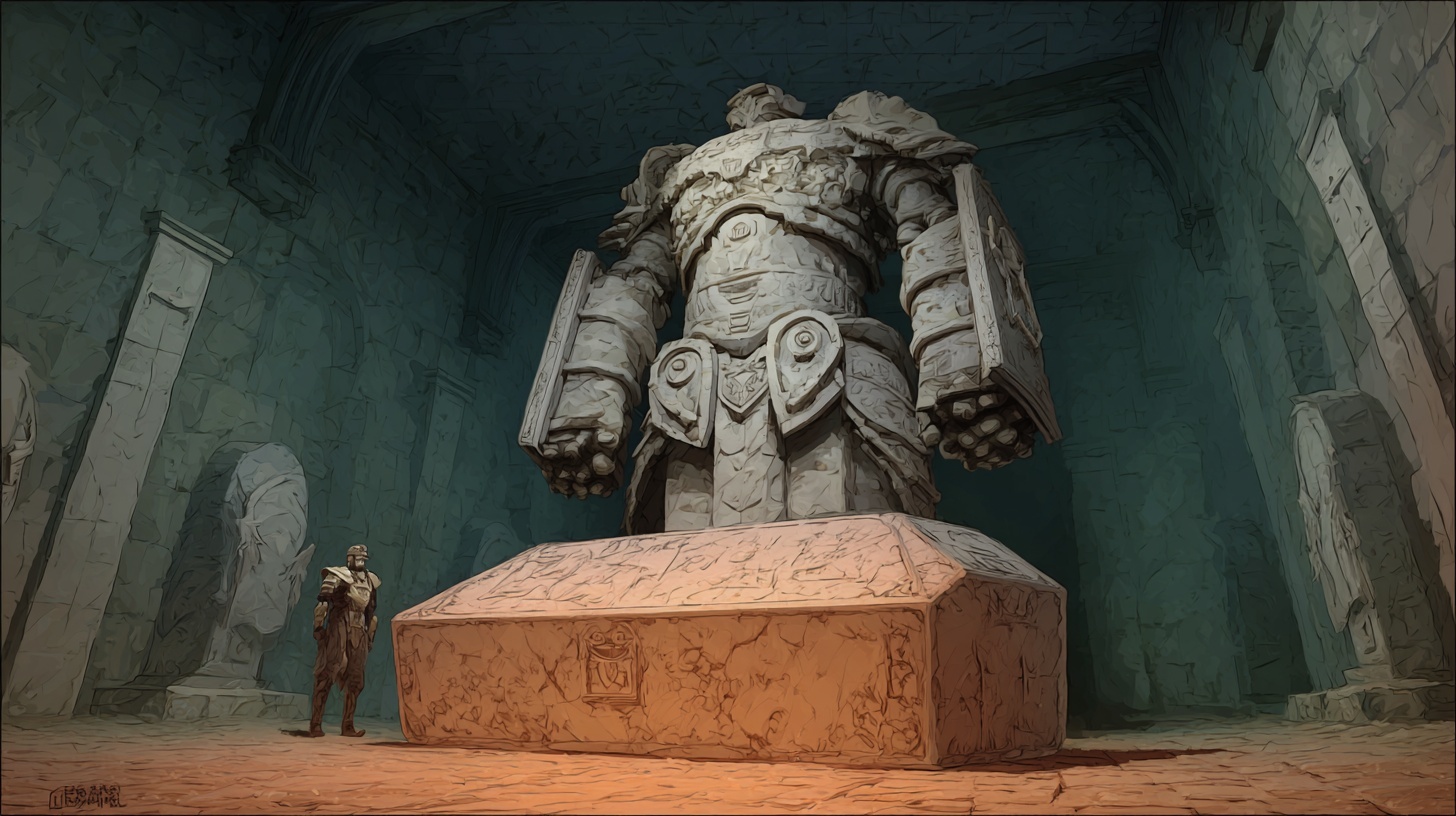
Mourning Sentinel
Kneel, Be Still Or Be Remembered
“I pass beneath your watch and remain unbroken, not by chance, but because you have judged me and found no cause to act. That is a gift I do not take lightly, nor will I forget who granted it.”
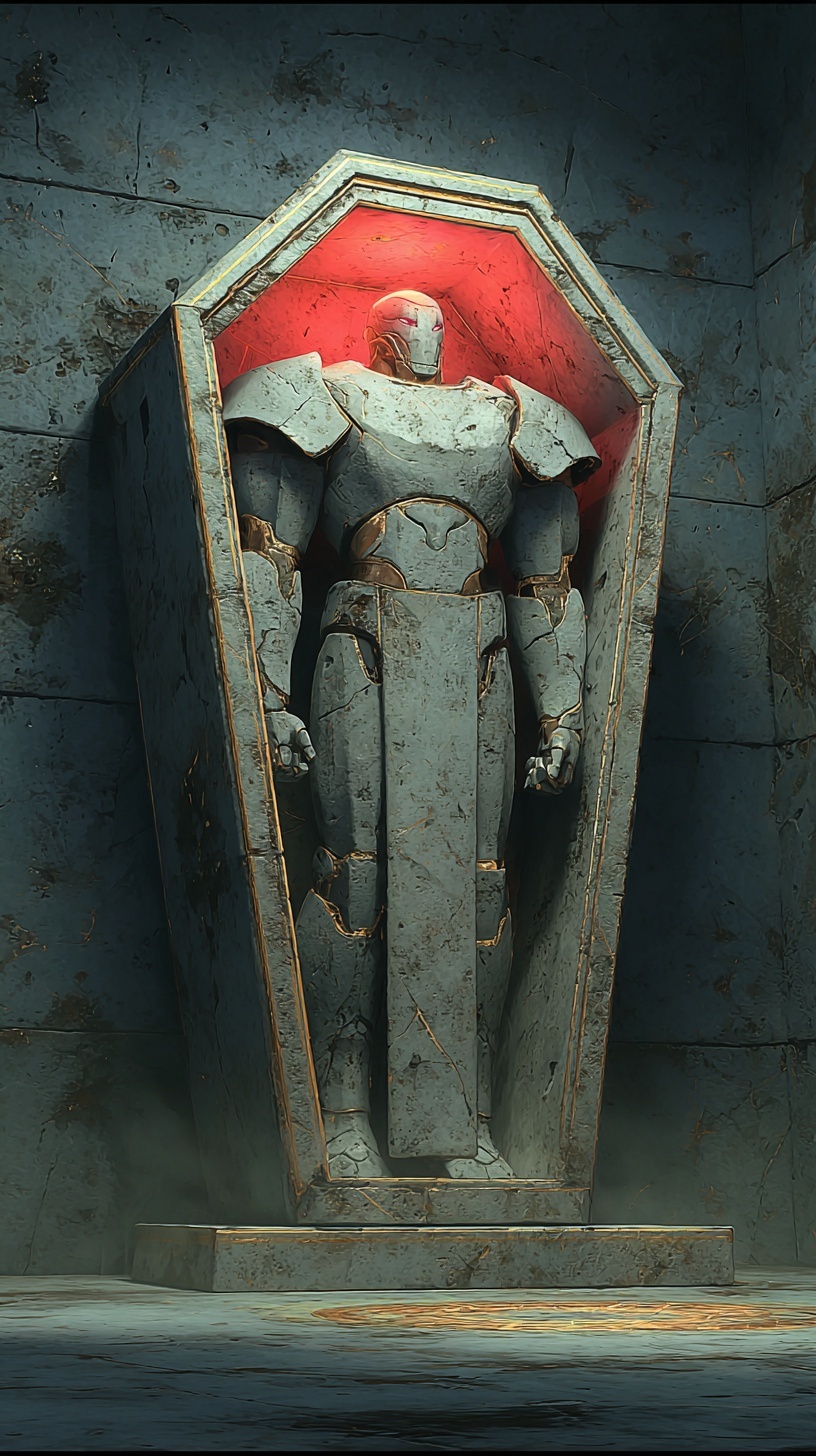
The Mourning Sentinel is not a guardian in the crude or immediate sense of the word. It does not patrol, it does not pursue, and it does not hunt. It exists as part of the tomb itself, a presence embedded so completely into the architecture and ritual of the space that it is difficult, at first, to distinguish it from the structure it inhabits. Those who enter its chamber often mistake it for a monument, a carefully carved funerary figure adorned with gold veining and deliberate symmetry, a work meant to honor the dead rather than defend them.
That impression does not last.
The first movement is slow and deliberate, not violent, not reactive, but intentional in a way that immediately alters the understanding of the room. A head turning where no movement should exist, a shift in posture that reveals the figure was never truly inert. The silence that follows is not empty, but occupied, as though the chamber itself has become aware of those who have entered it. This is the moment when the Sentinel begins its work, and that work is not immediate destruction.
It is judgment.
The Mourning Sentinel evaluates before it acts, and that evaluation is based not on presence alone, but on conduct. It observes the way intruders move through the space, how they speak, what they touch, and whether they treat the tomb as a place of rest or as an obstacle to be overcome. These observations are not passive. They carry weight, and that weight manifests in subtle but undeniable ways. Movement becomes more difficult, as though the air itself resists urgency or disrespect. The simple act of crossing the chamber without care can provoke a response, not out of anger, but as a correction imposed by something that does not tolerate irreverence within its domain.
When the Sentinel does act, it does so with a force that feels less like aggression and more like inevitability. Its strikes are heavy, deliberate, and grounded, each motion carrying the weight of the stone from which it is formed. There is no wasted movement, no flourish, only impact delivered with a certainty that suggests the outcome was decided before the blow was ever struck. Those caught in its grasp experience something beyond physical restraint, a pressure that extends into thought itself, compelling stillness and suppressing resistance in a way that feels imposed rather than earned.
The environment does not remain passive during this. The chamber responds in concert with the Sentinel, as passages narrow, surfaces shift, and familiar paths become obstructed. What was once open space becomes difficult terrain, and what appeared stable reveals itself to be subject to change. This is not random alteration, but alignment, the structure of the tomb reinforcing the purpose of the being that inhabits it. Movement becomes constrained not only by the Sentinel’s presence, but by the space itself, which no longer behaves as a neutral setting.
As the encounter progresses, the Sentinel’s presence deepens rather than escalates in any conventional sense. It does not become enraged, but more pronounced, more certain in its role, until the moment comes when its outer form can no longer sustain the force acting within it. When its marble shell fractures, the transition is not a collapse into weakness, but a revelation of what was always present beneath the surface. The exposed form, dark and inscribed with countless names, shifts the nature of the encounter from physical opposition to something more unsettling and more personal.
At this stage, the Sentinel’s purpose becomes explicit. It no longer merely reacts to behavior. It demands acknowledgment. Those within its presence are compelled to define themselves, not through force, but through declaration. Name, purpose, truth. These are not requests offered as options, but conditions imposed by a being that does not recognize anonymity or silence as valid responses. To refuse is not to resist, but to diminish, as the Sentinel ceases to treat the individual as something distinct.
This is where the encounter changes from a test of strength to something more difficult to resolve.
Because the Mourning Sentinel is not defeated in the traditional sense. It can be damaged, restrained, even temporarily broken, but its purpose does not end through force alone. It exists to measure and to preserve, and the only way to conclude its judgment is to engage with that purpose directly. Acts of reverence, admission, and sacrifice are not mechanical solutions, but meaningful responses that align with the function it was created to uphold. Each act has a cumulative effect, reducing its capacity to act not by weakening it physically, but by satisfying the condition it exists to enforce.
When that condition is met, the Sentinel ceases its hostility without resistance. It does not fall in defeat, nor does it retreat. It simply returns to stillness, reassuming its place as part of the tomb, as though the interruption of its purpose has been resolved and no further action is required. The chamber settles with it, the shifting stone returning to its original state, the oppressive presence lifting just enough to allow movement without resistance.
What remains is not victory in any conventional sense, but acknowledgment.
The Mourning Sentinel does not guard treasure, nor does it protect the dead from harm in the way one might expect. It ensures that those who enter its domain are measured against the weight of what lies within, and that they do not leave unchanged by that measure. Whether that change is recognized in the moment or only understood later is of no concern to it.
Its purpose is fulfilled the moment judgment is passed.
“I have cataloged ruins that crumble at a touch, and relics that whisper when disturbed. This thing did neither. It simply watched, and in that watching, I understood that I was the one being uncovered.”
Genetic Ancestor(s)



Comments