
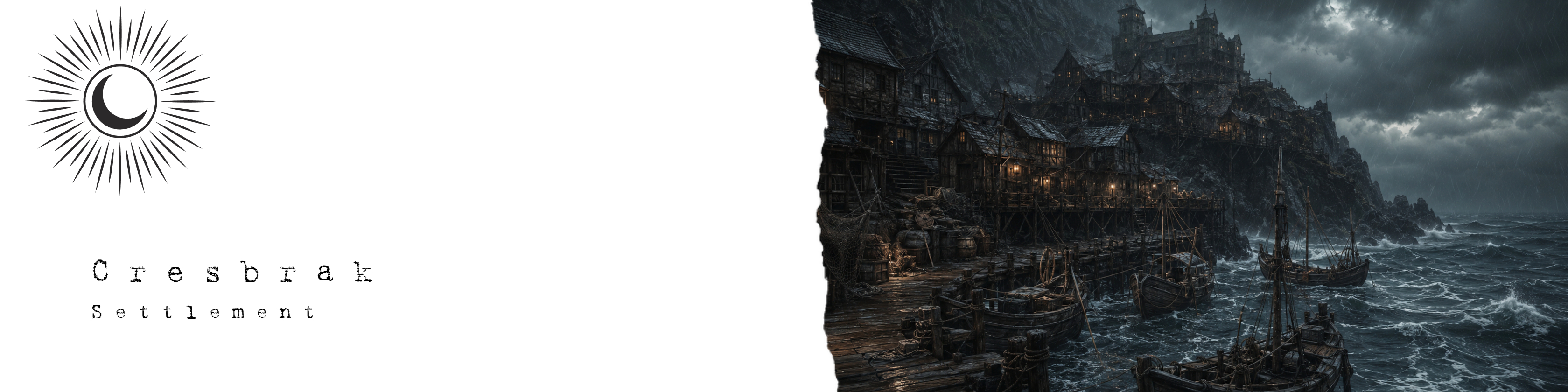
Cresbrak
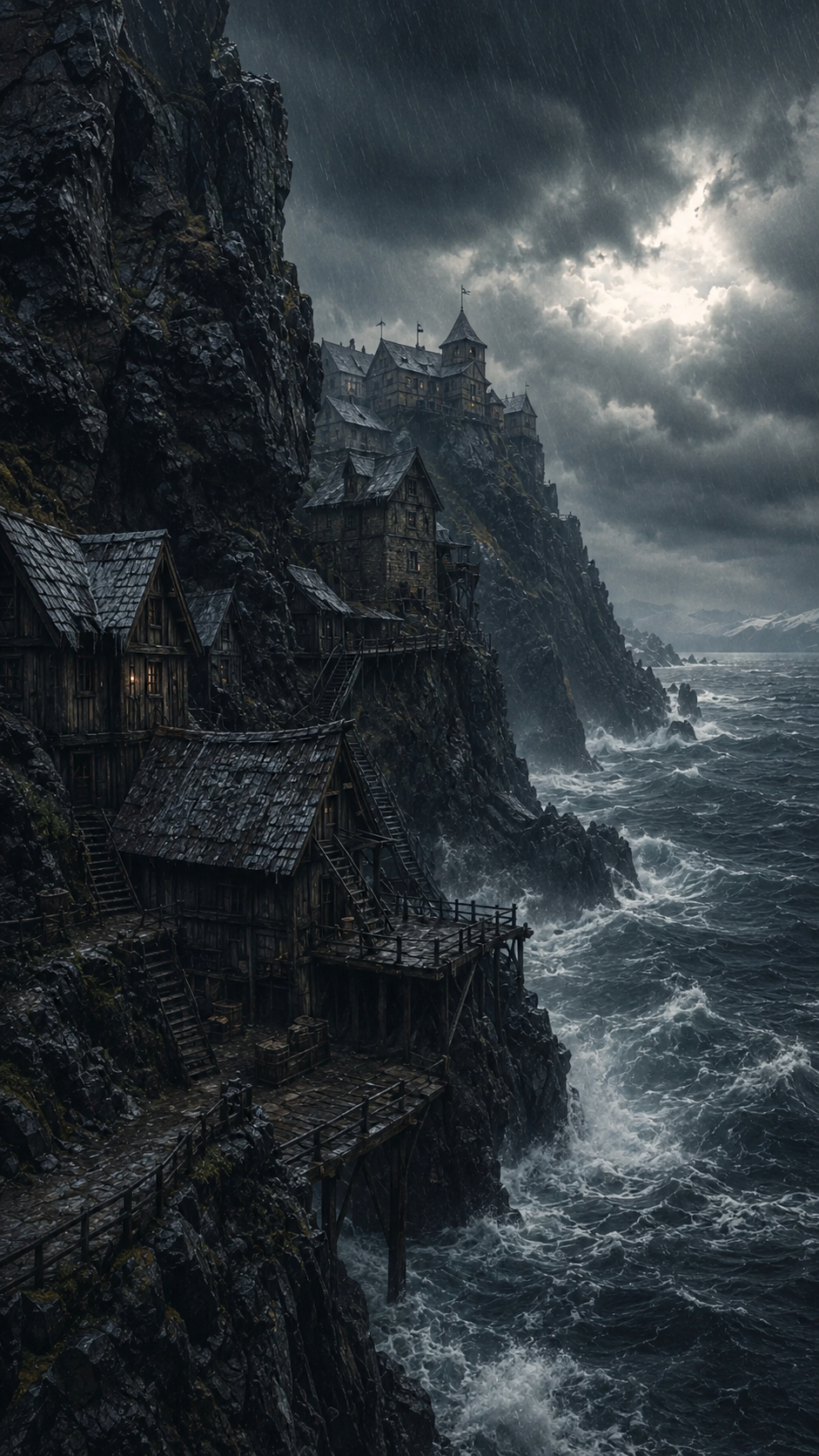
Cresbrak is a storm-battered fishing village built within the far northwestern Stormcraigs of Cevoryn. Though the land belongs to Cevoryn and remains under the authority of the Calavira royal family, Cresbrak is home to a proud Drecurian-descended people whose ancestors first settled the cliffs for access to the rich but dangerous fishing waters of the Furore Ocean.
The village exists under treaty, permitted to remain so long as a portion of each catch is shared with the Cevo.
Cresbrak rose from the ruin of Lanbrak, the original settlement destroyed during the deadly Crestfall Storm. Unlike Lanbrak, which was built with the confidence of founders who believed stone and strength could withstand the Stormcraigs, Cresbrak was shaped by loss. Its homes, docks, shelters, and walkways are built with survival in mind, designed to be repaired, reinforced, or rebuilt after the storms inevitably return.
Life in Cresbrak is harsh, disciplined, and deeply tied to the sea. Its people fish dangerous waters, watch the clouds with practiced suspicion, and keep their village alive through stubborn labor and inherited pride. The Cevo have offered shelter after disasters and continue to honor the treaty, though many still struggle to understand why Cresbrak’s people always return. To outsiders, the village may seem like a place constantly tempting ruin.
To its people, Cresbrak is proof that the storm may break their walls, but it will not break their claim to home.
History
To know Cresbrak's history is to know where it came from. Cresbrak was originally a town called Lanbrak.
Lanbrak
Life in Lanbrak was shaped by hard work, cliffside discipline, and the confident pride of its Drecurian founders. Raised in tiers along the Stormcraigs, the village looked more permanent and ambitious than its later form, with stone homes, steep roofs, carved paths, rope lifts, and a central hall where leaders kept records, settled disputes, and preserved the terms of the Calavira treaty. The upper levels held homes, gathering spaces, and shelters, while the lower tiers were devoted to fishing work: docks, net sheds, boat platforms, drying racks, storage houses, and narrow paths leading down toward the dangerous Furore waters.
Most days began before dawn. Fishers checked the wind and surf, storm-readers studied the clouds, and families prepared nets, repaired boats, salted catches, and carried supplies between the cliffside levels. Children grew up learning which paths became slick in rain, which bells meant danger, and how to move through a village built above violent water. Though life in Lanbrak was harsh, it was not joyless. Lantern-lit meals, Drecurian songs, shared repairs, and warm halls gave the village a strong communal heart.
The people of Lanbrak viewed the Stormcraigs with practical respect, but also with early overconfidence. They believed strong stone, strong hands, and Drecurian endurance could make the cliffs yield to them. To Lanbrak’s people, the settlement was proof that they could build a lasting legacy beyond Drecuria — a lawful fishing hold, a proud cliffside home, and a future carved into the edge of the storm.
The Crestfall Storm
The Crestfall Storm was the catastrophe that ended Lanbrak as people knew it. It struck late at night, when most of Lanbrak believed itself prepared for another violent Stormcraig storm. Windows were shuttered, boats were tied down, nets were pulled indoors, and families moved away from the lower tiers. The villagers had survived storms before, but Crestfall became something far worse than anything they had known.
After midnight, the storm shifted. Wind tore through the cliffs from several directions at once, rain blinded anyone caught outside, and the waves rose with terrifying force. The Furore Ocean did not simply strike the lower docks; it climbed the cliffside. Great crests smashed into the lower walkways, flooded sea caves beneath the village, and cracked parts of the stone from within. Docks snapped apart, rope bridges failed, stairways vanished, and several lower homes collapsed when their foundations gave way.
Lanbrak’s Drecurian settlers were poorly prepared for this kind of danger. They understood ice, snow, harsh wind, and northern storms, but the Stormcraigs attacked from below as much as above. Their early buildings had been made with confidence in stone and height, yet Crestfall proved that the cliffs themselves could fail. Fishers were swept from ledges while trying to secure their boats, families were trapped in homes thought to be safe, and shelters flooded as water forced its way through old stone seams.
By morning, Lanbrak was broken. Forty-three villagers had died, later remembered as the Forty-Three of Crestfall. The lower village was nearly gone, the docks and fish houses had been destroyed, and part of the old great hall had cracked open. Nearby Cevo communities responded with compassion, bringing healers, clean water, food, blankets, burial cloth, and shelter for the survivors. The Calavira royal family also sent aid, honoring both the treaty and the people's suffering.
The Cevo did not mock the survivors, but they did not understand them either. To many Cevo, Crestfall seemed like a clear warning to abandon the Stormcraigs. To the people of Lanbrak, leaving would have meant surrendering their dead to the sea. They accepted Cevo aid, mourned their losses, and then returned to rebuild. From Lanbrak’s ruin, Cresbrak would eventually rise: a humbler, harsher village shaped by the knowledge that the Stormcraigs could never be mastered, only survived.


Giving it a soundtrack too!? I can see we've got some tough competition. Jokes aside, great work, I really enjoyed this read.
Your freind,
The Graiffe
Working hard at Summercamp 2026
LOL! I just can't help but add music for more atmosphere while reading. Thank you so much for giving it a read, Graiffe!
Defy all da gravity! Create all da worlds!