Survivor statistics
Welcome to the world of Poisonous Mist! One day, Earth is suddenly covered in a mysterious Mist. As a result, billions of people die and the handful of survivors awakens with strange powers. As monsters start killing them, Anne-Line, a scientist, tries to make sense of what's happening and to prevent what's left of France from becoming a dystopian society. Come read about her struggle!
Introduction to the story | Anne-Line Decroix | Mist | Novel upcoming
Introduction to the story | Anne-Line Decroix | Mist | Novel upcoming
Table of Contents
Report: Survivors' statistics
Author: Colleague 1 — Date: 45 days post-Mist — Confidentiality: Public
Objective
Describe the population of Mist survivors and the factors associated with survival.
Background
Forty-five days ago, the country—and probably Earth—was covered in a weird Mist and more than 99% of the population died. If we can understand what differentiate those of us who survived, we might be able to build on this to develop protection against Mist contamination killing the rest of us.
Method
We have carried out a historical cohort study among the population of the Hauts-de-France region. For pre-Mist data, we have obtained population statistics for the Hauts-de-France region from the National Institute of Statistics and Economic Studies (INSEE). For post-Mist data, we have administered a general socio-demographic questionnaire to survivors (full questionnaire available in Appendix A). From these data, we calculated the relative "risks" of surviving First Exposure that were associated with sociodemographic factors, lifestyle factors, and location at time of First Exposure.
We then looked at the number of surviving genetical relatives each survivor in the region has compared to what was expected based on regional population statistics pre-Mist, using a paired t-test.
Finally, the effect of each survivor's strength of will (measured by proxy by using the Mist level an individual has been exposed to without succumbing to contamination) on the number of "emotional links" (pre-Mist relatives and friends who survived First Exposure) was assessed using ANOVA.
Describe the population of Mist survivors and the factors associated with survival.
Background
Forty-five days ago, the country—and probably Earth—was covered in a weird Mist and more than 99% of the population died. If we can understand what differentiate those of us who survived, we might be able to build on this to develop protection against Mist contamination killing the rest of us.
Method
We have carried out a historical cohort study among the population of the Hauts-de-France region. For pre-Mist data, we have obtained population statistics for the Hauts-de-France region from the National Institute of Statistics and Economic Studies (INSEE). For post-Mist data, we have administered a general socio-demographic questionnaire to survivors (full questionnaire available in Appendix A). From these data, we calculated the relative "risks" of surviving First Exposure that were associated with sociodemographic factors, lifestyle factors, and location at time of First Exposure.
We then looked at the number of surviving genetical relatives each survivor in the region has compared to what was expected based on regional population statistics pre-Mist, using a paired t-test.
Finally, the effect of each survivor's strength of will (measured by proxy by using the Mist level an individual has been exposed to without succumbing to contamination) on the number of "emotional links" (pre-Mist relatives and friends who survived First Exposure) was assessed using ANOVA.
Population description
The characteristics of the survivors versus the pre-Mist regional population are described in Table 1. Over the entire regional population, 0.84% survived First Exposure to the Mist.Table 1: General socio-demographic characteristics of the pre-Mist population of the Hauts-de-France region versus the survivors.
| n (%) or mean (standard deviation) | Pre-Mist regional population
(n=5,998,920) |
Survivors of the First Exposure
(n=50,112) |
|---|---|---|
| Socio-demographics | ||
| Women | 3,091,263 (51.5%) | 25,908 (51.7%) |
| Age (years) | 39.6 | 31.4 |
| Age category: <1 year, | 65,528 (1.1%) | 150 (0.3%) |
| Age category: 1—5 years | 339134 (5.7%) | 2,355 (4.7%) |
| Age category: 6—10 years | 387,457 (6.5%) | 7,295 (14.6%) |
| Age category: 11—14 years | 321,909 (5.4%) | 5,935 (11.8%) |
| Age category: 15—29 years | 1,101,448 (18.4%) | 10,073 (20.1%) |
| Age category: 30—44 years | 1,122,182 (18.7%) | 9,321 (18.6%) |
| Age category: 45—59 years | 1,157,226 (19.3%) | 9,471 (18.9%) |
| Age category: 60—74 years | 1,001,725 (16.7%) | 4,460 (8.9%) |
| Age category: ≥75 years | 502,307 (8.4%) | 1,052 (2.1%) |
| Age category: <18 years old | 1,515, 041 (25.3%) | 19,694 (39,3%) |
| Age category: ≥65 years | 1,140,156 (19.0%) | 3,007 (6,0%) |
| Lifestyle | ||
| BMI | ||
| BMI categories: underweight (<18.5 kg/m²) | 215,961 (3.6%) | 752 (1.5%) |
| BMI categories: normal weight (18.5-24.9 kg/m²) | 2,639,523 (44.0%) | 30,669 (61.2%) |
| BMI categories: overweight (25.0-29.9 kg/m²) | 1,949,648 (32.5%) | 14,583 (29.1%) |
| BMI categories: obese (≥30.0 kg/m²) | 1,193,784 (19.9%) | 4,109 (8.2%) |
| Physical activity | ||
| Practice of the equivalent of 30 min of fast walking daily | 3,257,411 (54.2%) | 41,643 (83.1%) |
| Practice of a sport activity | 2,183,605 (36.4%) | 31,370 (62.6%) |
| Education | ||
| Education level: Current student | 1,649,375 (27.5%) | 13,778 (27.5%) |
| Education level: No diploma, certificat or brevet | 1,274,416 (21.2%) | 10,646 (21.2% |
| Education level: CAP / BEP | 1,104,783 (18.4%) | 9,229 (18.4%) |
| Education level: Baccalauréat | 778,568 (13.0%) | 6,504 (13.0%) |
| Education level: Bac+2 | 469,750 (7.8%) | 3,924 (7.8%) |
| Education level: Bac+3 (Bachelor) —Bac+4 | 365,361 (6.1%) | 3,052 (6.1%) |
| Education level: Bac+5 (Master) | 313,167 (5.2%) | 2,616 (5.2%) |
| Education level: Bac+8 (Doctorate) | 43,495 (0.7%) | 363 (0.7%) |
| Profession | ||
| Profession: Military personnel | 430 (0.0%) | 9 (0.0%) |
| Profession: Gendarmes | 5,485 (0.1%) | 54 (0.1%) |
| Profession: Policemen | 14,911 (0.2%) | 166 (0.3%) |
| Profession: Doctors (including interns) | 19,393 (0.3%) | 162 (0.3%) |
| Profession: Nurses and associated professions | 65,118 (1.1%) | 544 (1.1%) |
| Profession: Agriculture | 120,000 (2.0%) | 1,203 (2.4%) |
| Profession: Construction | 360,000 (6.0%) | 4,911 (9.8%) |
| Profession: Engineers and other technical experts | 126,000 (2.1%) | 952 (1.9%) |
| Location during First Exposure | ||
| Urban/rural | ||
| Urban/rural: Urban area | 4,241,234 (70.7%) | 41,944 (83.7%) |
| Urban/rural: Urban peripheries | 1,211,781 (20.2%) | 7,016 (14.0%) |
| Urban/rural: Rural area (autonomous areas) | 545,901 (9.1%) | 1153 (2.3%) |
| Sea | ||
| Body of water: ≤10 km from the coast | 6,780 (0.1%) | 10,0224 (0.0%) |
Relative risks
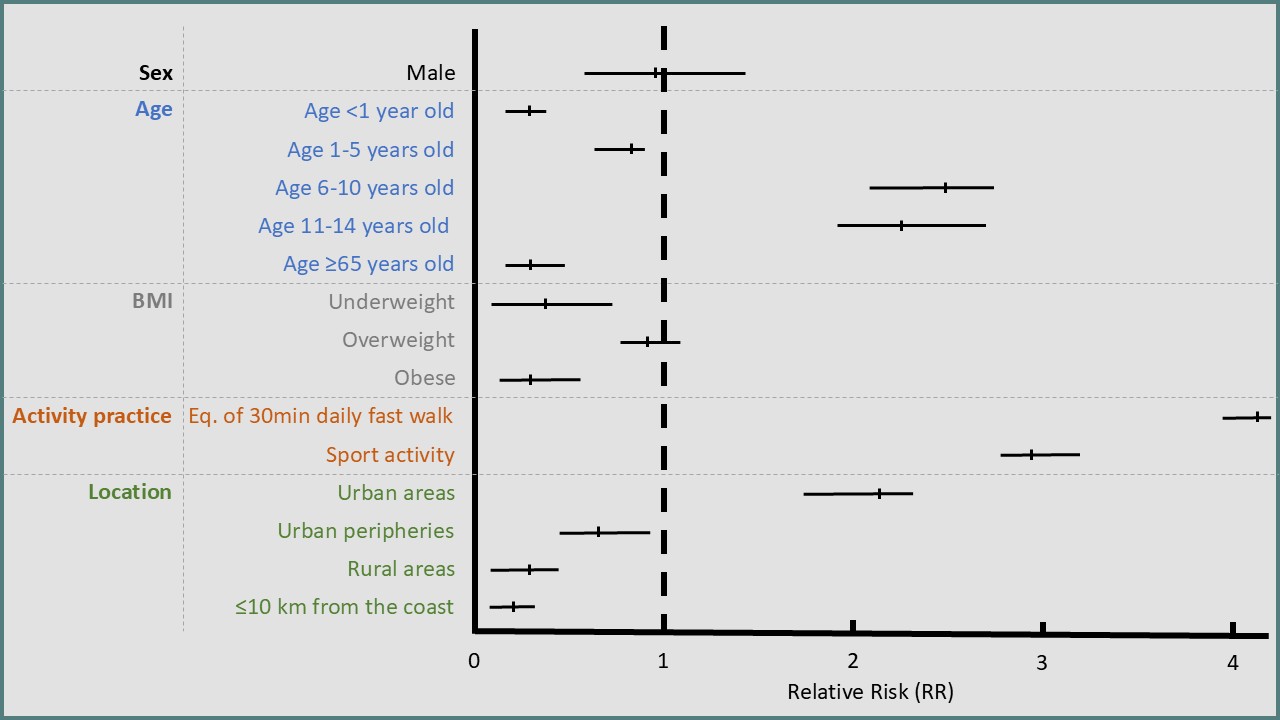
Relative risks are usually used to calculate the elevated (or lesser) risk of developing a disease for a group exposed to a specific risk (or protective) factor. Here, we instead focus on the probabilities of surviving First Exposure as the number of survivors is small and we are more interested in survival than death. To avoid any confusion, we will henceforth refer to "probabilities" of surviving instead of "risks", protective factors will refer to factors associated with higher survival probabilities, and risk factors to those associated with lower survival probabilities.The relative probabilities of surviving associated with each factor we studied are shown in Figure 1.
Figure 1: Risk and protective factors associated with survival to the First Exposure to the Mist.
Basic sociodemographic data
We started by looking at the association between basic sociodemographic data and the probabilities of surviving First Exposure. Sex was not associated with different probabilities, despite it being associated with different brain anatomies.
Age was associated with different probabilities of surviving First Exposure: children under 1 years old had -73% fewer probabilities of surviving compared to the rest of the population, children between 1 to 5 years old -18% fewer and adults above 65 years old 73% fewer. On the other hand, children between 6 to 10 and 11 to 14 years old were 2,47 and 2,37 times more likely to survive, respectively. This is likely to be due to very young children and the elderly being more fragile and having more difficulties surviving the challenges of adapting to the Mist. On the other hand, slightly older children are less fragile and have a higher brain plasticity, which would have helped them adapt.
Lifestyle
We then looked at the effect of lifestyle on survival. Individuals who were underweight (<18.5 kg/m²) or obese (≥30 kg/m²) had fewer probabilities of surviving First Exposure (-59% and -64% times the probabilities of the rest of the population, respectively), while practising a sport and practicing the equivalent of 30 min of fast walking daily were protective factors (4.14 and 2.92 times the probabilities of surviving of the rest of the population, respectively). This is also likely due to a bad physical condition making it more difficult for the body to adapt to the Mist.
Location at the time of First Exposure
Next, we looked at the effects of where individuals were located at the time of First Exposure, looking at the following categories:
Surprisingly, being in a rural area, being in urban peripheries, and being less than 10 km from the coast all lowered the probabilities of surviving First Exposure (by -76%, -36% and -82%, respectively), while being in a big urban area was a protective factor (by 113%). This is contrary to what could be expected from the affinity of the Mist for metals and the higher concentration of metals in urban areas due to their density and architecture. A possible explanation is that instead of metals being the potential source of contamination with high concentration of Mist that they have become post-Mist, at the time of First Exposure metals instead gathered Mist out of the atmosphere and so lessen exposure for nearby individuals. The sea and body of water would have the opposite effects by rejected the Mist and preventing it from sinking in the soil.
Genetics
Genetics factors are highly likely to have had an impact on how our brain cells adapted to the Mist and whether they were able to survive it. However, given the current state of modern technologies, we have been unable to perform genetic tests to identify different preponderance of certain genetic phenotypes among survivors.As a proxy to give us some inkling on the importance of genetics to survival, we instead assessed the probability of survivors of having at least one genetical relatives who also survived compared to what is predicted by regional population statistics.
Definitions:
Results: As expected, individuals who survived were more likely to have surviving relatives than what would have been expected (t-tests; first degree relatives: p<0.05; first and second degree relatives: p<0.01; first-, second-, and third-degree relatives: p<0.01).
Emotional links
Emotional links were finally assessed as a proxy to "strong will", with individuals with strong will potentially able to protect their loved one unconsciously as soon as they themselves became contaminated and started showing Mist abilities.Definitions:
Results: Individuals with stronger will had more emotional links, whether relatives were included in the count (ANOVA, p<0.01) or not (ANOVA, p<0.001).
The case of the Decroix-Vasseur-Gaultier
The Decroix-Vasseur-Gaultier family are an interesting case to examine as the family counting the most survivors to our knowledge. This includes three different genetic family linked together by marriage, with members dispersed throughout the region. The family tree is presented in Figure 2. In addition to relatives, two family friends survived: Colleague 1 and Colleague 2.Figure 2: Family tree of the Decroix-Vasseur-Gaultier family.
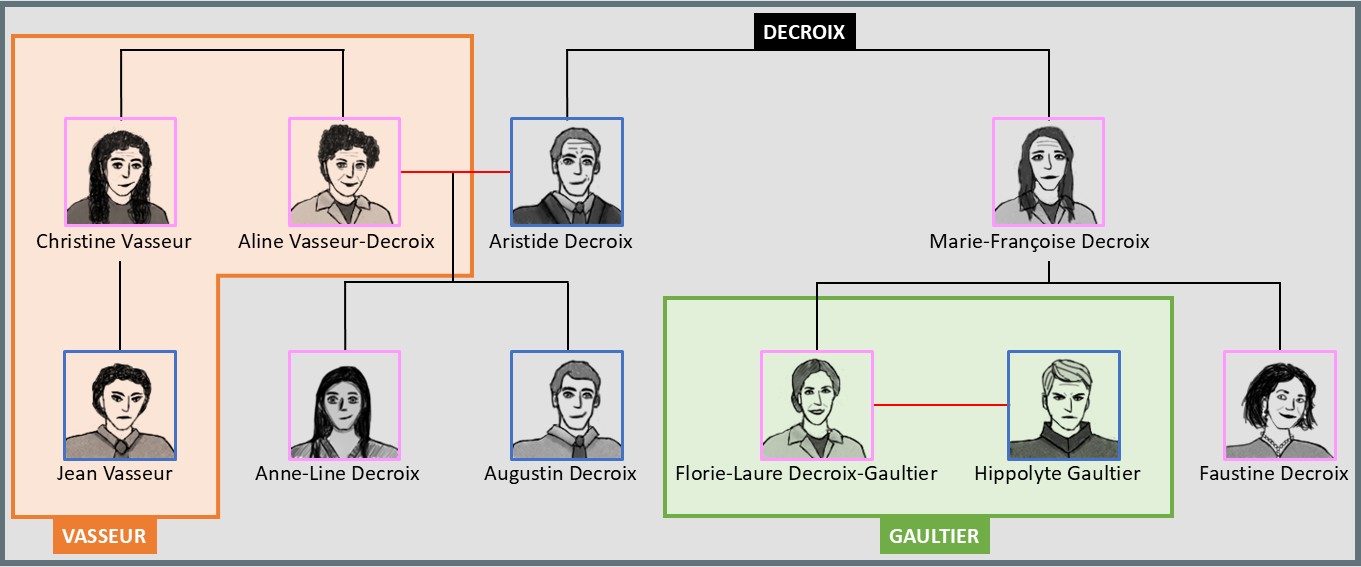
The common point between all of these seems to be Anne-Line Decroix. She happens to be both the individual with the highest number of surviving first-, second-, and third-degrees relatives (n=8) and the highest number of other family members and friends (n=3), coming to a total of 11 loved ones, and to also have been exposed to the highest level of Mist without succumbing to contamination.
Among survivors, Anne-Line Decroix is known for her strong will, however not all individuals with strong will have as many loved ones who survived (see the case off Colonel Pierre de Surmont in Appendix C). Anne-Line Decroix's Mist ability being shielding might have been the perfect medium to help her will manifest and protect her loved ones, resulting in this higher than average survival.
This appears to be a strong argument in favour of an association between survival and both genetic links and emotional links.
Limitations
An important limitation of this study is the fact that many survivors were killed directly after the First Exposure to the Mist via attacks by Mist monsters, preventing us from administering them our questionnaires. To reduce the risk of bias, when bodies were found with traces of injuries, they were classified as having survived first exposure. All reasonable and safe attempts were made to identify them via nearby identity papers, and if this was successful, further information were gathered from civil records accessible without computers. If they could not be identified, all their data waere considered as missing.Conclusion
Survival to First Exposure—and survival to future contamination exposure—was not and is not predetermined by our genes and circumstances. The most important factor predicting the survival of both yourself and your love ones is the possession of a strong will. Therefore the most important thing we can do to protect ourselves is to work on our will, our belief in ourselves, and our optimism.Future studies:
We are working on adapting our technologies so that we can do genetic testing despite the Mist, as this is the most likely way we will discover the mechanism by which the Mist affect our brain and how our neurons adapt to it. This will then allow us to develop drugs to help us withstand higher level of exposure and to avoid contamination.
Doctors with healing Mist ability are also investigating these mechanisms among potentially contaminated individuals that are kept under surveillance
Note: Full animal studies during which we would deliberately expose them to different Mist levels are currently prohibited given the higher death toll of the Mist and the necessity of letting their their population recover.

Comments
Author's Notes
Sources:INSEE population statistics in the Hauts-de-France region in 2022.
INSEE urban statistics in the Hauts-de-France region in 2018.
Regional agriculture and industry statistics from the chambers of commerce and industry of the Hauts-de-France region.
Mean age in the Hauts-de-France region.
BMI in the Hauts de France region in 2017.
Physical activity in the Hauts de France region in 2017.
Distance form the sea by department in 2017.
See Lille's military forces for the sources on profession data in the region.