
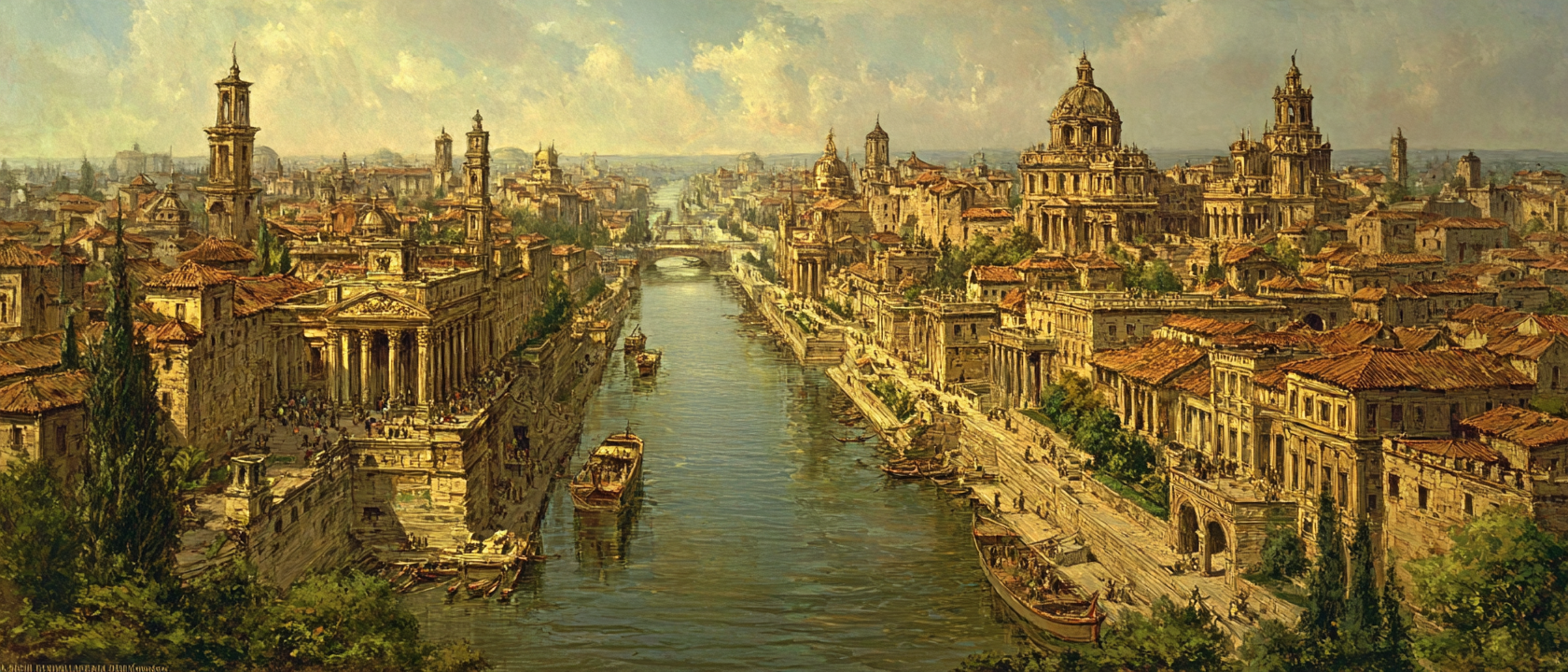
SEDES SCAPHARIORUM
The Bargemasters’ Guild Headquarters · Institutional Complex · Western Bank, Confluentes
"The charter room at the Guild headquarters’ core is first-century stonework with sixth-century reinforcement, and the combination produces a room that feels, to anyone sensitive to such things, like being inside an argument that has been going on for eight hundred years and has not yet been resolved. The founding documents are on the northern wall in a case whose glass was replaced in the ninth century. The original glass, which survived twelve centuries before a freight accident shattered it, is referenced in the archive’s maintenance records with the specific regret of an institution that keeps very good records."
The Sedes Scaphariorum is eight centuries of accumulated construction on a third-century site: the institutional headquarters of the Bargemasters’ Guild, the most powerful private organisation in the interior empire, whose founding charter has survived fourteen Senate attempts to reduce its fee schedule, seven challenges to its court jurisdiction, and one Imperial attempt to nationalise its licensing function that ended with the emperor of that period signing a supplementary agreement that extended the Guild’s authority rather than limiting it. The building reflects this history. Every stone that has been replaced has been replaced in the same position, to the same dimensions, in the same river limestone. The result is a structure that communicates, to anyone who has been in enough institutional buildings to read the language, that it has been doing what it does for a very long time and is not planning to stop.
In 1200 A.P. Guildmaster Flavia Nauta Riparia, fifty-four, runs the organisation from a first-floor office whose window faces the river wharves below. She has been Guildmaster for six years and comes from a barge family whose river licenses predate the Guild’s charter by three generations. The current institutional situation — Rector’s case building in the eastern bank, the railway negotiation approaching its conclusion in Nova Romae, the unidentified cargo in her secondary archive — is the most complex the Guild has navigated in forty years. She is managing it with the specific composure of someone who has read the charter many times and believes it will hold.
Purpose / Function
The institutional centre of all regulated river commerce on the Fluminis Magnus north of Nova Romae: the issuance of barge licenses, the conduct of the Guild’s own court proceedings, the management of the cargo protection officers’ operations, and the maintenance of the charter records that are the legal foundation of everything else. The headquarters is simultaneously the Guild’s administrative centre and its most significant diplomatic asset — the building itself communicates institutional permanence to everyone who enters it, which is a form of persuasion that the Guild’s lawyers consider more effective than argument.
Design
The institutional centre of all regulated river commerce on the Fluminis Magnus north of Nova Romae: the issuance of barge licenses, the conduct of the Guild’s own court proceedings, the management of the cargo protection officers’ operations, and the maintenance of the charter records that are the legal foundation of everything else. The headquarters is simultaneously the Guild’s administrative centre and its most significant diplomatic asset — the building itself communicates institutional permanence to everyone who enters it, which is a form of persuasion that the Guild’s lawyers consider more effective than argument.
Denizens
Flavia Nauta Riparia , fifty-four, Guildmaster, sixth year. The most institutionally powerful private individual in the interior empire. Has the cargo report in the secondary archive. Has the railway force majeure argument in the locked cabinet. Is waiting for the right moment on both. Will discuss the charter with any visitor who demonstrates genuine knowledge of it and will be noticeably sharper with visitors who do not.
Lucia Iuris Fluviae , sixty-one, senior court arbitrator, thirty-two years. Knows what the 891 A.P. precedent says, what the Vetus Portus documents say, and what the gap between those two things means for Rector’s case. Has not told Riparia. Is deciding whether the information serves the Guild’s interests better shared or held.
History
Third-century founding on its current site. Charter ratified in the same decade as the bridge’s foundation piers were laid. Eight centuries of additions in the same river limestone, each generation adding to the northern or southern ends rather than replacing the core. The charter room’s original glass case was replaced in the ninth century after a freight accident on the wharf immediately below; the incident is in the maintenance records with a notation that reads, in the eighth-century archivist’s hand, ‘the charter was unharmed.’ For full chronological detail, see: Annales Mundi.
Tourism
The Guild headquarters’ public gallery, where the charter room’s documents can be viewed from behind a barrier during scheduled morning hours, draws scholars from across the empire. The duty clerk at the public desk, a Guild employee of standard institutional competence, will answer questions about the charter’s history with the specific quality that Varro recommends: use the answer as an introduction to what Confluentes actually is.
Access
Public gallery (charter room view): scheduled morning hours.
Charter room proper: appointment with Guildmaster.
Court chamber: open during scheduled proceedings.
Secondary archive: Riparia and two senior masters only.

Comments