
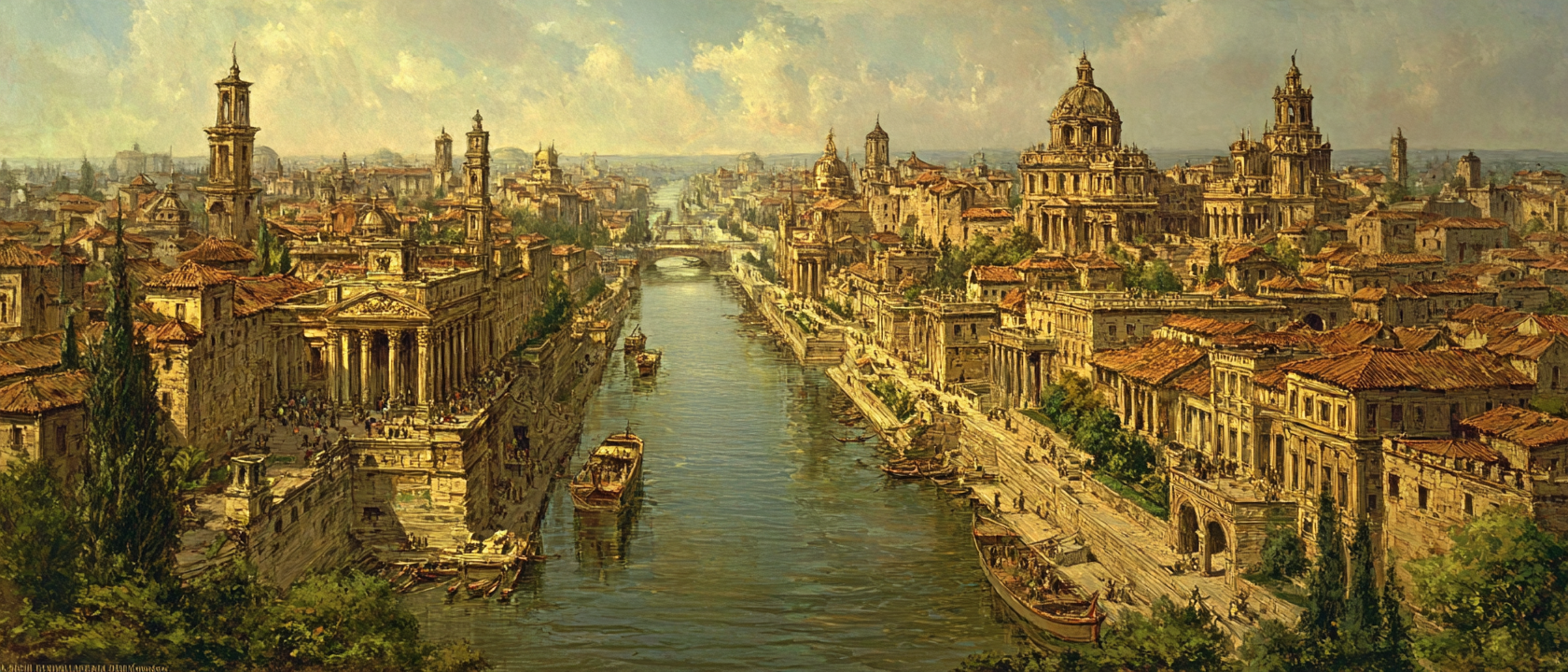
PORTUS SCAPHARIUS
The River Wharves · Working Harbour / Docking Infrastructure · Western Bank, Confluentes
"The wharves at Confluentes are the most continuously active piece of infrastructure in the interior empire. They run in overlapping shifts because the river does not stop, and the barge families have never stopped either. The wharf masters who manage the docking sequence have developed, across eight generations, a knowledge of the river’s daily rhythm that no instrument measures and no document contains. When I asked the senior wharf master how he knew when to hold a barge and when to let it dock, he thought for a moment and said: ‘The river tells you, if you’ve been listening long enough.’ I believed him."
Twelve major docking points along the western bank’s waterfront, each managed by a Guild-appointed wharf master whose authority over docking priority, loading sequence, and inspection scope makes them the most practically powerful people on the waterfront below Riparia herself. The wharves have been rebuilt four times in twelve centuries, always to the same layout, because the layout is correct — the barge families who use it have resisted every proposal to improve it on the grounds that improvement means change and change means relearning patterns that the river does not care about. The current infrastructure is the most recent rebuild, seventh-century below the waterline and eleventh-century above, and it handles the same volume that the original specification was designed for, which the River Authority’s infrastructure analysts find improbable and which the barge families find unremarkable.
The wharves are where the river’s commercial reality is most directly visible: the loaded barges arriving from the north and south, the transfer of eastern province goods from Rivus Orientalis barges to the main river traffic, the cargo protection officers’ presence that is the Guild’s visible operational face, and the manifest clerks’ inspection tables at wharf seven where the River Authority’s formal cargo documentation process takes place. The gap between what the manifest clerks record at wharf seven and what the wharf masters’ collective assessment knows about the same cargoes is the city’s most significant institutional information asymmetry.
Design
Twelve numbered wharves running north to south along the western bank, each wide enough for two loaded barges to dock simultaneously with working clearance between them. The loading cranes at wharves two, five, and nine are fourth-century ironwork maintained by the Guild’s engineering staff; the other wharves use portable lifting equipment. The cargo protection officers’ post at the southern end of the wharf line is the most structurally modest building on the waterfront and the one with the most institutional authority over what happens there.
Sensory & Appearance
The wharves at dawn, before the first morning arrivals: the river’s surface carrying the previous night’s upstream reports in the form of debris patterns and water colour that the wharf masters read before any official information arrives. The wharves at full operation, mid-morning: the overlapping activities of loading and unloading, the cargo protection officers’ visible patrols, the manifest clerks’ documentation at wharf seven, and the constant low-level coordination noise of a logistics operation that has been running the same way for generations. The wharves at the spring flood’s peak: the waterline rising to the indicators painted on the wharf posts, the barge families’ precise coordination of the changed docking sequence, and the River Authority’s monitoring staff observing a process they cannot improve.
Access
Wharf approaches: Guild-licensed commercial access.
Wharf seven inspection: River Authority staff.
Cargo Protection Officers’ Post: Guild security staff only.

Comments