
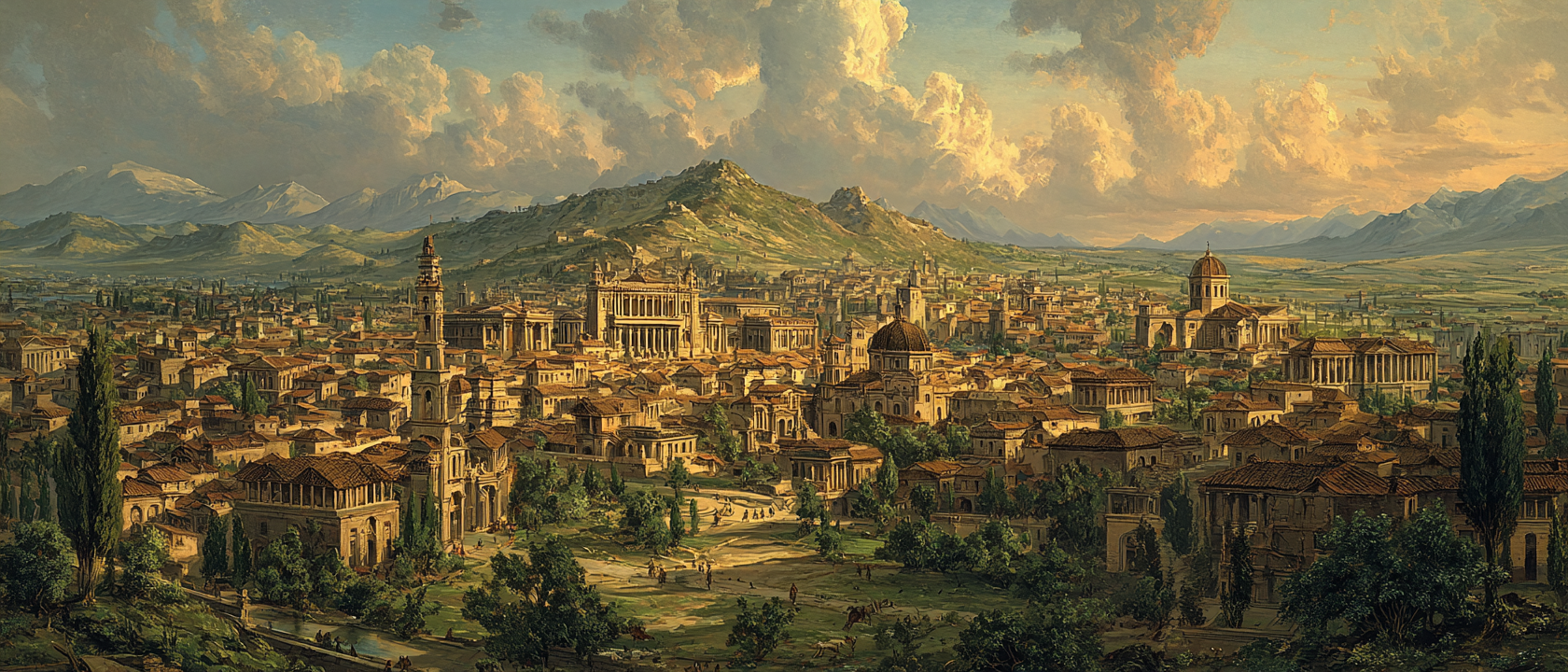
PORTA AUSTRALIS
The Southern Gate · City Gate · Plains Quarter, Nova Conspectus
"Standing at the southern gate looking out: the Campus Magnus begins immediately on the other side. There is no graduated transition, no suburb, no cultivated fields giving way to wilder ground. The city ends and the plains begin. I have stood at this gate perhaps a dozen times and found it, each time, the most honest geographical fact in Nova Conspectus. Everything the city is has been built here, at this specific edge, because the plains begin precisely here and do not offer gradual accommodation."
The Porta Australis is the city’s southern gate: the point where Nova Conspectus ends and the Campus Magnus begins without interval. It is the widest gate in the city’s wall — wide enough for a centaur elder to pass through without discomfort, a specification made in the original construction and maintained through every subsequent repair — and the gate that sees the most institutionally significant traffic in the city: diplomatic arrivals from the plains, patrol departures and returns, the XIV’s quarterly joint exercises with the Stonehoof outriders, the Grassland Runners at dawn, and the morning when Arrak arrived three days ago without advance notice, alone, at first light, and asked the gate watch to send word to Fides Camporum that he wished to speak with her.
The gate watch’s protocol manual for the Porta Australis is the seventh edition of the document that Watch Commander Vigil Aequus has been continuously updating since his appointment, and it is considerably thicker than the protocol manuals for any other gate. The core principle has not changed since the first edition: centaur visitors at the Porta Australis are received with the same procedural respect as Roman officials of equivalent standing, where equivalent standing is defined by the diplomatic context rather than by Roman rank categories. The gate watch staff, who have all read the manual and all attended the Mission’s introductory cultural briefing, apply this principle with the matter-of-fact professionalism of people who have been applying it for years and do not find it unusual.
Design
The gate structure is double-arched, wider than the standard provincial gate specification, its facing limestone worn smooth over six centuries at the arch points where centaur visitors have passed. The gate towers on either side provide the watch posts; the gate house between them is the watch station and the small administrative space where the gate watch’s records are kept. Immediately inside the gate, the Via Camporum begins: the city’s main north-south route, running from the Porta Australis to the Via Aquilae at the city’s northern side.
Sensory & Appearance
The gate at dawn, before the city’s daily movement begins: the grassland wind arriving from the south carrying the plains’ smell that the city’s residents know as home, the specific quality of light from the east that makes the Campus Magnus’s flat surface appear both vast and intimate simultaneously. The gate at midday when it is busy: the mixed traffic of the city’s institutional life — patrol returns, plains traders, Mission staff making the occasional supervised visit to the outer approach for one reason or another. The gate at evening when the Grassland Runners return from the dawn run, which in this season they have been returning without the Stonehoof outriders who joined them in previous years. The veterans who run have not mentioned this. The gate watch has noticed.
History
The Porta Australis was built in the city’s original construction in the fourth century, its wider-than-standard specification set from the beginning. The gate has been rebuilt twice: once in the fifth century after structural assessment, once in the eighth century after storm damage. Each rebuild maintained the original dimensions precisely. The gate watch protocol manual’s first edition dates from the Mission’s third Lead Diplomat, who wrote it after a centaur elder visit that the preceding unwritten practice had handled less well than the relationship required. For full chronological detail, see: Annales Mundi.
Outer approach turf: maintained to eastern plains grass species and length specification, introduced in the third edition of the gate protocol manual. The approach is the only public space in the city where Roman civic maintenance practices have been specifically adjusted to meet centaur physical preference.
Access
Open during daylight hours to all authorised traffic; closed overnight with watch presence.
All centaur arrivals logged in both standard and Mission protocols.

Comments