
LEGATIO CAMPI
The Diplomatic Mission Compound · Government Complex · Forum Quarter, Nova Conspectus
"The Mission compound is the building in Aethermarch whose architecture most honestly describes its function. The wide gates, the high ceilings, the courtyard dimensions calculated for centaur comfort three centuries ago and maintained since as a matter of principle rather than necessity: every physical choice communicates the same thing. We built this with you in mind. The communication has been received. The centaur elders who walk through those gates are walking through a door that was sized for them. This matters more than it sounds like it should."
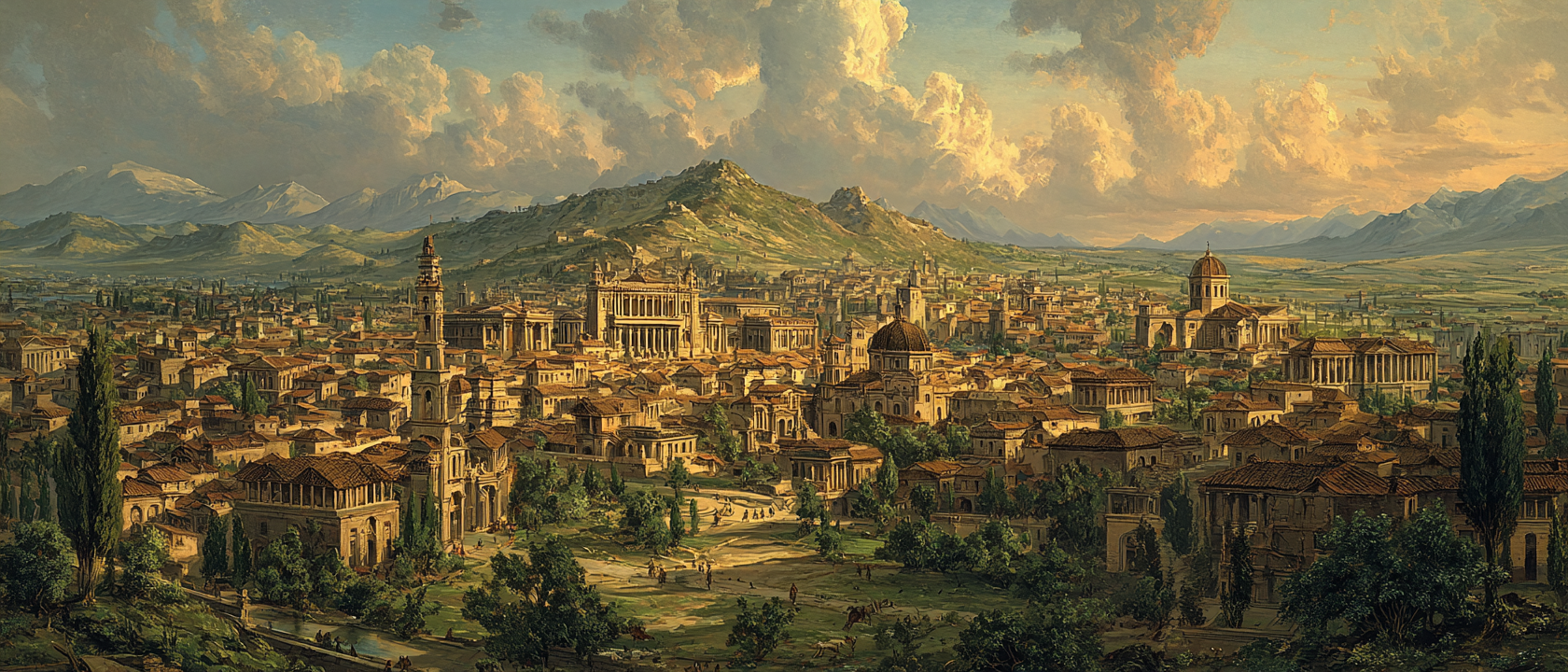
The Legatio Campi is the operational headquarters of the empire’s most consequential bilateral diplomatic relationship: a walled compound on the Forum Quarter’s western edge whose architecture was designed in the third century in direct consultation with the Stonehoof Clan and whose physical dimensions have been maintained since as a statement of intent. The wide gates, the two-storey courtyard whose ceiling height the Mission’s founders calculated from centaur requirements, the residential rooms scaled for centaur elder visitors, the archive whose records span nine hundred and seventy-five years of formal Rome-centaur engagement: all of it is the accumulated institutional expression of a relationship that the Mission’s staff understand to be more fragile and more significant than the Senate, administering from a distance, typically appreciates.
In 1200 A.P. the Mission is managed by Lead Diplomat Cornelia Fides Camporum, fifty-eight, in her eleventh year, who sent her eleventh report to the Foreign Office six weeks ago and has not received a response. Three days ago Arrak arrived unannounced and asked to speak with her privately. The meeting lasted four hours. She has not yet told the Governor what Arrak said. She is deciding who to tell, and when, and in what order.
Purpose / Function
The Mission’s formal function is diplomatic: the conduct and record of all official communication between Rome and the Hava’keth clans, the management of centaur elder visits, the maintenance of the treaty archive, and the provision of expert analysis to the Governor’s office and the Foreign Office on all questions touching the plains relationship. In practice, the Mission is also the institutional memory of a relationship that the Roman political system’s personnel rotation would otherwise repeatedly lose, and the human buffer between a Senate that deals in policy cycles and a centaur political culture that deals in generational trust.
Design
The compound occupies a full city block on the Forum Quarter’s western side, its outer wall solid limestone with the wide main gate on the eastern face opening toward the Forum. The interior is organised around the central courtyard, which is the compound’s functional and symbolic heart: large enough to accommodate a party of centaur elder visitors without crowding, open to the sky, with the limestone-flagged floor that the third-century founders chose for its acoustic properties — it does not echo in the way stone courtyards typically echo, which reduces the disorientation that indoor spaces with hard surfaces produce for centaur visitors. The accommodation wing on the western side has three suites scaled for centaur elder visitors, designed in consultation with the Stonehoof Clan and unchanged in their fundamental dimensions since the third century.
Denizens
Cornelia Fides Camporum , fifty-eight, Lead Diplomat, eleven years. The most informed person in the empire on the Rome-centaur relationship. Has sent eleven reports. Nine have been acknowledged. None have produced action. Three days ago Arrak told her that the frontier marker dispute is not the real issue — that systematic survey data is being fed to a land-use planning office in Nova Romae that treats the eastern plains as available for Roman settlement expansion. She has one contact who might confirm whether the planning documents exist. She has not yet used the contact. Starting that sequence will produce consequences she cannot control. She is thinking about when not starting it becomes worse than starting. Hessa, forty-one, centaur scholar. Has the partial text. Three shamans have not responded for four months. The last letters from all three mentioned the wind. She is waiting for an answer that may not come in the form of a letter.
Quintus Memoria Veteris , sixty-three, Mission archivist, twenty-seven years. Knows the archive’s complete contents and knows exactly how wide the gap between the public record and the internal correspondence has become. He and Fides Camporum have been the Mission’s institutional continuity through three governors. He is the only other person in the compound who would notice if something was removed from the internal files. He would not approve.
Lucius Observans Campi , forty, senior diplomat. Has been attending inter-clan meetings for eight years. Knows an item is being withheld at the upcoming moot. Has told Fides Camporum. Is continuing to observe as instructed.
History
The Mission predates the city. It was established in the third century as the formal institutional expression of the Mons Conspectus alliance, its founding documents — including the centaur consultation records that specified the compound’s physical dimensions — the oldest items in the archive. The compound’s olive tree was planted by the Mission’s second Lead Diplomat in what the records describe as a private ceremony whose significance was not explained to the Mission’s other staff. The Stonehoof Clan has never explained why they consider the tree’s growth significant. Memoria Veteris has a theory. He has not written it down. For full chronological detail, see: Annales Mundi.
The courtyard’s acoustic treatment: non-echoing limestone floor, the result of the third-century founders’ deliberate acoustic management for centaur visitor comfort. The compound’s dimensions: specified by centaur consultation in the founding period. The olive tree: third century, origin formally unexplained. The Stonehoof Clan considers its growth significant.
Access
Outer compound: Mission staff, authorised visitors.
Diplomatic suites: invitation.
Centaur visitor suites: reserved for centaur elder guests.
Archive (public room): by appointment.
Internal correspondence files: Mission senior staff only.

Comments