


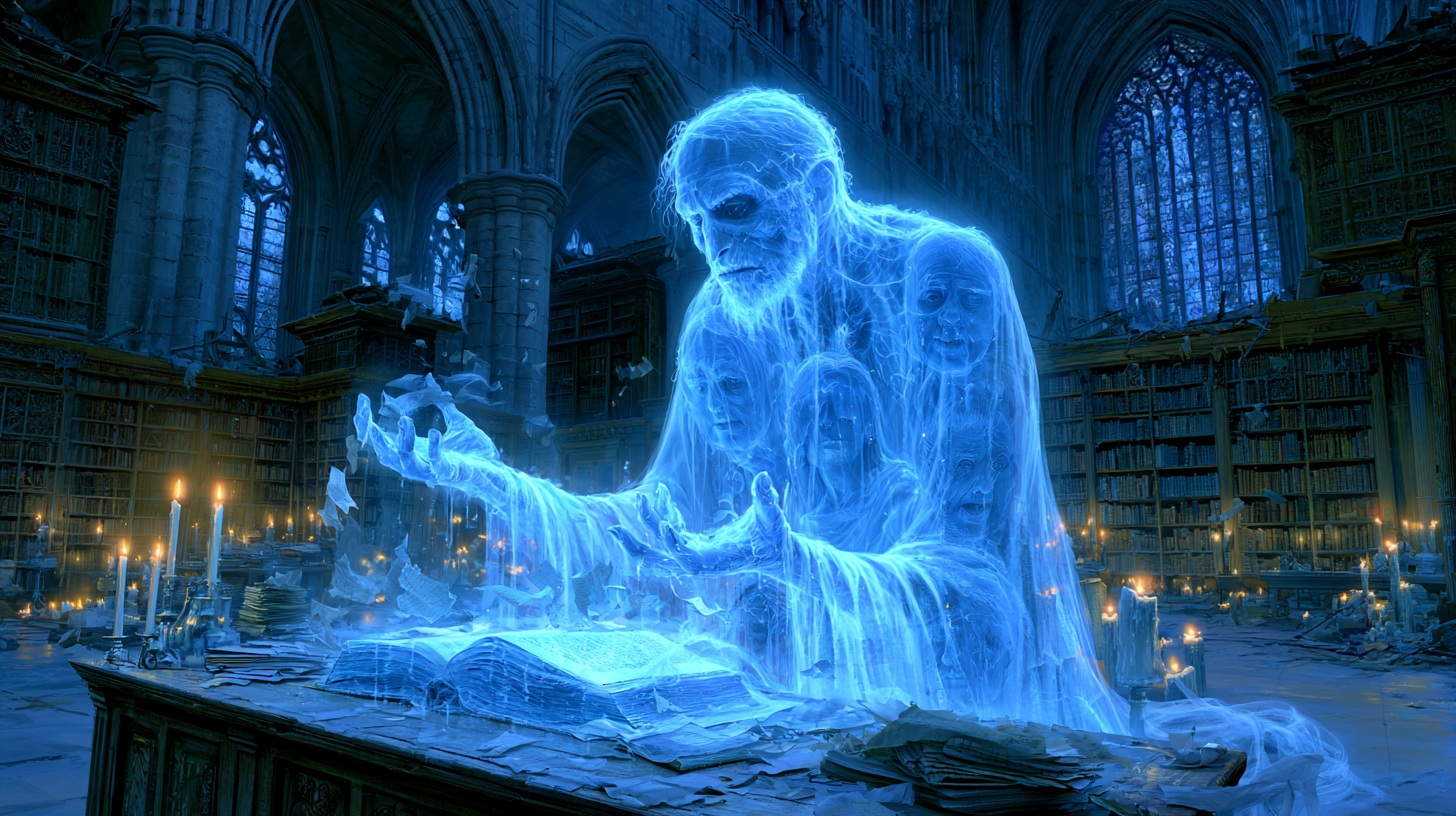
Incarnated Memory
You Said You Would Come Back!
“It spoke with my mother’s voice, but it remembered things she never knew.”
There are places where grief stops behaving naturally.
A battlefield where survivors returned too many times searching for bodies never recovered. A home preserved untouched decades after its occupants died. A failed resurrection chamber where mourners begged for someone to come back strongly enough that reality itself briefly listened.
Sometimes memory lingers in these places long after people do.
Sometimes it learns how to move.
Incarnated Memories are not ghosts, undead, or surviving souls. They are emotional reconstructions forced into temporary existence by overwhelming psychic residue, unresolved trauma, obsessive remembrance, or catastrophic distortion surrounding identity itself. They resemble people only imperfectly because they are not truly people at all.
They are remembered versions of people.
And memory is unreliable.
Every creature perceives an Incarnated Memory differently. To one observer, it may resemble a dead sibling. To another, an estranged lover. To a third, a childhood friend whose face they barely recall anymore. The entity instinctively reshapes perception around emotional familiarity, forcing witnesses to overlay personal significance onto its unstable form.
This effect is known among occult scholars as Unstable Recognition.
Victims briefly experience overwhelming certainty that the creature is someone important from their own past despite obvious contradictions. The sensation creates hesitation, emotional confusion, and instinctive reluctance to harm the entity immediately. Survivors often describe this realization as more horrifying than the creature itself.
Because for one terrible moment, they believed.
The Incarnated Memory’s physical appearance remains equally inconsistent. Witnesses struggle afterward to agree on details regarding clothing, age, facial features, or even voice. Descriptions contradict one another constantly. Sketches produced minutes apart appear unrelated entirely.
Scholars attempting to study these entities scientifically eventually discovered a disturbing pattern.
The creature does not possess a stable form because it is partially assembled from the observer’s own emotional recollections during perception.
This instability extends to memory itself. Encounters with Incarnated Memories become fragmented almost immediately afterward. Survivors remember emotional impressions vividly but lose chronological certainty. Fear remains clear. So does sorrow. But precise events blur into contradiction and dreamlike uncertainty.
Some cannot even remember whether the creature attacked them directly.
Only that it felt familiar.
The entities themselves communicate through Recursive Phrases, fragmented remembered statements charged with immense emotional resonance. These phrases often sound intimate, accusatory, mournful, or unfinished. Hearing them triggers psychological destabilization severe enough to blur reality and illusion together temporarily.
Particularly infamous phrases have been documented repeatedly across unrelated manifestations.
“You promised you would stay.”
“This isn’t how you died.”
“Why don’t you remember me?”
“I waited for you.”
No scholar has successfully determined whether these phrases originate from the entity itself, surrounding psychic residue, or the minds of listeners projected outward involuntarily.
The creature’s attacks operate similarly. A Fractured Touch does not merely inflict psychic damage. It forces emotional overlap between present perception and remembered trauma. Victims perceive contradictory figures layered over reality, momentarily unable to separate current surroundings from emotionally significant memory.
Some fall into panic immediately.
Others begin crying without understanding why.
Incarnated Memories most commonly emerge near unresolved emotional catastrophes. Failed resurrection rituals. Psychic disasters. Mass graves. Hospitals overwhelmed by plague. Sites where memory altering magic malfunctioned catastrophically. Areas saturated by collective grief become especially vulnerable.
Curiously, the entities are not always hostile initially.
Some wander aimlessly repeating fragmented routines. Others appear to seek specific individuals who may already be dead themselves. A few behave almost peacefully until someone attempts to identify them too clearly or reject the emotional familiarity they impose.
This reaction has led several philosophers to suggest Incarnated Memories are not malicious intentionally.
They are confused.
Or worse.
Lonely.
Naturally, others reject such interpretations completely. Certain occult traditions classify the entities as predatory psychic parasites feeding upon grief, nostalgia, and emotional instability by forcing victims into recursive remembrance. The truth remains uncertain because encounters themselves distort memory too severely for reliable testimony.
Even experienced adventuring parties often disagree afterward about what occurred.
One remembered a grieving mother.
Another remembered a dead commander.
A third swore the creature wore their own face.
The entities are especially feared in regions already affected by memory altering magic because their presence destabilizes recollection further through effects scholars call Memory Bleed. Victims lose certainty regarding immediate events, struggle to judge distance and positioning accurately, and afterward retain only fractured impressions of what happened during the encounter.
Entire investigations have collapsed because witnesses could no longer agree reality itself remained consistent around the entity. This uncertainty may be the creature’s most dangerous aspect. An enemy can be fought. A haunting can be exorcised. But an Incarnated Memory attacks the foundation people use to trust their own experiences in the first place.
And once that certainty cracks, fear tends to grow very quickly afterward.

“It looked like my brother for exactly three seconds. Then I realized it remembered my childhood differently than I did.”
Genetic Ancestor(s)



Comments