
Tydaria Castle
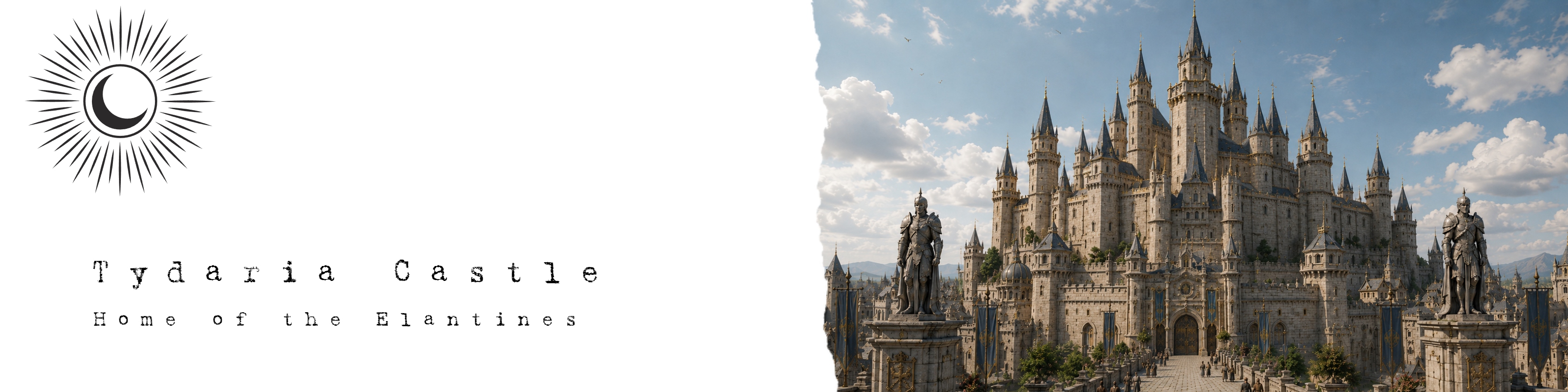
Tydaria Castle stands atop the three great rings of Tydaria as the royal seat of the Elantine line and the kingdom's central heart. It serves not only as the home of the ruling family, but also as a place of government, ceremony, scholarship, healing, protection, and daily work. Built and expanded across many generations, the castle contains ancient halls, newer wings, hidden chambers, practical corridors, sacred spaces, and areas shaped by both history and magic.
From the outside, Tydaria Castle is a symbol of royal authority and national unity. Within its walls, however, it is also a living place, filled with knights, advisors, scholars, healers, servants, messengers, visiting leaders, and citizens with official business. Its structure reflects the Elantine legacy itself: strong enough to defend the kingdom, open enough to serve it, and old enough to remember every ruler who helped shape Tydaria.
Alterations
Expansion Over Time
As the kingdom grew, the castle expanded with it. Each generation of Elantine rulers added new wings, halls, chambers, courtyards, gardens, and defensive structures according to the needs of their reign. Some additions were ceremonial, created for councils, royal rites, and visiting leaders. Others were practical, providing space for healers, scholars, knights, servants, advisors, and the daily work required to keep the castle functioning.
Built by Hand
Much of Tydaria Castle was built through ordinary mortal craft, shaped by the hands of Tydarian builders across many generations. Architects designed new wings, masons raised walls, carpenters framed chambers and doors, glassworkers shaped windows, metalworkers forged gates and fixtures, and artists, gardeners, and servants helped make each space usable and beautiful. These hand-built rooms form the visible body of the castle: its halls, towers, courtyards, kitchens, guard posts, guest chambers, healing wings, balconies, gardens, and ceremonial spaces.
Rooms built by hand often reflect the era in which they were made. Older sections of the castle tend to have heavier stonework, simpler shapes, and a stronger sense of ancient practicality, while newer areas may show more refined craftsmanship, broader windows, lighter materials, decorative carvings, or details tied to the ruler who commissioned them. Because these rooms were added over time, the castle carries the marks of many generations rather than one single design.
These physical expansions are usually created in response to the needs of the royal household and the kingdom. A growing family may require new private chambers. A period of political change may call for larger council spaces or guest quarters for visiting leaders. Times of unrest may lead to stronger guard posts, reinforced walls, or additional defensive corridors. In this way, the hand-built rooms of Tydaria Castle serve as a record of practical need, royal responsibility, and the labor of the people who helped shape the castle stone by stone.
Rooms Built By Hand
- Throne Room
- Grand Hall
- Dining Halls
- Healing Wings
- Sleeping Chambers
- Solar Wing
- Ballroom / Dance Hall
- Servant corridors and workrooms
- Kitchens and food storage rooms
- Bathing / Cleansing Chambers
Built by Wizardry
Separate from the castle’s ordinary expansions are the rooms and spaces created directly through magic. These are not built in the same way as towers, wings, courtyards, or halls. Instead, they are shaped by powerful wizards and Arcanums who understand the magical lattice running through Tydaria Castle. Through advanced latticework, these magic-users can create hidden rooms, altered passages, sealed chambers, and spaces that do not obey normal architectural limits.
Liniver Var Osyndor is especially known for this kind of work. His understanding of the magical lattice allows him to bend space within the castle, conceal rooms from ordinary sight, and create pathways that can appear, vanish, or shift depending on need. Some wizard-created rooms may be larger inside than they should be, while others may exist between known walls or behind corridors that seem solid to anyone without the proper magical access.
These rooms are usually created for protection, privacy, study, storage, secrecy, or emergency refuge. Some may be tied to royal need, while others belong to the Scholarium, the Arcanum Order, or trusted castle wizards. Unlike physical expansions, wizard-created rooms do not always appear on maps of the castle. Many are known only to the people permitted to use them, and some may remain hidden for generations until called upon again.
Together, these magical spaces add another layer to Tydaria Castle’s identity. The castle is not only a structure of stone, wood, glass, and metal, but also a place shaped by unseen currents of magic. Its visible halls tell the story of royal history, while its hidden rooms preserve the quieter history of protection, knowledge, and secrets kept within its walls.
The Creators Three have also had a hand in making a chamber: The Starhall Chamber, known to hold a secret behind its walls.
Rooms Built Through Magic
- Scholarium
- Arcane Wing of the Scholarium
- Arcane Chamber
- Hidden Room
- Starhall Chamber
- Lunar Wing, especially after its expansion from the Guest Wing
- The Royal Library (more of a mix of hand and magic)
- Altered corridors
- Sealed chambers
- Hidden archive rooms
- Private magical laboratories
- Emergency refuge rooms
- Spell-locked storage rooms
- Rooms larger inside than their outer dimensions suggest
- Secret passageways created or concealed through latticework
- Impossible rooms between known walls
- Protective chambers tied to the Elantine line
- Warded rooms used for dangerous texts, artifacts, or unstable magic
History
Tydaria Castle is said to stand upon the very height where the first age of Tydaria began. According to ancient tradition, after the Creators Three shaped the world of Tydas and brought the ancient Tydians into being, the people first stood upon the great plateau that would become the heart of the kingdom. From this elevated ground, the earliest Tydarians looked out over the lands that would one day form the Crown Ring, Hearth Ring, and Field Ring below.
At the highest point of the plateau, Tydian King Vaelorn the Founder established the first seat of the Elantine line. This original dwelling was not yet the vast castle known in later ages, but the first royal home of Tydaria: a place of shelter, leadership, gathering, and protection. It marked the beginning of the Elantine bond to the land, and from that first home, the shape of Tydaria’s future rule began to form.
Tydarian tradition remembers the founding of the castle not as an act of divine command, but as an act of care. The Creators Three did not see themselves as gods above their creation. They saw Tydas as something beloved, and the Tydians as a people worth protecting, teaching, and helping into life. When Vaelorn the Founder and the first Tydarians began establishing their home upon the plateau, the Creators are said to have worked beside them, bringing stone, preparing metals, shaping materials, and helping raise the earliest foundations of what would become Tydaria Castle.
Over time, that first sacred home grew into Tydaria Castle. Each generation added to it, expanding the structure from a founder’s dwelling into a royal fortress, a seat of government, a ceremonial center, and a living symbol of Tydarian identity. Though much of the castle has changed across the centuries, its oldest foundations are still believed to belong to the first home of Vaelorn and the ancient Elantines.



Always fascinating to have a building where the residents affect the actual structure. In that vein I do wonder if there are any rulers that are particularly known for expanding the castle? I really enjoyed this read, great work my friend!
Your freind,
The Graiffe
Working hard at Summercamp 2026