Jūnitō
Jūnitō (The Roll)
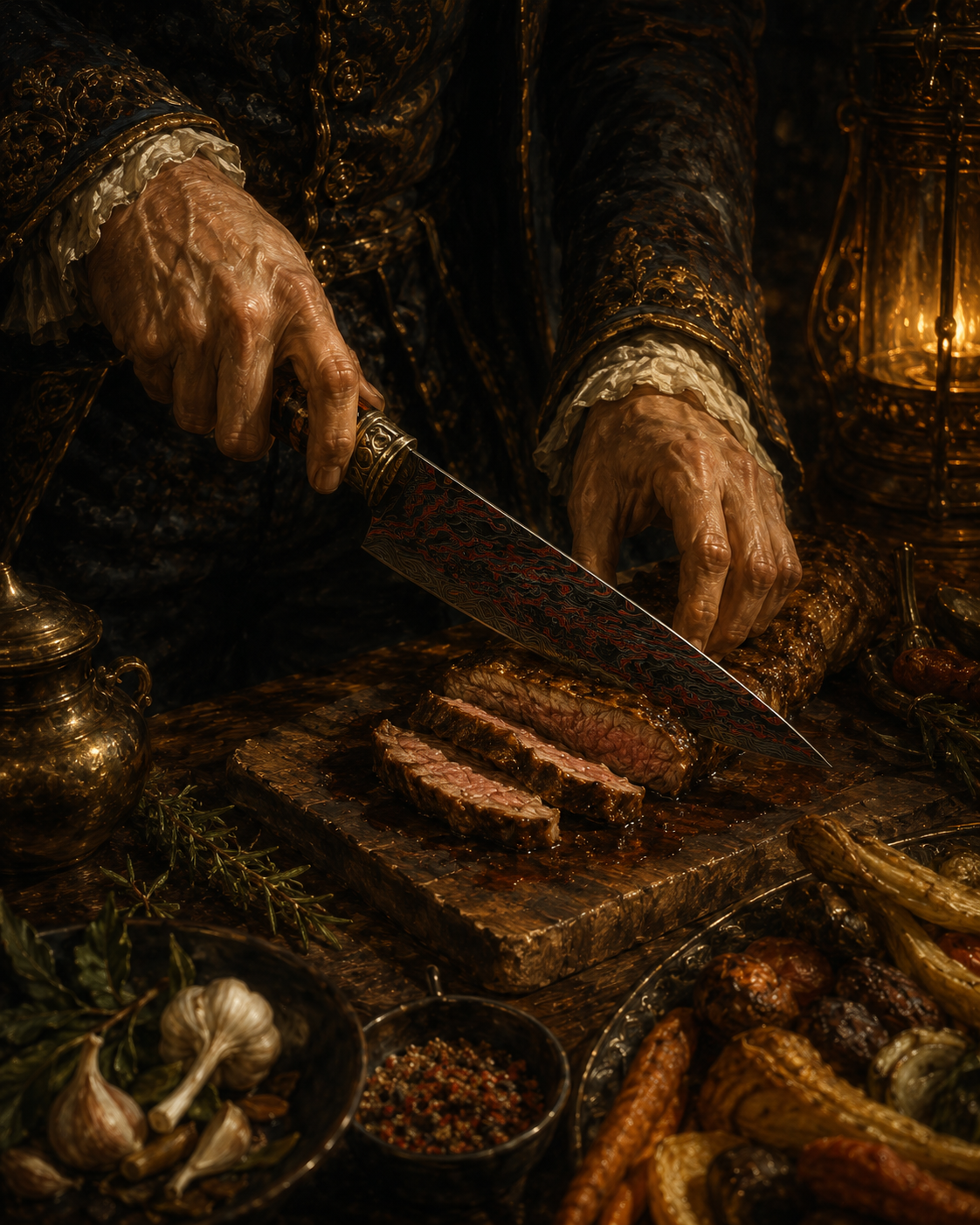
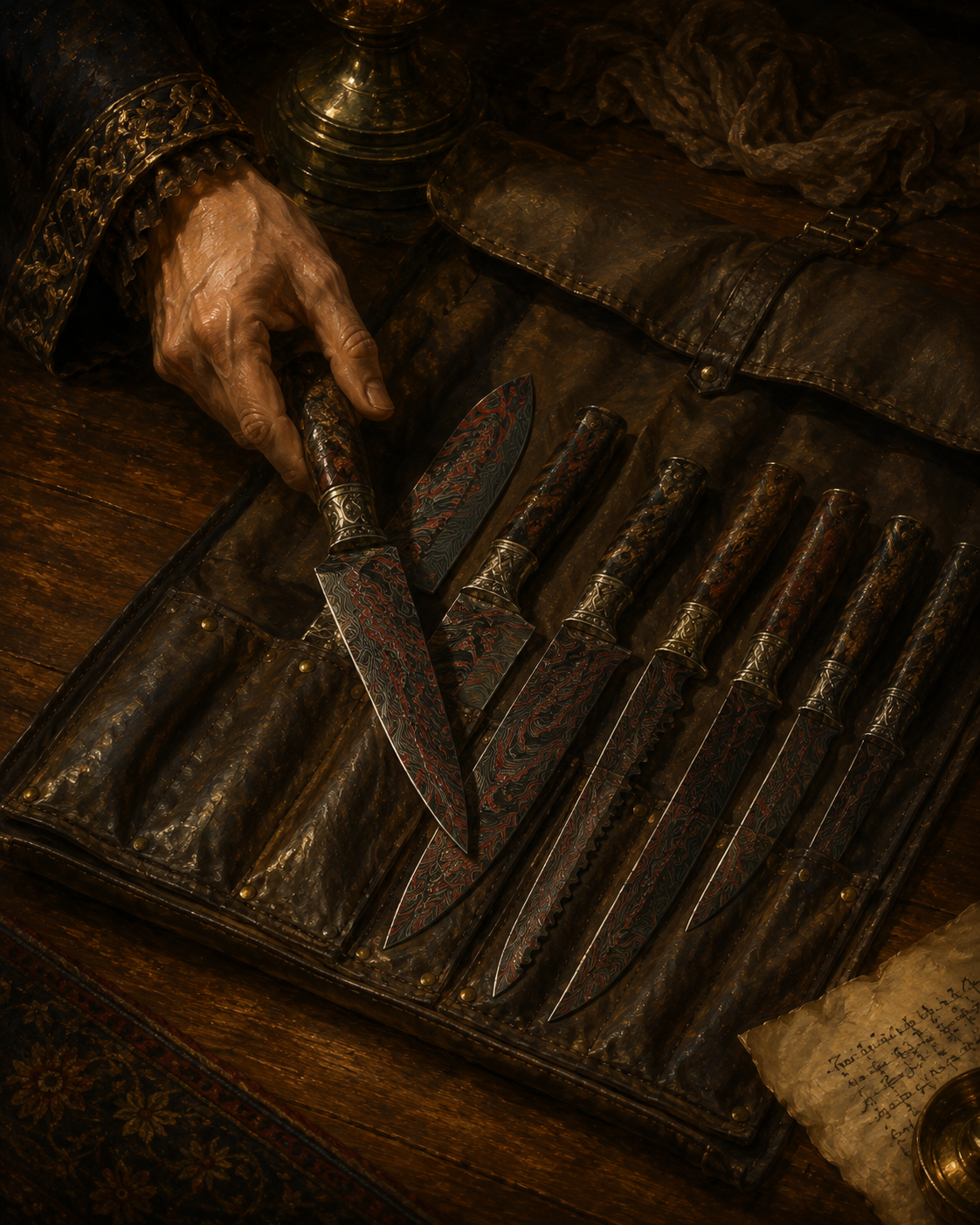
Twelve blades, twelve purposes. To use one outside its calibration is to misunderstand what a knife is for.The jūnitō — known colloquially across the City of Steel simply as "the roll" — is the personal set of kitchen blades every chef-hunter carries from apprenticeship until death or retirement. It is not a luxury implement. In Steel, where cooking is not hobby so much as civic discipline, the roll is closer to what a mortal kitchen drawer would be, if a kitchen drawer were treated with the gravity of a martial arsenal.
The standard count is twelve, though some old masters carry as many as twenty-four. Each blade in a jūnitō is calibrated for exactly one class of cut — the equivalent to a mortal knife designed to cut the membrane around a particular organ, the joint of a particular wing, the precise knot of cartilage at a particular vertebra. No blade in the set duplicates another's purpose, and none is interchangeable with its neighbors. A chef-hunter does not own twelve knives that happen to be sharp. They own twelve answers to twelve specific questions, carried together because the meals Steel demands ask all twelve questions in a single sitting.
To use a jūnitō blade outside its intended class is considered the most basic failure of Steel's culinary discipline, gently corrected in apprentices and never committed by the experienced. The error does not dull the edge; Steel's metallurgy holds an edge indefinitely. What it dulls is the calibration. A blade asked to perform a cut it was not made for loses the certainty of what it is for, and that certainty cannot be restored by any amount of sharpening. The damage is to the knife's identity, not its keenness.
A miscalibrated blade is not discarded carelessly. It is retired with honor, given one final ceremonial use on a meal that does not matter, a quiet acknowledgment that it served its purpose faithfully even in the moment it lost it, before being laid to rest. The remaining eleven continue in service, and a replacement is forged or earned in time.
The roll itself is treated as an extension of the chef-hunter who carries it. To be shown another's jūnitō, laid open and named blade by blade, is counted a real privilege between citizens. To touch one without invitation is a gesture Steel has no comfortable word for — closer to violation than mortal etiquette has language to describe, because the roll is understood to hold as much of its owner's history as their own hands do.
When a master dies, or chooses at last to lay the work down, the passing of their jūnitō to a chosen successor is the highest civic event the City of Steel recognizes. There is no equivalent ceremony for any other possession, except perhaps the swords. Wealth changes hands constantly in Steel and means little. A roll changes hands perhaps once in a long lifetime, and the city takes note when it does — because inheriting a jūnitō is not inheriting tools. It is inheriting twelve answered questions, and the obligation to keep answering them correctly.

This is an elegantly crafted piece; I enjoyed reading it very much.
Thank you! I’m glad you enjoyed it. Reasoning out the City of Steel and its culture has been a fun project for me.