
Threadways Guide
Reader Notice: This guide concerns the Threadway records of The Last Home. It has been compiled from Library records, patron accounts, staff observations, returned notebooks, recovered belongings, and several reports written by people who were almost certainly running at the time. It is useful rather than complete; Doors may move, roads may forget themselves, witnesses may disagree, and further details will be added as they survive the journey back to the Library.
"A Door is not an invitation merely because it opens. Occasionally, it is only proving that you have hands."
Using This Guide
This is not a map of the Infinite Elsewhere. Maps imply confidence, borders, scale, and a degree of professional optimism I refuse to encourage.
This guide exists for the practical traveller: the patron who has found a door that was not there yesterday, the scholar who believes curiosity is a virtue, the adventurer who has mistaken impulse for destiny, and anyone already halfway through making an avoidable mistake.
If you are looking for theory, begin with The Infinite Elsewhere. If you are looking for somewhere to go next, read carefully. Then read the local warnings. Then consider whether remaining in the Taproom might not be the wiser expression of courage.
Norrin's Note
I would like it recorded that “slightly more care than average” is not a comforting standard.
What This Is
The Threadway is the collected record of known doors, routes, visitor guides, local gazetteers, unstable destinations, and recurring places beyond The Last Home.
Some of these places are vast enough to require their own archives. Some are little more than a town, a ruin, a road, a city district, or a problem with weather. A few are technically temporary, though I recommend not saying that while standing inside one.
Each entry gathered here is intended to answer one simple question: what should a sensible traveller know before stepping through?
Marie's Note
If an entry is short, that does not mean it is safe. Sometimes it means the person writing ran out of ink. Or time. Or both.
Basic Advice
First: do not assume the other side follows the same rules as the Inn. The Last Home is unusually forgiving by the standards of Elsewhere, which is another way of saying that it usually waits until after dessert to become unreasonable.
Second: local customs matter. A greeting, coin, prayer, silence, bow, apology, song, or refusal may carry more weight than armour. In some places, manners will save your life. In others, they merely determine who gets to bury you.
Third: do not mistake familiarity for safety. A Threadworld may look like a kingdom, a city, a school, a harbour, a forest, or a perfectly ordinary street at dusk. That does not mean it is ordinary. It means the danger has learned presentation.
Fourth: if something welcomes you by name, consider whether you introduced yourself.
Freya's Note
If you do not know the local rules, keep your mouth shut, your hands visible, and your feet ready to move.
Choosing a Door
The records on this page are not arranged by safety. That would require certainty, and certainty is how scholars become cautionary plaques.
Instead, use the accompanying index to find the Threadworld that interests you. Some entries offer visitor guides. Some contain gazetteer notes. Some provide warnings, local histories, or records of previous incidents that should have discouraged further travel and somehow did not.
Pay attention to tone. A neon city with smiling mascots may be more dangerous than a blasted battlefield. A ruined kingdom may be safer than an academy with too many clubs. A friendly inn may be exactly what it appears to be, though I would still check the cellar.
Sylvie's Note
Some doors are invitations. Some are dares. The interesting ones are usually both.
Common Errors
Do not attempt to claim abandoned thrones.
Do not accept crowns, keys, masks, blades, flowers, contracts, invitations, suspiciously perfect desserts, or small animals that seem to understand politics.
Do not insult local gods unless you have confirmed they are absent, dead, imaginary, fictional, metaphorical, or currently losing at cards in the Taproom. Even then, lower your voice.
Do not assume a door will still be there when you turn around. Doors are dramatic creatures. They enjoy timing.
Rika's Note
If the crown starts glowing when you pick it up, put it back! Or call me first. Actually, call me first either way.
If You Get Lost
Remain calm. Panic rarely improves navigation, though it does sometimes attract attention. Unfortunately, attention and assistance are not synonyms.
Look for patterns. Repeated signs, familiar songs, impossible architecture, recurring strangers, and roads that return you to the same place are rarely accidents. They may be warnings. They may also be invitations. The difference is usually discovered later than one would prefer.
If you carry a Hearthstone, keep it close. If you do not carry a Hearthstone, consider why you thought leaving was wise.
Should a door back to The Last Home appear, enter politely. Do not bargain with it. Do not demand an explanation. Do not ask whether it was watching. It was.
Norrin's Note
Staying calm is considerably easier in theory than when the street you just used has become a canal, a shrine, or a suspiciously judgemental bakery.
Where Next?
The accompanying index contains the current recorded Threadworlds available for further reading. Some entries lead to developed gazetteers. Others are early records, travel notes, warnings, or names the Library insists are worth keeping visible.
Do not mistake an incomplete record for an unimportant one. Some places are quiet because little has happened there. Others are quiet because no one has returned with enough handwriting to be useful.
Choose carefully. Open politely. And if the door has teeth, do not put your hand near the hinge.
Seraphis' Note
If a place appears in the index, it is not necessarily recommended. It is recorded. There is a meaningful difference.
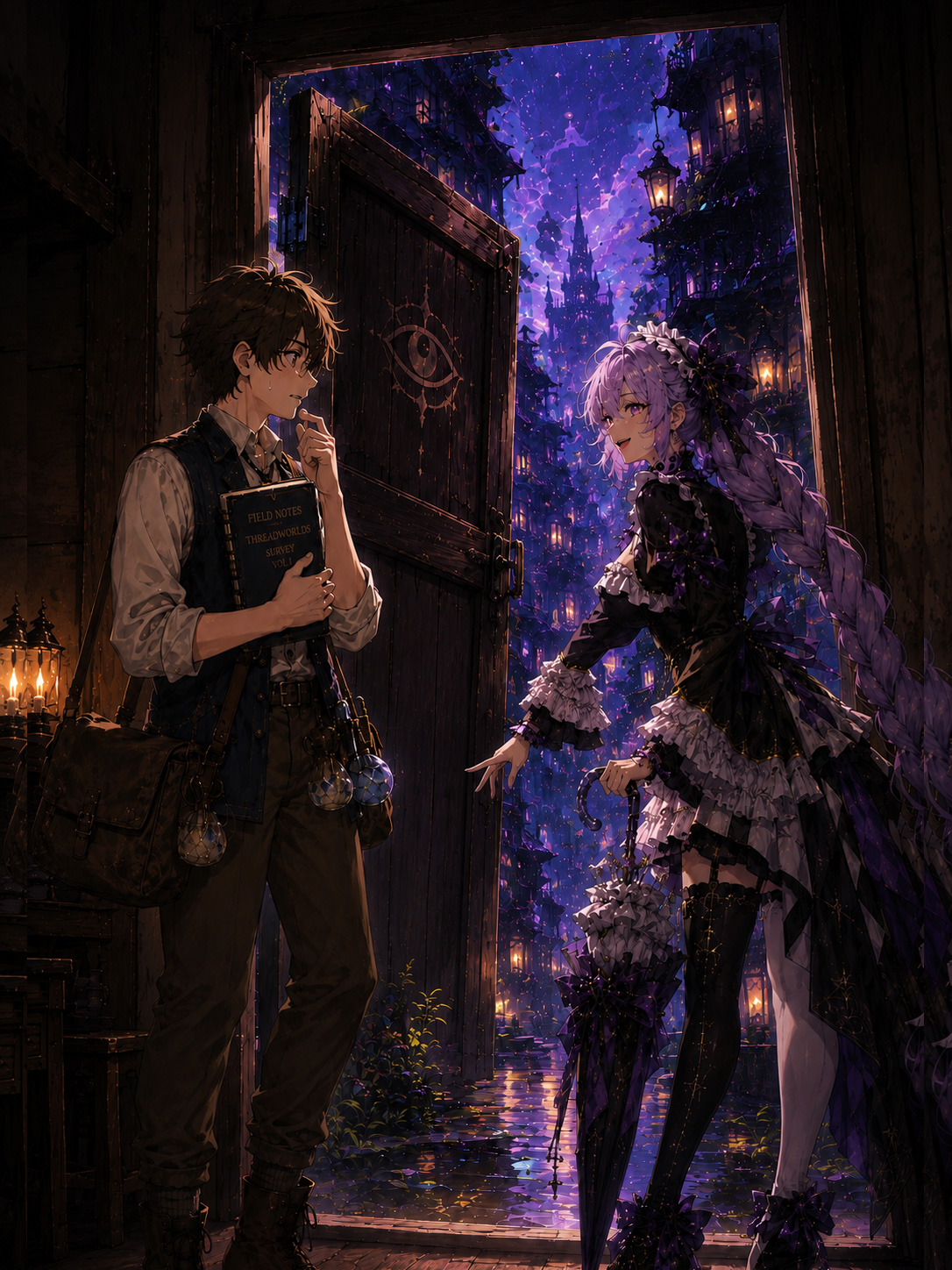
Known Threadworlds
What Is A Glamour?
A Threadworld may explain you to itself the moment you arrive. Your clothes, role, appearance, accent, documents, and obvious contradictions may become “normal enough” for locals to ignore.
Do not mistake this for safety. Glamour does not protect you. It protects the local story from the inconvenience of you.
Other Threadwalkers are not fooled. They will see the problem. They may also remember what you said during the problem.
About Threadspeak
You may understand the local language. This does not mean you understand the local meaning.
Threadspeak carries words across the gap. It does not reliably carry titles, insults, prayers, jokes, taboos, caste markers, flirtation, legal threats, or why everyone suddenly went quiet.
When in doubt, speak less. This advice has saved more travellers than swordsmanship.
Glamour Collapse
Under combat, panic, confession, ritual pressure, or other dramatic inconvenience, glamour may fail.
Symptoms include sudden weapons, glowing symbols, transformation sequences, environmental distortion, heroic declarations, tragic lighting, and music no one admits hearing.
Remain calm. The locals may forget. Other Threadwalkers will not.
Narrative Enforcement
You may, under pressure, find yourself saying things you had no intention of saying, posing in ways you did not rehearse, naming attacks you did not name, or explaining your emotional state to the sky.
This is not possession. It is the local story insisting the moment make sense.
Apologise afterwards if required. Denial is traditional, but rarely convincing.





This is really great!
Why thankyou, I shall let Seraphis know :D "You have been noted".
Still standing. Still scribbling. Still here.
The Last Home