Meranth
Traveller Notice: This guide concerns Meranth, a known Threadworld recorded by The Last Home. It has been compiled by Seraphis Nightvale from Norrin’s notes, testimony, corrections, and recollections of his homeworld. It is useful rather than complete; further details will be added should Norrin provide more time, clearer memory, or fewer reasons to avoid the subject.
"Meranth is a world very proud of its ability to classify danger. This appears to have helped, except on the occasions when the danger objected to being classified."
Before The Map Looks Back
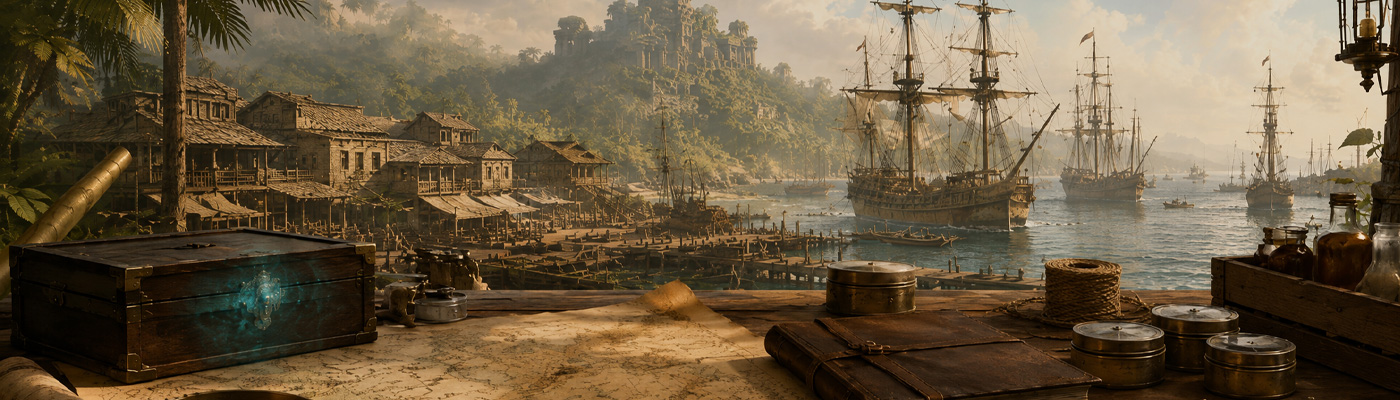
Meranth is the charted world Norrin calls home: a place of old universities, port cities, survey routes, state grants, insurance offices, cafés, containment teams, and ruins that sensible people insist are only dangerous in properly documented ways.
Magic is not openly practised as part of ordinary life. Norrin does not describe public spellcasters, court wizards, household charms, or tavern magicians as ordinary features of his world. A person announcing themselves as a wizard in respectable company would most likely end the conversation, begin an investigation, or be escorted somewhere with better locks and more paperwork.
This does not mean Meranth believes magic is impossible. It means Meranth believes magic is old.
That distinction shapes almost everything Norrin has told me. Old relics may be studied. Old inscriptions may be copied. Old ruins may be mapped. Old curses may be disputed, reclassified, insured against, contained, or locked in a crate until someone with the correct certification arrives.
The world’s great confidence lies in believing that this is usually enough.
Sometimes it is.
The important stories begin when it is not.
The Shape Of The Charted World
When Norrin speaks of Meranth, he does not mean a fully mapped globe. He means the known world of his own culture: mainland nations, university cities, charted sea routes, port settlements, survey regions, and those parts of the wider world that have been named, taxed, argued over, insured, or placed on a map.
Meranth’s scholars possess charts, globes, coastal records, shipping routes, and enough confidence to make all of it seem more complete than it is. Their maps reach far enough for trade, study, and expedition funding. They do not reach far enough to make the world safe.
Norrin’s own understanding is shaped by the Caerish mainland and its universities, especially Caerrow. He knows more about lecture halls, grant offices, café shifts, field notes, and being corrected by senior scholars than he does about distant courts, unknown continents, or the full history of Old Magic before institutions began rewriting its labels.
This is not a flaw in the record. It is the shape of the source. Meranth, as set down here, is a world seen by a young scholar who knew enough to notice details, not enough to be believed quickly, and far too little to understand what kind of story had begun to gather around him.
Where Norrin Learned To Be Useful
Caerrow is both a major city and an academic centre of some standing. Norrin describes it through the things that shaped his own days: university buildings, crowded streets, lecture rooms, narrow lodgings, part-time work, and the quiet pressure of being useful without being important.
Caerish culture, as he presents it, prizes records, grants, proper study, institutional rank, restraint, evidence, respectable employment, and the ability to apologise before anyone has quite decided whether an apology is owed. This explains a great deal about him.
Norrin came to Caerrow University on a state-paid apprenticeship grant. He has no family, no inherited standing, and no family name in use. By his account, there was no one to leave behind when the expedition sailed, and no one expecting word of his return. Meranth, whatever else it is, possesses the civic machinery to place a young man of no standing and no relations into useful education.
It does not necessarily place him into comfort.
When not studying or being sent on local assignments, he worked part-time in a café, and kept a very small room above it. Room may be generous. Cupboard is closer. By his description it held a narrow bed, a smaller window, too many books, and just enough floor to negotiate with if one turned carefully.
He did not describe this as tragic, which I find more telling than if he had. Meranth gave Norrin a place in its records, rotas, surveys, and expectations. Whether any of it amounted to a home is a question he does not seem to have known to ask.
Expeditions And Other Respectable Mistakes
Meranth’s scholars are not confined to lecture halls. Field expeditions are a recognised part of university life, particularly where old ruins, coastal erosion, relic fragments, inscriptions, or local warnings are involved.
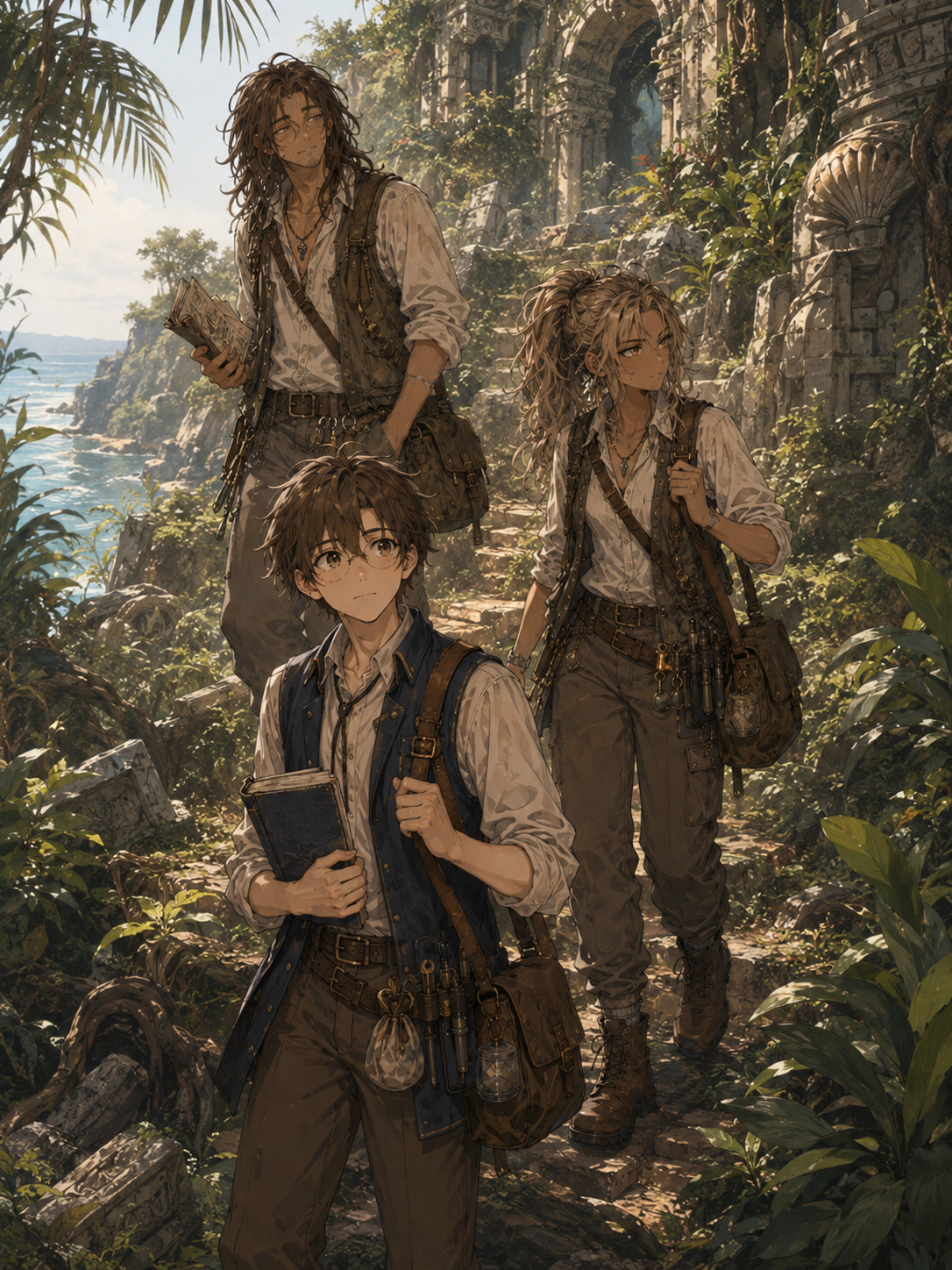
These are practical affairs. They require ships, port permissions, hired guides, route sheets, rubbing paper, sample tins, ledgers, insurance, pack animals, and enough confidence to believe that ancient stone will stay where it was measured. Students and apprentices are attached to such surveys as part of their training. Some copy inscriptions. Some sort samples. Some carry equipment, mark routes, count supplies, or perform the thousand small tasks that make scholarship possible while senior scholars explain why the alarming object is probably symbolic.
This should not be confused with adventuring. Meranthian survey teams do not set out to slay monsters, break curses, or recover treasure while shouting about destiny. They go to record, measure, copy, classify, compare, and publish.
If something begins screaming beneath the stone, that is regarded as a problem with the site.
Possibly also with the methodology.
There is a firm distinction in Meranthian practice between a university survey and an Old Magic containment response. A survey studies and interprets. A containment team is what sensible people send for when the object begins to hum, the sealed chamber opens, or the local warning turns out to have been grammatically accurate.
Norrin’s first major expedition was a university survey. The distinction did not remain academic for long.
The Old Magic That Remains
Magic is not openly practised in Meranth, but Old Magic remains.
It survives in ruins, relics, sealed books, temple inscriptions, damaged wards, cursed objects, buried chambers, and the leavings of older civilisations whose intentions did not always expire with them.
Meranth’s educated classes treat Old Magic as something to be studied, classified, contained, or disputed. It is held to be dangerous, but not always believed in the way local communities believe in it. A curse becomes an irregular influence. A warning becomes folklore. A sacred prohibition becomes the ritual memory of some earlier, more ordinary event.
This approach is not always wrong. That is precisely what makes it dangerous. A frightened village may misread a ruin. A priesthood may overstate its own importance. An old tale may preserve a natural hazard in symbolic dress. The dead do not become honest merely by being old.
But the reverse holds just as firmly.
A warning does not become false because a professor dislikes its tone.
Norrin’s knowledge of magic comes from lectures, university books, smaller field trips, and what he has personally survived. He is not a practitioner. He cannot cast spells, break curses, or argue with ancient things in their own language. He is simply a young scholar who learned to be frightened a little before the rest of his training caught up.
When Relics Require Paperwork
Meranth keeps specialists for the consequences of Old Magic, though they are not wizards in any theatrical sense. They are containment workers, hazard examiners, relic handlers, quarantine authorities, and sealed-archive staff: the sort of practical people one hopes have already arrived before anyone says, “I only touched it once.”
Their work is recognition, isolation, removal, storage, documentation, and the safe transport of dangerous objects. A cursed relic may be wrapped, boxed, signed for, catalogued, and locked in a warehouse for later study by people with better gloves and less curiosity.
They do not need to cast magic to manage it. They need to know what residue looks like, what symptoms matter, what materials hold and what fail, how to move an artefact without waking it further, and when everyone in the room should stop pretending curiosity is a virtue.
Insurance, too, exists in Meranth, which is more useful than it sounds. Shipping, cargo, expeditions, field equipment, relic transport, and warehouse storage may all be insured, though I suspect any policy touching Old Magic carries exclusions sharp enough to draw blood.
It is, perhaps, the most Meranthian fact Norrin has given me: a civilisation careful enough to insure an expedition, organised enough to certify a hazard team, and still hopeful enough to send students into a ruin before either has become useful.
Before You Touch The Artefact
A traveller from The Last Home should understand one thing before stepping into Meranth. The danger there does not always announce itself as danger.
It may look like a shell-carved wall. It may look like a harmless inscription, a local superstition, a sealed relic, an old crate, or a perfectly respectable opportunity for fieldwork.
So a short set of instructions, offered without apology.
Do not touch the artefact because it appears inactive. Do not read the inscription aloud because the grammar is interesting. Do not assume a warning is foolish because it sounds dramatic. Do not assume a professor is safer than a priest. Do not assume a containment label is decorative.
Above all, do not assume a ruin has stopped being a place of worship simply because everyone who worshipped there is dead.
Meranth is a world of maps, grants, spectacles, cafés, ports, survey roads, insurance policies, hidden magic, and old things waiting beneath respectable names. It taught Norrin that dangerous things should be studied carefully, labelled clearly, and handled only by trained persons with the proper paperwork.
This was not poor advice.
It was merely insufficient.
Reader Notice
Concerning The Temple Incident
This article records Meranth as a Threadworld and gives only limited context for Norrin’s first major expedition.
The events at the coastal temple are not summarised here. They belong first to the light novel account, where the sequence, danger, and consequences may be followed in full.
Those seeking what happened at the temple should begin with: Chapter 1 — Arrivals in Legendary Maids: Volume 1
New Arrival Notes
For travellers, lost Patrons, junior scholars, and anyone about to mistake an ancient warning for local colour.
Do not touch the artefact.
This remains good advice even if the artefact appears inactive, decorative, broken, scholarly, harmless, or already catalogued.
Respect local warnings.
A warning may be superstition. It may also be the only surviving instruction manual.
Read labels before opening crates.
Meranthian paperwork is not always sufficient, but it is usually trying to save someone from embarrassment, expense, or death.
Do not announce yourself as a wizard.
At best, this will complicate the conversation. At worst, someone will fetch better locks.
If a containment worker tells you to step back, step back.
You may ask questions later, preferably after everyone still has the same number of shadows.
Traveller’s Rule
Do not ask whether something in Meranth is magic.
Ask whether it is old enough to still matter.
The university is ordinary. The locked archive beneath it may not be. The port office is ordinary. The sealed cargo nobody wants to sign for may not be. The local warning may be exaggerated. The local warning may also be the reason anyone survived long enough to exaggerate it.
Meranth is very good at naming danger. It is less good at noticing when danger has kept its old name for a reason.
Threadworld Record



Comments