
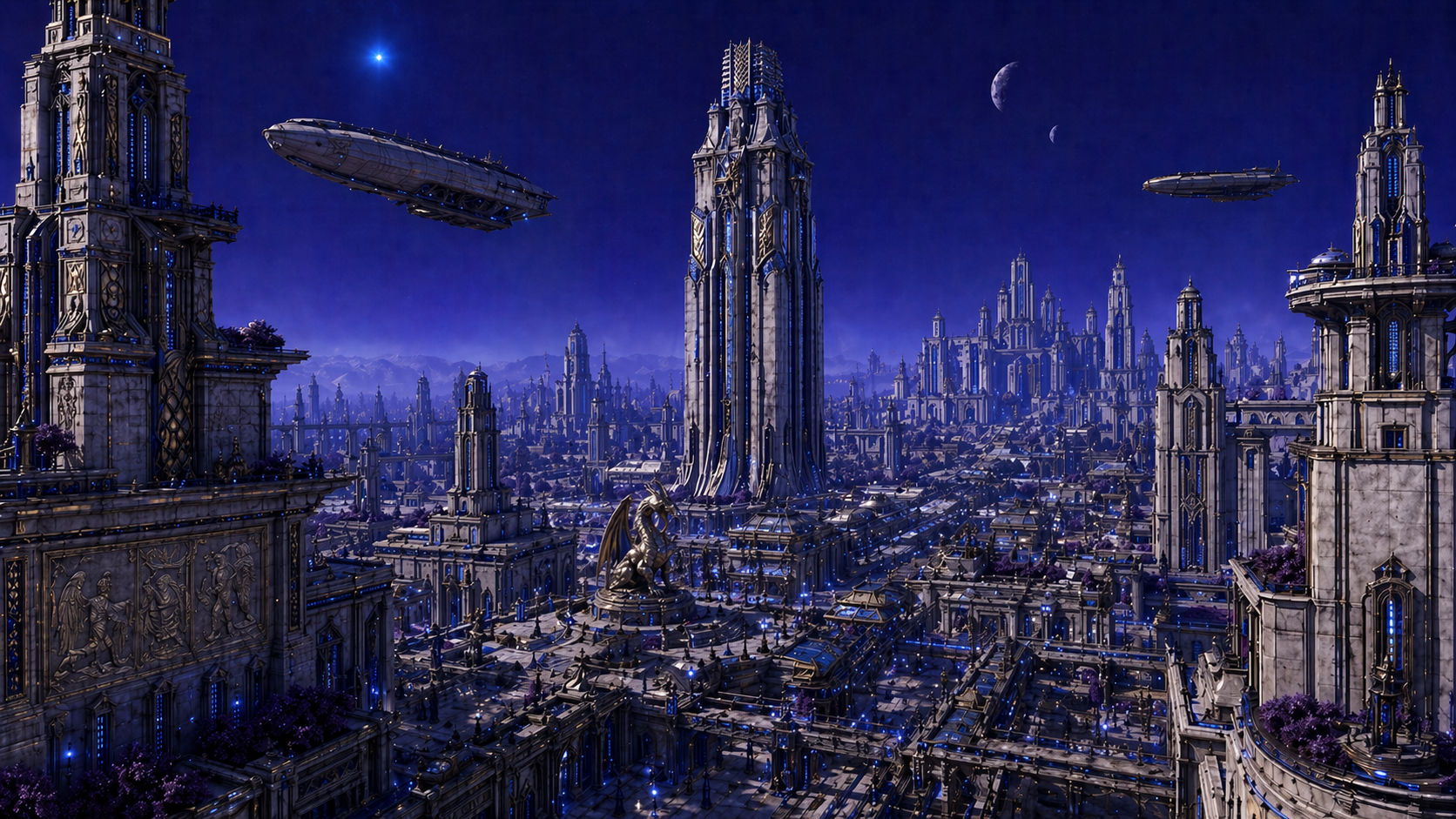
World Encyclopedia
in NovendragosA Preface to the Known World
To understand Novendragos is not to memorize its maps, but to know where its oaths hold and where they have fractured. This is a world shaped by dragons, yet governed in practice by those sworn to act in their name—syndics bound to charter and precedent, inquisitors bearing writ and consequence, sanctioned seers whose visions are weighed by councils, and rebel orders who treat truth as both ransom and weapon. Step with care. In Novendragos, knowledge is never neutral, and it is never without cost.
You have opened the archives of a world forged rather than gently formed. The foundations of Novendragos were set in catastrophe and covenant, and the marks of that origin remain close to the surface. Its stone carries the memory of fallen powers, and its depths are threaded with dragocite—elemental energy refined and bound into material form. Properly tended, it enables endurance and craft. Mishandled, it brings fire, collapse, and slow ruin. Its danger lies not in will, but in the violence of its making and the care it demands.
This encyclopedia serves as a guide through that hard inheritance. Within these pages are recorded the axioms, histories, institutions, and compromises that govern life in the current age. Read with discernment. Many of the truths preserved here are contested, and some endure only because they are partial.
The Draconic Accord
The present age is defined by the Ninefold Pact, a binding covenant established in the aftermath of the Elemental Deluge. When unrestrained elemental forces scoured the world and ended the dominion of countless mortal powers, the ancient dragons asserted overlordship to prevent a second unmaking.
These eldest scions of the Tro’Kai do not rule through constant presence. Their authority is exercised through mortal proxies, chartered orders, and oaths that carry real consequence. Cities stand because they are permitted to stand. Laws endure because named institutions enforce them. Peace holds not because it is natural, but because its violation invites response that is deliberate, personal, and overwhelming.
This stewardship has granted Novendragos a measure of stability unknown in earlier ages. Yet it is a stability born of restraint and memory—raised upon the remnants of empires that once believed themselves eternal, and maintained by the shared understanding that the dragons have ended ages before, and will do so again if forced.
The Ten Nations
The great supercontinent is divided into ten recognized nations and realms, each shaped by its own history, customs, and relationship to draconic authority. Some stand beneath clear dragon stewardship exercised through mortal institutions; others endure through distance, precedent, or careful restraint.
- Kendron: The Gilded Kingdom of the east, renowned for ordered governance under gold‑dragon stewardship. Kendron’s prosperity arises from disciplined craft, oath‑bound law, and carefully regulated dragocite use, maintained by named courts, syndics, and magistracies rather than impersonal mechanisms.
- Shal Manzir: A land of opulence and long memory, marked by deliberate efforts to atone for an ancient and exclusionary past. Its culture is shaped by ritual apology, cautious diplomacy, and institutions designed to prevent the return of old excesses.
- Kratakahn: Vast plains roamed by fiercely independent nomadic confederations. Though an amethyst dragon stands as distant overlord, authority here is exercised through seasonal councils, oath‑speakers, and negotiated allegiance rather than fixed borders or capitals.
- Dikkatsek: The northern forge‑lands of the dwarves, defined by fire, stone, and obligation. Loyalty is sworn through ancestral compacts and rigid hierarchy, shaped under the dominance of a red dragon overlord whose will is enforced through tradition, fear, and binding contract.
- The Chiryu Sovereignty: An enigmatic, isolationist empire of dragon-kin who operate from the shadows of the western mountains.
- Nelamdra: A secluded realm associated with the Dream Fae, spoken of in half‑remembered accounts and contradictory testimony. Its people describe a world shaped by altered perception and thin boundaries, though its true nature remains contested and largely unverified.
- Hamurk: The far northern frontier of ice and scarcity, where survival is earned daily. Authority is harsh and immediate, reinforced by endurance, violence, and the looming presence of a white dragon whose oversight is felt more through consequence than decree.
- Tanbhu: A spiritually rooted kingdom of deep forests and high mesas, governed through elder councils, layered ritual, and the guiding influence of a topaz dragon whose stewardship emphasizes balance and restraint over conquest.
- Myrrandor: A dense, poison‑choked jungle realm ruled through isolation and fear. Its reclusive green dragon overlord remains distant, allowing secrecy, controlled access, and manipulation to serve as instruments of rule.
- Nakashima: A mist‑shrouded archipelago of spirit‑focused traditions and martial orders. Though not directly governed by a dragon, Nakashima’s autonomy persists by long precedent and careful neutrality, tolerated so long as its actions do not disrupt the wider balance.
- Gregoran: A solitary island theocracy devoted to uncompromising worship of Vro’kahn. Its zealotry rejects secular authority and invites wary tolerance rather than trust from the draconic powers beyond its shores.
World Codex
The Great Factions
Power in Novendragos does not reside in crowns alone. It is exercised through enduring factions—guilds, orders, cults, and sworn institutions whose authority is recognized, contested, and enforced by name. These bodies act within and across nations, shaping events through law, doctrine, commerce, and violence. To understand the world as it stands is to know who holds writ, who bears sanction, and who answers when called.
- The Alchemedica Institute: A chartered body of physicians, chirurgeons, and sanctioned alchemists, recognized for its role in treating plague, mutation, and elemental injury. Its authority rests on accumulated precedent, hard‑won trust, and constant scrutiny from rival schools and civic magistrates.
- The Drakarchate: An internal order tasked with investigation, record‑keeping, and enforcement of draconic law where ordinary courts are insufficient. Its agents operate by sealed writ, conducting inquiries, seizures, and disappearances when mandated. They do not rule, but they ensure that rulings are remembered—and obeyed.
- The Brotherhood of Protectors: The visible face of civic law. Watch‑captains, patrol sergeants, and sworn protectors maintain order in streets and markets, handling theft, violence, and public dispute under local charter and magistrate oversight.
- The Drakemetal Vanguard: An elite enforcement order sworn to uphold the Ninefold Pact within Kendron. Their armor and arms are reinforced with carefully bound dragocite elements, maintained through ritual preparation and constant oversight. Each Vanguard acts as an individual bearer of sanction, not as part of any automated force.
- The Knights of Man: A seditious cult rooted in grievance and exclusion, preaching the supremacy of humanity and the overthrow of all draconic authority. Officially outlawed, they persist through cells, pamphlets, and sudden violence.
- The Lumenarch Collegium: Kendron's foremost academic institution, governed by rectors, councils, and sworn examiners. It licenses instruction, preserves dangerous texts under seal, and determines what knowledge may be taught openly—and what must remain restricted.
- The Order of the Platinum Sun: The sanctioned state faith, offering sanctuary, ritual authority, and moral arbitration. Its temples serve as places of refuge and judgment alike, often standing in tension with secular courts and unorthodox beliefs.
- The Siphoners' Union: A powerful guild of handlers, cutters, and wardens responsible for the controlled channeling of dragocite flows within cities. Their work is physical, dangerous, and localized—performed through valves, runes, and ritual discipline rather than abstract systems. Any major failure of light, heat, or motive force inevitably leads to their doors.
- The Umbral Serpents: A clandestine criminal syndicate dealing in illicit dragocite fragments, sealed texts, and forbidden contracts. Their influence spreads through bribery, silence, and carefully managed terror rather than open confrontation.
- The Vaerocasian Consortium (The Merchants' Guilds): The collective merchant houses and trade guilds of Platinus, bound by contract and rivalry. Their wealth fuels expeditions, private guards, and political pressure, making them indispensable—and dangerous—partners to nearly every other faction.
- The Azhra Cults: Fragmented but persistent sects devoted to primordial chaos. They revere the azhra and labor to weaken the bindings that hold their Titan masters at bay, acting through sabotage, corruption, and sacrificial rite.
This is Novendragos as it endures: a world of negotiated power, costly knowledge, and institutions held together by oath and consequence. No truth here is harmless, and no faction acts without leaving a mark.