
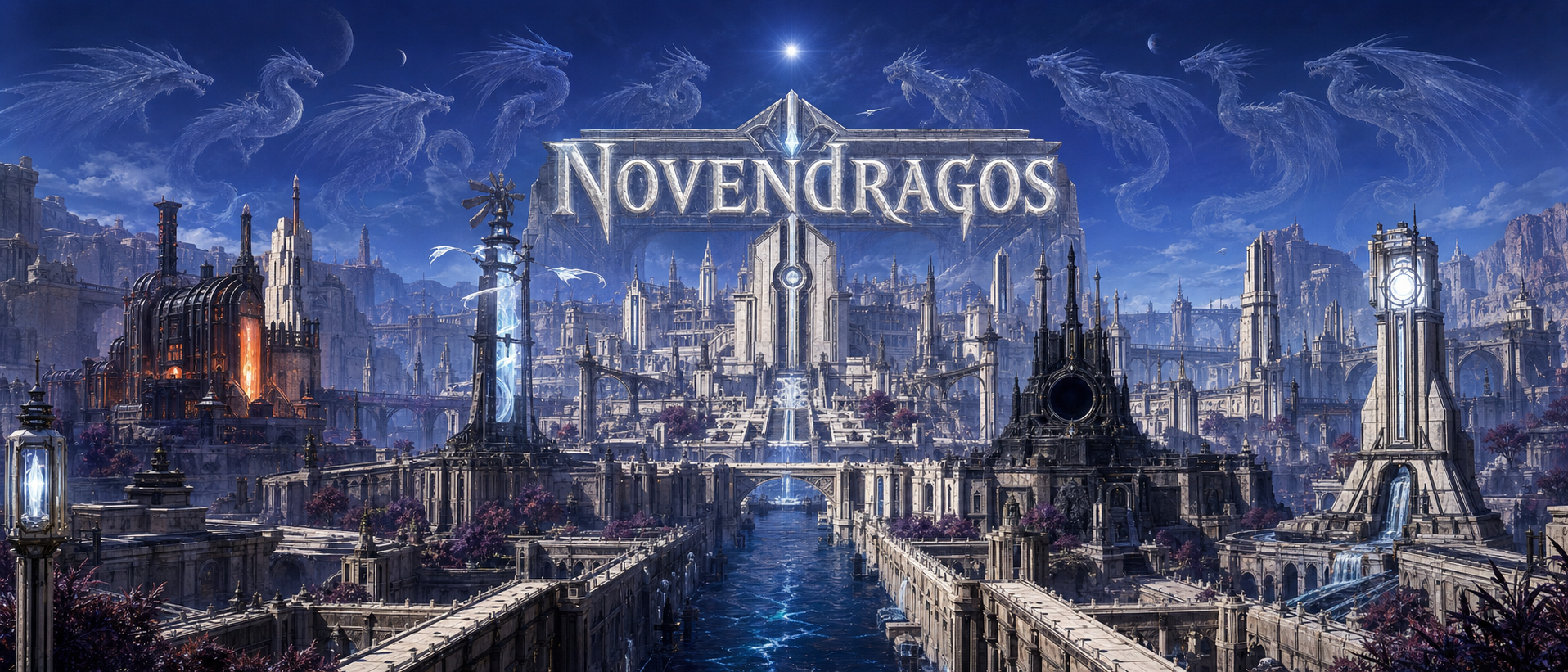
Kendron
Kendron is an ordered kingdom situated along the temperate equatorial band of Novendragos. Its lands encompass open grasslands, fertile forests, and mountain ranges that define travel, trade, and settlement. Roads, borders, and cities follow long‑established charters, each reinforced by precedent and upheld through sworn authority. The realm stands under the stewardship of the gold dragon Midasaura, the Gilded, whose rule is exercised through mortal governance rather than constant presence. Her appointed vassal, the Stormlord, oversees the kingdom in her name, issuing lawful writs, confirming offices, and answering directly for the conduct of the realm. Through this structure of dragon overlordship and mortal proxy, Kendron maintains continuity of law and practice across generations. Kendron’s population is predominantly Human, with significant dwarven and Balpura communities integrated into civic life. Daily labor, defense, and commerce rely on sanctioned craft that makes careful use of dragocite, a primordial substance drawn from ancient strata. Dragocite is cut, mounted, and channeled under strict guild oversight and ritual discipline. It is not magic, nor does it act without human direction; its continued use depends on trained handlers, accountable institutions, and ongoing maintenance. Law in Kendron is enacted through named officials, sworn orders, and public judgment.
- Majority Faiths: Worship of Vro’kahn, the Preserver, is formally embedded in Kendron’s civic and legal life. His principles of order, light, and creation inform public law as well as private devotion. The temples of the Order of the Platinum Sun function as places of worship, sanctuary, arbitration, and oath‑binding in every major settlement.
- Minority Faiths: Indarra, goddess of life, is venerated in agricultural regions such as Aurumvale and Gadorak, where seasonal rites accompany planting and harvest. A prohibited Cult of Mandur persists in secrecy among extremist human‑supremacist circles, often overlapping with the Knights of Man. Within the Collegium Quarter, some scholars maintain quiet reverence for Taraslian, Tro’Kai of Time and Memory, treating such devotion as contemplative tradition rather than public rite.
Imports: Exotic goods from Shal Manzir, raw non‑drakemetal minerals, fine silks and textiles, rare alchemical reagents.
Exports: Refined dragocite fragments, drakemetal works, sanctioned magi‑craft components, elemental firearms, timber, grain, and wine.
Platinus: The Gilded City
City Population: 155,000 (Humans 75%, Dwarves 10%, Balpura 6%, Shiira 4%, Jen'mahadim 2%, Other 3%)
Platinus is the administrative and ceremonial center of Kendron, located at the meeting of the Gallor River and Lake Windemere. Its districts are arranged according to chartered design, with civic, scholarly, commercial, and residential quarters clearly delineated. At the city’s heart stands the Sanctum Core, anchored by the Aurum Palace, from which both governance and faith are formally exercised.
Public life in Platinus is defined by assembly, instruction, and exchange. The Collegium Quarter houses licensed academies and archives, while the Vaerocasian Bazaar serves as the city’s principal market. Dragocite‑bound devices operate only where guild wardens and city officials oversee their use. Platinus functions as Kendron’s seat of law, learning, and trade through adherence to charter and constant civic presence.
Platinus Adventures
Game Masters who set their adventure in Platinus can use these plot hooks for inspiration.
- The Stolen Pattern (low‑level): A licensed craftsman is found dead in the Artisan’s Alcove, and several oath‑sealed molds are missing from his workshop. The Brotherhood of Protectors contracts the party to recover the materials, which relate to an articulated war‑harness requiring continuous human operation. The investigation draws the party into guild disputes, witness testimony, and rival claims of lawful ownership.
- Echoes of the Gilded Cage (high‑level): Coordinated attacks damage multiple sanctioned dragocite handling sites, disrupting city operations. Evidence leads to a cell of the Knights of Man, supplied by a member of the Heliox Assembly seeking to end proxy governance. Deputized by the Drakemetal Vanguard, the party must gather proof, navigate lawful process, and bring the conspirator to judgment before wider unrest follows.
Structure
The Organizational Structure of Kendron
Kendron is governed through a defined hierarchy that binds draconic authority to mortal administration. Ultimate stewardship rests with Midasaura, the Gilded, whose authority is exercised through sworn institutions rather than constant presence. Her will is expressed through charters, standing law, and the appointment of mortal officers charged with maintaining order in her name.
The realm’s day‑to‑day governance is carried out by the Stormlord, Eldred Ironhand, Midasaura’s appointed vassal. The Stormlord confirms offices, issues lawful writs, and presides over matters that affect the kingdom as a whole, answering directly to the dragon overlord for the conduct of the realm.
Beneath the Stormlord sits the Heliox Assembly, a council of ministerial lords, each entrusted with a defined sphere of governance such as trade, defense, civic law, or infrastructure. These ministers act through staffed offices and sworn deputies, and their authority is limited by charter and review. The Assembly is advised by the Elder Scales, a body of experienced counselors whose role is to provide historical precedent, institutional memory, and cautionary guidance, not to issue binding decree.
Operating alongside, but not subordinate to, these bodies is the Drakarchate. Answering directly to Midasaura’s standing law, the Drakarchate is tasked with investigation and enforcement in matters that exceed ordinary jurisdiction. Its agents act under sealed writ to pursue forbidden practices, breaches of draconic law, and threats that endanger the kingdom’s continuity. They do not govern, but they ensure that judgment, once rendered, is neither ignored nor forgotten.
Through this structure—dragon stewardship, mortal proxy rule, ministerial governance, and writ‑bound enforcement—Kendron maintains a clear chain of authority in which responsibility is named, exercised, and recorded.
Culture
The Culture of Kendron
Kendroni culture is shaped by a shared commitment to order, continuity, and civic responsibility. These values are rooted in the long stewardship of Midasaura, the Gilded, and expressed through the institutions and practices that govern daily life. Kendroni citizens understand society not as a self‑moving construct, but as a structure upheld through conscious participation—by oath, by labor, and by public accountability.
Order is regarded as a moral good, expressed through visible law and lawful conduct. Rules are not abstract ideals, but articulated expectations enforced by named offices and witnessed by the community. Public readings of writs, open adjudication, and recorded judgment reinforce the belief that stability depends on shared recognition rather than unseen control.
Innovation in Kendron is pursued within established bounds. Craft and refinement are encouraged where they preserve civic function and safety, particularly in the sanctioned use of dragocite. Advancement is understood as careful improvement under charter and oversight, not as unrestrained experimentation. This outlook is commonly summarized in the civic maxim “Preservation Through Continuance,” a phrase taught in schools and recited during civic induction.
Central to Kendroni identity is the Ninefold Pact, understood not as distant doctrine but as a living agreement that defines lawful order between dragon overlord and mortal realm. Its terms are referenced in oaths of office, temple instruction, and legal precedent. To challenge the Pact openly is treated not merely as dissent, but as rejection of the framework that grants legitimacy to authority itself.
Customs reinforce these principles through practice rather than spectacle. Young adults complete mandatory civic service under the supervision of guilds, temples, or city offices. Those assuming positions of authority publicly attest to their charters, often before both magistrates and clergy, with the Elder Scales or other witnesses present. Annual observances commemorate foundational charters, landmark judgments, and acts of preservation, presented through formal retellings and sanctioned pageantry that emphasize lawful continuity rather than personal heroism.
Public Agenda
The Mandate of the Accord
The Mandate of the Accord is issued through lawful process: drafted within the Heliox Assembly, confirmed by the Stormlord, and upheld under the standing authority of Midasaura, the Gilded. Together, these offices articulate Kendron’s public direction through a shared civic principle, commonly rendered as Preservation Through Continuance. This mandate affirms the Ninefold Pact as a living framework that binds draconic stewardship to mortal responsibility, defining what may be built, maintained, or restrained.
At the heart of the mandate is the preservation of order as a condition of endurance. Order is understood not as immobility, but as the consistent application of law through named offices, public writ, and witnessed judgment. The state commits its courts, watch orders, and sworn enforcers to the protection of civic life, addressing threats to continuity through lawful investigation and recorded decree rather than discretionary force.
Equally affirmed is the careful continuation of craft and practice. Guilds, academies, and sanctioned workshops are empowered to refine existing methods and develop new applications where they serve civic need. Materials such as dragocite and drakemetal are cut, mounted, and channeled only under charter and oversight, with responsibility borne by identifiable masters and wardens. Advancement, in this context, is measured by reliability, safety, and lawful integration rather than novelty.
The Mandate also sets expectations of allegiance. Loyalty to Midasaura is expressed through adherence to charter, fulfillment of oath, and respect for the Ninefold Pact as the source of legitimate authority. Public attestations—often conducted before magistrates and clergy, with witnesses present—reinforce this obligation at moments of appointment and transition. Through shared observance of the Mandate, Kendron maintains a collective identity grounded in continuity, lawful order, and balanced stewardship.
Demography and Population
Ordered Growth
Kendron’s population has expanded in a measured and sustained manner under the long stewardship of Midasaura, the Gilded, guided through mortal governance and civic charter. Current estimates place the kingdom’s population at approximately 3.5 million, with settlement patterns shaped by arable land, trade routes, and established centers of authority.
The capital city of Platinus, home to roughly 155,000 residents, functions as Kendron’s primary seat of governance, law, and commerce. The surrounding Couragian Grasslands form the kingdom’s demographic core, supporting dense town networks and market roads. To the south, the agricultural regions of Gadorak and Aurumvale sustain large rural populations through grain, wine, and managed irrigation. Along the coast, the Thalas Enclave supports fishing and trade communities tied to maritime guilds. The western mountains, particularly Eldoria, are dominated by dwarven settlements oriented around mining, stonecraft, and smelting, while the northern and more remote regions—Dragosia, the Skyreach Highlands, and the Verdant Expanse—remain lightly settled by design and necessity.
Population stability is supported by Kendron’s chartered approach to public welfare. Licensed physicians of the Alchemedica Institute, temple‑affiliated healers of the Order of the Platinum Sun, and sanctioned midwives operate under civic oversight, reducing early mortality and responding to injury and illness common to the world. As a result, life expectancy within Kendron commonly reaches seven to eight decades, though accidents, labor hazards, and violence remain present realities of Novendragos.
Demographically, Kendron is predominantly Human (approximately 85%), forming the backbone of civic administration, agriculture, and trade. Dwarves (around 8%) are concentrated in mining regions and artisan districts. The Balpura (roughly 4%) are most commonly found in coastal and riverine settlements, while the Shiira (about 2%) maintain nomadic traditions that manifest as transient enclaves within major cities. Elder‑blooded peoples, including the Jen’mahadim, comprise less than one percent of the population and are rarely encountered outside isolated communities or formal proceedings.
Military
The Accord's Edge
Kendron’s military exists to uphold the Ninefold Pact and the lawful order derived from it. Its purpose is defined by discipline, sworn service, and readiness to act when the realm’s continuity is threatened. Beyond defending borders, the military serves as a visible guarantor of order, acting only under chartered authority and recorded mandate.
Ultimate strategic authority rests with Midasaura, the Gilded, whose standing law defines the bounds within which force may be used. Operational command is exercised by the Stormlord, Eldred Ironhand, who issues campaign writs, appoints senior officers, and bears responsibility for the conduct of Kendron’s armed forces. Orders pass through established chains of command, with authority vested in named captains, marshals, and admirals rather than abstract command structures.
The Royal Kendroni Army forms the core of the kingdom’s military strength. Organized into legions of infantry, cavalry, and specialized support companies, it guards borders, patrols chartered roads, and answers formal calls to arms. Soldiers are equipped with elemental weapons and protective works reinforced by drakemetal, all maintained through guild oversight and ritual preparation. The army engages in open warfare only under declared writ and recorded cause.
Alongside the army operates the Drakemetal Vanguard, an elite order tasked with matters beyond ordinary military jurisdiction. Acting under sealed writ, the Vanguard responds to unlawful dragocite use, cult activity, and breaches of draconic law. Their arms and armor incorporate carefully mounted dragocite elements that require constant tending by sworn handlers. The Vanguard does not legislate or command; it enforces judgments already rendered by lawful authority.
The Dragon Knights, few in number, serve as champions and emissaries of Midasaura herself. Trained at the Ironhand War Academy, they undertake missions of exceptional importance, from high‑level diplomatic enforcement to singular acts of battlefield command. Their presence signals that a matter touches directly upon the Pact and the authority that sustains it.
Kendron’s naval forces secure both sea and sky. Fleets patrol the coast and protect trade routes across the Samudric Ocean, crewed by sailors and sky‑hands sworn to naval charter. Vessels bear dragocite‑powered engines and elemental artillery that function only while actively tended by trained crews and inspected by guild wardens. Through escort, blockade, and presence, the navy extends Kendron’s lawful reach without conquest.
Technological Level
The Artifice of Harmony
In Kendron, the use of magic and craft is governed by discipline, tradition, and lawful restraint. Elemental forces are not treated as unpredictable whims, but as realities that demand respect, preparation, and accountability. Through long practice, Kendron’s artisans, scholars, and wardens have developed methods to work alongside these forces without surrendering control to them.
The material foundation of Kendron’s craft is dragocite, drawn from ancient strata and shaped only under chartered authority. It is cut, braced, and mounted into engines, tools, and vessels that function only while actively tended. Furnaces, conduits, and vents are overseen by licensed guilds, inspected by magistrates, and maintained through ritual discipline. Nothing runs unattended, and nothing endures without care.
Within cities, daily life is supported by such bounded works. Workshops rely on dragocite‑mounted engines tended by named crews. Cargo and passengers move along established roads and waterways by conveyances that depend on animal power, sail, or elemental assistance under constant supervision. Devices designed to ease labor—pumps, lifts, presses, and regulators—operate only while guided by human hand. Comfort and safety arise from presence and maintenance, not unseen infrastructure.
Kendron’s military benefits from the same disciplined approach. Elemental firearms and reinforced arms are produced under strict charter, with each piece assigned to a bearer responsible for its condition. Drakemetal armor strengthens protection but confers no will of its own. Sky‑vessels and war engines rely on crews trained to read pressure, heat, and elemental flow moment by moment. Superiority, where it exists, is a matter of preparation and endurance rather than excess.
Innovation within Kendron proceeds by petition and review. The Lumenarch Collegium studies precedent and material behavior, while guild forges in Platinus and Eldoria refine approved designs. New applications are permitted only when responsibility for their use is clearly assigned and their risks understood. The Drakarchate intervenes not as a regulator of invention, but when unlawful practice, forbidden modification, or dangerous disregard for chartered limits is discovered.
Through these practices, Kendron maintains what its citizens call harmony: not a flawless balance, but a continuous effort to align power, law, and responsibility under the terms of the Ninefold Pact.
Religion
Divine Order in Service of the Accord
Religion in Kendron is a public and institutional presence, woven into civic life through law, ritual, and visible office. Faith is understood as one of the means by which the Ninefold Pact is interpreted and upheld, providing moral structure to governance rather than existing apart from it. Belief is permitted in many forms, but only insofar as it acknowledges the authority of the Pact and the order derived from it.
The dominant faith is the worship of Vro’kahn, the Preserver, whose doctrines of order, creation, and restraint are formally aligned with Kendron’s legal and civic traditions. His worship is administered by the Order of the Platinum Sun, whose temples serve as centers of instruction, sanctuary, and arbitration. The Order’s leader, the High Lumen, holds a permanent seat on the Heliox Assembly, reflecting the faith’s role in advising law rather than issuing it. Clergy trained under the Order frequently serve as magistrates, record‑keepers, and ethical counselors, and public oaths are often sworn within temple courts before both civic and religious witnesses.
Minor faiths are permitted within defined bounds. Devotion to Indarra, goddess of life, is common in agricultural regions, where her rites accompany planting, harvest, and healing. Such observances are locally registered and rarely intersect with state governance. The traditions of Taraslian, centered on time and memory, persist primarily as contemplative philosophies within monastic houses and scholarly circles, particularly among members of the Lumenarch Collegium, and are treated as intellectual disciplines rather than public cults.
Beliefs that reject the authority of the Pact are addressed through law. Organized worship of Mandur that promotes human supremacy and denies draconic stewardship is proscribed; discovered cells are dismantled under sealed writ, most often by the Drakemetal Vanguard, and their leaders brought before civic judgment. The Azhra cults, which seek the release or veneration of bound Titans, are declared existential threats. Participation in such cults is treated as treason against the realm, and confirmed adherents face the severest penalties available under Kendron law, including final judgment by the Drakarchate.
In Kendron, faith is neither wholly private nor wholly free. It is practiced openly, recorded publicly, and permitted only where it affirms the order that sustains the realm.
Foreign Relations
Diplomacy of the Accord
Kendron’s diplomacy reflects its internal order: deliberate, principled, and grounded in law. Foreign relations are conducted through chartered envoys, formal treaties, and recorded obligation rather than improvisation or secrecy. The kingdom seeks stability beyond its borders not as a means of dominance, but as a condition necessary for continuity under the Ninefold Pact.
All diplomatic authority ultimately derives from Midasaura, the Gilded, whose standing law defines Kendron’s posture toward other realms. Day‑to‑day relations are managed by the Stormlord and the Heliox Assembly, whose ministers oversee treaties, trade compacts, and border accords. Kendron does not present itself as warm or indulgent, but it is consistent: promises are honored, obligations enforced, and disputes addressed through formal process rather than sudden reprisal.
Kendron’s most enduring alliance is with Shal Manzir, formalized through the Silver Accord. This relationship emphasizes mutual defense, regulated trade, and shared interest in long‑term regional stability. While philosophical differences remain—particularly regarding Shal Manzir’s inward‑focused traditions—the alliance persists through respect for treaty and precedent rather than ideological alignment.
Relations with Kratakahn are managed through necessity and restraint. Kendron recognizes the autonomy of the plains confederations and maintains trade and border negotiation to prevent escalation. Diplomatic engagement focuses on seasonal agreements, migration corridors, and dispute mediation, accepting difference without seeking assimilation.
With Dikkatsek, Kendron maintains structured industrial and material exchange. Dwarven metals and stonework enter Kendron through long‑standing contracts overseen by guild and crown alike. While political systems differ, mutual reliance has produced durable protocols that favor predictability over intimacy.
Kendron’s posture toward the Chiryu Sovereignty is defined by caution and recognition rather than rivalry. Formal contact is limited, shaped by differing interpretations of order, restraint, and authority. Each realm acknowledges the other as a power that acts according to its own internal logic, and interaction proceeds through indirect channels, precedent, and silence where speech would bind too tightly.
Beyond these, Kendron maintains cordial scholarly and trade exchange with Tanbhu, enforces lawful embargoes and maritime restrictions against hostile actions originating from Hamurk, and limits engagement with Myrrandor due to the unpredictable influence of its ruling dragon. In all cases, Kendron’s diplomacy favors clear boundary, declared intent, and enforceable agreement over persuasion or expansion.
Laws
The Architecture of Order
In Kendron, law is understood as a living framework of obligation, precedent, and judgment. It is not conceived as an abstract mechanism, but as a body of commitments carried forward by named offices and public witness. Law exists to preserve continuity under the Ninefold Pact, ensuring that authority is exercised visibly, consistently, and with memory.
Statutes originate within the Heliox Assembly, where ministers debate, amend, and record proposed measures in reference to existing charter and historical ruling. Once affirmed, these statutes are confirmed by the Stormlord through formal edict, acting under the standing authority of Midasaura, the Gilded. The resulting law is preserved in multiple forms: master copies engraved upon drakemetal plates housed in Eldoria’s Great Library, and working copies maintained on parchment in city halls, temples, and guild courts throughout the realm.
Enforcement of law is distributed according to scope and severity. The Brotherhood of Protectors addresses routine offenses within cities and towns, operating under local magistrates. Matters involving grave threat—sedition, unlawful dragocite practice, or violations of draconic law—are addressed by the Drakemetal Vanguard acting under sealed writ. In the rarest cases, where danger exceeds the reach of ordinary jurisdiction, the Drakarchate intervenes, conducting investigation and enforcement only under explicit mandate. These bodies do not replace one another; each acts within defined bounds.
Judgment in Kendron is proportional and recorded. Lesser crimes commonly result in fines, mandatory civic service, or temporary suspension of privileges. Serious offenses such as murder, sabotage, or repeated breach of charter may lead to imprisonment, labor under supervision, or formal exile. The gravest crimes—treason against the Pact, Azhra worship, or existential endangerment of the realm—may result in Unmaking, a final sentence imposed only after confirmation by the highest authority. In such cases, names are stricken from civic rolls, public memory is formally closed, and the offender is removed from society through execution or perpetual confinement, as dictated by writ.
Justice in Kendron is intended to be consistent rather than flexible. All citizens are subject to the same statutes, though complexity of case may require learned advocacy or extended review. Appeals are permitted where charter allows, and all rulings are preserved in record. Law here does not promise mercy without cause, nor punishment without process. It endures because it is spoken, witnessed, and remembered.
Agriculture & Industry
The Forge and the Field
Kendron’s material strength arises from the coordinated stewardship of land and craft. Food production and material refinement are treated as parallel obligations, each governed by charter, tradition, and oversight. Together, they sustain the population and supply the tools required to maintain order under the Ninefold Pact.
In the western ranges of the Fallen Mountains, dwarven‑led holds in Eldoria oversee the extraction of stone, ore, drakemetal, and dragocite‑bearing strata. These operations proceed under long‑standing compacts that define limits of depth, yield, and handling. Raw materials are transported under guard to licensed forges and workshops, where their use is recorded and assigned to named masters. Nothing is taken or shaped without responsibility being clearly borne.
Within Platinus and Hallgrim, guild forges and foundries refine these materials into arms, tools, and civic works. Elemental firearms, armor reinforcements, and dragocite‑mounted engines are produced in small runs, each piece inspected, sealed, and assigned before release. Devices intended to aid labor—presses, lifts, pumps, and regulators—operate only while actively tended by trained crews. Artisan guilds also produce textiles, worked metals, and jewelry, contributing goods valued both within Kendron and abroad.
Agriculture anchors this craft with sustenance. The Couragian Grasslands and the plains of Gadorak support dense networks of farms and market towns, yielding grain and forage sufficient for both local use and controlled export. Herds are raised alongside native beasts such as tharnox and plainsrunners, managed through seasonal drives and chartered grazing rights. In Aurumvale, viticulture thrives on terraced slopes, while the Thalas Enclave supports fishing and aquaculture through coastal guilds. Forests and highlands provide timber and rare herbs under regulated harvest, ensuring renewal rather than exhaustion.
Across forge and field alike, Kendron emphasizes continuity over excess. Production is measured, recorded, and reviewed; harvests are tallied and tithed; and both are bound to civic obligation. Through this balance of cultivated land and disciplined craft, the kingdom maintains the material foundation required for endurance rather than unchecked growth.
Trade & Transport
Arteries of the Accord
Kendron’s trade and transport arise from chartered routes, maintained works, and sworn service rather than unseen systems. Movement of goods and people is treated as a civic responsibility: roads must be kept passable, ports guarded, and conveyances tended by named crews. Commerce is encouraged where it serves continuity under the Ninefold Pact, and restrained where it would erode accountability.
Across the realm, overland exchange relies on established roads and causeways laid by charter and repaired by levy. Heavy wagons carry ore, timber, and grain between provinces under convoy, stopping at market towns and weigh‑houses where cargo is recorded and tithed. Certain stretches are reinforced with stone or drakemetal fittings at bridges and gates—localized works maintained by guild contract rather than continuous paving. Patrols drawn from local watch and sworn escorts provide presence along these routes.
Over longer distances, Kendron relies on the Kendroni Railway System, a network of chartered rail lines laid between major population centers and resource regions. Trains are driven by dragocite‑fueled engines mounted at the fore and rear, each tended by licensed engine crews responsible for pressure, heat, and elemental flow throughout the journey. Rail traffic moves by schedule and writ, not by continuous operation, and stations serve as points of inspection, record, and handoff rather than uninterrupted transit. Bulk goods such as ore, timber, and grain are moved by rail where roads would overstrain land or labor, with delays accepted as the cost of safety and accountability.
For high‑value or time‑sensitive cargo, Kendron employs sky‑vessels and river craft whose dragocite mounts are braced and tended by trained hands. These conveyances operate by chartered schedule and fair weather, their crews responsible for inspection before every departure. Nothing moves unattended; delays are accepted as the cost of safety and record.
Maritime trade centers on protected ports and known sea‑lanes. From Port Luminar, merchant fleets follow the Silverwind Route toward allies such as Shal Manzir, sailing in seasons declared safe by naval notice. The navy escorts convoys, enforces lawful blockades, and maintains presence at chokepoints, not to hasten trade but to ensure it proceeds within declared bounds.
Commercial authority is exercised through charter. The Heliox Assembly approves trade compacts and tariff schedules, while licensed merchant guilds conduct exchange under those terms. Magistrates, clerks, and temple witnesses oversee weights, contracts, and oaths. Kendron exports refined dragocite works, drakemetal goods, sanctioned arms, and agricultural surplus; it imports rare materials, luxury goods, and specialized reagents from partners such as Shal Manzir and Dikkatsek.
Illicit trade persists at the margins. Smugglers exploit gaps in convoy timing, river fog, and remote crossings, moving forbidden dragocite fragments or sealed designs. Such activity is addressed through investigation and writ—by guild inspectors, harbor masters, and when necessary the Drakemetal Vanguard—rather than by blanket interdiction. Even here, enforcement relies on presence, testimony, and consequence, not omniscience.
Education
Calibrating the Mind
Education in Kendron is treated as a civic obligation shared between family, guild, temple, and state. Learning is intended to prepare individuals to participate responsibly in public life, to understand the laws that govern them, and to practice skills that sustain the realm. Instruction is shaped by charter and precedent rather than by abstract design, and is reinforced through visible practice and recorded obligation.
Most Kendroni children attend local Luminar Schools, where they are taught literacy, numeracy, history, and civic law. Instruction emphasizes reading of writs, understanding of chartered duty, and familiarity with public custom. Lessons are often accompanied by practical exercises: copying portions of city charters by hand, witnessing public judgments, or assisting clerks during census and tithe season. This foundational education is broadly accessible and intended to ensure that all citizens can read law, keep record, and account for themselves before authority.
From this base, many youths enter guild apprenticeship, where learning is embodied through labor. Artisans, merchants, and tradespeople train under named masters, binding skill to responsibility through oath and example. Advancement is measured not only by competence, but by reliability and adherence to guild charter. This vocational path sustains Kendron’s craft and commerce without separating education from consequence.
Advanced study is pursued by those who petition successfully or are nominated by guilds, temples, or magistrates. Institutions such as the Lumenarch Collegium, the Alchemedica Institute, and the Ironhand War Academy admit candidates based on aptitude, record, and willingness to bear responsibility. Students at this level are trained to interpret precedent, manage dangerous materials, or command others under lawful authority. Their education is narrower in number but deeper in scope, reflecting the risks inherent in the knowledge they are entrusted with.
Access to restricted texts and practices is governed by charter rather than secrecy. Certain histories, techniques, or treatises are sealed or supervised because misuse carries consequence for the wider realm. Oversight of such matters is conducted through institutional review, oath, and, in rare cases, investigation by the Drakarchate when unlawful handling or deliberate endangerment is discovered. Knowledge in Kendron is not hoarded for privilege, but released according to responsibility.
Through this layered approach, Kendron maintains a population that is literate, skilled, and capable of engaging with law and craft alike—prepared not as components of a system, but as participants in an enduring civic order.
Infrastructure
Bones of the Kingdom
Kendron’s infrastructure is the product of chartered labor, maintained works, and public obligation. Roads, railways, ports, waterworks, and defenses endure because they are built to be tended—by named crews, under guild contract, and within the bounds of lawful authority. The kingdom values durability and accountability over unseen efficiency.
Overland travel and haulage rely on established roads and causeways laid by charter and repaired by levy. At bridges, gates, and steep grades, stonework is reinforced with drakemetal fittings—localized braces maintained by contracted masons rather than continuous paving. Patrols drawn from local watch and sworn escorts provide presence along major routes, while market towns host weigh‑houses and clerks who record passage and tithe.
For long‑distance freight, Kendron employs the Kendroni Railway System. Rail lines connect major cities and resource regions, and trains are driven by dragocite‑fueled engines mounted fore and aft, each tended by licensed crews responsible for heat, pressure, and elemental flow throughout the journey. Rail traffic proceeds by schedule and writ, with stations serving as points of inspection and record rather than uninterrupted transit. Delays are accepted as the cost of safety and accountability.
Ports and harbors—most notably Port Luminar—anchor maritime movement. Quays, breakwaters, and beacons are maintained by guild contract, while harbor masters oversee manifests and convoy timing. Sky‑ports exist where charter allows, supporting sky‑vessels whose dragocite mounts are braced and tended by trained hands. No conveyance departs without inspection; nothing operates unattended.
Urban water and sanitation depend on long‑standing works. Aqueducts carry water by gravity into cisterns and distribution courts, where flow is regulated by valves and gates managed by wardens. Filtration relies on layered stone, sand, and alchemical media replaced on schedule, not on continuous enchantment. Sewers are deep and segmented, with access points marked for inspection and cleaning by civic crews. City halls and Courts of Accord anchor these works, serving as visible centers of governance, judgment, and record.
Defense is built with the same restraint. Fortresses in the Fallen Mountains secure passes and supply lines; coastal watchtowers maintain line‑of‑sight signaling; and the walls of Platinus are layered with stone, warded fittings, and controlled gates. Vanguard citadels exist where jurisdiction requires rapid response, housing armories, courts, and quarters under separate writs rather than as unified command hubs. Together, these works provide resilience through presence, maintenance, and lawful use—not through unseen systems.

Preservation through Progress.
The Couragian Grasslands
The vast, fertile heartland of Kendron, a sea of blue-green and golden grasses stretching between the great mountain ranges. It is home to massive herds of tharnox and velnari, and its history is deeply scarred by the Invasion of the Kalagiri. Today, it is a symbol of Kendron's resilience, its fields dotted with monuments to the heroes of that ancient war. The annual "Festival of Heroes" is held here, a grand celebration of the kingdom's history and martial spirit.
The Fallen Mountains
This formidable mountain range defines Kendron's western border. Formed millennia ago by a meteor strike that exposed rich veins of ore, these peaks have been a site of conflict for ages, from the early expansion of the Chiryu Empire to the tyrannical rule of the Azhra-led orcs. Today, the mountains are the kingdom's primary source of mineral wealth, with the dwarven-led region of Eldoria at its heart. The range is riddled with ancient ruins, forgotten tombs, and dangerous, unstable dragocite deposits.
Thalas Enclave
Situated on the southeastern coast, Thalas Enclave is a region of dramatic sea cliffs, luminescent marshes, and bustling port towns. Its principal city, Port Luminar, is a major hub for maritime trade. The region is known for its significant Balpura population, whose empathic nature and deep connection to the sea have shaped the local culture. The Enclave's history is marked by the devastating Necrophilic Plague and the subsequent Motaran Wars.
The Verdant Expanse
A vast, ancient forest in the north of Kendron, known for its mysterious beauty and unnaturally lush growth. The forest is rumored to be under a strange, eldritch influence that causes cleared areas to regrow with astonishing speed. Its main settlement is the secluded town of Sylvanhaven, whose people live in close harmony with the woods. The Expanse is also home to the Green Hand, a notorious band of outlaws who use the dense, magical foliage to their advantage.
Gadorak
The southern plains of Kendron, a land of fertile fields and deep-rooted chivalric traditions. Once a rival kingdom, Gadorak was annexed into Kendron after a period of internal conflict and war. It is now the agricultural breadbasket of the nation, its fields producing abundant crops and fine wines. The region's culture is heavily influenced by its history of knighthood, tracing back to the Knights of Man in Old Mandur, and it remains a hotbed of support for the subversive Cult of Mandur.
Skyreach Highlands
The rugged, windswept highlands in the northeast of Kendron. This sparsely populated region is known for its stunning vistas, its resilient herding communities, and its unique natural resources, including rare herbs and exotic bird species that attract alchemists and scholars. Its principal city, Windkeep, is a strategic fortress perched high in the mountains, a vital defensive position that has played a key role in many of Kendron's historical conflicts.
Aurumvale
The fertile river valleys in the southeast, a region known for its vibrant culture and artistic pursuits. Its central city, Goldspire, is a hub of creativity, famous for its master artisans who produce exquisite textiles, intricate metalwork, and beautiful pottery. Aurumvale experienced a cultural golden age under the reign of Stormlord Elara the Just, and it remains a pillar of Kendron's economy and artistic life.
Dragosia
A land of highlands and river valleys in the northwest, historically a separate entity but now integrated into Kendron. Governed by the United Stormriders, Dragosia is a diverse region with a significant population of humans and dwarves. Its history is tied to the discovery of adamant ore, which was crucial to the rise of the old Mandurian Empire. Its capital is Brightstone, with the cities of Forgehold and Gatefall serving as other major centers.
Eldoria
Nestled in the heart of the Fallen Mountains, Eldoria is the center of Kendron's mining and smithing industries. Dominated by a large dwarven population with a significant human presence, its principal city, Hallgrim, is a beacon of craftsmanship, renowned for its ability to forge high-quality armor and weapons from drakemetal and dragocite. Eldoria is a rugged, defensible region that has withstood numerous invasions throughout its long and storied history.
Denominations of the Realm
The currency of Kendron is standardized across the Golden Dominion and is based on the inherent value and rarity of the realm's most important resources.
Glimmer Shard (GS)
- Value: The lowest denomination, equivalent to a copper piece.
- Description: Glimmer Shards are small, polished, and uniformly faceted fragments of translucent crystal. They are not mined but are a stable, low-grade byproduct of the dragocite refining process. Each shard, roughly the size of a fingernail, emits a faint, constant, pale-white glow, making a purse of them shimmer softly in the dark.
- Use: This is the coin of the common folk, used for everyday transactions: buying food at the Vaerocasian Bazaar, paying for a drink at a tavern, or tipping a street performer in Gleaming Revelry.
Resonance Mark (RM)
- Value: Equivalent to a silver piece.
- Description: Resonance Marks are flattened, circular discs of a dull grey dragocite-drakemetal alloy. They are cool to the touch and emit a very faint, almost imperceptible hum if held close to the ear. Each Mark is impressed with a simple, official elemental sigil (Flame, Tide, Stone, Gale, Void, or Light) to denote its standardized value.
- Use: Marks are the workhorse of the Kendroni economy, used for purchasing common goods, paying for a room at an inn, or hiring unskilled labor.
Drakemetal Token (DT)
- Value: The standard of significant trade, equivalent to a gold piece.
- Description: Drakemetal Tokens are heavy, solid coins forged from refined drakemetal, a rare and resilient alloy prized for its ability to conduct magical energy. They are typically square with rounded corners and are deeply impressed with the intricate emblem of Kendron: the profile of a golden dragon on one side and the sigil of the Heliox Assembly on the other.
- Use: This is the currency of merchants, guilds, and the state. Tokens are used to pay soldiers' wages, finance trade expeditions, purchase high-quality equipment, and post bonds. Most adventurers will conduct their business primarily in Drakemetal Tokens.
Overlord Plate (OP)
- Value: The highest form of physical currency, equivalent to a platinum piece.
- Description: Overlord Plates are not coins but flat, rectangular plates of highly purified, shimmering dragocite crystal, cool and smooth to the touch. Each plate is masterfully impressed with the intricate, personal sigil of the Dragon Overlord, Midasaura the Gilded. The sigil appears to pulse faintly with a soft, golden light.
- Use: These plates are exceptionally rare and represent the direct backing of the Dragon Overlord's authority and wealth. They are used almost exclusively by noble houses, the highest echelons of government, and the wealthiest guilds for transactions of immense value, such as purchasing land, commissioning a sky-vessel, or securing a major political alliance. To possess even a single Overlord Plate is a sign of significant power and influence.
Methods of Transaction
While physical currency is used for the vast majority of transactions, the advanced magi-tech society of Kendron has developed more sophisticated methods for managing great wealth.
- Letters of Credit: For massive transactions, the major merchant guilds and the Bank of Platinus can issue Letters of Credit. These are drakemetal-laced documents, inscribed with complex arcane runes and sealed with a magical sigil unique to the issuing institution, which can be exchanged for a specified amount of Drakemetal Tokens.
- Arcane Ledgers: The highest levels of government and the Drakarchate do not deal in physical currency at all. They utilize secure, magically encrypted Arcane Ledgers to transfer vast sums between institutional vaults, their transactions nothing more than a silent, instantaneous flash of light between two scrying pools.
The Price of Progress
Kendron shapes the world not just through dominance, but through what it sells. Its exports are instruments of influence—refined goods, advanced magi-tech, and surplus harvests that bind other nations to its orbit. Trade is strategic, and every shipment reinforces Kendron’s authority.
At the core of its exports are refined dragocite and drakemetal, processed with unmatched precision in Platinus and Eldoria. These materials fuel the continent’s magi-tech infrastructure, while export-grade elemental firearms and components keep allied militaries reliant on Kendroni designs. Even simple clockwork automatons, while far from the kingdom’s cutting edge, are coveted luxuries abroad.
From its heartland, Kendron exports massive surpluses of grain, fine wines from Aurumvale, and, on occasion, rare livestock breeds like tharnox and plainsrunners. These agricultural exports feed less fertile nations and reinforce trade dependencies.
Beyond material goods, Kendron exports its ideology. The Lumenarch Collegium licenses outdated magi-tech schematics to allies, maintaining control while allowing limited advancement. Skilled experts—engineers, theorists, and advisors—are sent abroad under diplomatic terms, embedding Kendron’s philosophy of progress and order wherever they go.
The Price of Perfection
Though Kendron is largely self-sufficient, its pursuit of refinement and technological advancement drives a steady stream of imports. These goods—whether luxury, strategic, or simply cost-effective—reflect a kingdom that demands excellence and efficiency in all things.
For the elite, imported luxuries signal status and cultured taste. Fine silks and carpets from Shal Manzir, spices from Al Zamarud, rare fruits from Myrrandor, and exotic seafood from Nakashima fill Kendroni estates and banquets. Foreign art and literature—epic poetry, dreamlike sculpture, and intricate carvings—are prized not just for beauty, but as curated glimpses into the chaos beyond Kendron’s order.
On the industrial side, Kendron relies on rare alchemical reagents for research, sourced from Chiryu’s peaks, Myrrandor’s jungles, and Al Zamarud’s deserts. Durable, flame-forged alloys from Dikkatsek support deep-mining and infrastructure. Even with local mounts like plainsrunners, Kendron imports prized horses from Kratakahn and Shal Manzir for noble stables and officer cavalry.
To conserve resources, common goods like salted fish and base ores are often brought in from neighbors. Kendron’s focus remains on producing the extraordinary; for everything else, trade ensures its perfection continues uninterrupted.
The Heliox Assembly
In Kendron, lawmaking is viewed as the deliberate crafting of a perfected society, guided fundamentally by the will of Midasaura, the Gilded Dragon Overlord. Her philosophy, known as the Draconic Mandate or Accord, functions as the supreme unwritten constitution. All laws must reflect its principles of order and progress.
The Heliox Assembly, Kendron’s primary legislative body, translates these broad draconic principles into detailed laws necessary for governing the kingdom's magi-tech society. Composed of the Stormlord, elder statesmen, and influential faction leaders, the Assembly engages in careful debate and negotiation, balancing factional interests with overarching mandates.
The Stormlord, currently Eldred Ironhand, oversees the Assembly, proposes and approves legislation, and ensures laws align with Kendron’s best interests. Influential factions such as the Merchants' Guild and Alchemedica Institute further shape laws through active lobbying within this structured legislative process. Ultimately, the Dragon Overlord provides the foundational philosophy, the Heliox Assembly formulates the laws, and the Stormlord grants them authority.
The Scales of the Accord
In Kendron, interpreting law is a precise and sacred duty, entrusted to a structured judicial system designed to uphold order and harmony at every level. The Dragon Overlord, Midasaura the Gilded, stands as the ultimate authority on legal interpretation. Though she rarely intervenes directly, her foundational principles guide all judicial decisions, and she provides final judgments on matters threatening the kingdom's core order.
At the highest mortal level, the Heliox Assembly acts as Kendron’s supreme court, convening for cases involving significant political or constitutional issues. Their decisions set binding precedents for the entire realm.
Serious crimes are judged by the Aurumic Tribunals, presided over by Adjudicators appointed by the Stormlord from among the kingdom’s most respected scholars, clerics, and retired military officers. Common civic disputes and minor crimes are swiftly handled by Magistrates appointed by local leadership, maintaining daily civic order.
Additionally, two groups maintain separate jurisdictions: the Drakemetal Vanguard administers internal discipline through its own courts-martial, while the secretive Drakarchate independently identifies and eliminates systemic threats without formal trials.
The Will of the Accord
In Kendron, law enforcement is carefully divided among specialized bodies to maintain precise control over all aspects of society. At its head stands the Stormlord, Eldred Ironhand, the vassal-king entrusted with overseeing the application of all laws and commanding the kingdom's enforcement agencies.
The Drakemetal Vanguard serves as the elite enforcement arm, handling national security, threats of sedition, rogue magi-tech, and other critical dangers to the realm’s stability. On a local scale, the Brotherhood of Protectors maintains order within cities, managing everyday crimes and disputes to ensure societal harmony.
Operating secretly under the sole authority of the Dragon Overlord, Midasaura, is the Drakarchate. This clandestine body deals swiftly and silently with systemic threats—dangerous technologies, forbidden knowledge, and disruptive individuals—that standard legal mechanisms cannot adequately address. Together, these executive bodies ensure that Kendron’s laws and draconic principles are upheld with unwavering efficiency.

Comments