

Fayrin's Rest
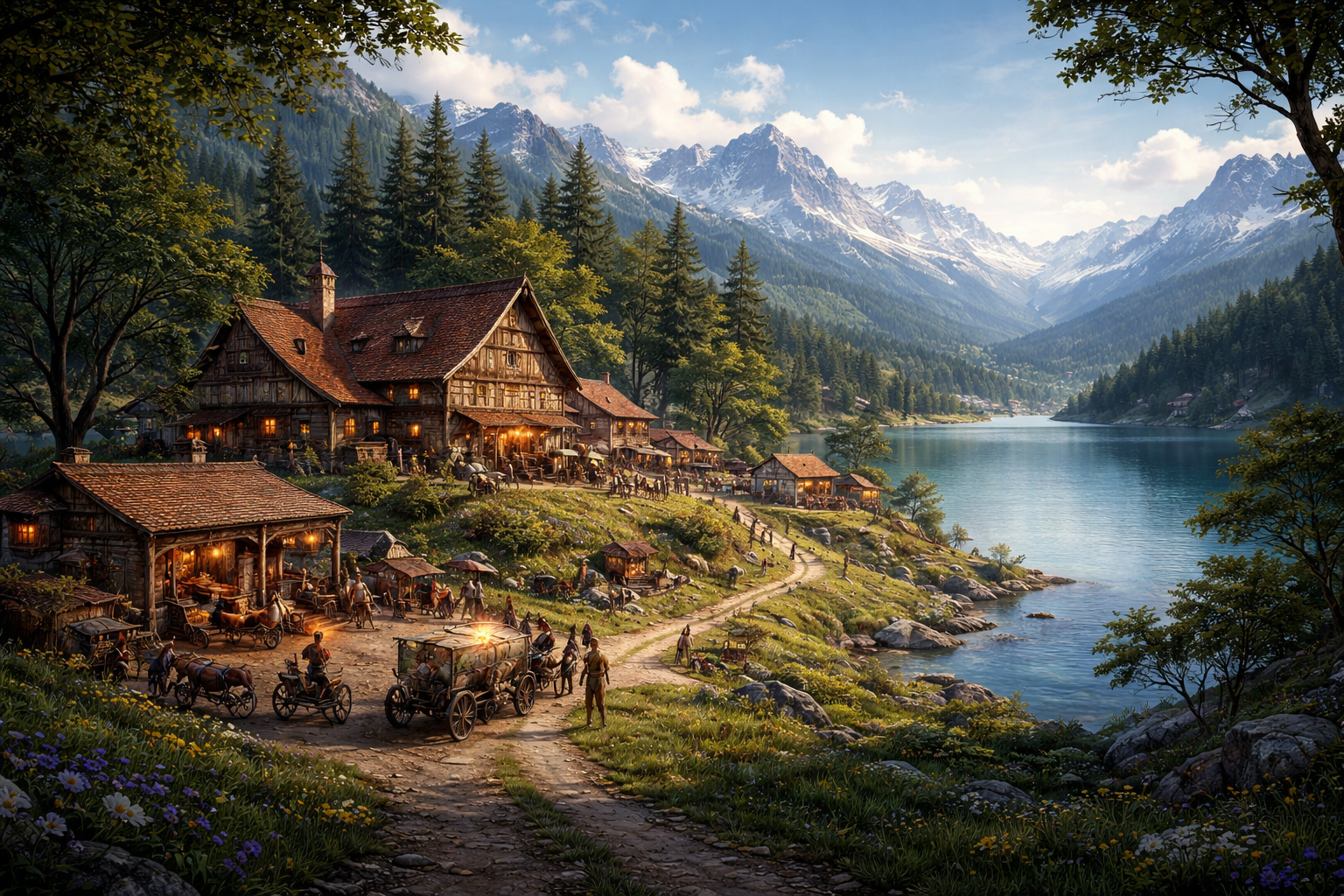
Fayrin’s Rest is a well-traveled waystop along the Southern Trade Road, situated roughly a day’s journey—some twenty miles (32 km)—south of the gondola crossing at the Great Divide. Perched against the gentle rise of a lakeside hill, the settlement overlooks a deep blue expanse of water framed by distant, snow-capped peaks, offering one of the most striking vistas in northern Ilithi. For caravans descending from the Divide or pressing onward toward Shard and the holdings of Steelclaw Clan, Fayrin’s Rest represents more than convenience—it is one of the last truly defensible and reliable refuges before the road begins to skirt the edges of The Verdanian Wilds . Travelers come for the safety, the scenery, and the rare opportunity to rest without fear of what may be watching from the deeper woods beyond.
Despite its reputation, Fayrin’s Rest is not a formal town in the traditional sense, but a loose collection of inns, workshops, and clustered dwellings that have grown organically around the needs of the road. The population is small but steady, composed primarily of humans, elves, and half-elves, with a modest dwarven presence tied to the settlement’s repair and metalworking trades. Governance is informal; while the settlement falls under the authority of Ilithi and, by extension, the Ferdahl, day-to-day affairs are managed locally through mutual agreement and necessity rather than decree. Order is maintained not by law, but by shared interest—those who threaten the stability of the Rest tend not to remain long.
The settlement’s infrastructure reflects its purpose. A prominent inn and stable complex serves as its central hub, supported by smithies, carpenters, and wagonwrights capable of handling the constant wear of long-distance trade. Hospitality is not merely a courtesy here, but a commodity—one shaped by the understanding that most who arrive are far from home and often closer to danger than they would prefer. Yet beneath its welcoming exterior, Fayrin’s Rest carries a quieter, less comfortable truth. The surrounding land, though only lightly forested, bears signs of age and attrition—scattered bones, weathered remnants, and the occasional suggestion that the wilderness nearby does not forget what passes through it. It is a place of rest, certainly—but one that exists in careful balance with the edge of something older, and far less forgiving, just beyond the treeline.
Despite its reputation, Fayrin’s Rest is not a formal town in the traditional sense, but a loose collection of inns, workshops, and clustered dwellings that have grown organically around the needs of the road. The population is small but steady, composed primarily of humans, elves, and half-elves, with a modest dwarven presence tied to the settlement’s repair and metalworking trades. Governance is informal; while the settlement falls under the authority of Ilithi and, by extension, the Ferdahl, day-to-day affairs are managed locally through mutual agreement and necessity rather than decree. Order is maintained not by law, but by shared interest—those who threaten the stability of the Rest tend not to remain long.
The settlement’s infrastructure reflects its purpose. A prominent inn and stable complex serves as its central hub, supported by smithies, carpenters, and wagonwrights capable of handling the constant wear of long-distance trade. Hospitality is not merely a courtesy here, but a commodity—one shaped by the understanding that most who arrive are far from home and often closer to danger than they would prefer. Yet beneath its welcoming exterior, Fayrin’s Rest carries a quieter, less comfortable truth. The surrounding land, though only lightly forested, bears signs of age and attrition—scattered bones, weathered remnants, and the occasional suggestion that the wilderness nearby does not forget what passes through it. It is a place of rest, certainly—but one that exists in careful balance with the edge of something older, and far less forgiving, just beyond the treeline.

Comments