

Darkwatch Tower
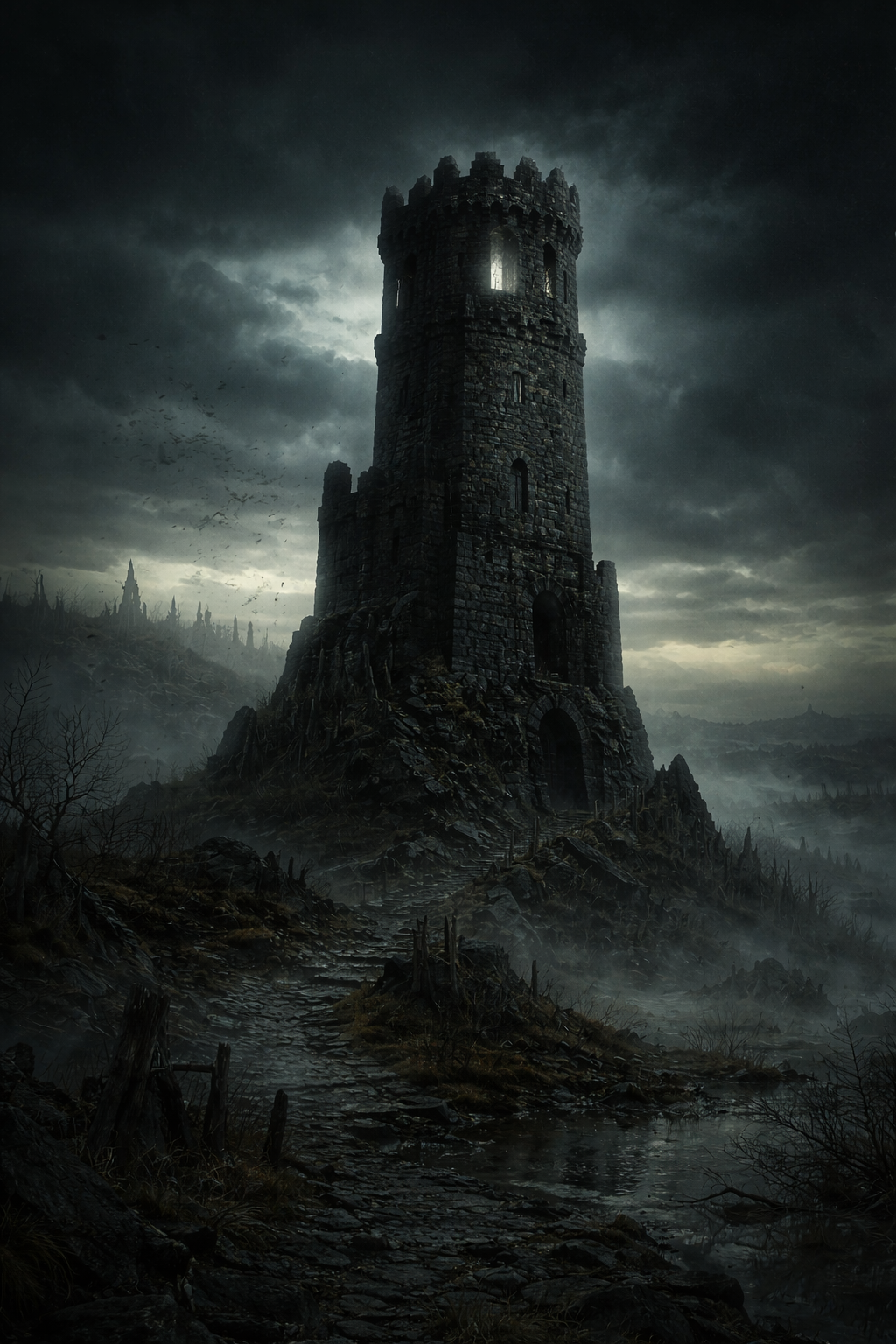
Darkwatch Tower rises from the edge of the Darkmist Moors like a warning left behind and never taken down. Once one of the highest artificial vantage points in Ilithi, the tower was raised to watch for approaching forces during the Lyras War, its height and isolation granting it a clear view across the fog-choked lowlands. From its upper galleries, sentries could once track movement across the Moors and guard a region long believed to conceal passages into deeper, more dangerous reaches beneath the earth.
With the end of the Lyras conflicts, Darkwatch lost its purpose and its garrison. Maintenance ceased, patrols dwindled, and the tower was eventually abandoned to weather and neglect. It was not long after this withdrawal that troubling reports began to surface from nearby villages: unnatural fogs pooling around the tower’s base, sounds echoing from within its hollow chambers, and, most disturbingly, a solitary wail carried across the night. These cries, often described as the voice of the dead, came to be associated with the growing terror of the Darkmist Moors themselves.
Repeated investigations yielded no clear answers. No intruder was found, no spirit conclusively bound, no source of the wailing ever confirmed. Yet the reports did not cease. Over time, Darkwatch Tower became a place avoided by all but the desperate or the foolish. Those who return speak little of what they encountered within its walls, only that the tower feels occupied in ways that defy simple explanation. In Ilithi, it is commonly said that Darkwatch does not forbid entry — it merely ensures that those who enter never leave unchanged.
With the end of the Lyras conflicts, Darkwatch lost its purpose and its garrison. Maintenance ceased, patrols dwindled, and the tower was eventually abandoned to weather and neglect. It was not long after this withdrawal that troubling reports began to surface from nearby villages: unnatural fogs pooling around the tower’s base, sounds echoing from within its hollow chambers, and, most disturbingly, a solitary wail carried across the night. These cries, often described as the voice of the dead, came to be associated with the growing terror of the Darkmist Moors themselves.
Repeated investigations yielded no clear answers. No intruder was found, no spirit conclusively bound, no source of the wailing ever confirmed. Yet the reports did not cease. Over time, Darkwatch Tower became a place avoided by all but the desperate or the foolish. Those who return speak little of what they encountered within its walls, only that the tower feels occupied in ways that defy simple explanation. In Ilithi, it is commonly said that Darkwatch does not forbid entry — it merely ensures that those who enter never leave unchanged.
Purpose / Function
Darkwatch Tower was originally constructed as a forward observation post during the wars of Lyras, intended to serve as both an early warning station and a symbol of vigilance along Ilithi’s most unsettled frontier. Its height allowed sentries to survey the Darkmist Moors in their entirety, tracking troop movements, unnatural activity, and any signs of emergence from the depths below. The tower’s position was deliberate: isolated enough to function independently, yet close enough to established settlements to relay warnings when needed.
Beyond its military role, Darkwatch also functioned as a point of oversight rather than engagement. Records suggest that patrols were instructed to observe and report, not to pursue threats into the Moors themselves. The tower was never heavily fortified, nor was it designed to withstand prolonged assault. Instead, its value lay in presence and awareness — a watchful eye trained on a place that could not be controlled, only monitored.
When the Lyras conflicts ended, Darkwatch’s strategic importance diminished rapidly. The garrison was withdrawn, supply lines were severed, and the tower was left unmanned. Yet the structure itself was never dismantled, nor was it formally decommissioned. Some scholars argue this was simple neglect; others note that even after abandonment, the tower continued to appear in reports, maps, and warnings as though it still served a function no one was willing to name. In Ilithi, there is a persistent belief that Darkwatch was never meant to stop watching — only to stop being watched itself.
Beyond its military role, Darkwatch also functioned as a point of oversight rather than engagement. Records suggest that patrols were instructed to observe and report, not to pursue threats into the Moors themselves. The tower was never heavily fortified, nor was it designed to withstand prolonged assault. Instead, its value lay in presence and awareness — a watchful eye trained on a place that could not be controlled, only monitored.
When the Lyras conflicts ended, Darkwatch’s strategic importance diminished rapidly. The garrison was withdrawn, supply lines were severed, and the tower was left unmanned. Yet the structure itself was never dismantled, nor was it formally decommissioned. Some scholars argue this was simple neglect; others note that even after abandonment, the tower continued to appear in reports, maps, and warnings as though it still served a function no one was willing to name. In Ilithi, there is a persistent belief that Darkwatch was never meant to stop watching — only to stop being watched itself.
Architecture
Darkwatch Tower was constructed from heavy, dark stone quarried locally, much of it volcanic in origin or heavily veined with darker minerals drawn from the surrounding highlands. The masonry is thick and uneven, prioritizing mass and endurance over refinement, with blocks set deep and tight to resist both weather and the slow encroachment of the Moor. Time has dulled the stone to near-black in places, stained by moisture and lichen, giving the tower a perpetually shadowed appearance even in full daylight.
Wooden elements were used sparingly and with clear intent. Internal stairways, support beams, and upper walkways were reinforced with dense, treated timbers, chosen more for resilience than comfort. Much of this wood has long since rotted or collapsed, leaving gaps and broken platforms within the tower’s interior. Where the stone endures, the wood has failed — a fact often cited by scholars as evidence that the tower was never meant to be lived in for long periods, only occupied when duty demanded it.
The tower’s design is stark and utilitarian. Narrow windows and slit-like openings favor outward visibility while admitting little light, and the upper levels remain cold and dim even during the day. There is no ornamentation beyond faint, weather-worn markings thought to have served as range indicators or directional references for watchers above. Darkwatch was not built to inspire loyalty or pride; it was built to stand, to see, and to endure — and in this, at least, it has succeeded.
Wooden elements were used sparingly and with clear intent. Internal stairways, support beams, and upper walkways were reinforced with dense, treated timbers, chosen more for resilience than comfort. Much of this wood has long since rotted or collapsed, leaving gaps and broken platforms within the tower’s interior. Where the stone endures, the wood has failed — a fact often cited by scholars as evidence that the tower was never meant to be lived in for long periods, only occupied when duty demanded it.
The tower’s design is stark and utilitarian. Narrow windows and slit-like openings favor outward visibility while admitting little light, and the upper levels remain cold and dim even during the day. There is no ornamentation beyond faint, weather-worn markings thought to have served as range indicators or directional references for watchers above. Darkwatch was not built to inspire loyalty or pride; it was built to stand, to see, and to endure — and in this, at least, it has succeeded.
Tourism
Darkwatch Tower is not considered a destination in any conventional sense. Its location on the western edge of the Darkmist Moors makes it technically accessible without entering the bog itself, and the roadways west of the Moors allow approach from Shard and nearby settlements. This proximity has led some to regard the tower as a “safe” vantage point from which to observe the Moors without fully committing to their dangers. Such assessments are generally made by those who have never lingered near the tower for long.
Those who travel to Darkwatch do so with purpose rather than curiosity. Ruin hunters, relic seekers, and scholars interested in the wars of Lyras occasionally make the journey, drawn by the tower’s history and its reputation as a place where the past has not entirely loosened its grip. Others arrive for less academic reasons: individuals claiming experience in confronting spirits or investigating supernatural disturbances, often motivated by rumor, personal obsession, or the hope of renown. Few remain longer than a single night.
Among the people of Ilithi, these visitors are viewed with a mixture of suspicion and quiet resignation. Locals rarely attempt to dissuade them outright, knowing such efforts tend to harden resolve rather than soften it. Instead, they offer practical advice — where to camp, when to leave, and what sounds should prompt immediate retreat. It is widely understood that Darkwatch does not reward attention, and that those who treat it as a curiosity rather than a warning seldom return with anything worth the cost of the journey.
Those who travel to Darkwatch do so with purpose rather than curiosity. Ruin hunters, relic seekers, and scholars interested in the wars of Lyras occasionally make the journey, drawn by the tower’s history and its reputation as a place where the past has not entirely loosened its grip. Others arrive for less academic reasons: individuals claiming experience in confronting spirits or investigating supernatural disturbances, often motivated by rumor, personal obsession, or the hope of renown. Few remain longer than a single night.
Among the people of Ilithi, these visitors are viewed with a mixture of suspicion and quiet resignation. Locals rarely attempt to dissuade them outright, knowing such efforts tend to harden resolve rather than soften it. Instead, they offer practical advice — where to camp, when to leave, and what sounds should prompt immediate retreat. It is widely understood that Darkwatch does not reward attention, and that those who treat it as a curiosity rather than a warning seldom return with anything worth the cost of the journey.
"Darkwatch did not feel hostile, which I found far more troubling. There was no screaming, no wailing — I confess I expected it. Instead, there was only a sense of being out of place, and an unmistakable relief when I finally put distance between myself and the tower." - Victoria Pendrake
RUINED STRUCTURE
2AV
2AV
Founding Date
112BD
Type
Tower, Guard
Parent Location
Owner
Ruling/Owning Rank

Comments