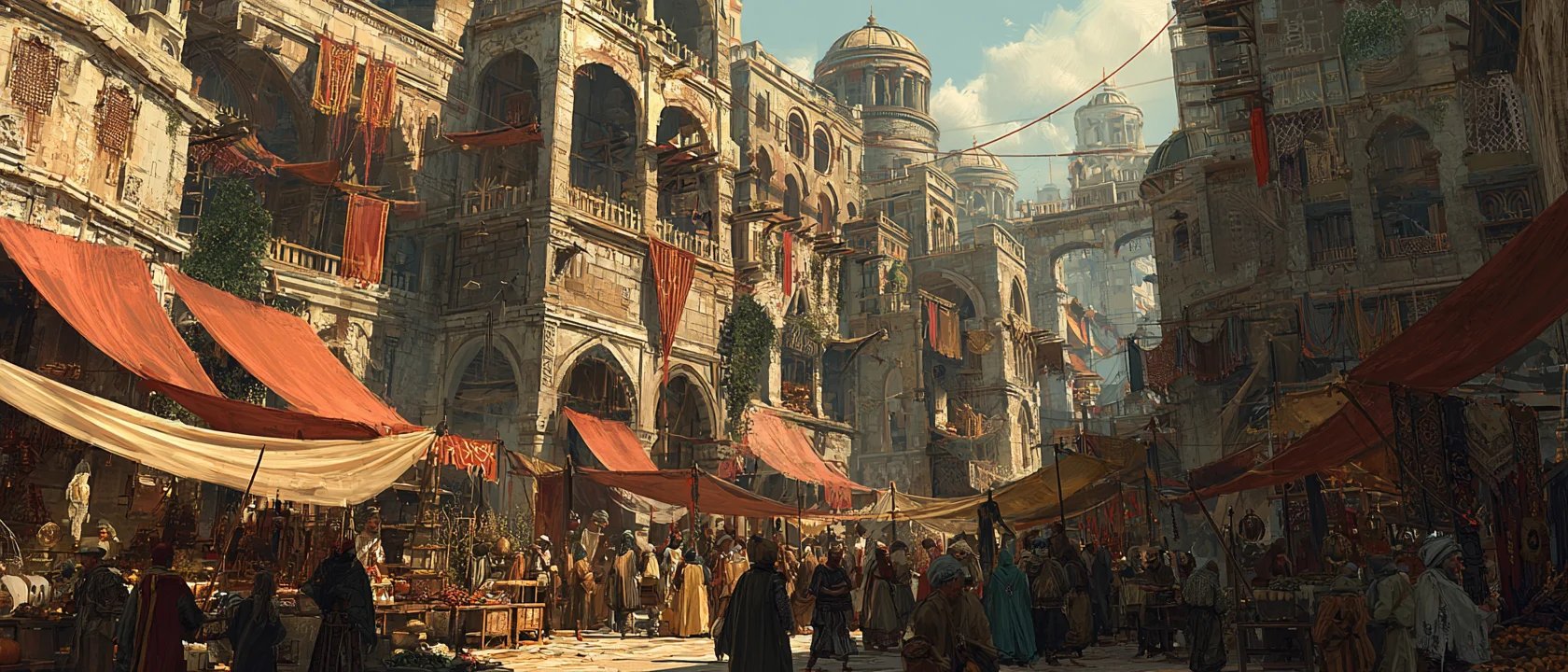
Grand Bazaar
Introduction
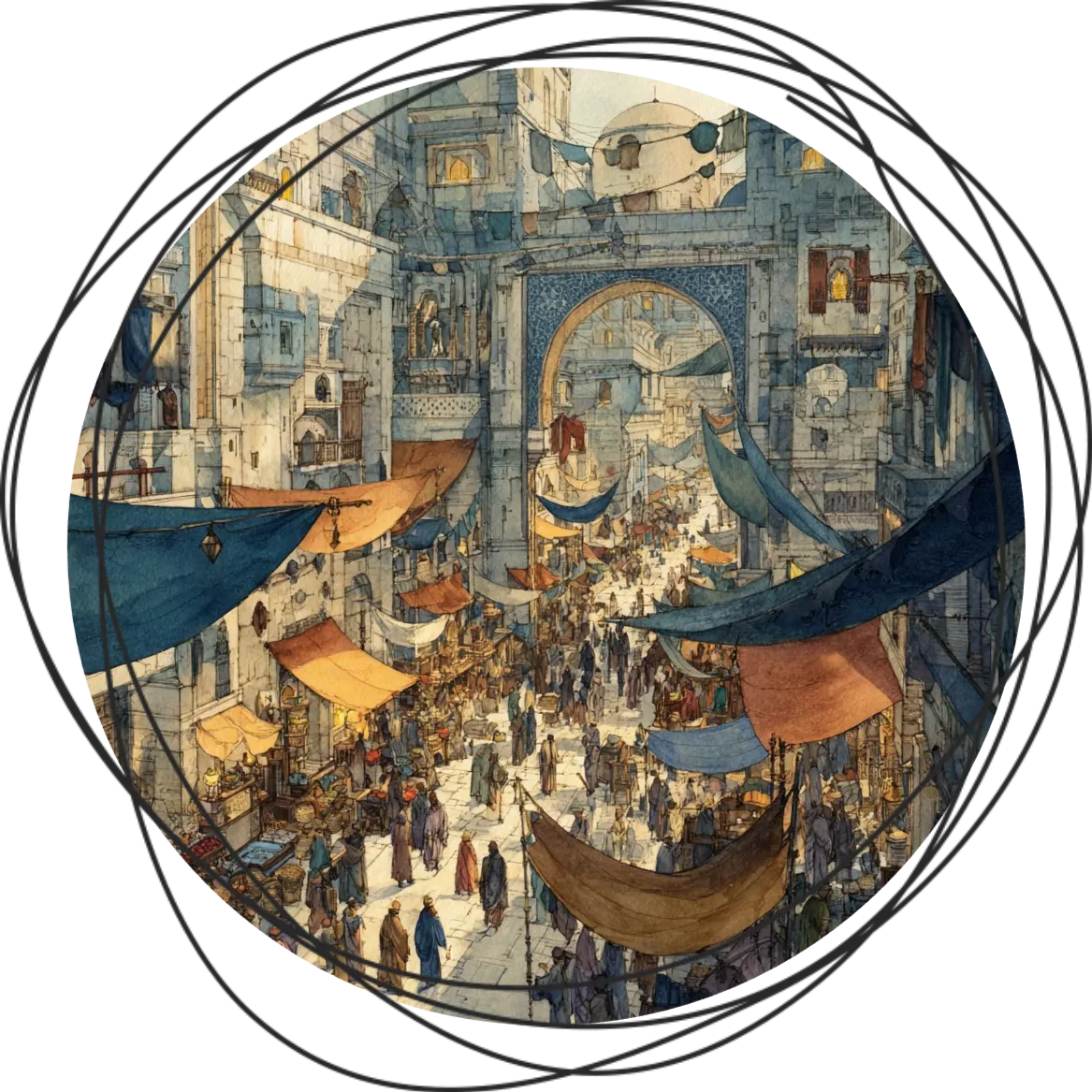
"If you listen closely in the Grand Bazaar, you can hear the city thinking.
Coins argue. Contracts whisper. And somewhere beneath it all, something keeps score.”
You know you have entered the Grand Bazaar district by the sudden density of voices, the press of bodies, the smell of spice and metal and old parchment warming in the sun. Streets narrow into alleys, then open without warning into courtyards. Sound rebounds in strange ways, laughter tangling with bargaining shouts and the measured cadence of guards calling the hour.
Everything in this part of Thandor is in constant motion. Stalls rise and vanish between dawn and dusk. Exotic fabric ripple like sails. Coins change hands so quickly they seem less like currency and more like breath: essential, constantly circulating, never resting for long.
Yet for all its noise, the Bazaar is not chaotic as one might expect.
Movement here follows invisible channels. Merchants know how far their tables may extend. Buyers learn quickly where to linger and where to keep walking. Disputes flare, voices rise, and then stop, abruptly, as if a hand had closed around the moment. Somewhere nearby, someone is always watching.
The heart of Thandor beats here, not in palaces or temples, but in these streets where agreements are made in half-words and glances, where fortunes are assembled piece by careful piece. This is where alliances begin, where rivalries sharpen, where debts are born long before they are named as such.
And like all hearts, it is powerful, tireless… and entirely indifferent to who gets crushed beneath its rhythm.
The Mortimer Shadow
The first thing everyone learns when they step into the Bazaar is who holds authority here. The presence of the Mortimer noble house is found in stamped permits, uniform ledgers, guards who arrive before tempers harden, and clerks who never raise their voices. The Bazaar functions because it is regulated, and it remains profitable because regulation is enforced without exception.
At its head stands Sophronius Mortimer. His name carries weight through the predictability of years of authority. He is rarely seen in the streets he controls, yet merchants obey his rules as sailors obey their captain.
Under Mortimer oversight, theft is rare and open violence rarer still. Disputes seldom escalate, because everyone involved knows who will arbitrate the outcome, and what defiance costs. Justice in the Bazaar is not generous, but it is consistent, and consistency is a luxury most districts cannot afford. In recent years, Sophronius has withdrawn from public life, conducting his affairs from a home within the district rather than the family estate in Silver Arc. Age has bent his frame, but not his mind.
Still, even the most orderly systems slowly wither. As Sophronius steps back from daily decisions, others step closer to the mechanisms of power: clerks with ambition, merchants with influence, nobles with interests carefully hidden behind polite compliance.
The Mortimer shadow remains long.
It simply no longer falls evenly.
Regulations of the Grand Bazaar
- No individual or guild may sell goods within the Bazaar without a valid permit issued by the Mortimer House.
- Permits dictate stall placement; location determines rent and visibility.
- The Mortimer family reserves the right to revoke permits and expel vendors at any time for breach of regulation.
- All commercial transactions must be accompanied by proof of purchase or exchange upon request.
- Private guards may only be employed with written Mortimer approval.
- The Bazaar is jointly patrolled by city watch and Mortimer retainers.
- All commercial disputes within the district fall under Mortimer arbitration.
The Emporium
"If the Bazaar teaches its lessons anywhere, it is here and the rules are simple: be visible, be compliant, and remember you are watched."
At the center of the Grand Bazaar lies the Emporium: a broad, open space where streets converge and trade sheds its subtleties. If the Bazaar has a pulse, it is here: loud, restless, and impossible to ignore. Stalls crowd the square in carefully measured chaos. Tables groan beneath spices, fabrics, tools, charms, weapons, and curiosities whose purpose is not immediately obvious. Merchants shout prices in half a dozen languages, voices rising and falling in practiced rhythms meant to cut through the din. Buyers haggle, argue, laugh, and linger, drawn by the promise that if something exists, it can be found here.
Visibility is the Emporium’s greatest currency.
A stall placed near the central lanes can make a career; one tucked toward the edges survives on scraps and luck. Everyone knows this, and everyone knows who decides where a merchant stands. Permits are checked openly, seals are examined and ledgers consulted constantly. Those who belong are left alone. Those who do not are corrected swiftly.
Unlicensed goods are confiscated and removed behind closed wagons bearing Mortimer markings. Fines are assessed, quietly but thoroughly. The crowd watches without interfering, because the lesson is not meant to entertain; it is meant to be remembered. Few argue. No one argues twice.
Disputes surface daily in the Emporium. A shipment shorted. A gem miscut. A charm that failed at an inopportune moment. Raised voices draw attention, but never escalation. Someone always fetches a clerk. Sometimes a guard arrives first. The outcome is recorded, decided, and enforced before anger can harden into violence.
And so the Emporium endures as the Bazaar’s great equalizer.
Circles of Trade
Places of Display
Closest to the Emporium stand the shops meant to be noticed first; those whose presence reassures visitors that the Grand Bazaar is refined, prosperous, and worthy of its reputation.
The most difficult to ignore is Hungry Munchies.
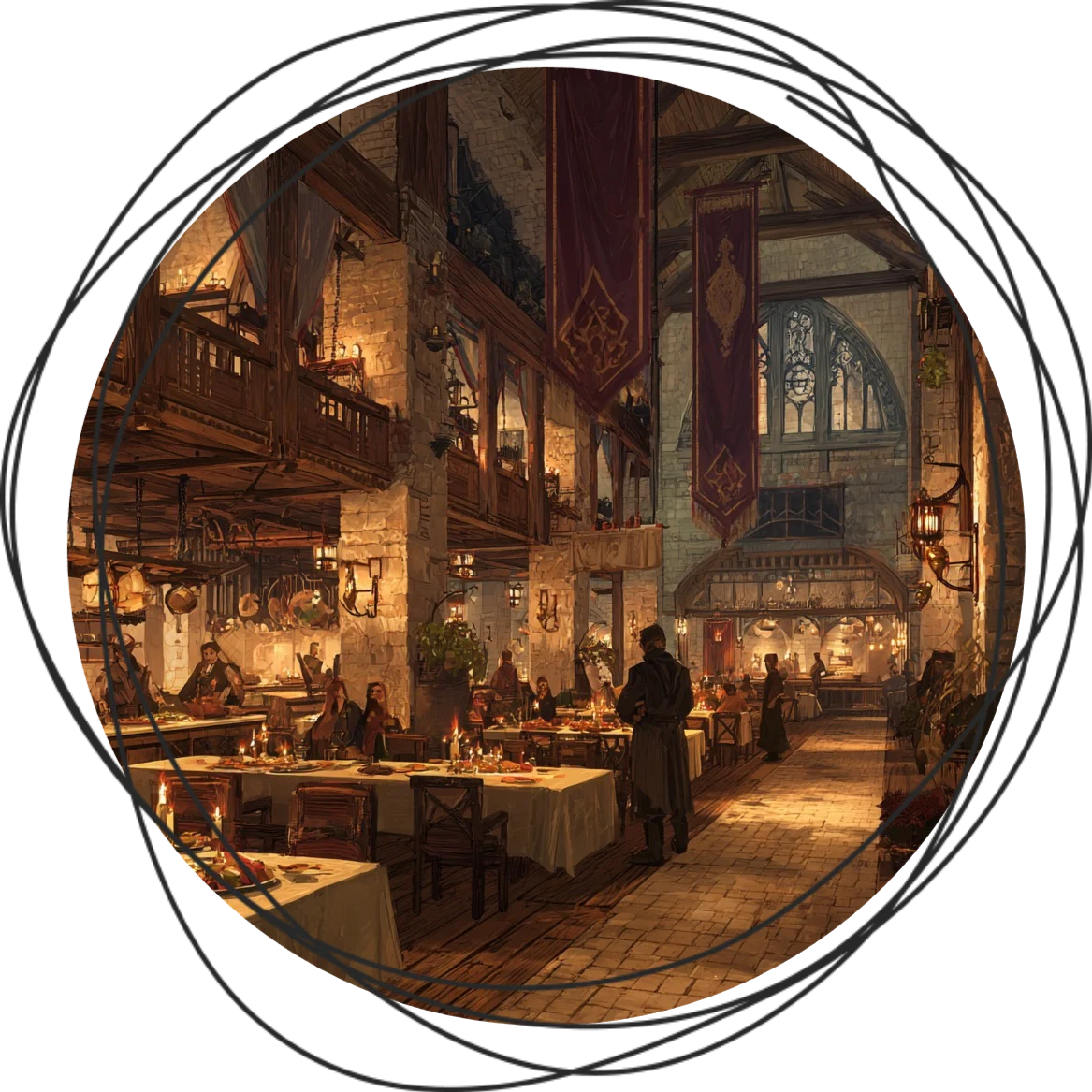
By day, its doors open onto a dining hall dressed in polished wood and warm light. By night, it becomes a place of ceremony: long tables laid for noble guests, private rooms reserved weeks in advance, menus crafted to impress as much as to satisfy. The food is exceptional and the prices unapologetic. Celebrations are hosted here, treaties agreed, and grudges dulled beneath layers of wine and careful hospitality. To dine at Hungry Munchies is to be reminded that the Mortimer family knows how to reward loyalty.
A quieter kind of elegance can be found at Leather Wonders.
The shop is small and its displays restrained: finely worked leathers, fitted cloaks, and masks shaped with unmistakable elven influence. Each piece favors form over bulk and beauty over ostentation. The space feels closer to an atelier than a storefront, its silence broken only by soft conversations. Leather Wonders is well known for providing costumes and masks for the city’s festivals, yet those with experience recognize something more practical in the half-elven owner's craftsmanship. What appears decorative often proves far sturdier than expected.
Steel claims its own dignity at The Last Repose.
The shop is lined wall to wall with weapons; simple in design, immaculate in upkeep. No piece is displayed without purpose, no blade without balance. The air smells of metal, oil, and leather, familiar to soldiers and mercenaries alike. The man behind the counter is Thalos Varn, a former soldier with curious eyes. He listens longer than he speaks. He studies customers before making a recommendation, weighing posture and callused hands as carefully as coin. When he finally speaks, few question his judgment. Warriors linger here longer than intended, hands resting on hilts, conversations drifting toward old battles and hard-earned lessons.
Not far from these stands Lock and Key, positioned where foot traffic is heaviest and first impressions matter most.
Its shelves are packed tightly with adventuring gear of the most basic sort: ropes, torches, bedrolls, rations, climbing tools, and travel kits stacked in careful abundance. Everything is serviceable. Nothing is cheap. The shop benefits from its location, and its prices reflect it without apology. The owner, Mark Avignon, presents himself with the confidence of a man convinced of his own importance. He speaks freely of influence, of connections, of how fortunate the district is to have him. Most customers do not stay long enough to question any of it. They pay, they leave, and only later learn how much convenience truly costs.
Together, these establishments form the Bazaar’s most polished face. They are where nobles stroll without escort, where foreign merchants bring their most valued clients, and where the city chooses to be presented as controlled, cultured, and prosperous. For many visitors, this is the Grand Bazaar they remember.
And it is exactly the one they are meant to see.
Places of Need
Not all trade in the Grand Bazaar seeks attention. Some shops exist for those who already know what they lack, and how little coin they have to acquire it. They serve those who need equipment now, repairs today, coin immediately. Their owners smile easily, bargain quickly, and ask few questions.
The most visible of these is the Lots O’Knots
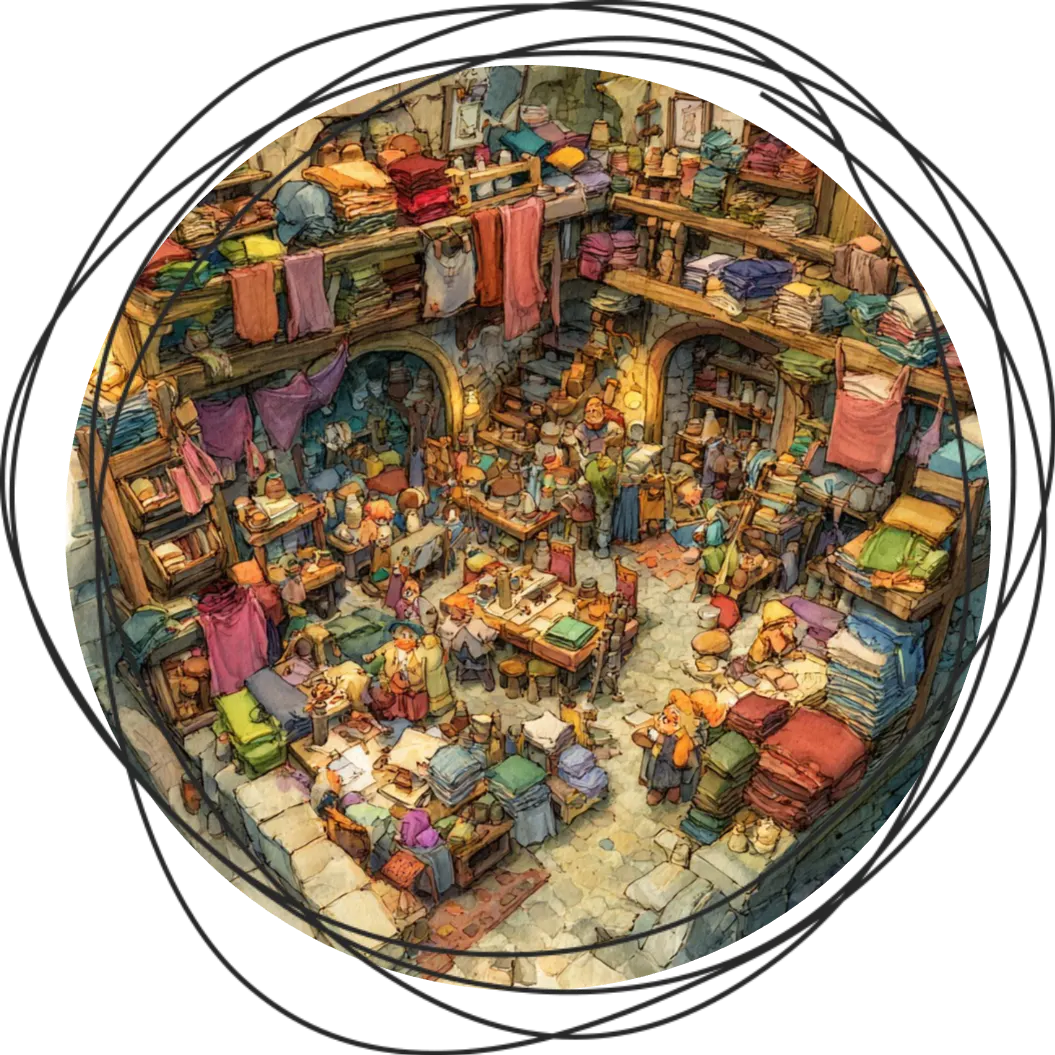
A cluttered, crowded, and tiny place that thrives in motion and the excitement of its halfling owners. Bolts of fabric spill from shelves. Half-finished garments hang beside work clothes and evening wear, all jostling for space. Prices are fair, negotiations brief, and repairs offered with a smile and understanding. This is where workers come to replace worn cloaks and where travelers patch what they cannot afford to lose. The shop feels hurried, but never careless; every stitch here serves a purpose.
Tucked slightly away from the busiest paths is a shop most people pass without noticing, cleverly named You Didn’t Know You Need It!
Its shelves are crowded but welcoming, stocked with everyday gear: cooking tools, travel supplies, small comforts, odd replacements for things long broken. The shop feels lived in, its warmth coming not from polish but from familiarity. The proprietor, Patricia of Brighthollow, greets customers with open cheer and an uncanny instinct for what they are missing. She listens more than she sells, and her suggestions arrive as offhand remarks that turn out, later, to have been exactly right. For those who know the Bazaar well, it is understood that when something small goes wrong - when a strap snaps, a tool is lost, or a journey grows longer than planned - this is the place to start looking.
The air grows heavier near The Dirty Cloak.
From the front, it presents itself as a modest secondhand shop, its racks crowded with used gear and mismatched items sold at tempting discounts. Many pass through simply looking for bargains. Fewer notice the quiet door at the back, or how certain customers are greeted with familiarity and led away from the main floor. Here, goods change hands quickly and at uneven prices. What one person sells in desperation, another acquires as an investment.
Places of Curiosity
Past the clamor of need-driven trade, the Grand Bazaar begins to wander. Shops grow stranger, their purposes less immediately obvious, their owners less inclined to explain themselves. These are the places where visitors slow their pace out of fascination.
Perhaps the most difficult to summarize is The Confused Shop.
Its shelves are a riot of contradictions: neatly arranged alchemical tools beside stacks of mismatched bottles, labeled reagents sharing space with musical instruments, poisons stored alongside tonics and inks. The catfolk owner - a young man named Albert - moves through the clutter with surprising ease, tail flicking as he talks, conversation jumping from subject to subject without warning. He speaks readily of alchemy, offers practical advice in a professional yet aloof way, and sells quality supplies, but pauses oddly when asked personal questions, as though searching for an answer that refuses to surface.
A few streets deeper, color announces the next shop long before its strange sign appears. No one can tell at first what the Which Witch Has the Wich? actual trade is.
The shop spills into the street in fabric, incense smoke, and painted charms. Inside, the space is layered with cushions, hanging beads, and murals that seem to shift depending on where one stands. Three sisters - identical in appearance - receive visitors, their voices overlapping, contradicting, and finishing one another’s sentences. Customers often leave confused, but return later, when events unfold in ways they cannot quite dismiss.
A quieter presence waits at The Mourning Wood.
The shop is dim and narrow, its walls lined with finely worked wooden pieces: furniture, tools, bows, and carvings shaped from rare and exotic woods. Every item bears meticulous craftsmanship. The elven woman who runs the shop works in near silence, her focus unwavering, her skill unquestionable. Customers sense that each piece carries more weight than its price suggests, though few can say why. Those who press for conversation rarely receive it.
Knowledge gathers, finally, at The Golden Quill.
This is the only place in the Bazaar where arcane texts are sold so openly. Shelves of scrolls and books line the walls, their contents carefully catalogued and treated with academic respect rather than mystique. Alexander Brenham, a human mage more interested in theory than conflict, opened the shop to fund his research and avoid the distractions of politics. Day-to-day operations fall to his apprentice, Ilestria, whose sharp eye and quiet competence keep the business running smoothly. Scholars linger here, debates unfolding in hushed tones amid parchment and ink.
These establishments do not shout for attention, but they invite it. Here, the Bazaar offers questions instead of certainty, curiosities instead of solutions. Answers are available, but never complete, and never without consequence.
Places of Wealth
Past the clamor of trade and the lure of curiosity, the Grand Bazaar grows quieter. Here, doors close more often than they open. These are not places meant for wandering: they exist for those who arrive knowing precisely what they seek.
The most imposing among them is Gold Beard’s Vault.
Its marble façade rises with confident solidity, blending dwarven endurance with human ornamentation. Broad steps lead to reinforced double doors banded in metal, their weight felt even before they are touched. Inside, counters are wide, ledgers precise, and coin is weighed with care. The bank is owned by Oratios Goldbeard, a dwarf whose reputation for reliability has made him indispensable to merchants and nobles alike. Loans are offered here with careful restraint, terms set clearly and without flourish. Many claim he is the only lender in Thandor who deals honestly.
Far less visible - but far more mysterious - is The Hoard.
From the street, it presents itself as a jewelry shop of impeccable taste. Necklaces gleam beneath soft light. Rings and brooches rest on velvet cushions, flawless and exorbitantly priced. Only those carrying the proper invitation are ever shown beyond the public displays. Behind locked doors and whispered passwords, rarities change hands: artifacts without provenance, treasures better left unnamed, and goods whose value cannot be measured in gold alone. The shop is owned by Garret Sparklegem, a gnome known for his charm and uncanny ability to recognize opportunity.
These places do not trade in impulse. Coin sleeps behind stone and steel. Debts are recorded in ink meant to outlast generations. Favors are extended carefully, each one carrying weight long after it is spent. In the Grand Bazaar, money flows everywhere.
But here, it ceases to circulate and begins to settle.
Beyond Mortimer Reach

There is a stretch of the Grand Bazaar where the rules thin, not because they are forgotten, but because enforcing them would demand more effort than authority is willing to spend. This place is known as Harvest Moon.
It is a warren of narrow passages where stalls crowd close and frayed canopies nearly touch overhead. Smoke hangs low, carrying the scent of bread, stew, spilled ale, and open flame. Food is sold cheaply and in abundance, called out over laughter and argument. Taverns and modest inns wedge themselves wherever space allows, their doors rarely closed and their floors rarely clean. Music of street artists drifts freely here, uneven and unpolished, carried by heart rather than coin.
Permits does not exist in Harvest Moon and rents are negotiated in quiet corners, if at all. Guards pass through, but do not linger. Authority is informal, and when enforced it is by reputation and mutual dependence. Those who cause trouble are not fined; they simply find no one willing to serve them again.
Order, such as it is, rests in the hands of an outsider and a commoner - a woman named Romilda Yannos. She does not claim title or wear insignia, yet her presence is felt throughout the alleys. Disputes quiet when she appears. People follow Romilda not because she commands them to, but because she stands against the absolute control of the nobility in the district and she simply refuses to step aside.
Harvest Moon feeds laborers who cannot afford polished tables and shelters travelers who arrive too late to be welcomed elsewhere. It offers work, warmth, and drink without asking questions that might demand answers no one here can afford to give. For many, it is the only part of the Bazaar that feels as though it belongs to them.
The Quiet Spaces
Threaded between louder streets and heavier dealings are places shaped for pause; small refuges carved of another era. Here the city allows itself to be observed instead of navigated.
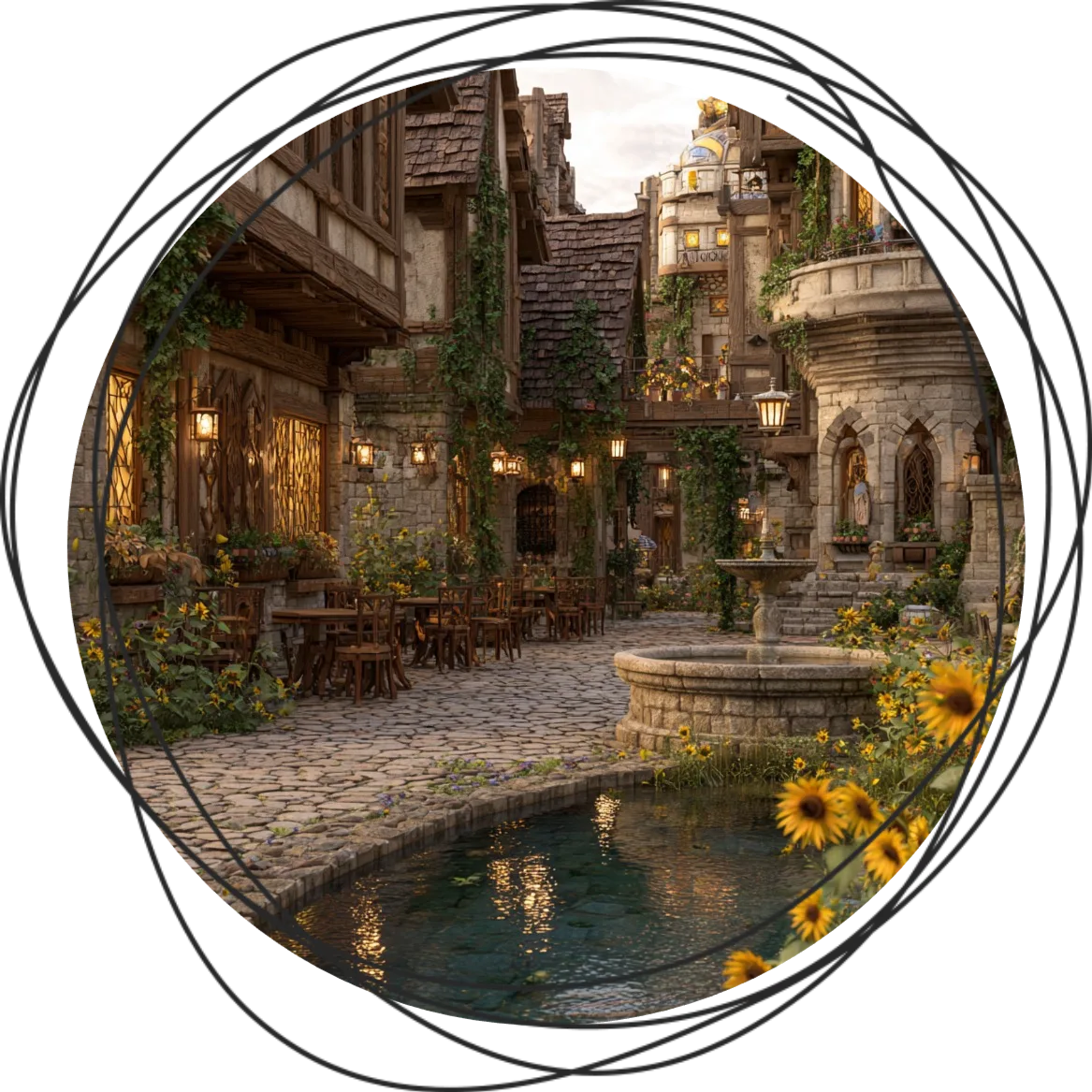
Sunflower Plaza opens suddenly, like a remembered dream. Yellow brick paths wind between low cafés and flower stalls, their warmth deliberate against the surrounding stone. Sunflowers grow in careful rows, their bright faces turning with the light, mirrored by the soft glow of shop windows nearby. At the center, a cistern of crystal-clear water reflects sky and passerby alike, its surface rarely disturbed. Locals linger here with sweet drinks and unhurried conversation, as though the rest of the Bazaar exists at a respectful distance.
Fairytales and myths find their shelter at A Houseful of Stories.
The bookstore is broad and well-appointed, shelves stretching high with volumes both rare and well-worn. Reading chairs invite visitors to sit, and many do. Toward the back, the steady rhythm of a newly acquired press hums behind closed doors. Writers, scholars, and the quietly curious pass through in equal measure. Here, knowledge is is shared, debated, and allowed to grow.
Elsewhere, quieter comforts persist without names or signs: a bench shaded by a climbing vine, a tea shop tucked into a bend in the street, a narrow balcony where one can watch the crowds without being part of them. These spaces exist because even the most tireless heart must rest between beats.
I arrived with a list and enough coin to feel confident. The Bazaar made quick work of both. There was always another street to turn down, another stall that promised something better, cheaper, faster. People spoke to me as if they had been expecting me. When I hesitated, someone else filled the silence. When I lingered, no one asked why. It wasn’t until I stopped moving that I noticed how smoothly the crowd flowed around me. I found what I was looking for. More than once, in fact. It wasn’t until later that I began to wonder which of those things I actually chose.





I need a little more on mourning wood, but I need it full of dirty puns >.>
I don't think they would be any, but I might make an exception for you ^^
Summer Camp is here and so is My pledge! <3
Visit my world of Kena'an for tales of fantasy and magic! Or, if you fancy something darker, Crux Umbra awaits.