

Lutrice
This article is an ongoing work in progress.
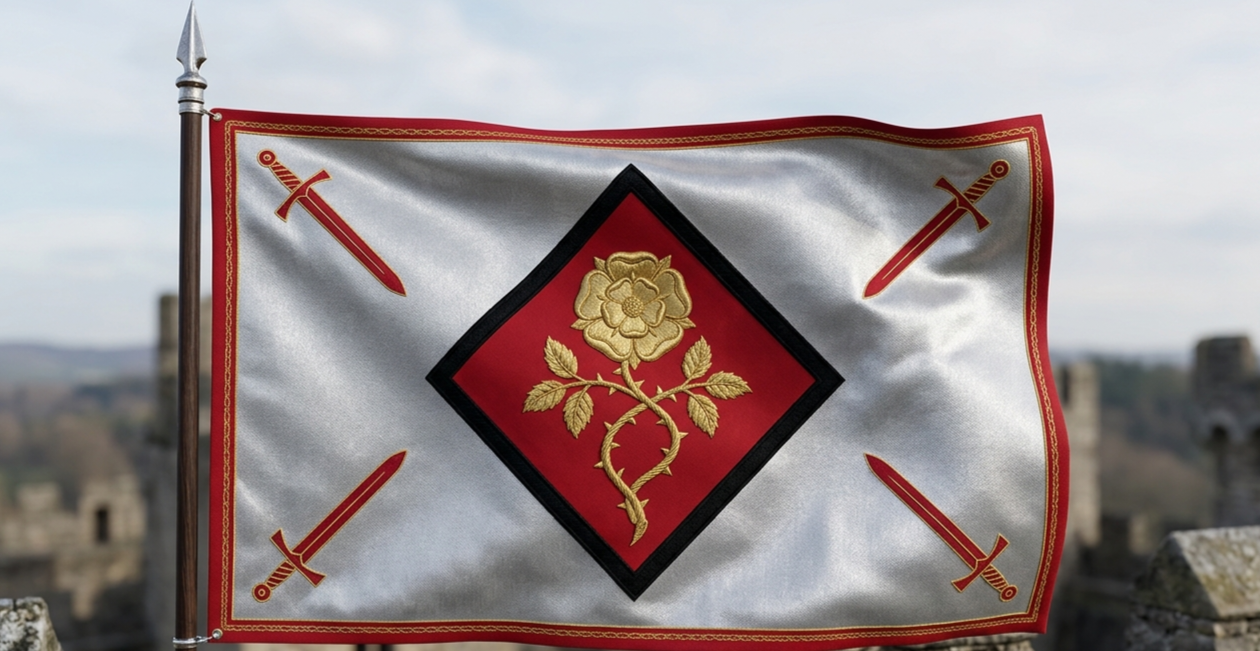
Symbol: Golden Rose within a scarlet diamond on a silver field, four scarlet swords in each corner. Often simplified as a golden rose.
Denonyms: Lutrecian (formal)
Capital: Verdeaux
Overview: Cosmopolitan, educated, and exceptionally powerful, Lutrice is the pinnacle of an increasingly enlightened world. Though they have only recently acquired overseas investments, their Grand Army is second to none in number and wealth, composed of elite troops, conscript fodder, revolutionary use of mageborn, and brilliant tacticians. The Lutrician king and queen, called the Crowned Radients, rule with absolute authority, assisted by the presence of the Tower of Magnificence in the capital, residence of the Most Beneficent High Pontificator of the One Faith.
Structure
Government:
Lutrice is an absolute monarchy with a clearly documented line of succession, formal Articles of Peerage that dictate noble titles and duties, and an organized Imperialist structure of authority for colonies beyond the continent of Ariae. However, titles of nobility are not a determining factor in appointments to the Table Radien, the body of direct advisors to the monarchy. Indeed, only the Crowned Radient or Crowned Radienne may determine the composition of the Table's Chairs, who in turn appoint lesser government officials with royal authority.
Crowned Radients: The absolute monarchs of Lutrice and heads of state. The king is known as the Crowned Radient while the queen is the Crowned Radienne.
Table Radien: The ten chief advisors of the Crowned Radients are known as the "Table Radien," or simply the Table. Each Chair of the Table is appointed by the Crowned Radients.
Premiere: The leader of the Table in the absence of the Radients, the Premiere has legal authority to act in the monarch's stead should both be incapacitated. They are generally the Radients' most trusted peer, mentor, and/or relative.
Signateur: The head of the judiciary, the Signateur holds the royal signets and signatures, formally signs laws, and administers the vast array of judges and legal authorities employed by the State.
Chamberlain: In immediate command of the royal household, the Chamberlain administers the Radients' schedules, palatial staff, state visits, foreign dignitaries, and other nonmilitary personnel.
Seneschal: In immediate command of palatial security, organized hunts, personnel manifests, escorts for foreign dignitaries, and domestic intelligence.
Financier: Responsible for maintaining all royal financial records, approving budgeting, dispensation of State salaries, setting tax rates, lending state money, incuring state debts, and investing state assets.
Marshal of the Grand Army: The Supreme commander of Lutrecian land forces and a primary war advisor.
Admiral of the Fleets: The Supreme commander of Lutrecian sea forces and a primary war advisor.
Captain of the Epines Noir: Head of the personal guard of the Crowned Radient. The Epines Noir are not simply guards, they are an elite cavalry unit equally adept with blades and firearms that can be deployed in war should the need arise. They are also adept at special operations, infiltration, covert operations, and "irregular" tactics. The Captain is therefore a soldier, an information gatherer, a tactician, a spymaster, and one of the closest royal confidantes.
Pontificator Radien: The representative of Purist Clergy within the Table Radien, the Pontificator is the only position not appointed by the Crowned Radients. Instead, they are assigned to the position by the Most Beneficent High Pontificator. Theoretically, they function to provide a moral sensibility to the council's decisions. In events where a vote is required, the Pontificateur Radien casts two votes, one for the Faith, the other for the One God.
Mage Radien: The arcane advisor to the Crowned Radients, the Mage Radien maintains records of known Mageborn, finds those who may be able to aid the State, and deals with mageborn that use their powers to break the nation's laws.
Other Appointed Positions:
Constables (6): The only appointed position that requires approval by both the Crowned Radients and the Pontificateur Radien, Constables are traveling state officials who ensure the landed nobility are meeting their responsibilities to the monarchy.
Viceroys: Responsible for the administration and enforcement of royal authority in large domains beyond the Lutrecian Peninsula.
Governors: Responsible for the administration and enforcement of royal authority in individual colonies.
Inherited Positions:
Landed nobility is responsible for enforcement of laws, collection of taxes, submission of taxes, meeting the summons of the Crowned Radients, military conscription, maintenance of localized military assets, and maintenance of infrastructure within their domains. Administration follows the strict hierarchy ingrained into Lutrecian culture. For example, the Monarchy collects taxes from the Ducs, who collect taxes from the Marquis, who collect taxes from the Comptes, and so forth.
Social Hierarchy:
Monarchy: At the top of the social Hierarchy is the Monarchy, which consists of the Crowned Radients, their heirs, and their direct relatives.
Crowned Radients: The King and Queen of Lutrice, the Crowned Radients are believed to hold the Divine Right of Rule from the One God. Their word is law and their power is absolute. They are each addressed as "Your Radiance".
Peregrine (Heir Apparent): The title given to the royal family member directly in line for the throne should the Crowned Radients die or be found unfit to rule. The Peregrine is always a Prince or Princess. Peregrines are addressed as "Your Brilliance"
Prince/Princess: Title given to all immediate members of the Royal Family, including those not within the line of succession. They are addressed as "Your Lustrousness"
Epines du Sang ("Bloodthorns"): The term for those within the line of succession who are not heir apparent, including cousins, aunts, and uncles. Addressed as "Your Lustrousness"
Clergy: It is debatable whether Lutrice or Renjus incurs more favor with the Purist Hierarchy of the One Faith, though many argue the Seat of the Most Beneficent High Pontificator's location within the city of Verdeaux is a clear answer. Beneath the pomp, the excess, the vitality, and the enlightened philosophies, Lutrice is a Purist State above all other things. So long as they uphold their vows to the One God, the clergy, from the High Pontificators in their golden finery to the lowliest, mud-spattered Teller trudging along a rain-slicked road, hold greater respect and social rights than any save the monarchy. Clergy are exempt from taxes, are legally obligated to be fed and sheltered, may pass anywhere within Lutrice unmolested, and may demand audiences with all save the monarchy with absolute immediacy.
Nobility
Duc/Ducesse: Rules one of the twelve ducdoms of which Lutrice is comprised. Addressed as "Your Grandeur."
Marquis/Marquess: Rules a marque; all ducdoms are divided into two marques, so there are a total of twenty-four marques. The marquises are responsible for conscription of soldiers in times of war and report directly to the Ducs and Ducesses. They are responsible for directly coordinating a census of their domain every five years. Addressed as "Your Mightiness."
Compte/Comptesse: Rules a comptaigne; all marques are divided into three comptaignies for a total of seventy-two. Addressed as "Your Lordship".
Barron/Barronesse: Rules a baronie. During the Age of Unknowing, the vast majority of Lutrice was divided into baronies. Many families retain this title, so there is no set number of baronies within a comptaigne. Indeed, some comptaignes might have many smaller baronies within their borders, while others might only have two. Addressed as "Your Lordship".
Chevalier se la terre: Descended from a knight granted lands in centuries past, chevaliers se la terre often possess a modest manor and a small domain. Many chevaliers continue the martial traditions of their ancestors. Addressed as Sieu, regardless of gender.
Chevalier su Bouclier: One granted entry into the landed nobility (knighted) by a Barron or above. They are often younger children of nobles, soldiers who performed particularly impressive feats of arms, or extremely wealthy merchants with a penchant for bribery. They are required to personally serve at the head of conscripted units of soldiers in times of war and to provide protection for the noble who knighted them in times of peace. Addressed as Sieu, regardless of gender.
Bourgeois:
Bourgeois Vrais: Wealthy coordinators of trade networks, bankers, money lenders, joint stock company owners, investors, industrialized business owners such as wool fullers and cloth dyers, guild masters, shipbuilders, mercenary captains, and other such large-scale employers.
Universitaire: Highly educated experts such as doctors, lawyers, architects, professors, philosophers, and politicians.
Membres: Term for the specialized craftsmen, artisans, artists, and highly skilled workers that are members of trade guilds. Trained mercenaries are considered Membres if they are part of a Mercenary Company.
Peasantry
Landed Peasantry: Peasants granted tracts of fertile land to farm and manage without receiving a noble title.
Free Laborers: Skilled workers who are not members of trade guilds. They are often fairly transient, moving where work is available in their area of expertise and uprooting when it is no longer available for them. Sellswords who are not members of a mercenary company are considered free laborers.
Villeins: Tenant farmers who owe fealty to nobles, villeins are granted shelter and a small field in exchange for working the vast expanses of their lord's land. They are permitted to keep whatever is grown in their field but rarely afforded the time to tend it. They may own property and sell property.
Indentured Servants: In place of a prison sentence, minor criminals like debtors, petty thieves, loiterers, poachers, and tax fraudsters may choose a life as an indentured servant. They are not permitted to legal rights or property ownership, but are assigned to a noble who must provide them with food and shelter in exchange for their total devotion for a specified duration of time.
Mageborn: Despite a fierce devotion to the Purist ideology of the One Faith, Lutrecians are extraordinarily tolerant of Mageborn who use their powers to benefit the state. Indeed, the Crowned Radients include a mage at the Table Radien and the Grand Army employs elite corps of mageborn to devastating effect. However, mageborn who defy the state or use their powers against the general population are swiftly executed.
Culture
Overview
Ethnicities: Lutrecian, Camascon, Thalnean, Calatanian
Literature: Lutrecian literature exists to evoke emotion and create beauty, whether through prose, verse, or subject matter. The most rudimentary literary exercises for Lutrecian authors involve describing something hideous in such a way that it becomes beautiful. Patterns, rhythm, rhyme, and extensive use of figurative language are hallmarks of Lutrecian literature. Themes of courtship, natural beauty, love, and certain levels of philosophy are prominent. There is a sort of countercultural movement as well that involves bawdy humor and scathing satire that is especially popular amongst the growing bourgeoisie.
Fine Art: Like their literature, Lutrecian art is intended to add beauty into the world. There is an elevated exaggeration to it, with heightened color, detail within detail, graceful lines, and an idealized sense of form. Portraiture is wildly unreliable because of this, but Lutrecian portraits are also wildly popular. Lutrecians are perhaps most renowned for their landscapes, which bedeck the walls of nobility and the hearths of the bourgeoisie alike. The frescoes, street art, and mosaics of other cultures are certainly looked down upon - art should not assault architectural form but enhance it.
Fashion: Lutrecians, specifically those from urban powerhouses Verdeaux and Tulis, are renowned for their fashion. Combinations of the various cultural influences within Lutrice have created finely detailed and highly ornate trends. Regardless of social class, women tend to wear fabric that takes up space, from tall, circular collars to wide, swirling dressess. Men wear patterned coats and fitted vests. Everyone wears feathered cocked hats of various degrees of ostentatiousness. The elaborate nature of one's clothing scales directly with social class. The Crowned Radients have ritualized attire for the upper classes, dictating seasonal patterns, color schemes, accouterments, and even hair styles. For example, after Crowned Radienne Isbeau had her hair intricately woven for the birth of a Duc's heir, all noble women began weaving their hair in a similar manner. However, there is also an expectation that one's clothing is an outward embodiment of who they are and this is reflected in the uniqueness of each outfit from the peasantry to the monarchy.
Performing Arts: Lutrecian music shows significant striation according to social class. Peasants are most exposed to traveling bands of folk musicians who earn their keep on tavern stages, town squares, city streets, and seasonal festivals. The Bourgeois attend small performances in cafes, salons, parlors of the wealthiest merchants, and concert halls. Nobility rarely finances mere concerts, as immense dance productions with full orchestras and operatic productions with hundreds of performers hold far more grandeur and prestige. Still, all Lutrecian music seeks to evoke beauty, and musicians compete ferociously to create the sweetest melody or most heart-wrenching harmony.
While theater has held importance in centuries past, the art of acting is often combined with music or dance on Lutrecian stages. Opera is the performing art of choice for the vast majority of the nobility and bourgeoisie, and several competing companies vie for composers, librettists, musicians, performers, and conductors. The Opera Radiant of Verdeaux is among the most spectacular arts centers throughout the whole of Ariae, with nigh-perfect acoustics, baroque decor, and seating for 4,000.
Architecture: As many Lutrecian towns and cities are constructed upon ancient Faen ruins, their architecture holds a certain harmonious aesthetic that is lacking in many other human nations. Most Lutrecian streets and avenues are lined with flowering trees, and public parks are common in urban centers. The spectacular palaces and chateaus of the nobility and monarchy rarely incorporate straight lines or right angles, opting instead for round towers, curved corners, and fluted rooftops. Use of intricate trim, sculpture, and naturalistic, baroque embellishment is common, as is use of mixed materials, bespoke stonework, and precious metal leaf.
Culinary: Lutrice is filled with fertile soil, vast pastoral expanses, verdant forests brimming with life, and exquisite wild game. Regardless of class, food is generally fresh and seasonal, as winters rarely suffer extreme cold and certain crops grow year round. Dairy products, such as cheeses and famously thick creams and butters, are hallmarks of Lutrecian cuisine. The Tulesian honey bee, which thrives in the ducdom of Tulis, is renowned for its intensely sweet and highly soluble honey, making it a top export for its culinary versatility and flavor. Hand-in-hand with a dairy- centric diet, Lutrecian red meat is prized for its flavor and texture. Native herbs factor significantly in cooking as well. Vineyards are plentiful in the north, while cultivation of hops and cereal grains has led to a booming beer and spirits industry in the south.
Lutrecian recipes are stereotypically rich, nutrient dense, and dairy-forward, featuring herbs, flavorful meats, fresh produce, and prominent incorporation of various regional cooking alcohols.
History
The Age of Prophecy
The Age of Unknowing
The Age of Rekindling:
The most recent Ariaenianian nation to establish a presence in the Baravian twenty years ago, the Lutrecians initially intended to use their bases as resupply points for naval forces. However, farms and villages have sprouted around these forts,
Territories
Ariae:
The Lutrecian Peninsula
The Lutrecian Peninsula has a temperate climate, with cooler winters that rarely suffer harsh cold and hot summers that see significant rain. Lutrice proper is divided into twelve Ducdoms, each with their own local character.
Alscatonne - Central River valleys between Deagonie and Tulis
Brimer - Northeastern coast, farmland, Drakespire foothills and border with Renjuguese Imperium.
Camasse - Central Camascon coast
Deagonie - North Central forests. Huge diversity of flora and fauna.
Grisfume - Easternmost ducdom that includes the Lake of Steam. Rolling pastoral hills and arable soil. Borders the Elder Wood.
Hautefort - Southern Camascon coastal cliffs, southern mountains
Monts'e Firroche - Central mountains and river
Olbigue - Landlocked east-central ducdom consisting of fertile land and hundreds of freshwater lakes
Pantheresse - Northwestern Camascon coast.
Radiense - Northern ducdom filled with vineyards and the capital of Verdeaux
Tulis - Southern forests and riverways, lowlands, and some marshes. Ducal seat of Tulis is the nation's second city, situated at the river delta on the Bay of Cir.
Valdonnais - Northern ducdom just east of Radiense. Heavily forested inland with a sandy coast harboring estuaries and salt marshes. Enormous producer.
Rhythen:
The Bruised Coast:
Roche Bleue: A small coastal settlement on the eastern shores of central Rhythen, Roche Bleue is a relatively new settlement. It sits upon a shoreline of blue stone, hence its name. It is hoped that Roche Bleue will establish a strong base of operations for further colonization of Rhythen.
Lyrcia:
The Baravian Sea:
Port Giraut (Colonial Seat): The administrative and military seat of Lutrecian power in the Baravian, Port Giraut is built around the massive chateau of its governor. More medieval in design than many colonial ports, the chateau is surrounded by three curtain walls that contain the more socially upstanding districts. The island itself is thoroughly occupied, and the main thrust of the Royal Fleet lies at berth within the harbor.
Quais Ondules: Unlike the other colonial powers who seek to gain dominion of the Saber Isles by force, the Lutrecians have dispatched diplomatic, exploratory, and religious personnel to gain the favor of locals and forge treaties with the more hostile powers. They are, of course, accompanied by infantry, artillery, and cavalry from the Grand Army, but the nature of the settlement is not inherently militant in nature.
Port Iseault: If Port Giraut is the colonial seat of Lutrice in the Baravian, Port Iseault is its cultural heart. The verdant, resource-rich interior of the island has made the port a bustling final stop before embarking back to Ariae, and law-abiding vessels of all nations are permitted at its docks. Lutrecian culture and the One Faith have permeated the fabric of the growing town. Theaters, art galleries, and meticulously manicured parks line the prosperous streets to the sounds of street musicians. An opera house is currently under construction, and the three towers of a Purist Refuge tower above the rooftops
Bon Chance: A small outpost, Bon Chance watches over a precious resource - a lake fed by fresh cold springs. The island itself was entirely uninhabited upon its discovery, hence its name.
Military
The Grand Army
Sigil: Same as the Lutrecian flag.
Motto: Blood for Honor, Life for the Radients
Base of Operations: Throughout the kingdom.
Equipment: Standard Lutrecian infantry are equipped with a sleeveless purple coat lined with black leather, a mass-produced flintlock musket, a service rapier, black boots, and a black cocked hat. Lutrecians make frequent use of cavalry, and mageborn are frequently used in tactical planning.
Officer Ranks: Like Lutrecian society, the army follows a strict hierarchy. Officers must be born to the nobility, though merit- based promotions are possible if physical valor or strategic aptitude is demonstrated.
Grand Marshal: The overall commander of the entire Grand Army of Lutrice, the Grand Marshal must be of noble birth and is directly appointed by the Radients. The current Grand Marshal is Peregrine Reynault S'Arcaunis.
General: Granted command of ducal divisions, consisting of all levied, conscripted, and noble soldiers mustered from a single ducdom. Generals are nearly always ducs by right. Should a duc be unable to fulfil the role of general due to age or infirmity, the title falls to one of the marques who owes fealty to said duc.
Gendarme: Granted command of a brigade, consisting of all troops mustered from a single marque. Gendarmes are generally marques or comptes and traditionally ride with the heavy cavalry.
Commandante: Granted command of a regiment, which consists of the mixed troops hailing from a single comptaigne. Commandantes are nearly always barrons or their issue.
Capitaine: Granted command of a battalion, consisting of 150 mixed troops from a baronie. More densely populated baronies field multiple battalions, so capitaines are generally barrons or chevaliers.
Lieutenant: Aide and second-in- command to capitaines. Often given command of multiple companies of infantry. Generally chevaliers.
Errant: New inductees to the officer corps. Generally young, inexperienced members of the nobility.
Conscripted Ranks:
Armee: Given command of individual companies of conscripted soldiers. Experienced and battle hardened.
Sergeant: Second to Armees, sergeants often bridge the chain of command between the common soldier and their commanders.
Entre: New conscripted soldiers.
The Radiant Fleets
Sigil: Same as Lutrecian flag, but anchors replace the swords in each corner.
Motto:
Base of Operations:
Vessels: Balance between large man-of-wars and support craft, often with large cargo capacity for transporting Kingdom soldiers and land artillery. Growing merchant fleet.
Ranks:
Naval Forces:
Other
Religion

Comments