
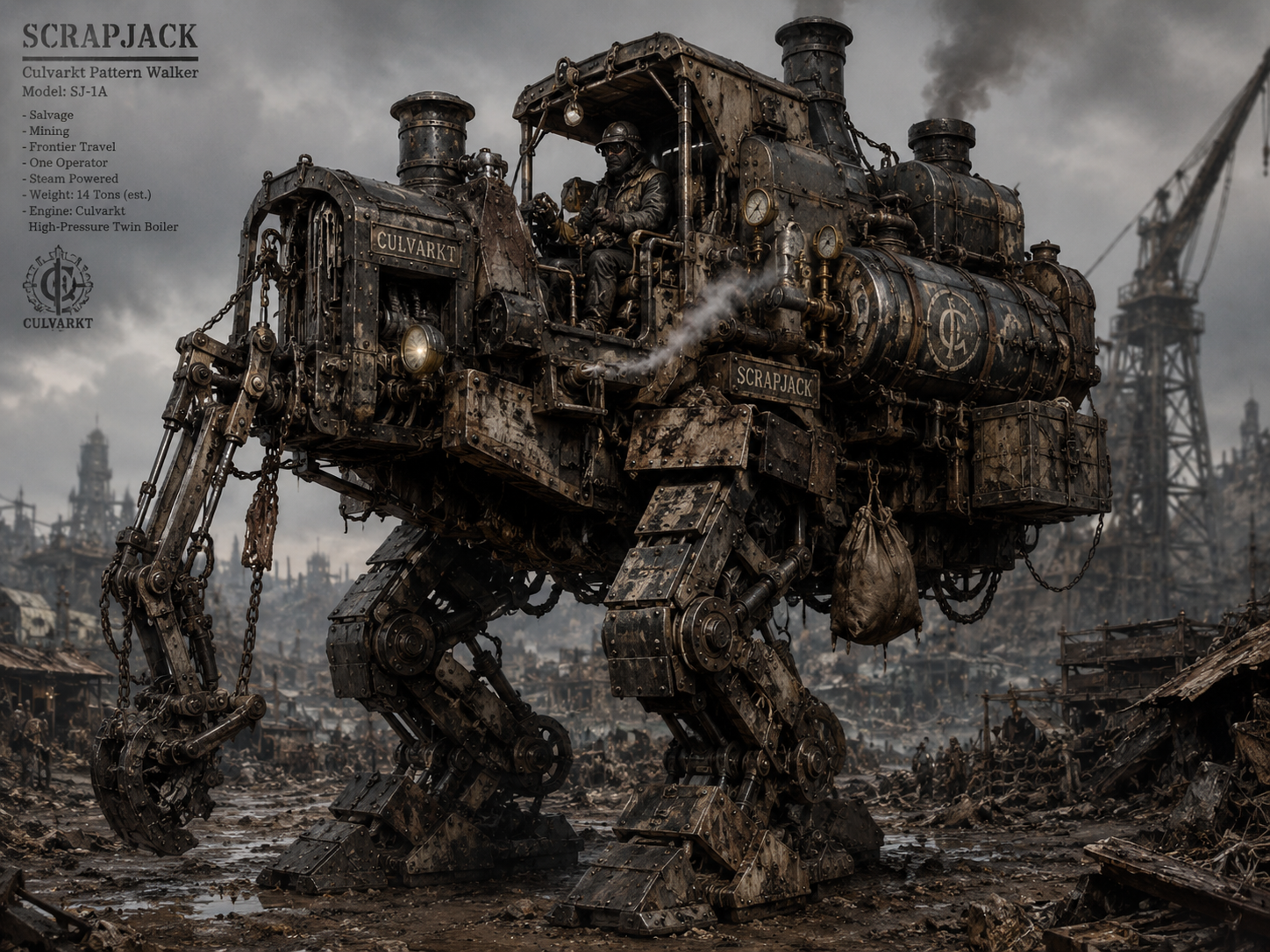
Scrapjack
The Scrapjack is a single-pilot mechanical walker first developed by Culvarkt engineers as a practical answer to broken terrain, salvage work, and dangerous industrial travel. Built from scavenged plates, reinforced joints, repurposed engine parts, and a compact steam drive, it is not fast, elegant, or quiet, but it is remarkably difficult to stop.
Unlike the grander Hammerdrive vehicles that depend on rare compressed Void fuel and Nullmetal components, the Scrapjack is a more rugged and accessible machine, relying on older steam principles and brute mechanical reliability. Its heavy legs allow it to cross rubble, mud, slopes, wreckage fields, and uneven ground that would cripple wheeled vehicles, while its armored frame can endure punishment that would destroy lighter conveyances.
Utility
The Scrapjack is valued for its durability, stability, and ability to cross terrain that would stop most conventional vehicles. It is not designed for speed or comfort, but for survival in places where roads are broken, ground is unstable, and ordinary transport cannot be trusted.
Its primary use is in salvage and recovery work. A Scrapjack can walk through rubble fields, collapsed districts, mining spoil, battlefield debris, and blighted industrial ruins while carrying tools, hauling scrap, or dragging damaged equipment back to safety. Its heavy frame allows it to push through wreckage, brace against shifting ground, and endure impacts that would destroy lighter machines.
In mining and frontier labor, the Scrapjack serves as a walking work platform. Operators use it to cross steep inclines, muddy excavation sites, flooded pits, loose stone, and unstable tunnels. Its slow pace makes it unsuitable for pursuit or travel over long open distances, but its strength and balance make it invaluable in hazardous work zones.
Militarily, the Scrapjack is sometimes used by engineers, sappers, and irregular forces. It can carry supplies under fire, move barricades, cross cratered terrain, recover wounded personnel, or serve as mobile cover in desperate engagements. While it is not a true war machine, its sturdy construction and high damage tolerance make it difficult to disable quickly.
Among poorer crews and remote settlements, the Scrapjack is especially prized because it can be built and repaired from scavenged materials. Unlike more advanced Culvarkt or Becht engines, it does not require rare compressed Void fuel or extensive Nullmetal systems. It is crude, loud, slow, and ugly, but in the right hands, it is one of the most dependable single-person vehicles in Cairne.
Manufacturing
The Scrapjack is usually manufactured less like a formal vehicle and more like a hardened industrial tool. While the original Culvarkt designs came from proper engineering workshops, most Scrapjacks are assembled from scavenged machine parts, damaged boiler housings, salvaged armor plate, mining rig components, locomotive scraps, and repurposed walker joints.
A standard Scrapjack begins with a reinforced central frame built around a compact steam engine. The engine is mounted low in the chassis to improve balance, with pressure lines running into the hip and leg assemblies. These legs are the most difficult part to construct, requiring heavy pistons, locking joints, shock braces, and broad iron feet capable of gripping uneven terrain without sinking too deeply into mud, rubble, or ash.
Most Scrapjacks are built in small batches or one at a time. No two are exactly alike. A mining settlement might produce one from broken lift equipment and boiler plate, while a battlefield engineer might rebuild one from wrecked artillery carriages and locomotive pistons. Culvarkt-made models tend to be sturdier, better balanced, and more reliable, but frontier-built Scrapjacks are often easier to repair because every part was chosen for availability rather than elegance.
Final assembly involves pressure testing, joint calibration, boiler cycling, and repeated balance trials. A poorly built Scrapjack may still walk, but it will lurch, overheat, lock a knee joint, or topple under stress. A well-built Scrapjack moves slowly but steadily, carrying its pilot through broken ground with the stubborn reliability of a walking iron mule.
Social Impact
Among miners, salvagers, rail crews, ruin pickers, and frontier settlements, the Scrapjack has become a trusted tool for work that would otherwise cost lives. It allows a single operator to cross unstable ground, recover heavy materials, move through wreckage, and endure hazardous conditions with a better chance of returning alive. In poorer regions, a functioning Scrapjack can mean the difference between abandoning a site and keeping a community supplied.
Because it can be assembled and repaired from scavenged materials, the Scrapjack has also become a symbol of Culvarkt resilience. It reflects a cultural belief that nothing useful should be wasted, and that survival often depends more on endurance than elegance. Many Scrapjacks are passed between families, crews, or settlements, accumulating replacement parts, dents, charms, clan marks, and personal modifications over years of service.
The machine has also changed the nature of dangerous labor. Jobs once requiring teams of workers, draft animals, or expensive industrial rigs can sometimes be handled by a single trained pilot. This has increased productivity, but it has also placed greater expectations on individual laborers, especially in mines, military recovery crews, and salvage operations where employers may see the machine as protection enough.
Militarily and politically, the Scrapjack is not powerful enough to reshape nations, but it has made small crews more capable and harder to ignore. Bandits, rebels, prospectors, militias, and remote settlements all value them. A Scrapjack gives mobility, protection, and leverage to people who might otherwise have none.
For most common folk, the Scrapjack is not a marvel. It is a hissing, clanking promise that the road does not need to be clear, the bridge does not need to be whole, and the work does not need to be safe. It only needs someone stubborn enough to climb inside and make the machine walk.
The original Scrapjack design is credited to Marceau Bellancourt, a Culvarkt engineer of mixed frontier and workshop reputation whose practical designs were often considered too crude for formal military adoption but too useful to ignore.
The Scrapjack is moderately available, especially in Culvarkt territories, mining settlements, salvage camps, rail yards, and frontier communities.
Factory-built Culvarkt models are expensive but reliable, usually owned by guilds, mining companies, military engineers, or wealthy salvage outfits. Cheaper field-built Scrapjacks are more common, assembled from scavenged machinery and repaired endlessly over years of use.
Because no two Scrapjacks are exactly alike, quality varies wildly. A well-maintained unit is a prized asset. A poorly built one is a walking boiler accident waiting to happen.



Comments