
Morvek
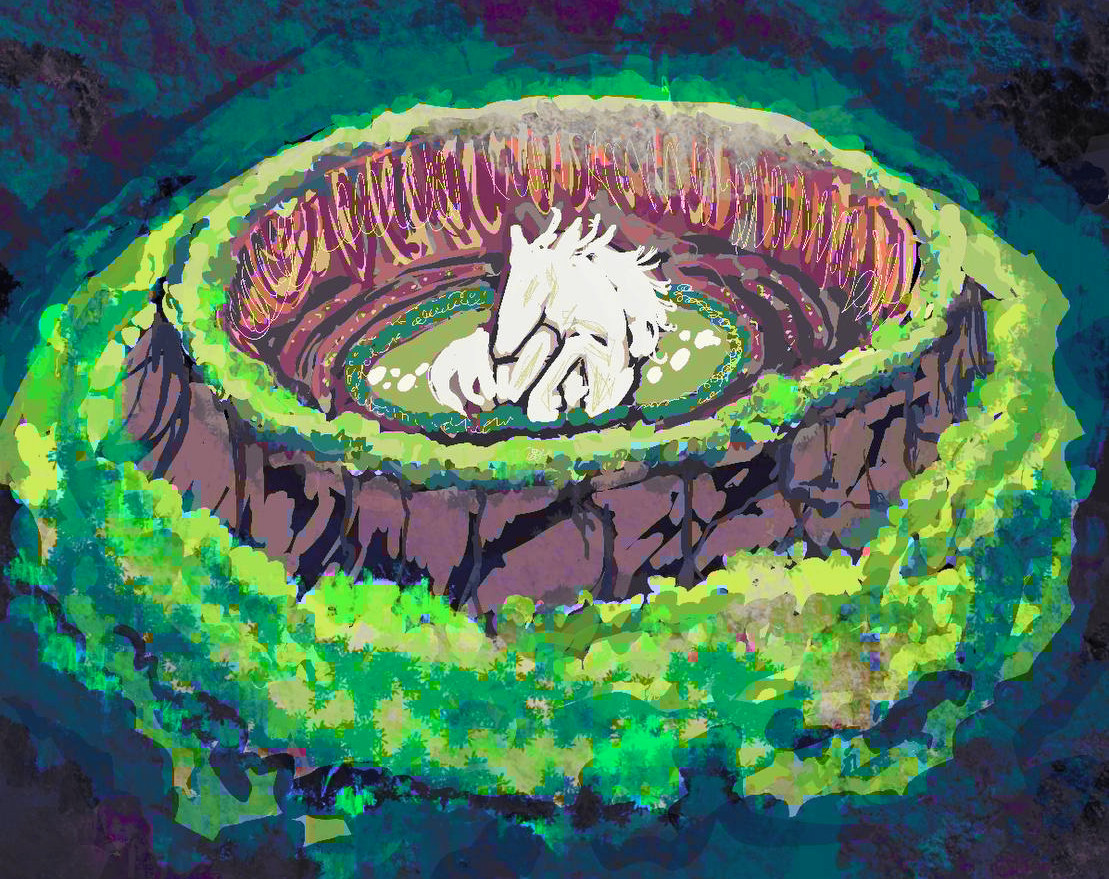
Morvek is a region within the Penumbra, consisting of a crater containing water which is close to the North Pole of the Messenger. It is approximately 9,000 square metres in area, with rocky cliff ridges surrounding a shadowed lake of ice water which is ritually melted for water.
What are your non-earth-like geographical features in your setting?
Morvek is a large crater with deposits of water ice, some of which is completely obscured from the sun. These areas are used by the Umbrians, the caste of people living in the underground lava tunnels, for irrigation and a natural border. It features steep cliffs and for many folks in Morvek almost nothing of the world outside is known, or suspected of existing. Because of Morvek crater's primordial origin, it's believed that the layers of rock and mineral are messages from creator deities.
Outside of the crater walls, there is an area that is somewhat habitable and open for transportation to other crater states such as Orok and Pythos. There is a Halo consisting of a sustaining ecosystem of lichen, fungi, and tundra which is kept going by an assortment of animals. It is forbidden to kill any of these living beings, though they are quite hardy and difficult to overwhelm, the punishment for taking life is to be cast out into the Antumbra under which the Indifferent Sun law will bestow a fate worse than death.
Most of the water remains frozen at the surface, though some is consistently melted enough by the energy of Morvarc'h that the water is liquid all year round, this is used for funerary rites . Much, however, remains as ice and keeps the area at a steady temperature. The reflective surface attracts the Watchers of LUNED, which supply a lot of Morvek's energy.
Morvek is named after Morvarc'h, a giant water horse who after being awakened began to melt from the exertion and exposure to the sun. This caused flooding in the surrounding settlements, drowning or freezing much of the already struggling population. However with the intervention of a Red Hood (a rural oracle-priest), Morvarc'h was saved just prior to death and frozen in permanent ice.
What’s the general “lay of the land” of your active worldbuilding area?
Morvek and the surrounding states are impact craters. Morvek is approximately 110 km deep, and made of a rocky ridge surrounding a lake of ice water. There are no islands in this lake, though there are some reed villages who live in permanant darkness. The lake is almost permanantly frozen in the centre with a large water horse frozen in time rising from it, like an ice-covered statue.
There are several villages and outposts within the crater, some closer to the surface than others. They are built with hermecrete, a concrete-like substance made with planetary debris, but it is common to see them decorated with reeds and bark, or have their own lichen ecosystems within the village. All of the terrestrial flora and fauna are small, though there are some large lake creatures. Most of the main roads are underground, though there are some aboveground roads for neighbourhoods.
At the edge is the aboveground construction for a subterranean monorail which circles the crater, these construction efforts (and old ruins) are now covered by a meadow of lichen and low-growing shrubs, with the occasional tree. These lands surround the edge of the crater for about a mile out before you reach the Antumbra, where it is a desolate and uninhabitable wasteland.
And what is the climate or environment like, in your active worldbuilding area?
While the temperature of the planet fluctuates drastically, the Penumbran states like Morvek have a stable base temperature of -170 degrees. However, energy generated by the Watchers combined with the output of the various inhabitants and machines of Morvek have significantly increased the temperature, using artificial clouds to trap heat. This has led to an island/maritime climate, where there is little seasonal variation but frequent rain from the storm system. The presence of sublimated ammonia in the cloud system causes sunlight to create ghostly halos and phenomena from the constant yet miniscule sunlight. However, there are some cold traps which remain due to imperfections in the cloud system, and being caught in a sudden cold trap and dying of hypothermia is a danger.
There are two seasons - First Sun and Second Sun, each last about 90 earth days, and these seasons make up a solar day on the planet, which lasts about 180 earth days. The temperature and night sky however, does not change much in the Penumbra, and the corresponding species have adapted to this. The seasons are much more volatile due to the exosphere and attempts to control it, with almanacs having to be continuously updated depending on the Sun's behavior. This means that in Penumbra, there is much more of a reliance on the sun's behavior than the planet's orbit for seasons and weather.
Next, What is the ecosystem & habitat like in your active worldbuilding area?
- invasive plants a big issue
- alfalfa/lumenze grass with low groundcover of lichens, moss, and tiny trees
- bees, weevils, aphids, and leaf-hoppers
- spotted knapweed, several species of thistle, nettle
- fruits - alpine strawberry, meadowsweet, microgreens
Immortal hydra plankton, a very common source of food as radiation (glowstone) therapy has allowed them to grow much larger, so they are approximately the size of krill or many crustaceans. It is thought they are a source of health and youth restoring powers, and due to their nature and the lack of face, it is assumed (somewhat ignorantly) that they can't feel pain. They tend to desert areas that are overfished, and overfishing is said to wake Malgwen, Lady of the Lake and the wife of Morvac'h, who can also only be calmed down by a Red Hood.
Finally, what natural resources are found in your active worldbuilding area?
- solar energy
- fish
- plants for terraforming
- woad pigment

Comments