
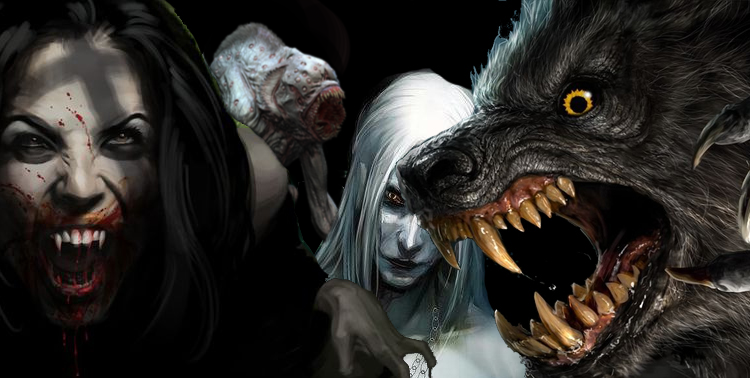
The Plague
"At three signs you shall see the plaguebeast in your midst: First sign: It shuns the light and seeks the dark. Second sign: It hungers for the flesh of those who possess a soul. Third and final sign: Its evil heart is a disgrace upon the Creator and thus he cursed its form to show its malice. If you become aware of a plaguebeast, hesitate not. The true believer does not allow the plaguebeast to live.”.
“The world is dark and full of terrors, yet nothing is more terrifying than the plague. One from our midst, a father, daughter, son or mother, friend or lover taken and turned against us. Most often obvious as in case of the gaunts, wights or shoggoths, yet sometimes veiled as is the case with the vampires and werecreatures , where only the truenight might reveal the evil, and some well hidden, like hags and rakshasas, hunting us from our midst, while hiding their true form with blackest magic. The only thing they have in common is that they almost seem designed to strike fear into us, their former brethren: Fear of the unknown, Fear of the dark, Fear of our very friends. Or are they formed by our fear? Do we need the terror they instil, to keep our society stable? To continue visiting the temples of the creator who promises to protect? Would we have other terrors, if we feared different things?”
“Today Tondak followed the call and went into the darkness through the eastern draughtunnel. Let us mourn him and honor his memory. We Norn lost a great friend and earned a worthy opponent. Share his secrets and his belongings and be prepared when the darkness below disgorges his pale form. He is Draugh now. Continue watch, don’t follow him.”
"Day 60: Subject A does not respond to the dosage. Yesterday was truenight, and neither the injection of fresh saliva into her blood, nor the bloodcontact with it through almost crippling wounds turn her into a werebeast. This seems to confirm my theory that a malevolent will has to stand behind the contagion. One final test remains." "Day 90: Alas, instead of just biting her, the vile werebeast mauled her to death, from which she, regardless of common belief, didn't wake up again. I fear we must find another subject and also a way to control the beast. I sent Curon into town to look for another prostitute. Like this we can cleanse the community of two plagues." Day 120: I have been bitten and i feel the change already. Everything within me wants to rage, tear and feast. But how can this be? I am good. Maker protects the good. So hungry. I need flesh. Curon looks tasty. Just one bite"
Transmission & Vectors
The plague follows in the footsteps of war
Contraction of the plague happens in two different ways: through spontaneous infection and through transmission from other plague infected.
Spontaneous Infection:
Spontaneous infection, the unprovoked breakout of symptoms of the plague, can happen entirely random, a fact which only compounds on the terror the affliction causes, because it means that it can happen to anyone at any time, to loved ones and strangers all the same, leaving no safe, neither beggar nor lord. In the past entire tragedies have been written about this truth, albeit it has to be said that, at least in ballads, the Plague often comes with a knack for karmic judgment. The real Plague shows no such tactfulness or mercy.However some factors seem to affect the probability of spontaneous infections.
First of all, much like an actual plague, the presence of plaguebeasts in the relative vicinity seems to negatively impact the probability at which people become arbitrarily infected by the plague. This is even worse if an abomination, also called a plaguefiend, is present., so a person possessed by a demon from the counterrealm, be it now a Nemesis Fiend or another demon who strives to achieve reality on Ardu. An abomination turns out to be an especially powerful catalyst for the plague., and regions roamed by an abomination express significantly higher numbers of spontaneous plague infections. People do not even need to face the respective plaguebeasts or plaguefiend to become afflicted, just their presence relatively nearby (at around a day's march distance, more in case of an abomination) seems to suffice to enhance the probability of arbitrary infection. This is the reason why both Sentry and Inquisition are tasked to eradicate plaguebeasts as soon as possible, lest the plague begins to reinforce itself, just by the number of plaguebeasts already present in a region.
Second, albeit rarely, intense phases of physical or emotional turmoil, desires of revenge or fear seem to raise the probability of spontaneous infection. This is the reason why it is said, that the plague follows in the footsteps of war, a known catalysts for these kinds of emotions. Appropriately , the stories of victims during these times are often tragic: Already down on their luck and driven to the fringe of despair, the poor affected families then also have to deal with this terror on top of it all.
The transformation into a plaguebeast can happen through spontaneous infection or infection through another plaguebeast (see transmission below). The transformation into a plaguefiend however can only happen through possession by a demon from the counterrealm, be it now a Nemesis Fiend of another demon who desires to achieve reality on Ardu.
It is worth noting that for some expressions of the plague, the spontaneous infection is the only way of infection by which it spreads. Notable here are the expressions of the Elves and Orcs. The gelf suffer a plague expression which can be transmitted, albeit through a very involved vector which is to be discussed in the appropriate section.
Spontaneous Infection (Norn and Sidh)
While Eadun elves, for reasons unknown, suffer the human plague expressions (and can also be infected just like humans), both Norn and Sidh elves spontaneously turn into so called Draugh elves only.Unlike most human plaguebeasts however, Draugh have no way to infect other elves to turn them into another Draugh. The Draugh argue, that this is because affected elves do not actually "succumb to a sickness", rather than that they become vessels for the so called Sidhe Lords, who slowly return nowadays, to banish the humans and claim the world back from them (and from all elves who have lost the cause). Notably, these are supposedly the very same Sidhe Lords, which Eadun elves believe to be their otherworldly ancestors. If this is the reason, why mostly only Norn and Sidh suffer this fate, while Eadun are mostly "spared", is an ongoing discussion. If this claim about the Sidhe Lords was true however, then becoming a Draugh would constitute a form of abomination. For reasons unknown however Draugh do not seem to weaken the fabric of the Veil, as other abominations do. Why this is the case remains mysterious too. Draugh, like all plaguebeasts (and abominations) hate the light and are subject to "the Pull" however, which is why they gather in the underdark, and why they are considered plaguebeasts too. To counter this Draugh claim, that elves do not "suffer" plague infections in the way humans do, but rather "are chosen" to serve as hosts to the Sidhe, This implied immunity of elves against the plague has put water on the mills of all those who argue, that the elves were the ones who created the plague in the first place. The Church even takes it as one of their leading arguments in the case. It is notable that Eadun elves do occasionally turn into Draugh. It happens, but is exceedingly rare.
Spontaneous infection (Orcs)
Much like the Draugh , orcish plaguebeasts, so Hobgoblins and Bugbears, only appear spontaneously. An infection of sorts only happens between a Hobgoblins and the orcs he or she led as an Orog. Even in this case it is something that automatically happens, due to the bond the orcs share with their former orog.As with the Draugh, their receptiveness to the Pull, and their desire to seek out the dark places, is what gives Hobgoblins and Bugbears away as Plague beasts.
Transmission of the plague
There is no single way of transmission which all of the plague expressions follow. Each expression (if it is transmittable) is transmitted in its own, oftentimes unique way. Therefore these different ways are to be described best in the respective subsections regarding the symptoms of each Plague expression. There are however someTruenight and the plague
Almost all ways to transmit human expressions of the plague seem to require the time of Truenight . The bite for example, the most common way of transmission for necroforms, lesser vampires and lycanthropes, must happen between sunset of Truenight and the first light of sunrise the next day to transmit the plague. And even higher forms of plaguebeasts, such as Hags, Elder Terrors, Greater Vampires, all with their more involved and complex ways of transmission,, still must do so during truenight for the infection to take root.Little is known however about the occasional unique plaguebeast, either human or otherwise. And while there has to be a human plaguebeast to be found yet, which does not require Truenight for spreading its infection, this doesn't mean that there couldn't be one. Or a plague expression of any other ancestry, which does require it, for that matter.
Cross infections
Although cross infections are exceedingly rare, they do happen between the different ancestries, provided the respective expression is transmittable (so not with Draugh). If such a Cross infection can succeed however, is so dependent on both the respective plague expression and the ancestry to be infected, that this subject will be handled in the subsections which describe the symptoms of the different expressions.As a common denominator it can be said however, that, regardless of source of infection, no ancestry can fall victim to an expression of another ancestry, meaning that, regardless of source, they always express their own if infected The Eadun are a notable exception, in that they are susceptible to the human plague. Sometimes they do seem to be susceptible to becoming Draughtoo however. As this is an expression which can only be contracted spontaneously however, it can be be said that each ancestry stays true to its expression(s).
Causes
Thus we shall note, that humans fear little more, than the things that dwell in the dark. And yet the True Night seems to be the night, when the Plaguebeast is at it's strongest.
Thus we shall note, that the dreaded Norn fear little, but the idea to be like us, greedy and always scheming, and that we humans might right in our claim on the world. And yet they turn into Draugh, the very epitome of all these fears.
Thus we shall note that a gelf fears little but to be alone and to see his works undone, and yet their plaguebeast is the gremlin whose singular goal it is, to drive a wedge among the family and see a gelfish reputation in shatters and their works crumble.
Thus we shall note that little does a wolven fear more, than to lose control and to bring danger to his tribe and its children, and yet their plaguebeasts are creatures of Rage AND spite, which stop at nothing, especially not the the young ones.
And aren't the plaguebeasts drawn near by fear? Isn't that the most appealing lure? Isn't that the reason why we hide our children on the day of truenight? Why we tell them uplifting stories and half-lies on this darkest of days?
What more do we need to see the light, my fellow colleagues? Isn't fear the thread which connects all these examples? Shouldn't we consider fear as the one enemy we have to banish, if we want to get rid of the plague? What... i dare say... what if we fear not?
Not being afraid has surely never stopped a ghoul from trying to gnaw off my legs...
Why there is a Plague: The Two Theories
It is well known that minor plaguebeasts, like ghouls, lesser Vampires and most lycanthropes, seem to lack a "shadow" in the counterrealm, something which all self aware beings cast there. And even greater plaguebeasts, like Terrors, Hags, Shapewalkers and Greater Vampires, and of course Plaguefiends, seem to need to "develop" a new shadow first, once they succumb to their infection. Which leaves these early stages of development as one of the few times, in which it is possible to magically detect them as what they are.Based on this fact,two major theories arose, which both"explain" the plague. Both of which arguem that the possession of a living being by its own shadow from the counterrealm is deeply related to the plague. However both disagree if this is the cause or a symptom of the Plague.
The Church Thesis
The traditional theory, also called the Church Thesis for it is the Church of the Creator who most strongly purports it, claims that the possession by the shadow in the counterrealm is merely a symptom, not the reason of the Plague. The true Reason, and one which is deeply ingrained in the faith of the Creator, is that the Plague is a punishment for sins and evil thoughts, for people, who have strayed too far from the plan of the Creator. Whereas the virtuous are protected.Once the curse takes hold , the mind of the afflicted opens to the counterrealm, just as the original Plague was intended to do. If nothing would happen, demons from the counterrealm could use this opportunity and possess the infected and create more abominations and weaken the Veil. Yet in his wisdom, the Creator made it so, that the accursed would instead merge with the Shadow they had cast behind the Veil, preventing any further possession. Yet, unable to hide their vile nature any further then, the Plaguebeast would begin to display it, which would turn them into the monsters everyone knows.
The traditional theory puts a great emphasis on the fact, that any infected is accursed BEFORE the merger with their shadow happens, and that it is a boon, that it is this shadow rather than a demon from the counterrealm who would possess the infected, thus preventing the creation of further plaguefiends.
The Church Thesis is the only allowed theory in all regions, where the Church of the Creator is dominant, whereas any other attempt to explain the Pague is considered Heresy. However, since it was the leading model during the Ring Empire it is also known and purported in other regions. While the role of the Creator in this case is usually taken by local deities, the emphasis on the fact that the curse is a punishment for a sinful life remains. Especially in remote regions with strong superstitions this model enjoys great popularity.
A major critique on this theory, oftentimes uttered by advocates of the other major model, the so called "Indifferent Fae" theory, is, that, while this model explains where spontaneous infections come from, it fails to explain infections through other Vectors. Surely one wouldn't assume that those poor souls bitten by Plaguezombie at Truenight are to be called responsible when they too turn into Plaguezombies. The Church Thesis acknowledges this, and claims that plaguebeasts are drawn to infect evil people. Representatives of the "indifferent Fae" theory doubt that and call it a convenient but unfounded claim.
The "Indifferent Fae" Theory
This model was known in the time of the Ring Empire already, although it was considered heretical almost everywhere. Since then it has seen a renaissance in places where the Church is not dominant.it claims that it is the merger of a person with it's shadow in the counterrealm which causes the plague in the first place, thus making it the cause and not just a symptom. The Fae and the Counterrealm are considered rather indifferent actors in this scenario, which couldn't care less for the morality of the infected.
The major perceived drawback of this model, at least according to Traditionalists, is, that it fails to address the Nemesis Fiend of a magicwielder. In case of a Nemesis Fiend, the very shadow of a magicwielder has become a self conscious demon. Now if it was the possession by this demon which creates the plague in the first place, and if the Counterrealm and Fae are so indifferent, then why would a mage not turn into an abomination, every time a plague infection happens? Because that is, what a possession by the nemesis usually results in. Instead it is known, that mages DO very well turn into common plaguebeasts too, like for example if they have been bitten at truenight by a necroform. Why this difference then? The proponents of the "Indifferent Fae "theory claim, that there might be a difference between merging with a Shadow and becoming possessed by it, yet traditionalists consider this humbug. On the other hand though, the Indifferent Fae theory can very well explain the contraction of the plague through bite, without the bitten needing to conform to any preconceptions about their morality.
Be that as it may be, both theories seem to have benefits and drawbacks, leaving it open which one to believe. That is in places where the Church or local religions do not enforce the traditionalist picture or their own ideas.
Albeit remaining the most common explanations, at least among sages, the two theories are of course only a fraction of the explanations which people have come up with for the Plague. Even nowadays superstitions in regard to it are present in many rural areas, and there is no shortage of ruthless miracle healers who claim to have found the ultimate reasons and also working remedies, which can be purchased for just a small fee. Those never work though.
The Role of Fear
People have recognized that fear seems to be a common theme among the plague expressions. The infected turn into those things which they fear most. Furthermore, fear also seems to attract plaguebeasts, which makes children, who haven't yet learned to control their fear, potent lures. On top of this, Plaguebeasts seem to enjoy spreading fear and even deliberately causing it. Quite a few Greater Plaguebeasts seem to literally savor the fear they cause, almost as if they live of it. What the reason is for this behavour eludes the sages, and no conclusive explanation has been foundyet. Nor has it been determined if it is a cause, or a symptom of the infection, and if it was added later or if it was part of the original curse.Symptoms
Each of the different intelligent ancestries on Ardu exhibits different expressions of the Plague and can also only be infected by their "own" expressions. The only ancestry which, for reasons yet unknown, also shows symptoms of the expressions of another ancestry, are the Eadun elves, who rarely ever turn into a Draugh like the Dark Elves, but show the same symptoms which Humans exhibit, once they are infected. If this is due to interbreeding, or cultural factors, is not yet fully understood.
The victims of necroformy first experience unexplained fits of rage and a need for violence, which they enjoy deeply. At the same time, they develop a hunger for the flesh of conscient beings, living or dead. While an infected might hold of that hunger for a few weeks, a constant degradation of their moral reasoning (and partially their mental capabilities) will see to it that they finally succumb to it. At that time, their changing appearance will also inevitably drive them away from the society they came from.
Then, they usually seek out caves, abandoned mines, dungeons or even find ways into the Underdark to protect themselves from the sun, which they despise. Before, on some final truenight , when the transformation is complete, they will leave their subterranean caves, and go on the hunt for the flesh of conscious beings, preferably in the company of other afflicted. Necroforms can feast on carrion flesh, provided the dead were conscious beings once, and thus often infest badly secured graveyards in which they also occupy old tombs. They greatly prefer freshly hunted flesh though, again provided it comes from intelligent beings.
First visible sign of person turning into a necroform is often a loss of hair, and a receding of gums, which bleaks the growing fangs of the infected. Fingers and hands elongate and sprout claws, Horns and thorns sprout from the victims body. The transformation is accompanied by a gain in muscletone and size, and their skin turns greyish blue, greenish pale or whitish purple, giving the infected the misleading appearance of corpses, which led to the name Necroforms.
Depending on the ancestry the infected stem from, they can become different things: Dwarves turn into stocky Gaunts, humans turn into plague zombies, wights, ghouls or drowners. Ice-Giants begin to sprout horns, to increase their already impressive muscletone and size, and turn into so called trolls. Eadun, the only elves who can be affected by necroformy turn into so called wraiths.
The bite of a necroform is infectious only during truenight . Infection furthermore requires two things: First it requires the survival of the victim and secondary the will of the necroform who performed the infectious bite to spread the plague. Due to the instinct driven nature of necroforms, which is result of the moral and oftentimes mental decline that comes with this expression, the second prerequisite is usually a given. It is the first prerequisite which victims may not conform to.
Some Necroforms, leasser as well as greater, have shown a knack for simple magic, mostly of the kind to mislead victims or to protect them from the sun in places which have no natural cover. These abilities are usually instinctual, even though Awakened, Grave Lords and Grave Hags depict a better understanding of the Fae and shouldn't be underestimated.
Drowner, Gaunts, Ghouls, Plague Zombies, Trolls, Wights, Wraiths.
Greater Necroforms:
Awakened, Deep Gaunts, Dire Trolls, Grave Lord / Grave Hag
Just like necroformy, this expression of the Plague begins with the afflicted showing less and less ability to control their rage. Yet, unlike necroformy the change is not accompanied by permanent physical changes or mental degradation. However, at the next truenight , the new monstrous nature finally breaks way, and with force. Once the last light has vanished, the afflicted transform into huge monsters which are half man and half beast, and entirely unable to control themselves.
For the first turning, which always happens during truenight , the afflicted instinctively leave their hometown and seek out the wilderness, probably in an attempt to avoid being witnessed in their transformation. Hence the first victims of lycanthropes are usually those living in the outskirts of a settlement, or the belong to those poor travelers who didn't make it in time to a safe place before the fall of truenight .
Note that, while most lycanthropes do turn back once the truenight is over, often with no or only unclear recollections of the night and the metallic taste of blood in their mouth, not all lycanthropes do that. Some poor souls lose themselves in the rage much like the wolven do when turning into a Ragebeast. However, while some legends claim that lycanthropes are only dangerous during truenight, this couldn't be further from the truth:
All lycanthropes are driven by an insatiable bloodlust even in their human form. A bloodlust which awakes with their first turning, yet which no amount of killing can ever satisfy. They are driven by it, even in the days between the truenights. What changes at truenight is only that their bite might infect another poor soul, and that they can't control the transformation anymore. In the time between the truenights however, lycanthropes might be even more dangerous. During this time they can change their form at will and keep the harmless one for just as long as they need it. While they are terrible unchecked beasts during truenight, In the days between the truenights they operate more like cold blooded serial killers who need a fix.
The most common type of lycanthrope are the werewolves, half man, half wolf, which, despite common superstition, are not related to the race of Wolven in any way. It seems to be the most common werebeast Humans and Eadun turn into. There are others however: Werebears, true monsters of 12 feet size or more, most common in Ice Giant regions, or werebadgers, huge monstrosities able to cut through almost anything with their digging claws and no joking matter at all , especially feared by Dwarves, as they are most often found haunting their caves.
Lost One's, Werewolves, Werebears, Werebadgers, Vukodlak
Greater Lycanthropes:
Greater Lycanthrope
Already relatively rare, and responsible for only 4 percent of all spontaneous infections, vampires also tend to be loners or thrive in small groups only.
Atypical for the plague, one of the first occurring symptoms of the vampiric expression is the perceived death of the infected, leading to many humans erroneously calling Vampire's undead. Actually the metabolism of a vampire changes completely after infection, so much so that the very concepts it worked on during its previous life lose meaning. A vampires body does not need to breath, it does not need a beating heart, albeit most Vampires express so much body control that thex can fake both, if tested. What a vampire needs for sustenance however is the blood and the souls of the living.
A common, recurring scene is a human being struck down by a mysterious illness, finally succumbing to fever and a general weakness. Peace returns to the village, yet after the next truenight the grave is found open: A new vampire is born and it hungers for the blood. More than blood even: The closer truenight draws, the bigger the vampires need to not only drink the blood of conscious beings, but take their life and drink their souls essence, which is the vampires true sustenance. And once the next truenight comes along, the need becomes unbearable and the vampire must follow up on it.
From time to time however, another need creeps into the vampires instincts, one that he can only follow up by not following the primal lust for murder that arises at the dawn of truenight . He sets out to sire new vampires. To do so, he does not consume its victims essence in the end, but rather, once he has taken all its blood, dripping some of his own blood on the victims lips, infecting it and triggering the transformation into a new bloodthirsty vampire which will arise from their deathlike state at the following Truenight.
A hungry vampire seems unhealthily pale, yet a fed one cannot easily be distinguished from a living human, since he can fake all signs of life. Only by attempting a mind journey through the Veil, to see if the vampire still casts a shadow in the counterrealm, can a vampire be detected. However only lesser Vampires, which oftentimes irrevocably transform into a monstrous form anyway, lose their shadow permanently. Like most greater Plaguebeasts, many Vampires regain their Shadow after a time.
Untouched by "life", The vampire also stops aging in the human sense. Its appearance stops to change, and, given nutrition in form of blood, even the worst kind of wound can heal back completely, which allows vampires centuries to exist, if they are not destroyed. Vampires, at least greater ones therefor often use a trick to escape persecution: Once a community is alerted to their presence, they leave, but only after creating a new vampire, who is then "exposed" as a culprit for their former crimes. In the Vampires stead this culprit burns on the Pyre, oftentimes under the mind control of his sire. The village returns to normal, thinking that justice has been served while the Vampire moves on to other places. Only after years, sometimes decades, when nobody even remembers them anymore, the vampire returns and continue to haunt the village.
This, together with the vampiric ability of mind control, make many vampires formidable foes, which are hard to spot, and even harder to track down, except for the most perceptive and strong willed.
Not all Vampires exhibit a humanlike apperance (or elflike if it was an Eadun who fell victim to the Plague). Especially lesser vampires are known to exhibit monstrous traits they can't hide or to fully transform into a monster, although
The power of a vampire comes with a price though, at least for the lesser kind of Vampires: Where most other plaguebeasts only shun the sunlight and suffer minor detriments, lesser vampires have developed a major intolerance to the light of the sun, and will inevitably die, once they are exposed to it for a prolonged time without ability to seek shelter.
Greater Vampires have learned to deal with it, even though the sun still inhibits their powers, However they still prefer not to stay out indoors during the day, whenever possible.
Alps, Revenants, Striga, Strigoi, Leanshee
Greater Vampires: :
Greater Vampire,
There are those plaguebeasts which spread fear and agony and those for which it seems to becomes the very thing that creates them. Although it stands to argue that, in their way all plaguebeasts seem to savor the fear and suffering of their victims, or at least be attratcted to it, almost as if it was something they feast on, there are those for which it becomes an essential part of the transmission.
Terrors often have truly monstrous forms which appear entirley inhuman. Furthermore. the transformation is different for all of them but always grueling. Whereas Vampires, werewolves and even the Necroforms can often easily be identified as once human, it is oftetimes hard, if not impossible, to recognize something human in a terror. At the same time it seems to be the slow transformation into something unnatural which is part of the infection. Those who die during the process, be it out of fear or agony or revulsion or just because they succumb to the wounds caused by the monsters, are just that: Dead. To be consumed by the Terror as food. Those who somehow survive the process however turn inevitably insane and this insanity then invites the plague in, very much like the desperation of a gelf creates a Gremlins. For a terror to procreate it must break the mind of the victim by putting it through a wringer. How it does that is different between all kinds of Terrors, but in the end its always the same. If a victim gives in to fear and insanity, the plague spreads.
The physical characteristics of Terrors often differ wildly and are dependent on the kind of Terror they belong to. There are the terrifying formlessShoggoths, the abhorrent Bies, the Bog who are also called Ogres , but there are also the Tortured One's, poor souls put through enough agony to turn anyone insane. In the end it is not the appearance of a terror which defines it as one, but the things the infected had to go through.
Be that as it may be, the final ingredient of a victim turning into a Terror is theTruenight. Only if the mind of the victim breaks before this night is over, does a new Terror arise. Should Truenight pass, and the victim still sane, then it has beaten the curse and can only serve as food for the Terror. Or wait for the This is why Terrors often intensify their attempts
Ogre, Mares, Shoggoths, Tortured One's
Greater Terrors::
Formless One's, Bog
Rakshasas do not suffer any detriment from sunlight, and their shapeshifting ability allows them to appear completely normal, yet also as beings of stunning and seductive beauty. In one moment they may appear as a poor child, in the next as a wise old man, or that cat who lounges next to the fireplace.
Of all plague infections, the infection of a hag or shapewalker may be the most insidious, because, before the physical change sets in, the psychological transformation is already complete. One truenight the hag or rakshasa awakes fully aware of what they have become, thinking nothing of the growing urge to eat the flesh of conscious beings or their desire to corrupt people and to make their nearby end as physically and emotionally painful as possible. Once they decide to follow up on it, and devour their first victims, which are almost always the former loved ones of the infected, their bodies change too. From that moment on though, fully aware of their power, they easily hide their real form with their innate shapechanging abilities.
Unlike other human plague expressions, there does not seem to be a lesser form of Rakshasas. All Hags and Shapewalkers are of the Greater Kind, meaning that, even though they lose their shadow in the counterrealm when they are created, they can reform another over time. Also there has yet to be a Hag or Rakshasa to be witnessed, who is not the utmost paradigm of deceitfulness. Furthermore, like other plaguebeasts, hags and Shapewalkers feel the call of truenight , urging them to commit heinous acts of sadism and bloodshed. But they can consciously decide not to act up on it, in order to escape detection. They do so only if necessary of course.
Every Rakshasa has a close connection to the Fae, making them natural magicwielders. This led to the misguided term witches, at least for their female kind, a term usually reserved for those heretical women who serve demons from the counterrealm or even lay with them, for the promise of magical power. This is nothing a Hag needs to do.
Only two out of a hundred spontaneous infections by the Plague turn out to be rakshasas. And the shapechangers like it that way, because they are loners and controlfreaks. It is said that no place could hold more than three hags at the same time, a fact which led to the "Crone, Mother, Maiden" superstition common in many rural parts of the world. However, even then it is an inconvenience and there is little trust among the Rakshasa. These "covens" exist, and can just as well contain male Rakshasas, yet they are always a relationship of convenience and similar goals, easy to be discarded if they are not needed anymore. Because, as it behooves a creature of deceit, neither Hag nor Shapewalker ever trust anyone. Much like Gremlins, rakshasa's see even their own kin as obstacles at best and as rivals for the control of a certain area at worst.
Nevertheless, despite this distrust of other rakshasas, one truenight all rakshasas will inevitably succumb to the need to infect another soul, in a process which of all might be the most emotionally crushing among all plaguebeasts, and a true testament to the sadistic and evil nature of these creatures.
To infect another being they need to have sexual intercourse with an unwitting victim. During the process they plant some of their corrupting essence in its body, before revealing their true form to it, which triggers the change, but at the same time renders the victim unable to speak about what is happening to him (or her). Up until truenight the given essence takes control of the victims body. It prevents the grace of a death by their own hand, all while it whispers what atrocities it plans to do with the loved one's of the victim, once truenight comes along. Meanwhile the poor victim is helpless to do anything about it.
Taking sustenance from the emotional pain that this dilemma creates, the essence grows, until, at the next truenight , it "hatches" and then follows up on all its promises, crushing the soul of the victim with its own feelings of guilt, before finally devouring it and taking over the body,
-
Greater Rakshasas:
Raksahasa
The Draugh expression of the Plague seems to work quite differently than any of the expressions of other ancestries. First of all, a Draugh cannot infect another elf, or any other being, with the plague. It is non contagious and spreads through spontaneous infection only and only to elves. At the same time, the change in appearance and behavior after an infection is also much less dramatic and horrifying compared to what it is with many other plaguebeasts. Instead of a tragic story that oftentimes involves senseless violence from the infected, an infected Elf will one day just decide to leave their brethren and follow something that the elves only know as "The Call", a desperate and urgent feeling, that lures them deep into the underdark, where, over time their skin and hair bleach out until they are stark white, while their irises turn red.
It is not that Draugh are not violent, they are, but the violence is always calculated, and part of a greater ploy. What Draugh seem to lack in taste for needless violence, they more than make up with their superiority complex and lack of compassion for all other beings.
All Draugh consider themselves the crown of all elves, and in a mockery of the Eadun faith, they believe that they are Aes Sidhe from beyond the Veil who are forced to possess he bodies of mortal elves, but who are destined to rule the world and to finish what the Sidhe Lords of old once attempted: to take the world from the seedborn. The Draugh use this to also explain the constant struggle for power and scheming and intrigues among themselves: It is but a shadow of the constant struggle and scheming at the Sidhe Courts from which they hail. The culture of Draugh in the underdark is hence often a mockery of the Sidhe courts as the Eadun imagine them: A society where might makes right, and which is full of falsehood and constant struggle for domination.
The Draugh believe, that the plague and the desire to seek the darkness that comes with it, was created by the humans to banish all things to the underdark, which dare to come back through the Veil. They argue that the Draugh resentment of the light will end, once all Seedborn are gone. All Draugh hence harbor a deep resentment for any seedborn life.
Unlike the plague expressions of humans, gnomes and wolven, there is no way of "transmission". The only way to become draugh is spontaneous infection. While on the surface,this should lead to a lot less infected, elves, at least Norn and Sidh elves, are a lot more often affected by spontaneous infection than humans, with the norn being affected most. Today every twentieth Nornelf will become a draugh one day. Sidh turn at the much lesser rate of only three percent of their population, which is still a major increase compared to how often humans and eadun elves are afflicted by the plague however.
Like Lycanthropes at truenight , these beasts are embodied rage and bloodlust. Unlike them however, just like necroforms, their transformation never stops. Yet, while necroforms keep at least a little drive of self preservation, and are capable of implementing basic tactics and strategy, a Rage Horror is unending rage without sense and purpose. Equipped with increased self healing, a strength that outmatches even trolls, extremely quick reflexes and enhanced senses, these things are very hard to kill. Once a wolven turns into one of these, its usually up to the entire pack, and sometimes even the tribe, to stop it. Not all packs survive this.
The transmission of "rage" is insidious and not at all physical, like the bite of necroforms or werebeasts for example, even if a bite from them on truenight might turn a wolven into a Rage Horror. However contracting the plague from a Rage Horror is psychological, and also, unlike human expressions does not seem to require Truenight:
If those who fight the Rage Horror, become carried away by the heat of the fight and give in to their own rage, then they become infected. The wolven have found a technical solution to this problem: They counter it by drinking a tea called "Sira's Peace" which contains Cryst before fighting Rage Horrors, a potent potion which helps them suppress their own rage and other emotions, and which has found some use and praise also outside wolven territories as a powerful sedative. If Wolven have no access to this tea, but have to face a Rage Horror, they try to becalm themselves by entering a state of cold fury, much like the one they experience when someone threatens a child.
Besides the physical change there is a psychological shift even more feared by the gnomes and goblins: The urge to destroy structures, be it social, technical or psychological. Humans sometimes mix up Gremlins and Goblins, because of the appearance of Goblins with their sharp teeth, big eyes and green skin, and also because of their mischievous nature, yet there is a distinct difference: Goblins, even though warlike, and a plague upon many swathes of land, value their tribe, share a faith, and are, despite all claims of pillaged farmers, able of kindness... Gremlins... are not. They are the embodiment of chaotic evil, seeking destruction of structures and people for their own joy, and are utter psychopaths, which, just like hags, take joy from the emotional and physical pain they create. Unlike hags and rakshasas, which, in order to protect their hunting grounds, only despise the presence of other hags and rakshasas, Gremlins are utterly unable to endure the presence of any other soulbearing creature, without the urge to make it suffer, not even another Gremlin.
Yet they also think that every other being shares the same mindset, so they are utterly paranoid, convinced that everything out there is out to get them, just for the fun of it. A trait which makes them very hard to catch. They often haunt the outskirts of settlements, despising its inhabitants with every fiber of their heart, and plotting how to bring it down by actions which don't betray their presence.
Like with the wolven, the transmission of the plague from a gremlin to another gnome is more a psychological transmission, rather than a physical. From time to time a gremlin will have an especially strong aversion against another gnome. Gremlins hate all thinking beings with each fiber of their body, and want them to suffer, but they do not mind if they die due to their schemes. There are always more to torment, and why waste tears for that worthless scum which would do the same to you if they had the chance?
But sometimes there are gnomes or goblins which just deserve to suffer. Really suffer. And it should never end. Death would be too sweet of a release for them. With these gnomes the gremlin is especially careful. His tricks and schemes become more refined, less inclined to kill and more to cause despair. The poor gnomes who are subject to their terror often do not even realize that they have caught the attention of a gremlin, and slowly witness how their lives turn horrible, how loved ones die and everything for which the gnome has ever worked crumble to dust. Step after step the gremlin tries to dismantle the gnomes composure, his or her self esteem and his inner peace, until, finally, the gnome breaks, unknowingly succumbing to the plague and turning into another gremlin which hates each and everything. This is often a process of months and years in which the whole attention of the gremlin is transfixed on this other gnome, who can only be saved if the gremlin can be killed, before the terrible deed is done.
A Hobgoblins has nothing to do with the goblins, but is a plague infected Orog, and as such belonged to the orcish leaderhip caste before his transformation. Bugbears, in contrast, stem from the ranks of the common orcs. This led to the myth that orcs, just like humans have more than one plague expression, while actually the difference is already present in the orcish biology to begin with.
Once the Plague takes hold in an orc, the respective orc begins to feel an ever growing need to escape the light of the sun, and feels a pull that draws him underground, oftentimes into the Underdark if possible, or at least nearby caves. This dirive is not not unlike the subconcious need which drives prospective Draugh. Following this need triggers a slow transformation into either a hobgoblin, if he had been an orog or a bugbear, if he had been a common orc.
By nature of the orcish powerstructure and psyche, Hobgoblins threaten to take all those lesser orcs with them, which they led when they were still orogs, and which will also, likely due to their connection to the Hobgoblin fall for the plague over time and turn into bugbears.
The orogs of a tribe are thus very cautious about signs, which betray a plague infection of one of them. Where in case of bugbears the loss of another common orc is barely even mentionable, an emerging Hobgoblin threatens not only himself, but the clout of an entire mob. Orogs which show signs of plague infection, imaginary or not, are therefore hunted by the other orogs, and constantly challenged for the leadership of their orcs. This practice has led to orogs hiding any weakness with respect to the sunlight, and, once they understand that they carry the plague, to even leaving the tribe behind before the plague takes hold fully, taking with them their following of orcs. Which in turn made the orcs even more attentive and paranoid, with one of the results of this "armsrace" being demonstrative sunstaring contests during the midday sun, and other, less well informed attempts which are based more in superstition, like the enforced practice of explicit daily displays of honor and sportsmanship, because "all hobgoblins are dishonorable".
If they still have "their" orcs, Hobgoblins inevitably become a kind of king or queen of their little tribe of bugbears or soon-to-be bugbears. They send them on raids towards the surface regularly after nightfall, to gather resources, food, or to abduct orcish or other prospective mates, such that the Hobgoblin king can further the continuance of his tribe. Because Hobgoblins and bugbears like to feast on the flesh of the intelligent and self aware, sometimes the abducted even serve two purposes.
It is known that Draugh sometimes choose a Hobgoblin King or Queen as mate, if they happen to cross each others path in the underdark. To the Draugh this is a move for power mostly, as it provides them with muscle in their constant schemes against their own brethren. Some Draugh, in the Aes Sidhe "Might makes Right" spirit, admit though, that they are attracted to the Hobgoblin trait which allows them to enforce faebirth pregnancies without magic support, solely by their own will. A trait the Hobgoblin inherited from their once orcish blood., and one which Draughvery much like to see in their halfbreeed children, who are called Deep Orcs.
The Draugh know that these relations are meaningless in their political schemes in the long run, and always temporary. Although Hobgoblins at first seem fall into a mating frenzy, to sire or conceive as much offspring as possible, over time they inevitable lose their sense of self, the one thing which allows them to enforce their will on the Fae and induce a pregnancy in their partners. This is a slow process which can last years, but it is a painful, very conscious process which Hobgoblins very much realize and experience as a slow decline into what they perceive as meaninglessness. The bugbears that follow them will sense this decay, and begin to leave them, until they are, bereft of the power they had, loners in the dark who are more like the bugbears they once commanded, except in appearance.
Bugbears hair grows into a thick dark fur, which helps them vanish in the darkness of the underdark. They also grow stronger and their darksight enhances, as does their tremorsense, turning them into natural stealth experts who can fight even in absolute darkness, a fact they often exploit when fighting in the underdark or during Truenight. Albeit their mental capabilities diminish slightly, they yet understand that on their own they won't survive long. Hence, once they turn, the almost legendary bugbear survival instinct drives them to find new masters whom they can serve, be it now draugh or other denizens below, yet preferably a Hobgoblin which understands their needs, and also comes with other bugbears in tow that promise strength in numbers.
There are four ways how this usually comes to pass:
Until, one day the Faebeing from behind the Veil takes them for good, breaks in with force and destroys them, taking their body. And so a new Plaguefiend is born.
However, piercing through the veil opens a passageway into their body, which is now left without a mind to inhabit it. Without any mental defenses this body is then easy prey for any demon who happens to stumble upon this entrancepoint, If the caster mindtraveled too far into the counterrealm to defend it, if he didn't hide it well, or left no one there to guard it, the demon who found it can slip through, possess the body unhindered and cut the thread that binds the former owners soul to the physical world. Thus a new plaguefiend is born, yet also a new demon, for this is what the soul of the lost mind traveler is bound to become.
To prevent this from happening all places where higher Magic is taught, be it now the human Towers, or the tents of shamans and druids teach ways to deal with a Nemesis Fiend. The Inquisition and the Sentry in their Mage towers demand, that the Nemesis Fiend is destroyed by the prospective Mage in what is the final Exam. Something which only banishes it temporarily, but allows the Mage to cme back in regular intervals afterwards to banish weaker versions, which pose much less of a threat.
The druids and shamans have found a different approach, one in which they pacify and befriend their Nemesis Fiend, appealing to its Wisdom, since possessing them would be to both of their detriment.
A plaguefiend is "born".
Albeit originally describing only a specific form of plaguefiend, namely the one which occurs when a caster succumbs to his own Nemesis Fiend, the word Abomination has started to replace the term Plaguefiend for all kinds of demon possession.
Plaguefiends, while not "infected" in the classical sense,seem invariably connected to the plague, acting as its catalysts. Some claim this is because they weaken the Veil, Be that as it may be, where Plaguefiends occur, so do infections with other forms of the plague, and in an increased rate. This led to the belief, that it was these beings who helped create the plague in the first place, by allowing the Fae to enter the world. It is also the reason that wielders of magic are eyed with suspicion and subjected to the control and persecution of either the Church, whereever it is dominant, or the Sentry.
Plaguewraiths are an especially powerful form of Specters. They come into existence once the Nemesis Fiend, in the last moments before death of the caster it belongs to, succeeds to push through the rift in the veil, that opens to allow the soul to leave body and pass into the afterlife. Closing the rift behind it, binding the soul of the dead person on Ardu, yet without a body to possess, the resulting mix of a Nemesis fiend and a bound soul becomes a type of Specter: A Plaguewraith.
Unlike most specters there is no need for a traumatic event, desire for revenge or deep desire or curse to make this happen, as the Nemesis Fiend might be strong enough on its own to push through the veil, if it reached a certain maturity and hasn't been dealt with before. It may help however, since strong emotions and curses are known to weaken the Veil, and might help keeping the rift open long enough for the Nemesis Fiend to slip through.
Unlike most specters Plaguewraiths are very well able to cast magic and are much harder to kill and banish than usual specters. Like most plaguefiends they also strongly enhance the occurrence of spontaneous plague expressions in a given region however.
Not all of them seek out the subterranean life though. Terror's, Draugh, Necroforms and Plaguefiends usually do, whereas Vampires, Hags, Rakshasas and Werebeasts prefer gloomy ground level forests to seek shelter from the light. Gremlins, due to their aversion against anything else but them, follow the Pull, but avoid contact with every other plaguebeast (or any other being at all). They usually live subterranean, but avoid the "crowded" underdark, or at least find caves just for themselves. Rage Horrors feel the pull too, but, due to their rather obvious presence, are already put down by the other wolven, before they can follow up on it.
This Pull leads to "regions of darkness", not too far from settlements, partly on ground level, and partly subterranean, where all the horrors dwell, torn between the pull and their hunger for victims. These are the places where no one dares to go, and "from where no one ever returned alive"
The pull increases in intensity with the number of plaguebeasts in a specific region, which led to places called "Black Holes", true maelstromes of darkness, where plaguebeasts prey upon each other, unable to leave it, as the Pull holds them back. The biggest such region is called "the Shadow" a giant region south of the Dragon Teeth, between the Thash in the East and the Dark Crest and the Blood Peak in its west. Legends say that the very first Plaguefiend, the Doombringer, also known under other names like Shadow Dealer, the Corruptor, the Nameless One, the most Unclean or, most famously, the Hunter, resides there, deep under the surface, ruling over legions of Plaguebeasts, waiting until the ranks are full to unleash the next "Scourge", just as it has happened 5 times already since the church started chronicling.
The exact nature of the pull is unclear, some argue that it is the nature of evil to stick together, a claim often repeated by the Church of the Creator and its priests. Others claim that exactly the opposite should be the case. A theory which has found some traction after the end of the Ring empire is that it is the Hunter who desires all Plaguebeasts and fiends to gather, so he can flood the land with another Scourge. Be that as it may be, it exists, and binds all of the plague expressions together as the one common factors they all seem to have, next to the "secret".
Regardless, even though the infected speak about the existence of such a secret, none ever betrayed what is actually is. And even the worst torture by the inquisition or the Sentry couldn't bring it out. Some say that one doesn't want to know it, as knowing something so terrible means contracting the plague, for surely it will rob you of your sanity. Since even gremlins and Draugh mentioned it before their death, without ever betraying it however, it became one of the known characteristics of the plague that is shared among all expressions. Next to the Pull, it is one of the major arguments for the plague being one infection and not several.
Human expressions:
There are five most common human expressions of the plague, each of which separates into even more sub-expressions, which result in different, yet related monsters. Moreover, the plaguebeasts into which infected turn can be categorized into lesser and greater forms, with the exception of Shapewalkers and Hags, who only ever seem to appear in the greater form. Lesser Shapewalkers either don't exist or they get mixed up with other plaguebeasts.1. Necroformy
Necroformy is by far the most common human plague expression. More than 80 out of 100 spontaneous plague infections are infections with necroformy. Necroforms thrive in groups which haunt subterranean lairs, caves, but also swamps. They often feast on the dead, but do not spare the living either, and hunt them under the cover of night throughout the whole month. Only if Truenight draws near do Necroforms consider sparing their victims to rather spread their curse. On most other days they will just hunt and kill hem.The victims of necroformy first experience unexplained fits of rage and a need for violence, which they enjoy deeply. At the same time, they develop a hunger for the flesh of conscient beings, living or dead. While an infected might hold of that hunger for a few weeks, a constant degradation of their moral reasoning (and partially their mental capabilities) will see to it that they finally succumb to it. At that time, their changing appearance will also inevitably drive them away from the society they came from.
Then, they usually seek out caves, abandoned mines, dungeons or even find ways into the Underdark to protect themselves from the sun, which they despise. Before, on some final truenight , when the transformation is complete, they will leave their subterranean caves, and go on the hunt for the flesh of conscious beings, preferably in the company of other afflicted. Necroforms can feast on carrion flesh, provided the dead were conscious beings once, and thus often infest badly secured graveyards in which they also occupy old tombs. They greatly prefer freshly hunted flesh though, again provided it comes from intelligent beings.
First visible sign of person turning into a necroform is often a loss of hair, and a receding of gums, which bleaks the growing fangs of the infected. Fingers and hands elongate and sprout claws, Horns and thorns sprout from the victims body. The transformation is accompanied by a gain in muscletone and size, and their skin turns greyish blue, greenish pale or whitish purple, giving the infected the misleading appearance of corpses, which led to the name Necroforms.
Depending on the ancestry the infected stem from, they can become different things: Dwarves turn into stocky Gaunts, humans turn into plague zombies, wights, ghouls or drowners. Ice-Giants begin to sprout horns, to increase their already impressive muscletone and size, and turn into so called trolls. Eadun, the only elves who can be affected by necroformy turn into so called wraiths.
The bite of a necroform is infectious only during truenight . Infection furthermore requires two things: First it requires the survival of the victim and secondary the will of the necroform who performed the infectious bite to spread the plague. Due to the instinct driven nature of necroforms, which is result of the moral and oftentimes mental decline that comes with this expression, the second prerequisite is usually a given. It is the first prerequisite which victims may not conform to.
Some Necroforms, leasser as well as greater, have shown a knack for simple magic, mostly of the kind to mislead victims or to protect them from the sun in places which have no natural cover. These abilities are usually instinctual, even though Awakened, Grave Lords and Grave Hags depict a better understanding of the Fae and shouldn't be underestimated.
Types of Necroformy:
Lesser Necroforms:Drowner, Gaunts, Ghouls, Plague Zombies, Trolls, Wights, Wraiths.
Greater Necroforms:
Awakened, Deep Gaunts, Dire Trolls, Grave Lord / Grave Hag
Can infect;
Humans, Eadun, Wolven (will turn into a Ragebeast), Gelf (will turn into a Gremlin), Orogs (will turn into a Hobgoblins)2. Lycanthropy
Lycanthropy, although rarer than Necroformy, is the second most common type of human plague expression. Around ten percent of all spontaneous infections are lycanthropes. Lycanthropes spread their curse much like Necroforms, through a bite which is only infectious during truenight.Just like necroformy, this expression of the Plague begins with the afflicted showing less and less ability to control their rage. Yet, unlike necroformy the change is not accompanied by permanent physical changes or mental degradation. However, at the next truenight , the new monstrous nature finally breaks way, and with force. Once the last light has vanished, the afflicted transform into huge monsters which are half man and half beast, and entirely unable to control themselves.
For the first turning, which always happens during truenight , the afflicted instinctively leave their hometown and seek out the wilderness, probably in an attempt to avoid being witnessed in their transformation. Hence the first victims of lycanthropes are usually those living in the outskirts of a settlement, or the belong to those poor travelers who didn't make it in time to a safe place before the fall of truenight .
Note that, while most lycanthropes do turn back once the truenight is over, often with no or only unclear recollections of the night and the metallic taste of blood in their mouth, not all lycanthropes do that. Some poor souls lose themselves in the rage much like the wolven do when turning into a Ragebeast. However, while some legends claim that lycanthropes are only dangerous during truenight, this couldn't be further from the truth:
All lycanthropes are driven by an insatiable bloodlust even in their human form. A bloodlust which awakes with their first turning, yet which no amount of killing can ever satisfy. They are driven by it, even in the days between the truenights. What changes at truenight is only that their bite might infect another poor soul, and that they can't control the transformation anymore. In the time between the truenights however, lycanthropes might be even more dangerous. During this time they can change their form at will and keep the harmless one for just as long as they need it. While they are terrible unchecked beasts during truenight, In the days between the truenights they operate more like cold blooded serial killers who need a fix.
The most common type of lycanthrope are the werewolves, half man, half wolf, which, despite common superstition, are not related to the race of Wolven in any way. It seems to be the most common werebeast Humans and Eadun turn into. There are others however: Werebears, true monsters of 12 feet size or more, most common in Ice Giant regions, or werebadgers, huge monstrosities able to cut through almost anything with their digging claws and no joking matter at all , especially feared by Dwarves, as they are most often found haunting their caves.
Types of Lycanthropy:
Lesser Lyvanthropes:Lost One's, Werewolves, Werebears, Werebadgers, Vukodlak
Greater Lycanthropes:
Greater Lycanthrope
Can infect;
Humans, Eadun, Wolven (will turn into a Ragebeast), Gelf (will turn into a Gremlin), Orogs (will turn into a Hobgoblins)3. Vampirism
Already relatively rare, and responsible for only 4 percent of all spontaneous infections, vampires also tend to be loners or thrive in small groups only.
Atypical for the plague, one of the first occurring symptoms of the vampiric expression is the perceived death of the infected, leading to many humans erroneously calling Vampire's undead. Actually the metabolism of a vampire changes completely after infection, so much so that the very concepts it worked on during its previous life lose meaning. A vampires body does not need to breath, it does not need a beating heart, albeit most Vampires express so much body control that thex can fake both, if tested. What a vampire needs for sustenance however is the blood and the souls of the living.
A common, recurring scene is a human being struck down by a mysterious illness, finally succumbing to fever and a general weakness. Peace returns to the village, yet after the next truenight the grave is found open: A new vampire is born and it hungers for the blood. More than blood even: The closer truenight draws, the bigger the vampires need to not only drink the blood of conscious beings, but take their life and drink their souls essence, which is the vampires true sustenance. And once the next truenight comes along, the need becomes unbearable and the vampire must follow up on it.
From time to time however, another need creeps into the vampires instincts, one that he can only follow up by not following the primal lust for murder that arises at the dawn of truenight . He sets out to sire new vampires. To do so, he does not consume its victims essence in the end, but rather, once he has taken all its blood, dripping some of his own blood on the victims lips, infecting it and triggering the transformation into a new bloodthirsty vampire which will arise from their deathlike state at the following Truenight.
A hungry vampire seems unhealthily pale, yet a fed one cannot easily be distinguished from a living human, since he can fake all signs of life. Only by attempting a mind journey through the Veil, to see if the vampire still casts a shadow in the counterrealm, can a vampire be detected. However only lesser Vampires, which oftentimes irrevocably transform into a monstrous form anyway, lose their shadow permanently. Like most greater Plaguebeasts, many Vampires regain their Shadow after a time.
Untouched by "life", The vampire also stops aging in the human sense. Its appearance stops to change, and, given nutrition in form of blood, even the worst kind of wound can heal back completely, which allows vampires centuries to exist, if they are not destroyed. Vampires, at least greater ones therefor often use a trick to escape persecution: Once a community is alerted to their presence, they leave, but only after creating a new vampire, who is then "exposed" as a culprit for their former crimes. In the Vampires stead this culprit burns on the Pyre, oftentimes under the mind control of his sire. The village returns to normal, thinking that justice has been served while the Vampire moves on to other places. Only after years, sometimes decades, when nobody even remembers them anymore, the vampire returns and continue to haunt the village.
This, together with the vampiric ability of mind control, make many vampires formidable foes, which are hard to spot, and even harder to track down, except for the most perceptive and strong willed.
Not all Vampires exhibit a humanlike apperance (or elflike if it was an Eadun who fell victim to the Plague). Especially lesser vampires are known to exhibit monstrous traits they can't hide or to fully transform into a monster, although
The power of a vampire comes with a price though, at least for the lesser kind of Vampires: Where most other plaguebeasts only shun the sunlight and suffer minor detriments, lesser vampires have developed a major intolerance to the light of the sun, and will inevitably die, once they are exposed to it for a prolonged time without ability to seek shelter.
Greater Vampires have learned to deal with it, even though the sun still inhibits their powers, However they still prefer not to stay out indoors during the day, whenever possible.
Types of Vampirism:
Lesser Vampires:Alps, Revenants, Striga, Strigoi, Leanshee
Greater Vampires: :
Greater Vampire,
can infect;
Humans, Eadun, all other ancestries will simply die due to blood loss during the transformation.4. Terrors
Remember gentlemen, we are hunting a Bog. The only thing to fear is fear itself. And just a hint. IF he catches you.. just kill yourself. It's way more dignified
There are those plaguebeasts which spread fear and agony and those for which it seems to becomes the very thing that creates them. Although it stands to argue that, in their way all plaguebeasts seem to savor the fear and suffering of their victims, or at least be attratcted to it, almost as if it was something they feast on, there are those for which it becomes an essential part of the transmission.
Terrors often have truly monstrous forms which appear entirley inhuman. Furthermore. the transformation is different for all of them but always grueling. Whereas Vampires, werewolves and even the Necroforms can often easily be identified as once human, it is oftetimes hard, if not impossible, to recognize something human in a terror. At the same time it seems to be the slow transformation into something unnatural which is part of the infection. Those who die during the process, be it out of fear or agony or revulsion or just because they succumb to the wounds caused by the monsters, are just that: Dead. To be consumed by the Terror as food. Those who somehow survive the process however turn inevitably insane and this insanity then invites the plague in, very much like the desperation of a gelf creates a Gremlins. For a terror to procreate it must break the mind of the victim by putting it through a wringer. How it does that is different between all kinds of Terrors, but in the end its always the same. If a victim gives in to fear and insanity, the plague spreads.
The physical characteristics of Terrors often differ wildly and are dependent on the kind of Terror they belong to. There are the terrifying formlessShoggoths, the abhorrent Bies, the Bog who are also called Ogres , but there are also the Tortured One's, poor souls put through enough agony to turn anyone insane. In the end it is not the appearance of a terror which defines it as one, but the things the infected had to go through.
Be that as it may be, the final ingredient of a victim turning into a Terror is theTruenight. Only if the mind of the victim breaks before this night is over, does a new Terror arise. Should Truenight pass, and the victim still sane, then it has beaten the curse and can only serve as food for the Terror. Or wait for the This is why Terrors often intensify their attempts
Types of Terrors :
Lesser Terrors:Ogre, Mares, Shoggoths, Tortured One's
Greater Terrors::
Formless One's, Bog
Can infect:
Humans, Eadun, Wolven (will turn into a Ragebeast), Gelf (will turn into a Gremlin), Orogs (will turn into a Hobgoblin)5. Rakshasas: Hags and Shapewalkers
Hags (female) and Shapewalkers (male), also known as rakhshasas to the Eadun, a term which the humans adopted only for the male variant, may appeal frail or weak in their true form. It is inevitably that of a very old, and very, very ugly woman (in case of hags) or a similarly old and seemingly decrepit man (in case of Shapewalkers). No one ever sees them in this form however and survives it, for Rakshasa's despise being seen like this.Rakshasas do not suffer any detriment from sunlight, and their shapeshifting ability allows them to appear completely normal, yet also as beings of stunning and seductive beauty. In one moment they may appear as a poor child, in the next as a wise old man, or that cat who lounges next to the fireplace.
Of all plague infections, the infection of a hag or shapewalker may be the most insidious, because, before the physical change sets in, the psychological transformation is already complete. One truenight the hag or rakshasa awakes fully aware of what they have become, thinking nothing of the growing urge to eat the flesh of conscious beings or their desire to corrupt people and to make their nearby end as physically and emotionally painful as possible. Once they decide to follow up on it, and devour their first victims, which are almost always the former loved ones of the infected, their bodies change too. From that moment on though, fully aware of their power, they easily hide their real form with their innate shapechanging abilities.
Unlike other human plague expressions, there does not seem to be a lesser form of Rakshasas. All Hags and Shapewalkers are of the Greater Kind, meaning that, even though they lose their shadow in the counterrealm when they are created, they can reform another over time. Also there has yet to be a Hag or Rakshasa to be witnessed, who is not the utmost paradigm of deceitfulness. Furthermore, like other plaguebeasts, hags and Shapewalkers feel the call of truenight , urging them to commit heinous acts of sadism and bloodshed. But they can consciously decide not to act up on it, in order to escape detection. They do so only if necessary of course.
Every Rakshasa has a close connection to the Fae, making them natural magicwielders. This led to the misguided term witches, at least for their female kind, a term usually reserved for those heretical women who serve demons from the counterrealm or even lay with them, for the promise of magical power. This is nothing a Hag needs to do.
Only two out of a hundred spontaneous infections by the Plague turn out to be rakshasas. And the shapechangers like it that way, because they are loners and controlfreaks. It is said that no place could hold more than three hags at the same time, a fact which led to the "Crone, Mother, Maiden" superstition common in many rural parts of the world. However, even then it is an inconvenience and there is little trust among the Rakshasa. These "covens" exist, and can just as well contain male Rakshasas, yet they are always a relationship of convenience and similar goals, easy to be discarded if they are not needed anymore. Because, as it behooves a creature of deceit, neither Hag nor Shapewalker ever trust anyone. Much like Gremlins, rakshasa's see even their own kin as obstacles at best and as rivals for the control of a certain area at worst.
Nevertheless, despite this distrust of other rakshasas, one truenight all rakshasas will inevitably succumb to the need to infect another soul, in a process which of all might be the most emotionally crushing among all plaguebeasts, and a true testament to the sadistic and evil nature of these creatures.
To infect another being they need to have sexual intercourse with an unwitting victim. During the process they plant some of their corrupting essence in its body, before revealing their true form to it, which triggers the change, but at the same time renders the victim unable to speak about what is happening to him (or her). Up until truenight the given essence takes control of the victims body. It prevents the grace of a death by their own hand, all while it whispers what atrocities it plans to do with the loved one's of the victim, once truenight comes along. Meanwhile the poor victim is helpless to do anything about it.
Taking sustenance from the emotional pain that this dilemma creates, the essence grows, until, at the next truenight , it "hatches" and then follows up on all its promises, crushing the soul of the victim with its own feelings of guilt, before finally devouring it and taking over the body,
Types of Rakshasas :
Lesser Rakshasas:-
Greater Rakshasas:
Raksahasa
Can infect:
Humans and EadunThe Draugh expression, the "Elvish Plague"
There has not been a case of elvish plague infection which did not lead to the infected becoming a so called Draugh, hence the general populace has begun to call this expression "the Elvish Curse". This however would be a misnomer, since Eadun elves almost never seem to be affected by it. Sometimes they are, but only about one plague infected Eadun in a hundred turns into a Draugh. And this does not even account for the fact, that Eadun elves contract the plague through spontaneous infection at way lower rates than other elves, at about the same rate as humans do. And this expression can only be contracted spontaneously. To account for this, many sages and the The Sentry call it "the Draugh Expression".The Draugh expression of the Plague seems to work quite differently than any of the expressions of other ancestries. First of all, a Draugh cannot infect another elf, or any other being, with the plague. It is non contagious and spreads through spontaneous infection only and only to elves. At the same time, the change in appearance and behavior after an infection is also much less dramatic and horrifying compared to what it is with many other plaguebeasts. Instead of a tragic story that oftentimes involves senseless violence from the infected, an infected Elf will one day just decide to leave their brethren and follow something that the elves only know as "The Call", a desperate and urgent feeling, that lures them deep into the underdark, where, over time their skin and hair bleach out until they are stark white, while their irises turn red.
It is not that Draugh are not violent, they are, but the violence is always calculated, and part of a greater ploy. What Draugh seem to lack in taste for needless violence, they more than make up with their superiority complex and lack of compassion for all other beings.
All Draugh consider themselves the crown of all elves, and in a mockery of the Eadun faith, they believe that they are Aes Sidhe from beyond the Veil who are forced to possess he bodies of mortal elves, but who are destined to rule the world and to finish what the Sidhe Lords of old once attempted: to take the world from the seedborn. The Draugh use this to also explain the constant struggle for power and scheming and intrigues among themselves: It is but a shadow of the constant struggle and scheming at the Sidhe Courts from which they hail. The culture of Draugh in the underdark is hence often a mockery of the Sidhe courts as the Eadun imagine them: A society where might makes right, and which is full of falsehood and constant struggle for domination.
The Draugh believe, that the plague and the desire to seek the darkness that comes with it, was created by the humans to banish all things to the underdark, which dare to come back through the Veil. They argue that the Draugh resentment of the light will end, once all Seedborn are gone. All Draugh hence harbor a deep resentment for any seedborn life.
Unlike the plague expressions of humans, gnomes and wolven, there is no way of "transmission". The only way to become draugh is spontaneous infection. While on the surface,this should lead to a lot less infected, elves, at least Norn and Sidh elves, are a lot more often affected by spontaneous infection than humans, with the norn being affected most. Today every twentieth Nornelf will become a draugh one day. Sidh turn at the much lesser rate of only three percent of their population, which is still a major increase compared to how often humans and eadun elves are afflicted by the plague however.
Types of Draugh :
There are no different types of Draugh. All Drow are Greater Plaguebeasts in the sense, that they regain a new shadow in the counterrealm after some time.Can infect:
None. The Draugh Expression is inert and can only be contracted via spontaneous infection and only by elves.The Wolven Expression
The wolven expression reminds at a mix of necroformy and lycanthropy, turning the wolven into even larger but nightmarish, hairless caricatures. It became infamous under the name "Rage Horrors", and it is often likened to a wolven (already of immense proportions) turning into a lycanthrope, only even more ugly, and way bigger.Like Lycanthropes at truenight , these beasts are embodied rage and bloodlust. Unlike them however, just like necroforms, their transformation never stops. Yet, while necroforms keep at least a little drive of self preservation, and are capable of implementing basic tactics and strategy, a Rage Horror is unending rage without sense and purpose. Equipped with increased self healing, a strength that outmatches even trolls, extremely quick reflexes and enhanced senses, these things are very hard to kill. Once a wolven turns into one of these, its usually up to the entire pack, and sometimes even the tribe, to stop it. Not all packs survive this.
The transmission of "rage" is insidious and not at all physical, like the bite of necroforms or werebeasts for example, even if a bite from them on truenight might turn a wolven into a Rage Horror. However contracting the plague from a Rage Horror is psychological, and also, unlike human expressions does not seem to require Truenight:
If those who fight the Rage Horror, become carried away by the heat of the fight and give in to their own rage, then they become infected. The wolven have found a technical solution to this problem: They counter it by drinking a tea called "Sira's Peace" which contains Cryst before fighting Rage Horrors, a potent potion which helps them suppress their own rage and other emotions, and which has found some use and praise also outside wolven territories as a powerful sedative. If Wolven have no access to this tea, but have to face a Rage Horror, they try to becalm themselves by entering a state of cold fury, much like the one they experience when someone threatens a child.
Can infect:
Humans (will turn into a Necroform or Lycanthrope), Wolven, Gelf, Orcs.The Gnomish Expression
All Gelfling subraces, including the goblins, have one thing they fear most: Turning into a gremlin. When infected by the plague, the gnome's skin begins to crinkle and blister. The eyes grow and bulge, and spikes begin to grow from the spine of the infected, while the hands elongate, turning into terrible claws. The skin turns greyish green or red, the gums and lips recede, pronouncing the canines of the former gnome, and giving it a dead, skull like appearance, once combined with the holes which gremlins have for a nose.Besides the physical change there is a psychological shift even more feared by the gnomes and goblins: The urge to destroy structures, be it social, technical or psychological. Humans sometimes mix up Gremlins and Goblins, because of the appearance of Goblins with their sharp teeth, big eyes and green skin, and also because of their mischievous nature, yet there is a distinct difference: Goblins, even though warlike, and a plague upon many swathes of land, value their tribe, share a faith, and are, despite all claims of pillaged farmers, able of kindness... Gremlins... are not. They are the embodiment of chaotic evil, seeking destruction of structures and people for their own joy, and are utter psychopaths, which, just like hags, take joy from the emotional and physical pain they create. Unlike hags and rakshasas, which, in order to protect their hunting grounds, only despise the presence of other hags and rakshasas, Gremlins are utterly unable to endure the presence of any other soulbearing creature, without the urge to make it suffer, not even another Gremlin.
Yet they also think that every other being shares the same mindset, so they are utterly paranoid, convinced that everything out there is out to get them, just for the fun of it. A trait which makes them very hard to catch. They often haunt the outskirts of settlements, despising its inhabitants with every fiber of their heart, and plotting how to bring it down by actions which don't betray their presence.
Like with the wolven, the transmission of the plague from a gremlin to another gnome is more a psychological transmission, rather than a physical. From time to time a gremlin will have an especially strong aversion against another gnome. Gremlins hate all thinking beings with each fiber of their body, and want them to suffer, but they do not mind if they die due to their schemes. There are always more to torment, and why waste tears for that worthless scum which would do the same to you if they had the chance?
But sometimes there are gnomes or goblins which just deserve to suffer. Really suffer. And it should never end. Death would be too sweet of a release for them. With these gnomes the gremlin is especially careful. His tricks and schemes become more refined, less inclined to kill and more to cause despair. The poor gnomes who are subject to their terror often do not even realize that they have caught the attention of a gremlin, and slowly witness how their lives turn horrible, how loved ones die and everything for which the gnome has ever worked crumble to dust. Step after step the gremlin tries to dismantle the gnomes composure, his or her self esteem and his inner peace, until, finally, the gnome breaks, unknowingly succumbing to the plague and turning into another gremlin which hates each and everything. This is often a process of months and years in which the whole attention of the gremlin is transfixed on this other gnome, who can only be saved if the gremlin can be killed, before the terrible deed is done.
The Orcish Expression
The victims of this plague expression are called "Hobgoblins" and "Bugbears", depending on if it was an orog or a common orc who became infected. The misnomer Hobgoblin in this case, just like the term "Goblinoids", stems from the ancient human misconception, that the savage orcs and the sly goblins are related, a belief which still survived in more rural regions.A Hobgoblins has nothing to do with the goblins, but is a plague infected Orog, and as such belonged to the orcish leaderhip caste before his transformation. Bugbears, in contrast, stem from the ranks of the common orcs. This led to the myth that orcs, just like humans have more than one plague expression, while actually the difference is already present in the orcish biology to begin with.
Once the Plague takes hold in an orc, the respective orc begins to feel an ever growing need to escape the light of the sun, and feels a pull that draws him underground, oftentimes into the Underdark if possible, or at least nearby caves. This dirive is not not unlike the subconcious need which drives prospective Draugh. Following this need triggers a slow transformation into either a hobgoblin, if he had been an orog or a bugbear, if he had been a common orc.
By nature of the orcish powerstructure and psyche, Hobgoblins threaten to take all those lesser orcs with them, which they led when they were still orogs, and which will also, likely due to their connection to the Hobgoblin fall for the plague over time and turn into bugbears.
The orogs of a tribe are thus very cautious about signs, which betray a plague infection of one of them. Where in case of bugbears the loss of another common orc is barely even mentionable, an emerging Hobgoblin threatens not only himself, but the clout of an entire mob. Orogs which show signs of plague infection, imaginary or not, are therefore hunted by the other orogs, and constantly challenged for the leadership of their orcs. This practice has led to orogs hiding any weakness with respect to the sunlight, and, once they understand that they carry the plague, to even leaving the tribe behind before the plague takes hold fully, taking with them their following of orcs. Which in turn made the orcs even more attentive and paranoid, with one of the results of this "armsrace" being demonstrative sunstaring contests during the midday sun, and other, less well informed attempts which are based more in superstition, like the enforced practice of explicit daily displays of honor and sportsmanship, because "all hobgoblins are dishonorable".
Hobgoblins
Once a Hobgoblin settles in the underdark, preferably, at least from the hobgoblins point of view, with a comfortable tribe of common orcs in track, a slow process of transformation sets in. The gums of the Hobgoblin recede, as do the lips, bearing the sharp orc teeth even further and giving them a threatening, skull-like apperance. The skin of the Hobgoblin turns from the original dark tone into either a pale brown or grey, and the large eyes glaze over until no pupils are left visible they have turned completely white. The skull grows protrusions, horns and thorns, which sooner or later penetrate the skin, giving the creature an almost demonic appearance. The remaining body stretches and hunches, and further horns sprout from its back along the spine, and from the wrists and elbows.If they still have "their" orcs, Hobgoblins inevitably become a kind of king or queen of their little tribe of bugbears or soon-to-be bugbears. They send them on raids towards the surface regularly after nightfall, to gather resources, food, or to abduct orcish or other prospective mates, such that the Hobgoblin king can further the continuance of his tribe. Because Hobgoblins and bugbears like to feast on the flesh of the intelligent and self aware, sometimes the abducted even serve two purposes.
It is known that Draugh sometimes choose a Hobgoblin King or Queen as mate, if they happen to cross each others path in the underdark. To the Draugh this is a move for power mostly, as it provides them with muscle in their constant schemes against their own brethren. Some Draugh, in the Aes Sidhe "Might makes Right" spirit, admit though, that they are attracted to the Hobgoblin trait which allows them to enforce faebirth pregnancies without magic support, solely by their own will. A trait the Hobgoblin inherited from their once orcish blood., and one which Draughvery much like to see in their halfbreeed children, who are called Deep Orcs.
The Draugh know that these relations are meaningless in their political schemes in the long run, and always temporary. Although Hobgoblins at first seem fall into a mating frenzy, to sire or conceive as much offspring as possible, over time they inevitable lose their sense of self, the one thing which allows them to enforce their will on the Fae and induce a pregnancy in their partners. This is a slow process which can last years, but it is a painful, very conscious process which Hobgoblins very much realize and experience as a slow decline into what they perceive as meaninglessness. The bugbears that follow them will sense this decay, and begin to leave them, until they are, bereft of the power they had, loners in the dark who are more like the bugbears they once commanded, except in appearance.
Bugbears
A bugbear transformation at first does not come unwelcome to the orc: He becomes stronger, even slightly taller, already before being afflicted by light susceptibility. Much more driven by his instincts and not by an abstract concept of self like their orog brethren, it doesn't take long for the emerging bugbear to flee the light, once the light aversion sets in. The physical transformation that follows is less extreme than the transformation a Hobgoblin undergoes, yet the result is almost just as far removed from the orc as the Hobgoblin is from the orog.Bugbears hair grows into a thick dark fur, which helps them vanish in the darkness of the underdark. They also grow stronger and their darksight enhances, as does their tremorsense, turning them into natural stealth experts who can fight even in absolute darkness, a fact they often exploit when fighting in the underdark or during Truenight. Albeit their mental capabilities diminish slightly, they yet understand that on their own they won't survive long. Hence, once they turn, the almost legendary bugbear survival instinct drives them to find new masters whom they can serve, be it now draugh or other denizens below, yet preferably a Hobgoblin which understands their needs, and also comes with other bugbears in tow that promise strength in numbers.
Plaguefiends/Abominations
The creation of plaguefiends
Every soulbearing creature can turn into a plaguefiend, be it humans, elves, gnomes, wolven, or orcs, or even one of more rare self conscious beings that inhabit Ardu. Turning into a Plaguefiend is the inevitable result of a person being possessed by a demon from behind the VeilThere are four ways how this usually comes to pass:
- The conjuration of a demon into the real world, which is a terrible crime in almost all parts of the world.
- The possession of a (non divine) magic wielder by his or her Nemesis Fiend
- The slow corruption and inevitable possession of those who serve the demons as a witch or warlock
- The carelessness of a mind traveler behind the Veil, who left the path to his body in the Counterrealm unguarded , allowing a demon to slip through.
Demon Conjuration
Demon conjuration is a terrible act, for it demands the sacrifice of a soulbearing victim. Invited by the ritual into the body of the victim, whose mental defenses are shut down by drugs or spells, the fiend of the counterrealm enters, destroying the victims soul in the process while replacing it with himself. Magic wielders and those educated in the practice of mind traveling sometimes manage to escape into the Counterrealm. However this fate is barely a better one, since, corrupted by its influence, they become just another demon, hungering to become real in the Real world again, a feeling even reinforced by the recollections of life they hold.Demon Pacts
The second way, less violent, but more insidious, is the corruption of a mortal being, who succumbs to the promises, or threats, of the denizens of the Counterrealm. Sometimes for the promise of revenge or wealth or simple power the mortals promise to allow the demon to use their body as a conduit, to channel their magic. For small things at first, even though the experience of power inevitably corrupts them. Quite a few stories and plays have been written, treating the dangers of these pacts, and usually the stories always end badly for the one who enters them,. Yet oddly... not much happens at first. And then they do it again. And again once more.... channel the power of their patron. They were warned, but what do those who warned them know anyway? So far nothing happened right? A stupid superstition…Until, one day the Faebeing from behind the Veil takes them for good, breaks in with force and destroys them, taking their body. And so a new Plaguefiend is born.
The dangers of the Mind Journey
The mind journey is a technique most non Divine Magic wielders have mastered. Unsurprisingly one might say, since opening the mind to the Fae as a whole is a prerequisite to learn how to cast magic (the manipulation of the Fae of all beings, and not just one's personal Fae) in the first place. From there it is only a small step to separate the mind from the body and pass through the Veil.However, piercing through the veil opens a passageway into their body, which is now left without a mind to inhabit it. Without any mental defenses this body is then easy prey for any demon who happens to stumble upon this entrancepoint, If the caster mindtraveled too far into the counterrealm to defend it, if he didn't hide it well, or left no one there to guard it, the demon who found it can slip through, possess the body unhindered and cut the thread that binds the former owners soul to the physical world. Thus a new plaguefiend is born, yet also a new demon, for this is what the soul of the lost mind traveler is bound to become.
Possession by a Nemesis Fiend
All Magic wielders as of a certain powerlevel, if they are not divine casters that is, so priests who work wonders through the magic of the deities they serve, creat a so called Nemesis Fiend in the counterrealm. This fiend is the sum total of their suppressed wishes, fears and desires which leaked into the counterrealm. It is unique to the specific caster, and it begins to form, once he casts his very first spell from more than his own personal Fae. Further on it only grows in power, until it is so strong, that its presence and the personal connection it has to the caster weakens the veil, allowing it to push through and to possess the caste, creating another, but often particularly terrifying, plaguefiend. Since the former owner of the body was a magic wielder, who likely knew how to mind travel, he can probably manage to escape into the Counterrealm, where he will inevitably turn into another demon who tries to return back to Ardu. If he doesn't his soul will be destroyed.To prevent this from happening all places where higher Magic is taught, be it now the human Towers, or the tents of shamans and druids teach ways to deal with a Nemesis Fiend. The Inquisition and the Sentry in their Mage towers demand, that the Nemesis Fiend is destroyed by the prospective Mage in what is the final Exam. Something which only banishes it temporarily, but allows the Mage to cme back in regular intervals afterwards to banish weaker versions, which pose much less of a threat.
The druids and shamans have found a different approach, one in which they pacify and befriend their Nemesis Fiend, appealing to its Wisdom, since possessing them would be to both of their detriment.
Being a Draugh / Possession by an Aes Sidhe
The plague expression of the Elves explicitly states that, once an elf is infected, he will inevitably become possessed by one of the Aes Sidhe, who wish to rid Ardu of the Seedborn. At least that is what the Draugh claim. Now since the Aes Sidhe are definitely beings from behind the Veil, this would mean that the resulting Draugh must be Plaguefiends. However, for reasons which have yet to be explored, these Draugh do not seem to weaken the Veil as much as other Plaguefiends do, leading to a much less pronounced raise in the frequency of occurence of spontaneous plague infections in their vicinity. This doesn't hinder the Church to claim that they are Plaguefiends indeed, and that it was them who created the Plague once for this very purpose, but the difference is surely worth noting.The Effect of Plaguefiends
Be it an unwilling victim, like in the case of demon conjuration, or a victim of ones own ignorance or carelessness, the result is the same. Once a demon possesses the body, the former person is gone. In the matter of moments the possessed body physically changes to accommodate for the nature of the new owner, making itself resemble form and nature of the demon who posesses it, giving the Faecreature what it always wanted: a physical representation.A plaguefiend is "born".
Albeit originally describing only a specific form of plaguefiend, namely the one which occurs when a caster succumbs to his own Nemesis Fiend, the word Abomination has started to replace the term Plaguefiend for all kinds of demon possession.
Plaguefiends, while not "infected" in the classical sense,seem invariably connected to the plague, acting as its catalysts. Some claim this is because they weaken the Veil, Be that as it may be, where Plaguefiends occur, so do infections with other forms of the plague, and in an increased rate. This led to the belief, that it was these beings who helped create the plague in the first place, by allowing the Fae to enter the world. It is also the reason that wielders of magic are eyed with suspicion and subjected to the control and persecution of either the Church, whereever it is dominant, or the Sentry.
Plaguewraiths
Plaguewraiths are a specific subform of plaguefiends, albeit one that does not have a corporeal body to possess. Sounding like a contradiction to the rule, that a plaguefiend comes into existence once a being from the Counterrealm possesses a mortal body, one should be reminded that Spectres, Hauntings and Apparitions exist, so souls stuck on Ardu's side of the Veil, because they wouldn't let go of their living lives, for whatever reason.Plaguewraiths are an especially powerful form of Specters. They come into existence once the Nemesis Fiend, in the last moments before death of the caster it belongs to, succeeds to push through the rift in the veil, that opens to allow the soul to leave body and pass into the afterlife. Closing the rift behind it, binding the soul of the dead person on Ardu, yet without a body to possess, the resulting mix of a Nemesis fiend and a bound soul becomes a type of Specter: A Plaguewraith.
Unlike most specters there is no need for a traumatic event, desire for revenge or deep desire or curse to make this happen, as the Nemesis Fiend might be strong enough on its own to push through the veil, if it reached a certain maturity and hasn't been dealt with before. It may help however, since strong emotions and curses are known to weaken the Veil, and might help keeping the rift open long enough for the Nemesis Fiend to slip through.
Unlike most specters Plaguewraiths are very well able to cast magic and are much harder to kill and banish than usual specters. Like most plaguefiends they also strongly enhance the occurrence of spontaneous plague expressions in a given region however.
Unique Plaguebeasts
Not all plaguebeasts which arise from mortal hosts can be easily put into categories. Sometimes something awakes, some monster which defies description, which has never occurred in this form, or at least only ago. These rare beasts are oftentimes the hardest to kill, as their weaknesses as well as their strengths are unknown, except to the most experienced of hunters. Even experienced plaguehunters often decline to hunt them, or do so only after excessive preparation, oftentimes in a library.DMTip:
This is the place to get creative, you don't have to use this category, but it provides you with the opportunity to generate unique monsters for your characters to fight. Or probably rescue? There might be some rare non evil plague expressions...
The Pull
Common to all expressions of the plague, all infected feel a pull, some instinct, which draws them towards each other, which is subconscious and hard to withstand. Together with the aversion for sunlight, or even light at all, many plaguebeasts sooner or later seek out abandoned dungeons or caves, or find their way into the underdark, which caters to such needs.Not all of them seek out the subterranean life though. Terror's, Draugh, Necroforms and Plaguefiends usually do, whereas Vampires, Hags, Rakshasas and Werebeasts prefer gloomy ground level forests to seek shelter from the light. Gremlins, due to their aversion against anything else but them, follow the Pull, but avoid contact with every other plaguebeast (or any other being at all). They usually live subterranean, but avoid the "crowded" underdark, or at least find caves just for themselves. Rage Horrors feel the pull too, but, due to their rather obvious presence, are already put down by the other wolven, before they can follow up on it.
This Pull leads to "regions of darkness", not too far from settlements, partly on ground level, and partly subterranean, where all the horrors dwell, torn between the pull and their hunger for victims. These are the places where no one dares to go, and "from where no one ever returned alive"
The pull increases in intensity with the number of plaguebeasts in a specific region, which led to places called "Black Holes", true maelstromes of darkness, where plaguebeasts prey upon each other, unable to leave it, as the Pull holds them back. The biggest such region is called "the Shadow" a giant region south of the Dragon Teeth, between the Thash in the East and the Dark Crest and the Blood Peak in its west. Legends say that the very first Plaguefiend, the Doombringer, also known under other names like Shadow Dealer, the Corruptor, the Nameless One, the most Unclean or, most famously, the Hunter, resides there, deep under the surface, ruling over legions of Plaguebeasts, waiting until the ranks are full to unleash the next "Scourge", just as it has happened 5 times already since the church started chronicling.
The exact nature of the pull is unclear, some argue that it is the nature of evil to stick together, a claim often repeated by the Church of the Creator and its priests. Others claim that exactly the opposite should be the case. A theory which has found some traction after the end of the Ring empire is that it is the Hunter who desires all Plaguebeasts and fiends to gather, so he can flood the land with another Scourge. Be that as it may be, it exists, and binds all of the plague expressions together as the one common factors they all seem to have, next to the "secret".
The Secret
There is a terrible secret behind the plague, and the infected seem to know it. Some Terrors, before finally succumbing to the transformation, have spoken about how it drives them crazy that they cannot share it. Other plague expressions, like Hags, have oftentimes referred to a twisted secret which cannot be shared, unless they turn the victims first, something they use to taunt their victims and scare them.Regardless, even though the infected speak about the existence of such a secret, none ever betrayed what is actually is. And even the worst torture by the inquisition or the Sentry couldn't bring it out. Some say that one doesn't want to know it, as knowing something so terrible means contracting the plague, for surely it will rob you of your sanity. Since even gremlins and Draugh mentioned it before their death, without ever betraying it however, it became one of the known characteristics of the plague that is shared among all expressions. Next to the Pull, it is one of the major arguments for the plague being one infection and not several.
Hosts & Carriers
All soulbearing beings are affected. The true hosts seem to be the plaguefiends, the abominations which occur when an intelligent being is possessed by a demon of the counterrealm. However there have always also been cases of spontaneous infection when none of those were near, and where a whole plaguecycle started off with another expression alltogether, thus casting doubt about this suspicion. In the end it is not fully explained. Non soulbearing beings, so animals and other creatures who are not self aware, do not seem to be able to contract the plague and also do not carry it.
History
The plague has been part of Ardus history since the first chronicles, in a time even before the first Scourge. Mentions of "the Shadow" or "the Hunter", allegedly the first plaguefiend and once the Founder and first Prophet of the Church of the Creator, reach back to this very age.
The Church of the Creator, argues, that it is the faith in the Creator and his seven aspects, which prevents the infection best. It speaks about a cycle in which, after a time of relative peace, many believers forsake the faith in favor of other religions, leading to an increase in infections, until another Scourge breaks lose, one in which again only those survive who believe in the Creator, for they are protected. And thus the cycle begins anew. As this completely ignores the plague expressions of other ancestries, and puts humans somewhat into the center of the plague, this explanation is contested even by human sages.
Dismissing this critique, the Church argues, that it was the Dark Elves (Norn and Sidh), whom they call the Unseelie, which cursed the humans in the first place, unaware that the creator would protect them, yet naturally putting the humans into the center of the curse.
The Unseelie Elves however, the Norn and Sidh that is, have another legend. One, which says that it was the arrival of the humans which brought the plague, and that the world was good and peaceful before the humans arrived. Yet as they had no written history at the time, and as the few legendstones theNorn own do not go back before the time of the first Scourge, it is not clear if this is true, or if such a time ever existed.
The Church of the Creator, argues, that it is the faith in the Creator and his seven aspects, which prevents the infection best. It speaks about a cycle in which, after a time of relative peace, many believers forsake the faith in favor of other religions, leading to an increase in infections, until another Scourge breaks lose, one in which again only those survive who believe in the Creator, for they are protected. And thus the cycle begins anew. As this completely ignores the plague expressions of other ancestries, and puts humans somewhat into the center of the plague, this explanation is contested even by human sages.
Dismissing this critique, the Church argues, that it was the Dark Elves (Norn and Sidh), whom they call the Unseelie, which cursed the humans in the first place, unaware that the creator would protect them, yet naturally putting the humans into the center of the curse.
The Unseelie Elves however, the Norn and Sidh that is, have another legend. One, which says that it was the arrival of the humans which brought the plague, and that the world was good and peaceful before the humans arrived. Yet as they had no written history at the time, and as the few legendstones theNorn own do not go back before the time of the first Scourge, it is not clear if this is true, or if such a time ever existed.
Cultural Reception
Plaguebeasts
Every ancestry hunts and kills those who are infected by the Plague. The most successful in this are surely the wolven, although one can argue that for them it is the easiest, as Ragebeasts are easily spotted and oftentimes unable to deceive, consumed by rage as they are. Most other ancestries are not so lucky, especially those whose plaguebeasts are defined by craftyness, like theGelf , whose Gremlins are especially devious. Although there are other exceptions:Draugh, the plaguebeast of the Norn or Sidh seem to sense their transformation early, therefore they often escape into the underdark, long before the members of their former tribe realizes their true nature. This makes it seem to outsiders almost as if they are let go, a racist claim humans often purport, whenever they instigate against the "Unseelie" or "Dark Elves" as they call both Norn and Sidh. This impression cannot be further from the truth. Any Norn or Sidh would put down a Draugh once he faces them,they only rarely ever get the chance. Still the Church claims this inaction as a sign that the Unseelie elves accept the Draugh as one of their own, almost as if would like to support them and their claim on the World. Yet, at the same time, Church and Inquisition have troubles to explain, why they have so much problems fiding out a hag. An observation which both Norn or Sidh do not tire to point out.
Plaguefiends
To prevent plaguefiends, the humans have outlawed all magic that eludes the control of the Towers, the only place, where it is allowed to teach it. In regions where the Church of the Creator is dominant, the The Inquisition upholds this law, in other regions the Sentry took over this responsibility.Be that as it may be, in all regions under human control it has become law under the penalty of death by the pyre, that only those, who successfully complete their training in one of the Towers, may perform magic. Those few individuals who pass their exam may call themselves Mage, or Magus, and they are venerated among men, even though the common people often rather call them wizards or sorcerors. They receive a branding into their palm which is of magical nature so it cannot be faked (and easy to spot for humans, who have the gift of magesight after all). Casting magic without such branding... is a dangerous thing to do wherever the Humans are in power.
How the plague affects the perception of magic
MagesMages must be trained in one of the officially sanctioned schools (called Towers). If they do not, they risk being hunted by the Inquisition or the Sentry. In these towers they undergo a rigorous mental training, where they, next to the technicalities of spells, learn to withstand the persuasions and extortions of the Fae and its inhabitants, and how they are supposed to confront them as well as their own Nemesis Fiend, the most dangerous of all demons.
At the end of their training waits the dreaded, final test: Here a mage has to find and face their Nemesis Fiend, in the Counterrealm, the demon who threatens to possess them otherwise and who was formed there by the sum total of all their suppressed fears, hopes, desires and experiences, which leaked through the Veil, since the day they cast their first true Spell.
If they can banish it (which is always temporary), they pass the test. Those who fail however are never heard of again, because succumbing to ones own nemesis spirit is a direct ticket to becoming a plaguefiend. And the wizards and Sntinels who stand guard during the test do not hesitate to put it down. But the fate of those, who aren't even considered worthy to take the test may be worse: These poor souls are curbed, their Ego is taken away and put into a soul crystal, never to be reconnected to their original self (which after a time isn't even possible anymore), leaving their bodies as listless husks, that wither away, if they do not find a mercyful soul who may care for them.
The training is especially hard on so called "creative" mages though, so mages who thrive in practising their magic through their art, be it now music or any other form of expression. Because with their power of imagination comes the danger of especially dangerous Nemesis Fiends, Fiends who are highly creative AND persuasive and thus hard to manage and conquer.
"Creative" mages receive an even more rigorous mental training than normal mages, which is designed to starve their Nemesis and make it managable. Their education requires them to follow strict magical rules when working their art. Yet, because "creative differences" are a norm with these highly individualistic people, not all creative mages follow the dictate and would rather rebel and flee, and risk to be hunted by the Sentry or the Inquisition, than further suffocating and drowning their creativity. Few of these mages manage to banish their Nemesis on their own however, so they present an especially potent danger of plaguefiends. If they do, they are a force to be reckoned with, but one neither Sentry nor Inquisition will let live if they ever get their hands on them.
Those creative mages who stay in the Towers, suffer a mental training that inhibits their creativity: It disconnects them from some of their most intense feelings. This leaves them predictable and unable to create any art of original value, turning them into artisans rather then artists. They often find well paid jobs in the service of nobles, whereas the "rogue" ones, who fled, are often forced to live a life of wandering musicians, artists and artisans, wherein they have to hide their genius to avoid the attention of the Church or the Sentry.
Be that as it may be, the idea not to pass the test, or worse, not being allowed even to take it, and thus to suffer a life as a husk, puts a toll on every student. Therefore it is not just the creative one's who flee. And the towers, intended to be schools, nowadays look like Prisons rather than educational institutions.
Druids, Shamans
The druidic (also called shamanic) tradition of magic takes a radically different approach in regard to the nemesis, which begins with the name they give it. Some call it the "Image" or the "Shadow", others call it "brother" or "sister", and they take the approach to pacify and befriend it, rather than antagonize and banish it. This comes with several benefits but also comes with threats.
Where Mages after their initiation confront their Nemesis on a regular basis, to banish it while it is still weak and easy to confront, druids foster a friendly relation to their "Image". This allows the demon to grow in power until it matches the druid in every way. Druids rely on their Nemesis to abstain from seeking power in the real world, educating them how it would be for both of their ill if they attempted it. They also practise a more ews
However, due to the tainting effect the counterrealm has on the Faebeings wo dwell their this is a constant uphill battle a druid must conscribe to on an almost daily basis. And IF a druids nemesis Fiend decides to ignore the warnings and betray the druid, the resulting Plaguefiends are all the more terrible. And if the druid notices this development and decides to confront his Nemesis, then fights with it are considerably more dangerous.
Druidic practises are therefore forbidden in all regions under the Protection of the Inquisition or the Sentry. But Magicwielders without a sigil brand of one of the Towers are at risk of ending on a Pyre anyway.
Most who follow the druidic / shamanistic practise of dealing with the nemesis are elven, wolven, orcish or gelf. There might be singular human druids, who may have started as mages who fled the schools or as young children who came under the tutelage under another druid, but they are exceedingly rare and oftentimes in hiding. Persecuted by Church and Sentry, they also consider very carefully whom they take on as a new student, and whom not.
Druidic magic is often more subtle than the magic of a Magus, and some people think this is born from their need to hide their practise. Actually this is wrong however. Many of the powerful and flashy spells a magus wields do have a negative effect on the Nemesis Fiend in turning it more aggressive, as it allows the wrong emotion to flow through the veil. Now a mage would care little of this, since he is going to banish it anyways. Druids however prefer a more balanced approach with magic, use spell which seem more natural and oftentimes subtle, and oftentimes balance their magic with appropriate sacrifices, or as the wolven say, take from Gaea's Tent but leave some tools as payment. This doesn't mean that druidic magic is less powerful, far from so actually, but it is oftetimes weaved into the fabric of the world rather than forced upon it.
Warlocks, Witches
Make no mistake, they may come along as benevolent Fae Lord or Mistress, seem kind and understanding, but a creature of the Fae who offers their service to a mortal is always a demon. In the end they wish to penetrate the Veil, and woe will befall all those who help them
Many a story tells from an evil witch or warlock in the service of otherworldly masters, and for good reason it is always a cautionary tale. As beings of the Fae, Demons are often powerful casters, even though their magic can never affect the world, except if they have a helper through whom they work it on the other side of the veil.
It usually begins harmless, as little services which serve the mortal and the demon alike, and at first the demon requires little more than the warlock to allow it to channel its magic through his body. With time however, often unnoticed by the warlock, as it is such an insidious process, the warlock or witch takes on characteristics of their "patron" until, one day, they are "ready", and the demon passes through the veil to possess them, creating another abomination.
Other stories tell of witches who , for their powers, spiritwalk into the counterrealm, to give themselves to demons and carry the fruit of their connection back into the real world inside their womb, thus preparing the demons advent. Many more superstitious rural folk say this is what the Hags are doing, but they are mistaken as Hags are a form of Plaguebeast already.
The children of these connections between mortals and creatures of the Fae are called Faebrood or Fiendbrood. And while some of those might as well spring from true love between a mortal and a Faebeing, whom they met in a truedream, there are demons who use this to further their influence on Ardu. Through theie offspring they attempt to locally reform the world behind the Veil to their needs, such that, one day, they can possess one of those children thereby creating another abomination. This is the reason why almost all Faebrood, as mixed blood between beings of the World behind the Veil with mortals are called, are shunned, if not actively hunted, regardless if their conception was innocuous or not.
To be a warlock or witch, one does not require to be able to cast or even learn magic, as all magic comes from their patron. Since extreme emotions are known to penetrate the Veil, it is oftentimes the desperation of a future warlock, which allows him or her to peek through the veil and contact a future patron. Or it is a place where the Veil to the Counterrealm is thin , so a demon can meet a future warlock in his dreams,
However if found out, no warlock or witch could hope to escape the very same pyre as if he were an unlicensed mage. Contrary to most depictions in tales and plays a contract is not required however, sometimes being tired an seeing no other way out in a weak moment may suffice to start the slow descent,
Harmless Magic: Clerical Magic, Monks and Magical Adepts
The magic of priests and clerics
Clerical Magic does not happen through the caster himself, thus risking the creation of a Nemesis Fiend, and furthermore gods are considered beings above the Fae and not part of it as Demons are. The magic of a cleric happens through another, inherently benevolent being, leaving the cleric or priest who casts it protected. On top of this the magic they wield is usually considered beneficial to the order of things, and believed to counter the plague and not further it.
Note however that this only holds for those deities which are at least considered allowed in the respective region. Clerics and paladins following a faith that is considered heretic by the dominating faith are treated like warlocks, and even named such. Therfore a cleric of the Father, who is a deity of the Faith in the Seven for example, would be well advised to hide his faith in the region of Haven, where the Church has outlawed all other religions.
Monks, Ki Disciples, Magical Adepts
The power of a monk, sometimes also called a Ki disciple, arises from his own personal Fae only. The Monks call the personal Fae their Ki or Qi. Since they do not open their mind to manipulate the general fae, and even learn meditative measures to prevent that, which oddly seems to strengthen their personal fae, they do not create a Nemesis Fiend. The magic of a maonk, while still impressive, is thus considered harmless. With the Seat of Shadows in Bannishold, the realm of Haven even supports a monastery, whose monks are sometimes considered morally... questionable. And yet no Inquisitor nor Sentinel would ever bet an eye at them. In fact the Church of the Creator considers them an asset in the fight against the plague.
Another kind of magic wielder who pose little threat of creating a plague incident, at least in the eyes of the Sentry, are the so called arcane adepts or arcane disciples. Much like monks, albeit more because they never enjoyed a proper training, they do not know how to open their mind to the Fae to manipulate it, and only ever use their own personal Fae for the workings of their magic. Their magic is often subtle, instinctive and related to their daily work. Once this changes however, and they are witnessed doing magic that should be beyond their reach, they can expect a visit by either the Sentry or the Inquisition however, to carry them off towards the nearby towers.
Demonology, Black magic
Little more reprehensible is there, than to summon a demon from the counterrealm for the promise of its services. Not only does it create an abomination and thus threatens each and everyone around with the plague, it also requires the body of fully aware victim to do so. Said victim however will be possessed and whoever he or she was before, the self will be replaced by the demon. The original soul however will either be destroyed, or it will be cast out into the counterrealm, to become just another demon who thirsts for a place in the real world, thud continuing the vicious cycle.
The term Demon was coined for those self aware Fae Beings who live in the Counterrealm, which is the name of the Fae Realm just beyond the Veil. Originally the name Demon described all Fae beings who strived to achieve reality on Ardu, but the difference between living in the counterrealm and following that goal is seen as a technicality. While it can be argued that a Feabeing could have accidently wandered into the counterrealm, it is said that the counterrealm itself has a corrupting influence on all those spirits who dwell there, and that every spirit who dwells there has one goal and one goal only: to find a host on Ardu to possess.
Thus the practise of demon conjuration is considered one of the worst offenses anyone could commit. While it is technicaly possible to sacrifice onesellf to be possessed by a demon (and inevitably turning into an abominaton) most demonologists use a poor victim and force its mind open with Drugs like Cryst, only to summon a demon of their choosing into them. The poor victim is fully aware of the process, that is until either its mind is destroyed by the new proprietor of the body or until its mind is expelled into the counterrealm to become a new demon itself.
This practise is outlawed almost everywhere, except for the Wicked Realm of Soth, where the Hand of Soth, a pseudoreligious order of magicwielders, offers it as a service for all those who can provide the victim and to pay the price. Everywhere else it carries the penalty of death
How to use the Plague as a DM
There are a few possibilities which present themselves naturally. The DM could use a spontaneous plague outbreak as a hook for any adventure which includes one of the monsters that the plague creates, be it a draugh who vanished, but took something very precious with him, which has to be returned, Or a vampire or hag terrorising an area, who have to be put down, before the plague takes hold and more expressions show up, leaning more towards the detective kind of stories, as it first has to be found out who it is... but quick. The heroes could arrive in a city or village in which the plague has had more time to settle, and thus developed different expressions already. Here the plaguebeasts probably roam publicly already, while the humans seek shelter in their homes, leaving it up to the heroes to clear out the base of the plague, which is usually some dungeon or abandoned mine. Probably the DM wants to impact his players more on a personal level. While they are out of their hometown, adventuring, a vampire moves in and starts a new plaguecycle, or a former friend is infected and turns into a Hag or Shapewalker. They get the message that something is wrong, yet if they leave NOW they would have to give up hunting the evil duke, who is the only one who knows where to find the antidote which can save the young princess. But if they don't, they can never be back before the fall of the next truenight. When the characters finally return the DM could make them see the results of their decision, with a damage done the bigger, the longer the players took time. etc.
Type
Magical
Origin
Magical
Cycle
Chronic, Acquired
Rarity
Rare

oooooofff. This be a beefy one. ok sorry, so im gonna be real here. Ive been putting it off. I didnt forget. made sure of that, but i was putting it off. There is alot of information here and i can tell you have more to say im sure of it. i would suggest breaking the different kinds of critters into other articles and adding article blocks (which is right by text blocks in the edit screen) not because of the length but because you speak very little of the plague in those sections and more about the monsters themselves. You could also throw em in the sidebar. No biggie tho as ive said a long article is no big deal but i was intimidated by it and though id say so. Breaking it down with images and moving those quotes throughout the article is a good move too. . This article is about the plague and after going back im still not sure what the plague actually is. i know what it does and all of that, but what is the plague itself. is it a curse, a bacteria or virus? either way its a good piece and it brings so much lore. i like that you put info for GM's. thats a good spot to use a spoiler box and throw in those closely guarded secrets as well. are these the only monsters that can form? i hope i dont seem rude with this critique here. i really liked the read and the article. you have a good premise here.
Its okay, no worries I know they are long, i work on content first. The articles are somewhat like my backlog, such that things won't become inconsistent once i spread them out over different articles: Thanks for the tip with the article blocks.
Ohhhhhhhhh you know....that tottally makes sense now.
Have to workon content first, because i have players. As a DM my first responsibility are always the players, and my world second.
Well yeah. Its your world but its their story. Completely agree. And to be honest there really isn't anything wrong with your world. Your worldbuilding is rock solid.