
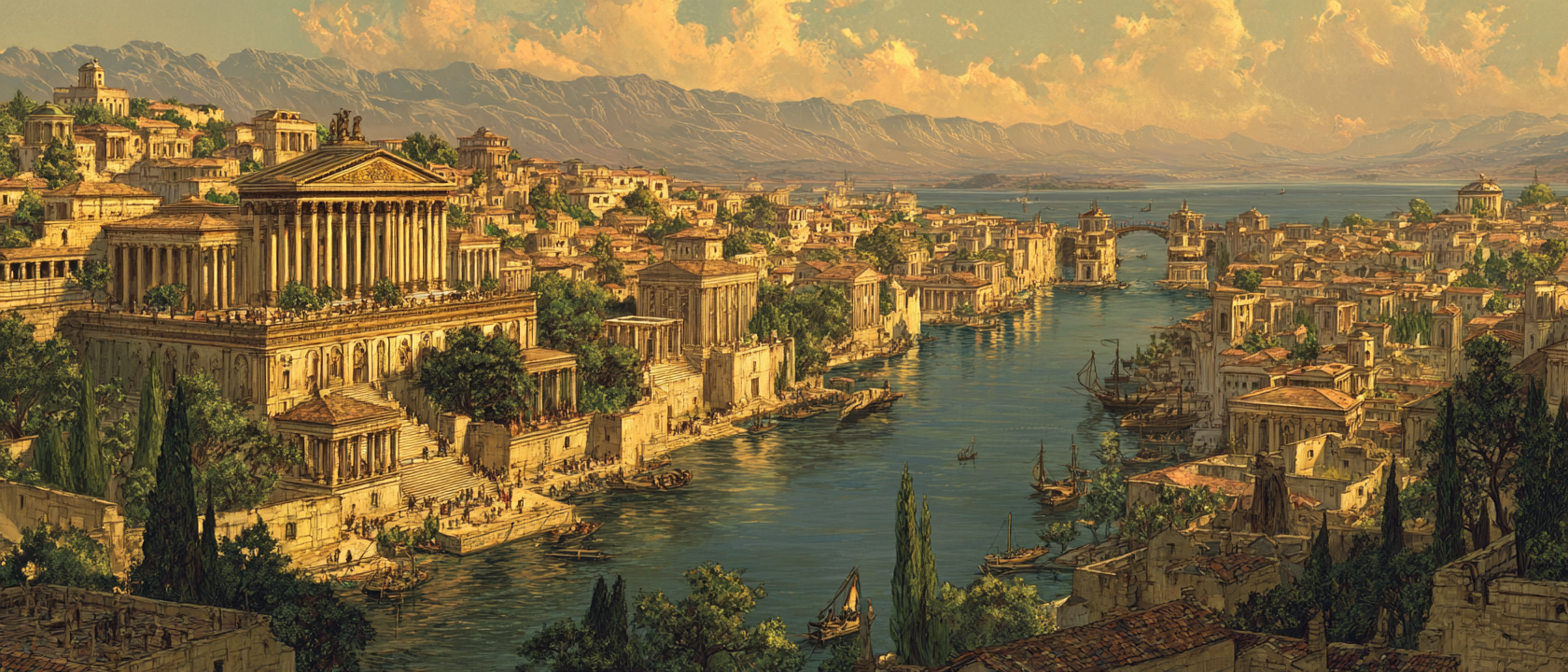
TEMPLUM CERERIS
Temple of Ceres · Sacred Site and Civic Anchor · Forum District, Agropolis
"The Templum Cereris is twelve centuries of the province’s self-understanding accumulated in stone and paint. Its walls carry agricultural imagery from every period of Roman settlement — each generation adding to the record of what the province grows and how it grows it, which means the temple’s interior is an unintentional visual history of Roman farming practice in Aethermarch that agricultural historians find invaluable and that visiting dignitaries find impressively comprehensive and somewhat relentless. The harvest festival here is the city’s one occasion when all of its institutional divisions are suspended. I have attended twice. The second time I understood why it matters that this happens at all."
The Templum Cereris is the most visited religious site in Agropolis and the city’s primary institutional expression of what it considers important. Built in the first century, 78 A.P., by the founding generation’s expression in stone of what they understood the new province to require, it has been the province’s most significant religious site for twelve centuries without a single period of diminished use or theological controversy. In a province where the harvest goddess is also the economy’s foundation, the theology and the commerce are the same thing, which produces a religious community that is practically minded in a way the College of Pontiffs finds comfortable and theoretically orthodox in a way that the College’s more philosophically inclined clergy find somewhat limiting. The Pontifex who manages the Templum Cereris and the Forum District’s two smaller temples has learned to work within this constraint.
Purpose / Function
The standard College shrine functions: the maintenance of the sacred precinct, the calendar of observances, the administration of the rites that Roman civic and religious life requires. The harvest festival — held annually in late summer, its timing coordinated with the assessment season’s beginning — is the temple’s primary civic function and the one that gives it its distinctive character. The festival is not a theological event in the conventional sense; it is the city’s annual acknowledgment that what happens in the fields determines everything else, and the temple is where this acknowledgment is formalised. Arvum attends. Satura attends. They sit in adjacent seats of honour and behave with complete formal cordiality.
Design
The standard Roman temple form in the local sandstone with marble accents funded by estate family donation across twelve centuries. The pronaos leads to the main cella, whose walls carry the agricultural imagery that Varro documents as an unintentional visual history: twelve centuries of harvest scenes, farming techniques, and the specific crop varieties that the province’s farming practices have developed, each generation adding its contribution to a record that was not planned as a record but has become one. The storage buildings adjacent to the temple’s rear hold the votive offerings — grain samples from each estate’s first harvest, a tradition the estate families maintain with the seriousness of a commercial obligation rather than a religious one.
Sensory & Appearance
The temple’s exterior: the marble columns’ pale contrast against the surrounding sandstone, visible from the forum square’s southern end. Inside: the agricultural imagery’s density, the smell of the incense the temple uses — a grain-derived compound rather than the standard imported formula, prepared by the temple’s own staff from a recipe maintained since the fifth century — and the specific quality of a religious space whose primary function is not contemplation but acknowledgment. The harvest festival: the smell of freshly cut grain brought from the current year’s first harvest, the city’s full population compressed into and around the festival platform, and the moment in the ceremony when Arvum and Satura stand adjacent to each other before the province’s entire population and both smile.
Denizens
Pontifex Aedis Cereris Marcus Aurelius Frumentum , fifty-four, twelve years: manages the temple and the district’s two smaller temples with the practical theology of someone who has spent twelve years in a province where the harvest goddess is the economy. His sermons are more commercially informed than the College prefers and more theologically coherent than it acknowledges. Has opinions about the votive grain store catalogue that he has not shared with Caelestis because nobody has asked him about the connection. Would share them immediately if asked.
Contents & Furnishings
The main cella: the statue of Ceres in fourth-century marble, surrounded by twelve centuries of agricultural imagery on every wall surface. The treasury: votive offerings from twelve centuries of the province’s commercial community, ranging from small coin offerings to significant donations of the marble columns and the festival platform’s most recent inlay. The votive grain store: the catalogue and nine centuries of dried sample records.
Valuables
The votive grain store catalogue is the temple’s most commercially significant asset and the one that nobody outside the temple’s staff has assessed in those terms. Nine centuries of estate yield records compiled from physical samples rather than self-reported figures constitutes an independent verification dataset that the Annona’s weigh-houses complement but do not replicate for the pre-fifth-century period.
Architecture
First-century foundation in the local sandstone, with marble-faced columns added in the fourth century from the first significant estate family donation to the temple’s fabric. The interior’s accumulated agricultural imagery covers every surface from floor to ceiling, its density reflecting twelve centuries of contribution rather than a single decorative vision. The effect, for a first-time visitor, is overwhelming. For the city’s permanent residents, it is background: the visual texture of a space they have known since childhood, as unremarkable as the grain that passes through the city’s wharves.
History
Built 78 A.P. by the founding generation. Marble columns added 312 A.P. The festival platform constructed 441 A.P. The votive grain store catalogue begun 243 A.P. The Annona’s 1167 A.P. platform inlay is the most recent significant addition to the temple’s fabric and the one whose institutional significance — the Annona’s first direct participation in the temple’s maintenance — the estate families are still processing. See Annales Mundi for full chronological detail.
Tourism
The Templum Cereris is worth visiting for its accumulated agricultural imagery alone, which constitutes a twelve-century visual record of Roman farming practice that agricultural historians find invaluable. The harvest festival is the city’s largest public event and the one experience available in Agropolis that makes the province’s identity immediately comprehensible to an outside observer. The votive grain store is not part of any tour.
Services
Daily observances. Harvest festival (late summer, annual). Votive offering receipt and storage. Agricultural blessing rites for estate first-harvest.
Access
Temple exterior and main cella: open during service hours.
Votive grain store: temple staff permission.
Treasury: restricted.

Comments