
AULA FRUMENTARIA
The Grain Exchange · Provincial Pricing Floor · Harbourfront, Agropolis
"The grain exchange is the most politely contested space in Aethermarch. The first day of the pricing session is attended by the full commercial community and produces the framework: the yield range, the demand projections, the transport cost assumptions. The gallery is full. The oratory is magnificent. Nothing of significance is decided. The second day is when the actual price is set. The gallery empties to a third of capacity. The professionals who remain are there for the education. I have attended both days. The second day is the more useful. It is also quieter, which is itself informative."
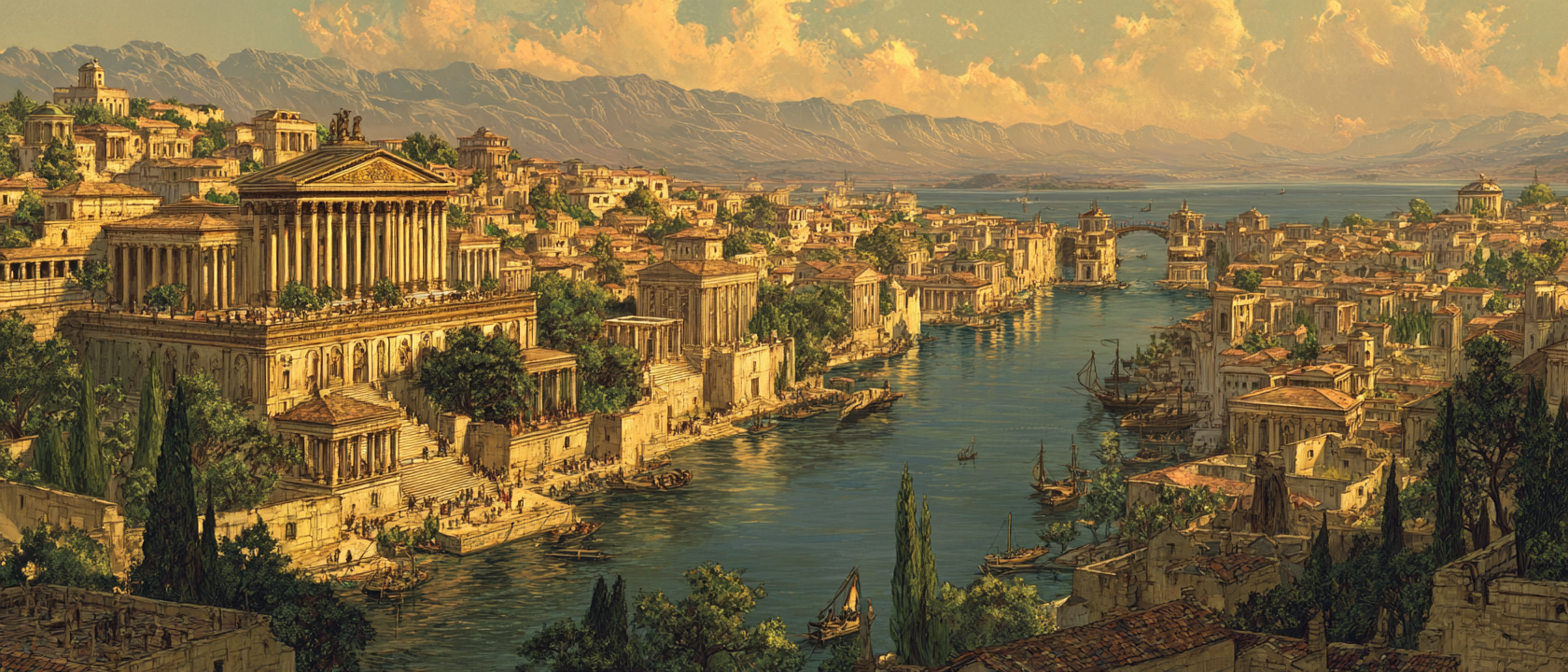
The Aula Frumentaria is the commercially most significant building in Provincia Septentrionalis: the grain exchange at the river mouth’s eastern corner, its pale limestone colonnade the city’s only architectural statement commissioned to impress people from the capital, its twice-yearly pricing sessions the events around which the province’s entire commercial calendar organises. The exchange sets the provincial harvest price each season through a formal trading session whose public-gallery theatre conceals the genuine price discovery that happens on the second day when the gallery has thinned. The membership board that governs the exchange — estate families, Lacusum factors, and the Annona’s regional office in carefully negotiated proportions — has been renegotiated four times in the past century without producing a document that satisfies anyone.
Purpose / Function
Twice-yearly grain pricing sessions: the harvest price session in late summer, the inter-season adjustment session in winter. The harvest session is the province’s commercial apex — the moment at which everything that has grown in the fields becomes a number that every contract in the province uses as its reference. What happens on the session’s first day, in the public gallery, is commercial theatre. What happens on the second day is the actual negotiation: the Annona’s assessors and the estate managers converging on a price that both sides can work with, within the range established the previous day, with the Lacusum factors watching to calculate how the number will move their futures positions.
Design
The fourth-century building is the exchange’s original construction, the only building in Agropolis deliberately built to impress visitors from the capital: pale limestone from the coast (the local sandstone was not considered adequate), the colonnade’s proportions calibrated for the exchange floor’s visual requirements, the public gallery on the exchange floor’s upper level with fifty positions and adequate standing room for somewhat more. The exchange floor itself is the building’s heart: a large rectangular trading floor with the session chair’s position at the northern end and the membership’s assigned positions around the perimeter.
Sensory & Appearance
The colonnade’s pale limestone against the surrounding sandstone and the harbour’s sea light: the most immediately distinguishing visual element in the Harbourfront district. Inside during the harvest pricing session’s first day: the full gallery’s conversation before the session begins, the specific atmosphere of a room where everyone present has a financial interest in the outcome and is performing their confidence in their position. The second day: the same room at a third capacity, quieter, the professionals’ focus replacing the previous day’s performance.
Denizens
Session Chair Gaius Arvina Sessor , seventy-three, eight years: manages the exchange’s sessions with the technical authority of someone who has spent a career in grain contract law and who knows exactly which of the session’s procedural rules are meaningful constraints and which are negotiating positions. Will speak with parties who demonstrate genuine understanding of the exchange’s pricing mechanics. Will not discuss specific members’ positions.
Halfling Factor Calla Goodseed , sixty-one, twenty-two years: the Merchant Council’s most valuable commercial intelligence asset in Provincia Septentrionalis. Has been watching the current yield discrepancy for the past two assessment seasons with the quiet attention of someone who is certain what it means and waiting to see what the Annona does with it. The halfling factor’s office does not receive casual visitors. Parties who approach with a demonstrated understanding of why Calla’s yield assessments are more accurate than the official ones will find someone who has been waiting for a conversation partner.
Architecture
The only building in Agropolis that was built to make a statement rather than to perform a function, which is not strictly accurate — it performs the pricing function well — but which captures the intention. The pale limestone colonnade is visible from the river and from the sea approaches, a deliberate architectural signal that the province’s commercial activity is conducted at the standard of the capital’s institutions rather than a provincial approximation of it. The estate families who funded it in the fourth century, 332 A.P., understood what they were communicating. Twelve centuries later, the communication has been received.
History
The grain exchange was built in 332 A.P. on the site of an earlier informal trading post that had served the same function since the second century. The pale limestone colonnade was part of the original construction; the estate families who funded it specified the coastal limestone when the building’s architect proposed the local sandstone. The Lacusum banking houses established offices in the district in the sixth century, 558 A.P. Calla Goodseed’s office was established in 1095 A.P. See Annales Mundi for full chronological detail.
Tourism
The exchange gallery is open to visitors during pricing sessions. The first-day gallery experience is recommended for visitors who want to understand the province’s commercial culture from a position that gives them form without content. The second-day experience is recommended for visitors who want the content. Attending both is the approach Varro endorses.
Access
Public gallery: open during sessions.
Exchange floor: members and authorised agents.
Halfling factor’s office: factor’s discretion.

Comments