
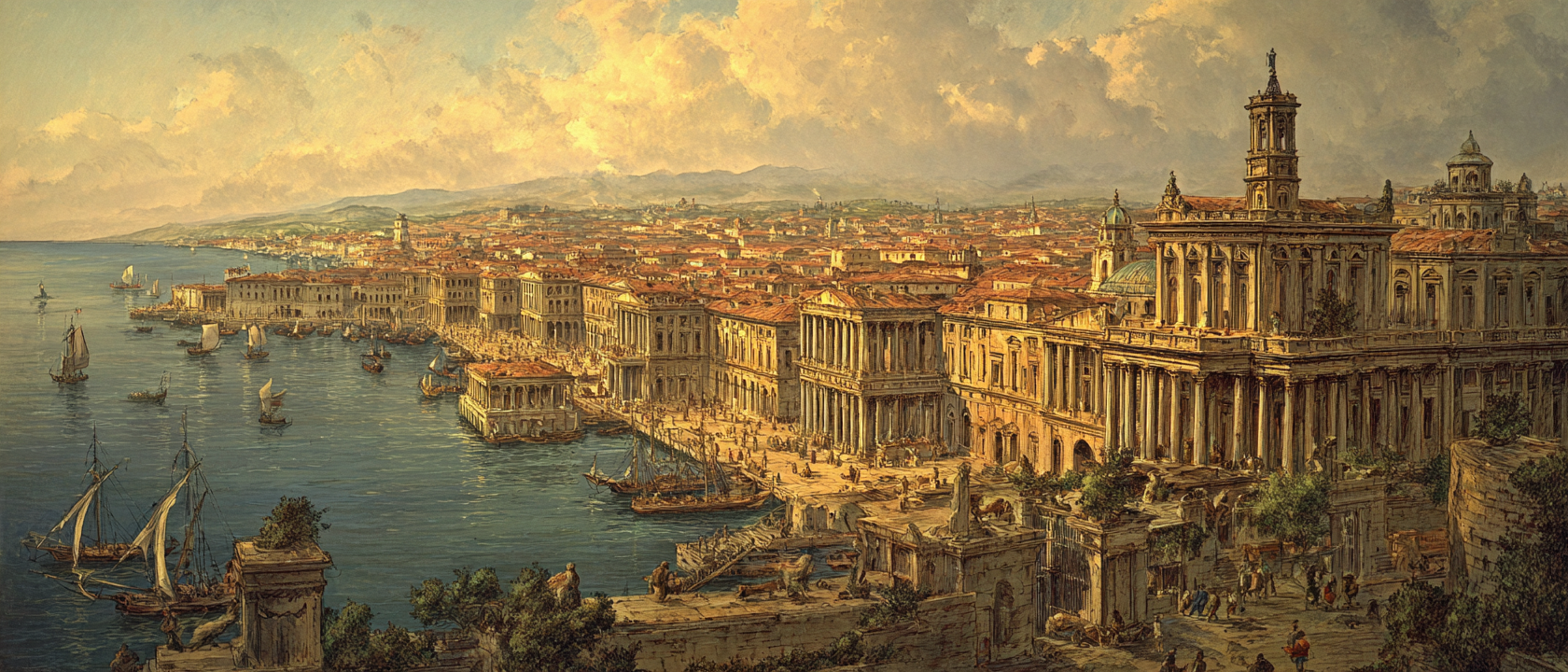
MERCHANT VILLAS DISTRICT
Old Money, Restrained · District · Lacusum
"The Merchant Villas District is where Lacusum keeps its wealth in the specific way that a city of traders keeps wealth: quietly, securely, and in a form that can be liquidated quickly if conditions require. The villas are beautiful in the way that expensive things maintained by people with good taste are beautiful — nothing ostentatious, nothing that signals vulnerability, nothing that a competitor could look at and use to calibrate their assessment of your financial position. The families who live here have been in Lacusum for twelve generations in some cases. They have outlasted Senate policies, Annona interventions, market crashes, and three significant changes in the empire's trade route geography. The secret to this durability, as far as I can determine, is that they have never confused the empire's interests with their own."
The Merchant Villas District is the residential expression of what Lacusum's commercial success looks like after twelve generations — a district of large houses set back from the city's commercial core, their gardens the most extensive private green space in the city, their owners the Mercatorum faction's Lacusum families who have been conducting the lobbying campaign against the Annona's grain futures control through their Senate representatives while conducting commercial operations that make the lobbying's outcome, in either direction, financially manageable. The district's atmosphere is the specific combination of comfort and watchfulness that old commercial money produces — not aristocratic ease, not nouveau anxiety, but the settled attention of people who have been managing significant resources for long enough that the management is automatic and the attention is available for strategy.
Demographics
Approximately eight thousand permanent residents — the merchant families, their extended households, the professional staff that significant commercial operations require to maintain. The halfling community in the district is smaller than on the Harbour Front but not absent — three of the most significant halfling commercial families in Lacusum have maintained residential premises here for generations, a presence that the Roman families find commercially advantageous and culturally comfortable in the specific way that twelve generations of commercial partnership produces.
Government
Approximately eight thousand permanent residents — the merchant families, their extended households, the professional staff that significant commercial operations require to maintain. The halfling community in the district is smaller than on the Harbour Front but not absent — three of the most significant halfling commercial families in Lacusum have maintained residential premises here for generations, a presence that the Roman families find commercially advantageous and culturally comfortable in the specific way that twelve generations of commercial partnership produces.
History
The district was established in the second and third centuries as the commercial families' wealth accumulated sufficiently to require residential separation from the commercial core. The Domus Marcella was built in the fourth century. The weekly commercial dinner tradition is ninth-century. The current lobbying campaign against the Annona's grain futures control began eight years ago and has been building legislative momentum with a patience that reflects the families' assessment that Senate processes reward sustained pressure rather than urgent advocacy. For full chronological detail, see: Annales Mundi.
Points of interest
The Domus Marcella's weekly commercial dinner — a tradition maintained for nine generations, at which the district's senior commercial families discuss the week's events and the coming week's strategy in a format that has no formal minutes, no official agenda, and the most complete situational awareness of the Inland Sea's commercial position available in any single room in the empire. Attendance is by long-standing invitation. Varro has attended four times. He describes the conversation as the most commercially sophisticated he has encountered anywhere and the most revealing about the gap between what the Senate knows and what is actually happening. He does not specify which dinner he found most revealing. The families have asked him not to.
Geography
The district occupies the high ground immediately behind the Harbour Front — the best residential position in the city, close enough to the commercial centre to walk to the exchange floor in fifteen minutes and elevated enough above the harbour to avoid the smell on windless summer days. The villas are large by urban standards, their gardens walled in the limestone that the district's buildings use throughout, their street facades presenting the same restrained prosperity as the Harbour Front's commercial buildings. The largest villa — the Domus Marcella, seat of the most commercially significant family in the province — occupies a corner site that allows it a harbour view from its upper floors, a feature that every subsequent generation of the family has found commercially useful.
Access
Streets — public.
Villas — private.
Domus Marcella weekly dinner — invitation only.

Comments