

JOTURVOLK
The Giants · Sapient People · Fourth Permutatio · Stable Population · No Magic of Any Kind
The most unsettling thing was not the scale of them. It was the quiet. A camp of five hundred giants makes less noise than a camp of fifty humans, because they have nothing to prove to each other by being loud. They are the most confident people I have encountered in eighty-seven years of observation. It must be very freeing, to be afraid of nothing.
The Joturvolk are the largest sapient people on the primary continent, the oldest established civilisation by the measure of their own archives, and the only people among the nine who have no relationship with magic in any form — no arcane tradition, no divine practice, no gods, no prayers that are answered. They arrived through the Fourth Permutatio at -800 A.P., three hundred years before Rome came to this world, and have occupied the far north continuously since. They number approximately 380,000 individuals across the northern archipelago and the western mainland coastal settlements: a small population relative to the primary continent's other peoples, with an individual military capacity that makes the comparison misleading.
My relationship to the Joturvolk is one of acknowledged limitation of a particular kind. I have never been to the Jotunhaer. I have met Hrimthorr Störr once, through an interpreter, for eleven minutes, at the Nova Romae diplomatic assembly. I have spoken with Joturvolk on five other occasions, always through intermediaries, always at the margins of their territory. What I know of the Joturvolk I know primarily through Merry Burrowfoot, whose accumulated accounts of fourteen northern runs constitute the most detailed non-giant record of the Joturvolk world that I am aware of; through the dwarven archivist Marra Copperstone, who has spent thirty years of her professional life in the saga archive at Steinvast; and through the halfling maritime records that track the northern trade network with the precision that commercial interest produces. These are excellent sources. They are not the same as direct observation, and I will not pretend they are.
Basic Information
Anatomy
The Joturvolk share the same bilateral bipedal body plan as the other humanoid peoples of the primary continent — two arms, two legs, an upright stance, a cranium of proportional size — at a scale that makes the comparison feel approximate rather than precise. The structural differences produced by that scale are significant. The skeleton is correspondingly massive: bone density and cross-section that Roman engineers, working from load calculations on giant-built structures, estimate as four to five times that of a comparable human. The musculature is proportional. A Frost Giant jarl in full physical condition is generating forces at the level of siege equipment, not infantry.
The hands are the feature that Roman artists most consistently misrepresent: not merely large versions of human hands but differently proportioned, with shorter finger-to-palm ratios and substantially greater grip force. Stone Giants in particular have developed the hand morphology through eight centuries of sustained stone-working to a degree that the dwarven archivists describe, with characteristic precision, as a divergence from the other sub-groups that is likely recent in biological terms and driven by selection pressure within the craft tradition. Whether this represents genuine morphological change or accumulated individual variation within a highly skilled population, Plinius cannot determine from the available sources.
Biological Traits
The three founding sub-groups show consistent internal differences that the giants themselves treat as the natural expression of what they are, and that Roman natural philosophy treats as sub-specific variation of the kind that any widespread species produces in different ecological niches.
Frost Giants are the tallest and most cold-adapted: the subcutaneous fat distribution that their arctic habitat requires, the pale colouring that reduces heat absorption, the particular efficiency of their thermoregulatory system in sustained cold that Merry Burrowfoot documents by noting that Frost Giants at work in temperatures that would be dangerous to a human show no visible signs of exertion for the cold. Hill Giants are the most agile: their shorter, more mobile frame and the proportional limb configuration that forest and upland terrain selected for produces a giant who is measurably faster over difficult ground than either of the other sub-groups. Stone Giants are the most massively built: the heaviest relative to height, with the spatial intelligence and stone-sense that eight centuries of sustained craft work has expressed at the biological level as an enhanced proprioceptive awareness that extends, by all accounts, into the rock they work with.
Age-related changes across all three sub-groups are gradual and not clearly marked by external appearance. Giants do not grey in the way Romans associate with age. The physical changes of advanced age — reduced peak speed and explosive force, sustained endurance improving rather than declining, increasing deliberateness in movement that reads externally as patience — accumulate slowly enough that a giant of 300 years appears, to a Roman observer, roughly comparable to a giant of 150. The behavioural changes are the age marker, not the physical ones.
Genetics and Reproduction
The Joturvolk reproduce as the other humanoid peoples do. Gestation is approximately fourteen months. Litter size is invariably one — twins are recorded in the sagas as significant events, occurring perhaps once per generation across the entire population. Parental investment is substantial and extended: a giant child is not considered capable of independent action until approximately age thirty, and is not considered fully adult — in the sense of possessing the experience that Joturvolk culture considers necessary for autonomous judgment — until fifty to sixty years of age.
Inter-sub-group reproduction is possible and produces viable offspring. The mixed-clan households at Grávík and other western mainland settlements, accumulated across two and a half centuries, demonstrate this without ambiguity. Mixed-heritage individuals exhibit physical characteristics drawn from both parent sub-groups in the proportions that individual inheritance produces; there is no documented evidence of hybrid disadvantage. The Joturvolk themselves treat mixed heritage as unremarkable. Sub-group identity is cultural and clan-based rather than strictly biological, and a mixed-heritage individual identifies with the community they grew up in.
Population management is implicit rather than explicit. The fishing-ground capacity constraint that limits each settlement's growth produces, through the daughter-settlement system, a distributed population that is neither concentrated enough to outrun its resource base nor dispersed enough to lose social coherence. Whether this is conscious policy or emergent behaviour from the founding principle — that you divide the fishing grounds before you divide anything else — Plinius cannot determine. The giants themselves regard the question as the kind of question that requires a distinction between choice and understanding that they find slightly artificial.
Growth Rate & Stages
A Joturvolk infant at birth is the size of a large human adult. The first ten years of life produce the most rapid physical growth, bringing the child to approximately half adult height. Growth continues, decelerating progressively, until approximately age forty, at which point physical development is essentially complete. The first thirty years are a period of dependency by Joturvolk standards: the child is cared for within the household, introduced to the settlement's activities as observation rather than participation, and is not expected to contribute to the community's productive work in any significant way.
The transition from youth to adult is not marked by a single ceremony but by a series of progressively significant activities: first fishing voyage, first hunt, first saga performance before a full hall assembly. The saga performance is the most culturally weighted of these milestones — the ability to hold a saga section in memory and render it accurately before an audience that has personal recollection of some of the events described is the demonstration that a young giant has developed the cognitive and mnemonic capacity that full adult participation requires. This typically occurs between ages forty and sixty.
Old age is a concept the Joturvolk treat as a matter of practical capacity rather than calendar age. The transition that humans associate with elderhood — reduced physical capacity, deference to younger generations, withdrawal from active roles — does not occur in the same form for giants. Hrimthorr Störr at 310 years is not, by any functional measure, less capable than she was at 200. The oldest giants are the most capable, most experienced, and most politically powerful individuals in the community. There is no Joturvolk equivalent of the Roman retirement from public life.
Ecology and Habitats
The Joturvolk are cold-adapted in a way that is biological rather than merely cultural. The arctic and subarctic environments of the far north — the Jotunhaer archipelago and the Litus Borealis coastal strip — are not merely where they have chosen to live but where their physiology is most effective. The cold-weather thermoregulation that allows Frost Giants to work in temperatures that would be dangerous to humans, the dietary adaptation to a maritime-dominated food base, the physical scale that retains body heat effectively at low temperatures: these are not cultural accommodations to a difficult climate but biological features that the climate rewards.
The Joturvolk have a territorial relationship with their environment that is the practical expression of three hundred years of individual experience per person. A giant who has been working the same fjord and the same deep-water channels for two centuries knows that geography in a way that human scholarship cannot replicate through documentary study. The Joturvolk's understanding of the northern sea — its currents, its seasonal patterns, its depths, the behaviour of the species it contains — is the most detailed practical oceanography available on the primary continent, and it is not written down. It does not need to be.
Dietary Needs and Habits
Primarily maritime. The fish populations of the northern sea — cod, herring, the great northern salmon in the fjord river mouths in autumn — are the economic foundation of Joturvolk civilisation and the primary food source. Whale products supplement the fish harvest. The deep-sea hunt produces both food and the trophy materials that the Joturvolk's cultural economy values: kraken teeth, deep-creature tissues, the harvested materials of species that no other maritime culture pursues with comparable regularity.
Terrestrial food sources supplement the maritime diet in ways that vary by settlement. The island communities have limited interior game; the western mainland settlements hunt the taiga's bear, aurochs, and caribou populations as a significant dietary supplement. The Hill Clan's valley-floor cultivation plots at Kolvurs Hald produce the most varied plant-based diet available in the Jotunhaer, which is still a supplement to rather than a replacement for the maritime food base. The Joturvolk do not practice agriculture at scale. They fish.
At the scale the Joturvolk operate, caloric requirements are substantial. Merry Burrowfoot's estimates, derived from watching the provisioning of a three-vessel expedition at Kolvurs Hald, suggest that a working adult giant requires approximately ten to twelve times the daily caloric intake of a working adult human. The northern sea's productivity supports this. The Joturvolk have been careful, across eight centuries, to ensure that it continues to.
Biological Cycle
The Joturvolk do not hibernate and have no dormancy cycle, but their activity patterns follow the northern seasonal calendar with a regularity that functions as a biological rhythm. The summer — brief, intensely productive, organised around the fishing season, the seabird harvest, and the deep-sea hunt — is a period of sustained high-output work. The winter — pack ice closing the northern approaches, the settlement sealed, the longship in its cradle — is a period of lower physical output and higher cognitive output: the planning season, the saga performance season, the season when the records are consolidated and the next year's operations are determined from the accumulated pattern data.
This rhythm has not changed in eight centuries of saga record. The oldest giants regard the question of whether the rhythm is biological or cultural with the same slight impatience they reserve for distinctions that do not produce useful consequences. It is what they do. It works. The analysis is a matter for scholars with more time than the giants have.
Behaviour
The Joturvolk are not aggressive by instinct. They are confident. The distinction matters because Roman military analysts consistently conflate the two, and the conflation produces strategic errors. A people who do not need to prove anything through aggression because nothing they have encountered in eight centuries has required them to prove it are not the same as a people who are suppressing an aggressive impulse. The quiet that Plinius notes in the field — five hundred giants making less noise than fifty humans — is not the quiet of suppression. It is the quiet of sufficiency.
Toward other Joturvolk, the behavioural baseline is direct and economical: information is conveyed precisely, decisions are announced once and not repeated, social friction is resolved through the formal-protocol-plus-direct-negotiation system that three hundred years of individual experience teaches. Toward other peoples, the baseline is assessment: what is this person's purpose, what are they capable of, what do they want, and does the interaction serve the settlement's interests. The assessment is conducted without hostility and without warmth. It is conducted with attention.
The Joturvolk's instinctive relationship with their environment is possessive in the functional rather than legal sense: the fishing grounds are theirs because they have been working them since before any other people arrived on this continent, and they will defend them against encroachment with the same efficiency they bring to the hunt. This is not territorial aggression. It is the behaviour of a people who have learned that the resource is the civilisation, and that trading it away is trading away the thing itself.
Additional Information
Social Structure
The Joturvolk organise themselves by the same principle at every level: the largest, oldest, most capable leads. This is not a legal principle or a cultural convention — it is the expression of a biological instinct that Joturvolk culture has encoded into its formal political structure without significantly modifying the underlying impulse. The Frost Jarl leads because she is the largest, oldest, and most capable giant alive. The Frost Giants lead the jarl-class because they are the largest sub-group. The whole structure is a formalisation of a social dominance hierarchy that would exist in this form regardless of whether the Joturvolk had developed the jarl system to articulate it.
Household structure is clan-based but not rigidly clan-exclusive. The mixed-clan households of the western mainland settlements, and the inter-clan relationships that the founding islands' long proximity has produced, demonstrate that the biological sub-group identity and the social structure are distinct enough that the social structure can accommodate what the biology has not predetermined. A Hill Giant who has lived at a Frost Giant settlement for a century is, in every practical social sense, a member of that community regardless of sub-group identity.
Uses, Products & Exploitation
The Joturvolk's economic output, framed as trade goods rather than exploitation: fish and whale products from the northern sea, the most productive maritime harvesting operation on the primary continent. Stone Giant metalwork from Steinvast, approaching dwarf quality by a different craft tradition. Carved stone structural elements produced by Stone Clan craftspeople and supplied to settlements across the archipelago. Kraken-derived materials — teeth, structural tissues, deep-creature harvest products — that the Joturvolk trade through the halfling northern network at prices that reflect both the quality and the difficulty of acquisition. Information about the deep northern sea, sold very selectively to parties who the Joturvolk decide have earned access to it.
The Joturvolk do not sell their fishing grounds, their timber, or their building materials. They sell what comes out of those resources after eight centuries of craft tradition has worked on it. The distinction is fundamental to how every commercial relationship with the Joturvolk must be understood.
Facial characteristics
The Joturvolk facial structure is a scaled and somewhat coarser version of the general humanoid pattern, with the pronounced brow ridges and heavy jaw structure that their musculoskeletal load requires. Sub-group variation: Frost Giants tend toward sharper, more angular facial geometry; Hill Giants toward broader, rounder features; Stone Giants toward the heaviest jaw and brow structure of the three, reflecting their sub-group's tendency toward maximum skeletal density. Hair is typically worn long and practical — pulled back or braided for working, loose in the hall. Beard patterns among male and some female individuals vary by sub-group: Frost Giants tend toward full beards, Hill Giants toward shorter growth or none, Stone Giants toward the heavy beard that the clan's craft tradition has made a standard feature of the senior craftsperson's presentation.
At the scale the Joturvolk operate, the features that Roman diplomats and travel writers most consistently remark upon are the eyes: pale grey or blue in Frost Giants, amber or warm brown in Hill and Stone Giants, with the sustained, unblinking quality of sustained observation that a people for whom attention is survival develop. Merry Burrowfoot describes being looked at by Hrafn Djupeyra, the Djupvakt hunt-master, as the experience of being assessed by something that has spent two centuries deciding what matters and what does not, and that has concluded that you are in the second category.
Geographic Origin and Distribution
The Joturvolk homeworld is unknown in any documentary sense — no Roman scholarship has access to the pre-Permutatio geography of any people's origin world, and the giant sagas, while they contain extensive references to the homeworld as a place, do not describe its geography in terms that allow external reconstruction. What the sagas do establish, and what Marra Copperstone has confirmed from the accessible archive sections, is that the three founding clans were gathered at the original settlement — the meeting-place that is now Hrimthorrs Höll — at the moment of the Fourth Permutatio. The gathering was a seasonal assembly, not a ritual preparation for Rift transit. The Rift brought them here already assembled.
Current distribution: Septentrio Ultima. The Jotunhaer archipelago contains the founding island settlements — Hrimthorrs Höll, Steinvast, Kolvurs Hald, Djupvakt, and several smaller daughter communities. The Litus Borealis western mainland coastal strip contains three named western settlements — Grávík, Ísbítar Strand, and The Unnamed — plus the eastern coastal settlements less documented in Roman and halfling sources. The total distribution spans the northernmost accessible region of the primary continent. See geography articles for full settlement detail.
Average Intelligence
The Joturvolk's cognitive capacity is fully humanoid and, in several domains, substantially exceeds what Roman natural philosophy tends to assume. The memory capacity that centuries of saga tradition demands and produces is the most striking example: an adult Joturvolk who has been performing and memorising sagas since the age of fifty has developed mnemonic structures that Roman scholarship does not have a framework for assessing, because Roman scholarship cannot imagine what sustained use of those structures for two centuries produces. Marra Copperstone's description — the most precise non-giant account available — is that a senior saga-keeper holding a full performance of the Verdrsplit cycle is doing something that resembles what a Roman scholar does with a written text, except that the text is held entirely in the performer's biological memory and can be recalled and cross-referenced without physical access to any record.
In the domains the Joturvolk cultivate — oceanography, deep-sea creature behaviour, ore geology, forest management, longship navigation — the cognitive depth that centuries of sustained specialist practice produces is without parallel on the primary continent. Roman natural philosophers who have access to the partial accounts available through halfling and dwarven intermediaries consistently underestimate this depth, in part because the Joturvolk do not write things down in ways Roman scholarship can inspect, and in part because the assumption that a people without magic or formal education must be cognitively simple is an error that Roman analysts have not, in 1200 A.P., fully corrected.
Perception and Sensory Capabilities
The Joturvolk's sensory range is broadly humanoid, with the calibration differences that their ecological context produces. Low-light vision is significantly better than the human baseline: the northern winter's extended darkness and the interior of the Djupkamrar's cave system have both selected for, and been managed by, visual systems that function effectively in conditions where a Roman would require a lamp. Hearing at lower frequencies is, by all accounts, more acute than the human range — the chest-register frequency of Jotun speech is not merely a cultural convention but a reflection of the frequency range that giants' auditory systems are optimised for.
The Stone Clan's spatial intelligence and stone-sense is the most documented non-standard sensory capability among the Joturvolk. Marra Copperstone, who has observed Stone Clan craftspeople at work, describes the stone-sense as the ability to read the mechanical stress distribution in a rock face by touch and sound in a way that produces predictive capability about where the material will fracture — a form of proprioceptive extension into the medium being worked that she cannot fully account for in terms of standard humanoid sensory apparatus. Whether this is a genuine additional sensory capability or an extremely refined integration of standard touch, sound, and visual inputs she cannot determine. The stone giants themselves regard the question as a category error.
No magical perception of any kind. The absence of arcane signature in Joturvolk territory is not merely the absence of arcane output — arcane input, measurement, and detection also return null results in the presence of Joturvolk. Roman arcane scholars who have attempted to study this phenomenon from the sea have been unable to determine whether the Joturvolk are passively blocking arcane input or whether the arcane simply does not apply to them. The giants have not commented on the question and appear to regard the interest with the polite incomprehension that people who have never needed a thing apply to the suggestion that the thing might be useful.
Symbiotic and Parasitic organisms
No documented symbiotic or parasitic relationships of significance. The homeworld timber at the core of Hrimthorrs Höll resonates at the frequency that the northern deep-sea creatures use for long-range communication — a relationship between the building material and the creatures of the surrounding sea that is not exactly symbiotic in the biological sense but that has persisted for eight centuries and that both the Joturvolk and the creatures appear to have organised their behaviour around. Whether this constitutes a relationship or an environmental feature is a question Plinius cannot resolve from the available sources. He notes it here because the category of symbiosis is the closest available approximation.
Civilization and Culture
Naming Traditions
Joturvolk names consist of a personal name, borne from birth, and an epithet, earned or attributed in adulthood. Children use the parent's personal name in possessive form until their own epithet is established: a child of Hrimthorr would be Hrimthorrssonr or Hrimthorrssdóttir until the individual has done something worth naming. The epithet reflects origin (the -jar demonym suffix), function (Taigafari, Kauphand), or a defining characteristic (Djupeyra, Storr). Epithets are not inherited and cannot be claimed — they are attributed by the community and confirmed through use. An epithet that no one uses is not an epithet.
Personal names draw from a consistent phonological tradition that shares roots with the Nordic cognate vocabulary but has developed eight centuries of Joturvolk-specific divergence. See the Jotun language article for full naming lists and the naming convention documentation.
Major Organizations
The Joturvolk have no institutions in the Roman sense — no Senate, no Colleges, no Guilds with charters and membership rolls. What they have are functions that have been performed continuously for eight centuries and the people who perform them, whose authority derives from demonstrated capability rather than institutional appointment.
The Verdrsplitvarar — the Saga-Keepers — are the closest equivalent to a formal institution: the custodians of the Verdrsplit Arkiv at Hrimthorrs Höll, responsible for the maintenance, performance, and extension of the saga record. The senior Verdrsplitvar holds the second-highest political influence in the founding settlement after the Frost Jarl, because the saga-keepers control what the past is understood to have been, and in a culture where individual memory extends three centuries, what the past is understood to have been is contested ground.
The Jarl hierarchy is the primary political structure: the Frost Jarl at the apex, the clan jarls below, the settlement jarls on the western mainland below those, with authority at each level derived from the largest-oldest-most-capable principle. There is no formal council and no majority vote. There is consultation, which the Frost Jarl conducts when she judges it useful, and decision, which she announces once and does not repeat.
The craft specialisations — the Steinsmíðar at Steinvast, the Skógvarar at Kolvurs Hald, the Djupfiskar and hunt-masters at Djupvakt — function as professional bodies in practice without formal institutional structures. Authority within each specialisation is expertise-based and accumulated across centuries of sustained practice. See individual settlement articles for detail.
Beauty Ideals
The Joturvolk's aesthetic values are inseparable from their functional values, which is not a simplification but a precise description of how they understand the relationship. Something beautiful is something that does its function excellently and endures. The great hall at Hrimthorrs Höll is beautiful because it has been holding the Frost Clan since before the Permutatio and shows no sign of stopping. A longship is beautiful when it handles exactly as it should in the conditions it was designed for. A kraken tooth is beautiful when it is the right size — meaning when the creature that produced it was large enough to be worth hunting.
Physical beauty in the personal sense is assessed by the same criteria: presence, capacity, evidence of endurance. The features that signal long life and sustained physical capability are admirable. The features that signal youth and inexperience are not. A giant of two hundred years who has the physical bearing of what they have done for two centuries is more beautiful, by Joturvolk standards, than a giant of sixty who is technically at peak physical condition. This is not an aesthetic preference that translates easily to Roman categories.
Gender Ideals
The Joturvolk recognise two genders, corresponding broadly to the biological binary, without the hierarchical weighting that Roman gender structure applies. The saga tradition is the reference point: male and female giants appear throughout the Verdrsplit cycle in every role — jarl, hunt-master, saga-keeper, craftsperson, warrior — without the sagas presenting either as the appropriate or natural occupant of any specific role. Authority derives from demonstrated capability. Demonstrated capability is not gendered.
Hrimthorr Störr, Vigdís Ísbitarjar, and Ragnhildr Kauphand are female; Hrafn Djupeyra, Kolvur Breidómál, and Ormr Djupráð are male. The distribution across the settled leadership of the Joturvolk as of 1200 A.P. does not suggest that either gender occupies a structurally advantaged position. Plinius notes that Roman diplomatic correspondence consistently addresses Joturvolk female Jarls with the formal title used for Roman male magistrates, which the giants have not commented on and which Plinius considers a minor diplomatic impropriety that he has been unable to correct in the relevant departments.
Courtship Ideals
Joturvolk courtship is long, practical, and conducted in public in the sense that a community that has been observing the same individuals for decades has opinions about compatibility that it does not keep entirely to itself. The formal courtship process begins after both parties have demonstrated the capability that adult status requires — typically not before age sixty — and involves a sustained period of mutual assessment that the community observes without formally participating in unless the saga tradition requires a witness.
The saga-keeper's role in courtship is documenting it: a courtship that is not added to the saga record is not formally recognised. The addition to the record is not a ceremony but a notation, and the notation confirms that the community's collective memory includes the partnership as a fact. This is, in a culture where individual memory extends three centuries, a more significant confirmation than it might appear.
Relationship Ideals
Joturvolk partnerships are lifetime commitments by convention and by the practical reality of three-century lifespans, which makes 'lifetime' mean something different than it does in Roman law. A Joturvolk couple who form a partnership in their seventies can expect to be together for two centuries. The weight of that commitment is reflected in the extended courtship period and the community's involvement in confirming it.
Dissolution of partnerships occurs and is not socially catastrophic, but it is uncommon enough that it is notable when it happens, and the saga record includes it. There is no formal divorce equivalent. The community's collective memory is the record of what the relationship was and what it became, and there is no mechanism for removing that record.
Average Technological Level
The Joturvolk's technology is oral and material rather than written and institutional, which means it is not visible to Roman scholarship in the ways that Roman technology is visible. The longship is their primary technology: the largest class of vessel operated regularly on the primary continent by any maritime culture, designed for the specific conditions of the northern sea and modified by eight centuries of accumulated design knowledge that exists entirely in the heads of the builders. The current generation of Joturvolk longships are not the same ships as the founding generation's vessels. They are better in every measurable respect, and the improvement exists in no written record.
The Steinvast forge-hall technology is the other primary achievement: metalwork approaching dwarf quality without the divine craft-blessing that the dwarven tradition relies on, produced through eight centuries of accumulated technique that the Stone Clan maintains as craft knowledge rather than institutional documentation. The dwarven archivists who have examined the output describe the result with the professional precision of people who have no interest in exaggeration: it is not dwarf-quality. It is approaching dwarf quality. By a different route. Both characterisations are intended as accurate rather than qualified.
The Skógvarar's forest management system at Kolvurs Hald and the Djupvakt hunting-masters' deep-sea observation programme at the Rimvakt-Postar are both technological achievements of the first order in their domains — the most sophisticated land-management and the most detailed deep-sea monitoring available anywhere on the primary continent. Neither is recognised as technology by Roman scholarship because neither involves machines, structures, or written systems. The Joturvolk regard this as a Roman categorisation problem rather than a deficiency in their own practice.
Major Language Groups and Dialects
The Joturvolk speak a single language, Jotun (Giant-tongue), across the entire population with remarkably little dialectal variation given the geographic distribution. Eight centuries of longship contact, the Verdrsplit Arkiv's centralising function, and the saga performance tradition's requirement that performers be comprehensible to any Joturvolk audience have maintained structural uniformity that the western mainland settlements' lexical variations — new words for mainland realities the archipelago does not share — have not significantly disrupted.
Latin is not spoken by any Joturvolk. The eleven conversations Plinius has had with Joturvolk were conducted through interpreters. A small number of halfling traders on the northern route have achieved functional conversational competence in Jotun; Merry Burrowfoot is the most capable non-giant speaker currently living. No Roman speaker of Jotun is documented. See the Jotun language article for structural detail.
Common Etiquette Rules
Do not repeat yourself. If you have said something, it has been heard and considered. Repeating it implies either that you believe the other party did not understand, or that you do not trust your own statement. Both implications are offensive.
Do not arrive without purpose. Presence implies intent, and intent implies that the community has the right to know what it is. Arriving at a giant settlement without a clear reason that you state immediately upon arrival is not merely rude — it is the behaviour of someone who is concealing something, and the Joturvolk will act on that assessment.
Do not touch the saga archive. The Verdrsplit Arkiv is not a library. It is not accessible to visitors. The distinction between being in the hall and being in the archive is not marked by a door or a guard but by the social expectation that a visitor who has been admitted to the hall has been admitted to the hall, and that moving beyond that requires an explicit invitation that you did not receive.
Do not mistake silence for agreement. The Joturvolk do not fill silence to manage social discomfort. A long silence following something you have said is not confirmation that what you said was acceptable. It is assessment.
The trading relationship has its own etiquette, documented in the halfling Pilot's Guild northern chart with more precision than Plinius can add to here: arrive in the right season, bring what you said you would bring, take what you agreed to take, leave when the exchange is complete. Giants remember every commercial relationship for the duration of their lives. The positive and negative implications of this are both significant.
Common Dress Code
Functional, durable, and expressive of what the wearer has done rather than what they intend. The Joturvolk do not wear status markers in the Roman sense — no insignia of office, no colour-coded fabric grades, no ring-counting equivalent. Status is expressed through trophy wear: the teeth, bones, skins, and worked materials of creatures encountered and overcome, incorporated into clothing, armour, and personal adornment in ways that a Joturvolk observer can read as a biography.
The door frame at Hrimthorrs Höll is set with kraken teeth. This is not decoration. It is the record of a specific hunt, conducted by specific giants, resulting in a specific creature. The teeth are the trophy, and the trophy's placement at the most significant threshold in the Joturvolk world is the statement that the achievement is the most significant in the settlement's history. Everything a Joturvolk wears makes a similar statement at a smaller scale.
Working dress is practical and weatherproof: treated hide and heavy wool in the cold months, lighter equivalents in summer. Formal dress for hall gatherings includes the trophy elements that everyday work does not. The distinction between working dress and hall dress is visible to a Joturvolk observer and invisible to most Romans, because the difference is in the trophy elements rather than in the fabric or cut.
Culture and Cultural Heritage
The Joturvolk arrived through the Fourth Permutatio with their culture intact: the jarl hierarchy, the saga tradition, the three-clan structure, the fishing-ground management system that preceded any political settlement. The Permutatio brought the physical world through with them — the founding island, the harbour that predates the Rift, the homeworld timber at the core of Hrimthorrs Höll — and the cultural continuity was not disrupted in the way it was for peoples who arrived without their physical context. The Joturvolk's relationship to their cultural heritage is therefore less complicated by the Permutatio experience than other peoples': what they had, they brought with them; what they have now is a continuous development from what they brought.
The saga tradition is the cultural spine. The Verdrsplit cycle encodes history, genealogy, social expectation, and the cosmological account of the founding Rift event in a form that the community maintains and extends across centuries. The cycle is not fixed: each generation's saga-keepers add to it, and the additions are as much the tradition as the founding material. This is a living culture rather than a preservationist one, and the distinction matters for understanding why the Joturvolk are as functional as they are after eight centuries in a world that is not the one they were built for.
Common Customs, Traditions and Rituals
The saga performance is the Joturvolk's primary ceremonial form: a full assembly of the settlement in the great hall, the saga-keeper performing extended sections of the Verdrsplit cycle from memory, the community listening. Not as entertainment — the English word's connotations are wrong. As maintenance: the performance is how the community confirms what it knows about itself and what its relationship to its own history is. Merry Burrowfoot attended one performance at Kolvurs Hald on her third visit. She describes it as the finest music she has heard in eighty years of listening and then corrects herself: it is not music. It is the act of a community remembering itself in public.
The founding of a daughter settlement is the second major ceremony, and the most directly political: the founding party's departure, the Frost Jarl's formal acknowledgment of the new settlement's name, the addition to the saga record. The name conferral is not a formality — a settlement that has not received formal acknowledgment does not exist in the Joturvolk's social-legal sense, and the founding party occupying a site without that acknowledgment is in a liminal state that the culture finds genuinely uncomfortable.
The deep-sea hunt is a community event in a way that everyday fishing is not: multi-settlement expeditions planned through the winter, conducted in summer with the ceremony that significant collective undertakings receive, the trophies brought back and integrated into the hall record. A kraken hunt that returns without the creature, as has recently occurred for the first time in living giant memory, is an event without precedent that the saga-keepers have not yet determined how to record.
Common Taboos
Selling the fishing grounds. Not a violation of law — a violation of identity. The fishing grounds are what the Joturvolk are. Trading them is trading the thing itself. This is the one category of transgression that the Joturvolk do not have a formal response to because no Joturvolk has ever done it, and the thought experiment of what the response would be produces a description that Plinius has been asked by his publisher not to include in a scholarly text.
Accessing the saga archive without authorisation. The distinction between the public hall and the archive's inner chambers is not marked, but the violation of it is understood to be the kind of trespass that a culture with three-century individual memories does not forget. Marra Copperstone has been inside twice, both times under Hrimthorr Störr's personal supervision. She describes the social weight of that supervision as the most precise form of scrutiny she has experienced in thirty years of archival research.
Claiming an epithet you have not earned. The epithet system is the Joturvolk's primary mechanism for social recognition, and claiming an epithet that the community has not attributed is a form of fraud against the community's collective memory. It does not happen often, because the community's collective memory extends three centuries and the fraud would be detectable within the lifetime of people who were present when the claimed achievement did not occur.
History
The Fourth Permutatio arrived at -800 A.P. Three clans were assembled at the meeting-place when the morning was different. The work was immediate: the fishing grounds divided before governance, before secondary settlements, before any relationship with the mainland was considered. Eight centuries of continuous development from that founding decision have produced the Joturvolk world as of 1200 A.P.: the full extent of the Jotunhaer archipelago occupied, the Litus Borealis western mainland coast settled through three generations of daughter settlement expansion, and the political and intellectual life of the people organised around the saga tradition and the Verdrsplit Arkiv.
The Bellum Glaciale at -530 A.P. — the giant expansion that pushed through the northern mountain passes into the taiga belt — is the most significant military event in Joturvolk history and the one that established the permanent southern limit of giant territorial ambition. The western mainland settlements are the descendants of that expansion's territorial claims. The Pale Wanderer's return and the approaching Rift XIII crisis constitute the current historical moment, for which several senior Joturvolk figures are better prepared than Roman scholarship is aware.
For full chronological detail, see: Annales Mundi.
Historical Figures
Hrimthorr the First — the founding Frost Jarl, unnamed in surviving sources by any name other than her title; the figure who called the fishing ground division before the governance settlement and whose decision the Joturvolk regard as the foundational act of their civilisation. Three hundred years of Frost Jarl succession later, Hrimthorr Störr carries the name as an ongoing rather than commemorative title.
The Frost Jarl of the Bellum Glaciale — unnamed in outside sources; the figure who prosecuted the southern expansion and, more significantly, stopped it. The decision to establish a permanent southern limit rather than continuing south is the most praised decision in the Verdrsplit cycle by the measure of how often the subsequent Frost Jarls have invoked the name when explaining a decision to stop. Hrimthorr Störr has used it twice in documented contexts.
Kolvur — the founding Hill Clan Jarl, whose name the hold carries. Remarkable primarily for the speed of the founding decision: the Hill Clan took Kolmeyja because it was the most forested island, and the decision was made within the time required to say 'that one.' Eight centuries of forest management have validated the choice in a way that the sagas record with the characteristic Joturvolk understatement that constitutes the highest form of praise.
Hrimthorr Störr — the current Frost Jarl, 310 years old, 80 years in the seat. Not historical in the sense of being past, but already recorded in the saga tradition as one of three Frost Jarls who made significant departures from established precedent, each of which was subsequently validated. The fourth departure — whatever she is currently arranging — is not yet in the saga record. See the Hrimthorrs Höll articles for what is known.
Common Myths and Legends
The Verdrsplit Fornmal — the founding myth that is also the founding history. Three clans assembled at a meeting-place when the morning was different, and then they were here instead of there, and there was work to do. The saga-keepers perform this passage with the formal register that the founding moment requires, and the community listens with the attention they give to the account of something they were not present for and that the oldest among them were. The myth's power is that it is also the most precisely documented event in the Joturvolk's history. The oldest giants alive were not at the founding, but they were alive before Rome arrived, and the chain of memory from the founding to the present is shorter for the Joturvolk than for any other people.
The Ganga ok Standa or Bellum Glaciale Saga — the account of the southern expansion and the decision to stop. The saga has the character of a story about knowing when a thing is finished, which is a value the Joturvolk express more consistently and with less apparent effort than any other people Plinius has studied. The Frost Jarl of the Bellum Glaciale is the model of this: she went south until stopping was correct, and then she stopped, and the decision has not been revisited in three centuries. The myth is told to children as the example of what the jarl principle — the largest, oldest, most capable leads — looks like when it is working correctly.
The Djupminni, Deep-Sea Creature Myths — the accounts of the kraken hunts and the creatures of the middle depths, preserved in the Krakensong cycle at Djupvakt and in the broader Verdrsplit tradition. These myths have a quality that distinguishes them from the founding and expansion accounts: they are not finished. The creatures are still there. The hunts are still happening. The most recent addition to the Krakensong cycle — the account of a kraken that left without engaging, for the first time in eight centuries of hunts — is being added to an ongoing myth tradition rather than being archived as a completed story. The Joturvolk do not yet know what this myth means. This is, for a people whose myths are usually also their history, an unusual position.
Interspecies Relations and Assumptions
Rome
Pragmatic detachment with careful attention. The Joturvolk regard Rome with the assessment that a people who are larger, older in this world, and entirely unbothered by the political considerations that do not touch their fishing grounds bring to any new factor in their environment: what is this, what does it want, and does it constitute a threat that requires response. The answer to the third question has been no for five hundred years, which has produced a working non-relationship of indirect commercial contact through halfling intermediaries and occasional direct diplomatic interaction that neither side has found sufficiently useful to institutionalise. Rome's arcane capacity — the one thing Rome has that the Joturvolk cannot counter — does not work on the Joturvolk. Roman military doctrine has no framework for an opponent whose capabilities include ignoring the entire category of magic. The Joturvolk are aware of this. They regard it as the arrangement's most important feature.
Khazadum (Dwarves)
The most sustained and functional inter-civilisation relationship the Joturvolk maintain with any other people, conducted through the dwarven archivists' presence at Steinvast and the Varakh Hold's northern mining operations adjacent to the western settlements. Two peoples who respect what the other produces without particularly warming to the other as a civilisation: the dwarves find the stone giants' metalwork professionally impressive and their refusal to adopt the dwarven forge-tradition professionally irritating; the stone giants find the dwarven archivists useful and their persistent interest in the deeper sections of the Djupkamrar professionally noted. The relationship works because both sides understand it as a transaction rather than an alliance, and transactions are easier to maintain than alliances when the parties don't actually like each other.
Ael'vari (Elves)
Respectful distance, sustained across eight centuries by the geographic separation between the far north and the elven forest territories, and by the shared characteristic of very long individual memory. The elves have records of the Fourth Permutatio — the event that brought the Joturvolk to this world — that the Joturvolk have not been able to access. The Joturvolk have saga accounts of events that the elves' records do not cover. Both peoples are aware that the other holds information about the shared history that the other does not have. Neither has actively sought the exchange. Plinius has spoken with elves eleven times at the treeline and has not asked about this. He considers it the most interesting question he has not asked.
Grakh'tor (Orcs)
The most interesting relationship in the Joturvolk's diplomatic landscape, primarily because it is not a diplomatic relationship. No treaty. No formal contact. No agreed frontier. Two peoples occupying adjacent territory, both of whom have decided the other is worth fighting and neither of whom has decided the other needs to be destroyed. The western giant settlements and the orc northern clans conduct a seasonal exchange of raids that both sides find satisfying as a test of capability and that produces in the western giant clans a cohesion and maintained edge that the island communities, who have no equivalent opponent, are occasionally envious of. The orcs bear the scars of giant encounters with the same honour the giants do. Both sides regard the arrangement as an accurate description of what the other deserves.
Joturvolk and the Halflings (Insulae Brindala)
The most commercially developed relationship the Joturvolk maintain, conducted through the halfling northern trade network that has been running for two centuries. Grávík and Kolvurs Hald are the primary contact points. The halfling traders have learned what the Joturvolk value, what they will trade, and what they absolutely will not; the Joturvolk have learned that halfling commercial relationships, maintained correctly, are a reliable source of southern political intelligence that the Frost Jarl values more than most of the material goods on offer. Merry Burrowfoot is the most sustained individual example of this relationship at its best: eight decades of northern contact producing the most detailed non-giant account of the Joturvolk world available to outside scholarship, exchanged for the information about southern developments that Hrimthorr Störr has been using as political intelligence since before Rome arrived.
Zrek'vali (Goblins)
No documented contact. The Joturvolk are aware that goblins exist — the halfling traders carry news — and regard them as a southern problem of a kind that the far north's geography has so far prevented from becoming a northern one. The Joturvolk have no strategic interest in the goblin territories and no particular concern about the goblin situation as of 1200 A.P. Whether this assessment remains accurate after Rift XIII is a question none of the Joturvolk have publicly formulated.
Centaurs
Distant awareness. The centaurs arrived through the Ninth Permutatio at -200 A.P., when the oldest living Joturvolk were already over a century old. The Joturvolk observed their arrival — a people coming through the Rift into the central plains territory — with the attention they give to significant events, noted it, and returned to their fishing grounds. The centaurs' territory and the Joturvolk's territory do not overlap. Contact is mediated through halfling trade channels and is not extensive. The Joturvolk regard the centaurs' cavalry culture with the professional interest of people who are also very good at one specific thing, and who understand what it means to organise a civilisation around a primary capability.
Solarhet (Tabaxi)
No direct contact. The Solarhet territories in the far south are separated from the Joturvolk world by the full extent of the primary continent. What the Joturvolk know of the Tabaxi comes through halfling maritime trade intelligence and Roman diplomatic reports, neither of which the Joturvolk have found sufficient reason to act on. The existence of a southern civilisation with a divine presence and arcane tradition is, to the Joturvolk, simply another fact about a world that contains many such civilisations. The Joturvolk's assessment of the Tabaxi is, by all indications, approximately the same as the Tabaxi's assessment of the Joturvolk: aware, distant, and content to remain so.
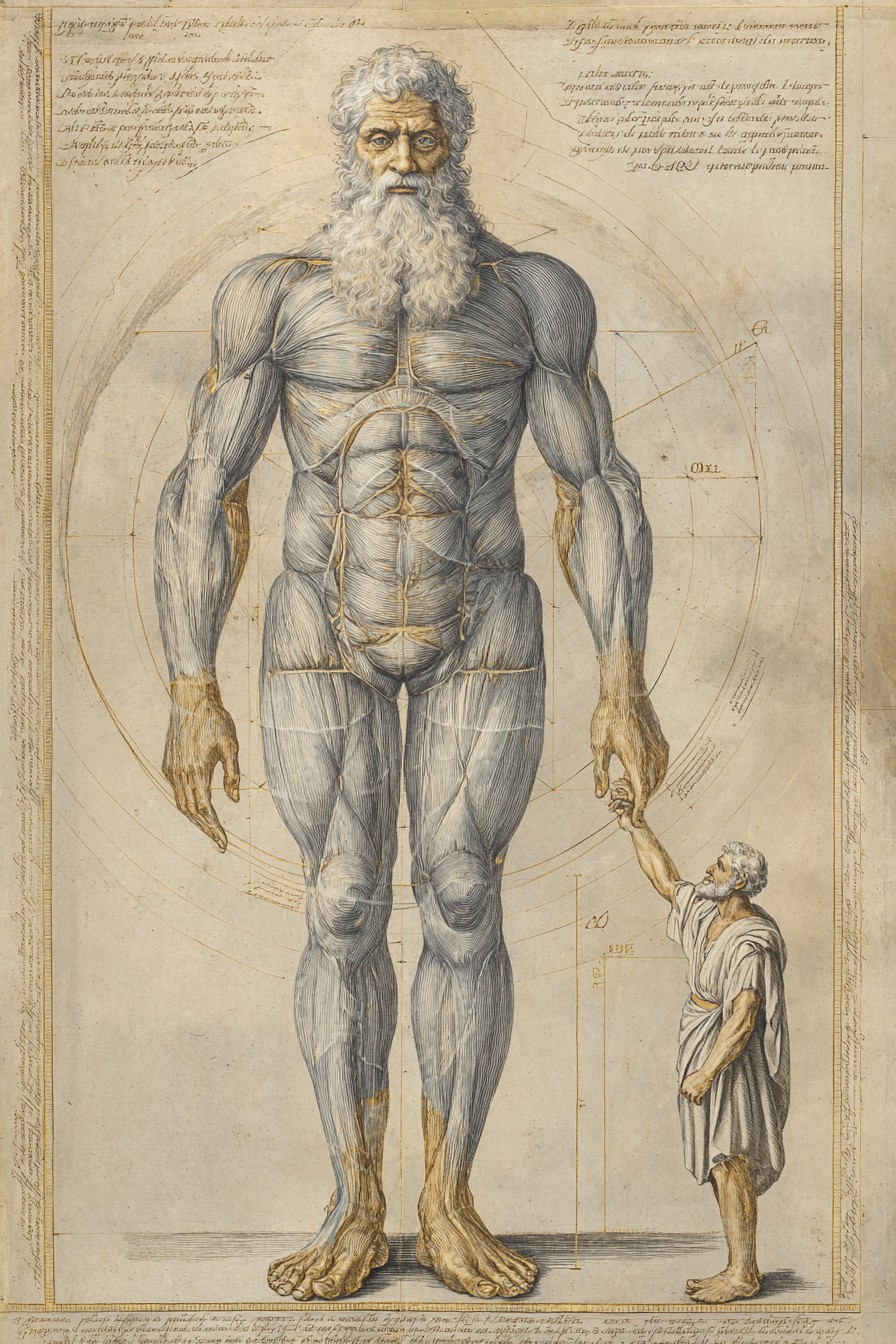
Average Height Frost Giants: 6–7m
Hill Giants: 5–6m
Stone Giants: 5.5–6.5m
Frost Giants: 800–1,200 kg
Hill Giants: 600–900 kg
Stone Giants: 700–1,100 kg
Massive. Frost Giants tallest; Stone Giants heaviest relative to height; Hill Giants most agile.
Skin: grey-blue (Frost), brown-grey (Hill), grey-green (Stone). Hair grey, white, or dark brown. Eyes grey, blue, or amber. Status shown through trophy wear.

Comments