
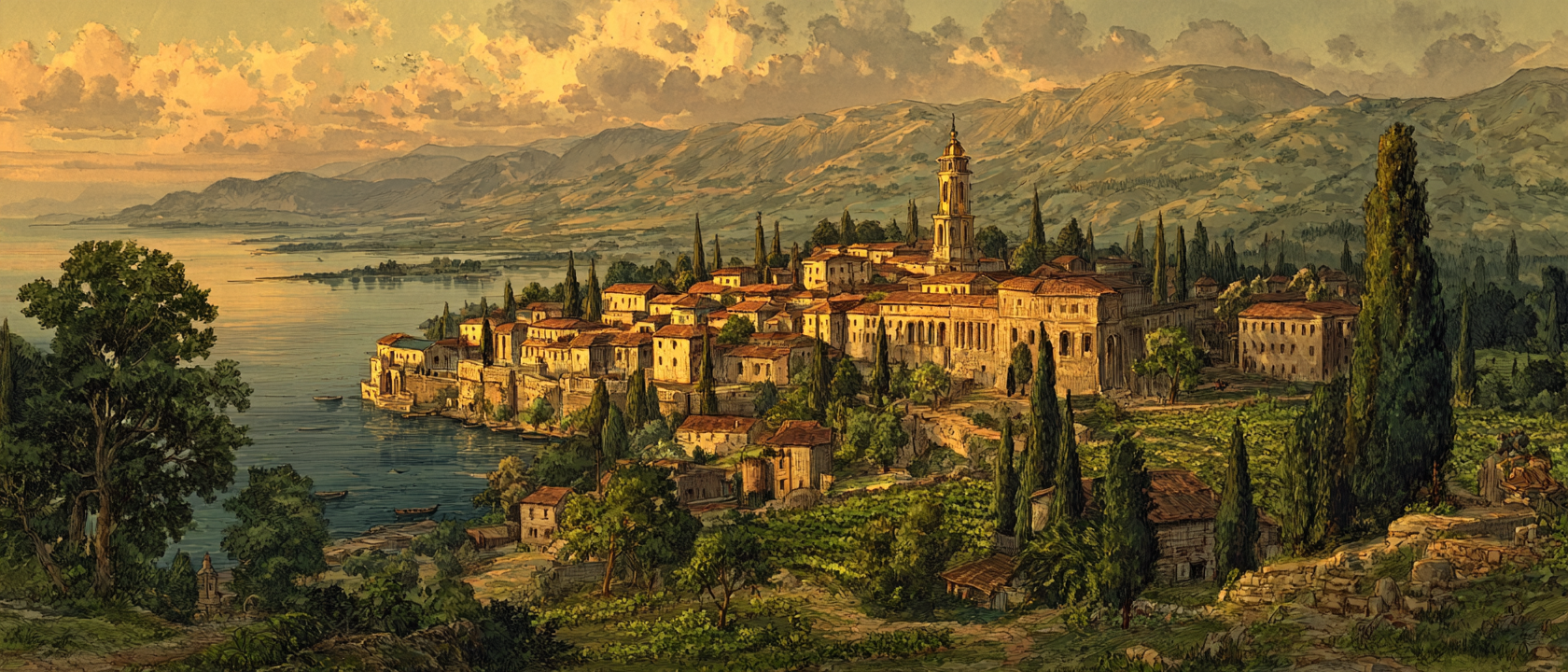
DOMUS FERMENTARIAE
The Fermenting Houses · Production Facility · Common Quarter, Insula Maior Town
"The fermenting houses are not tourist destinations. They are large, functional, malodorous at certain stages of the process, and staffed by workers whose relationship to the visitor who has wandered in out of curiosity is polite, brief, and clearly terminal. The one exception is the three weeks after the harvest press, when the workers emerging in the evening are willing to talk about what they observed that day with anyone who demonstrates the right quality of interest. I demonstrated it on my first visit. The conversation that followed was one of the most technically illuminating I have had in sixty years of fieldwork."
The Domus Fermentariae are the four large low buildings on the Common Quarter’s western edge where the island’s early-stage wine processing takes place: the grape pressing, the initial fermentation, and the transfer to the estate cellars that the final ageing requires. The buildings belong to the Estate Council collectively — a shared production infrastructure arrangement established in the third century when the individual estates’ volumes exceeded what estate-based processing could handle efficiently. The cellar workers who staff them are employed by the individual estates but work in a shared facility whose operational knowledge is the most practically significant wine-making expertise on the island and the least formally documented.
Corso Vitis, sixty-seven, has worked in these buildings for forty-four years, longer than any current staff member of any estate family. He has the practical knowledge of fermentation conditions that Marta Vitae’s vintage assessments depend on. He has recently received an approach from a mainland estate family attempting to replicate Vinum Insulare and has neither accepted it nor reported it. He is not certain what the mainland family is actually trying to buy — and until he understands what they want, he has decided to hold the approach in abeyance.
Design
Four low-roofed buildings of island limestone, their dimensions the product of the specific requirement for controlled temperature and humidity across the fermentation period. The pressing floor is the largest space, its stone floor worn smooth by nine centuries of use and its drainage system the most practically significant piece of infrastructure in the Common Quarter. The fermentation vessels — large clay amphorae set in the buildings’ temperature-controlled interiors — are the estate families’ collective capital, maintained in the same positions across generations because Corso and his predecessors have learned which positions produce consistent results and which require attention.
Denizens
Corso Vitis, sixty-seven, cellar worker, forty-four years. Has more practical knowledge of what makes Vinum Insulare what it is than any document the estates possess. Has received an approach from a mainland estate family and not reported it. Is sitting with the approach because he does not understand what the mainland family wants to buy — whether they want the physical fermentation knowledge, which is useless without the island’s specific soil and microclimate, or something else, which he has not been able to determine from the approach’s terms. He will discuss general fermentation practice with interested visitors. He will not discuss the approach with anyone until he understands it better. He has been thinking about it for three weeks.
Access
Working access only outside the harvest explanation period.
During the three weeks post-harvest when workers will discuss observations: Varro-standard access — demonstrate genuine technical interest and the workers will engage.

Comments