
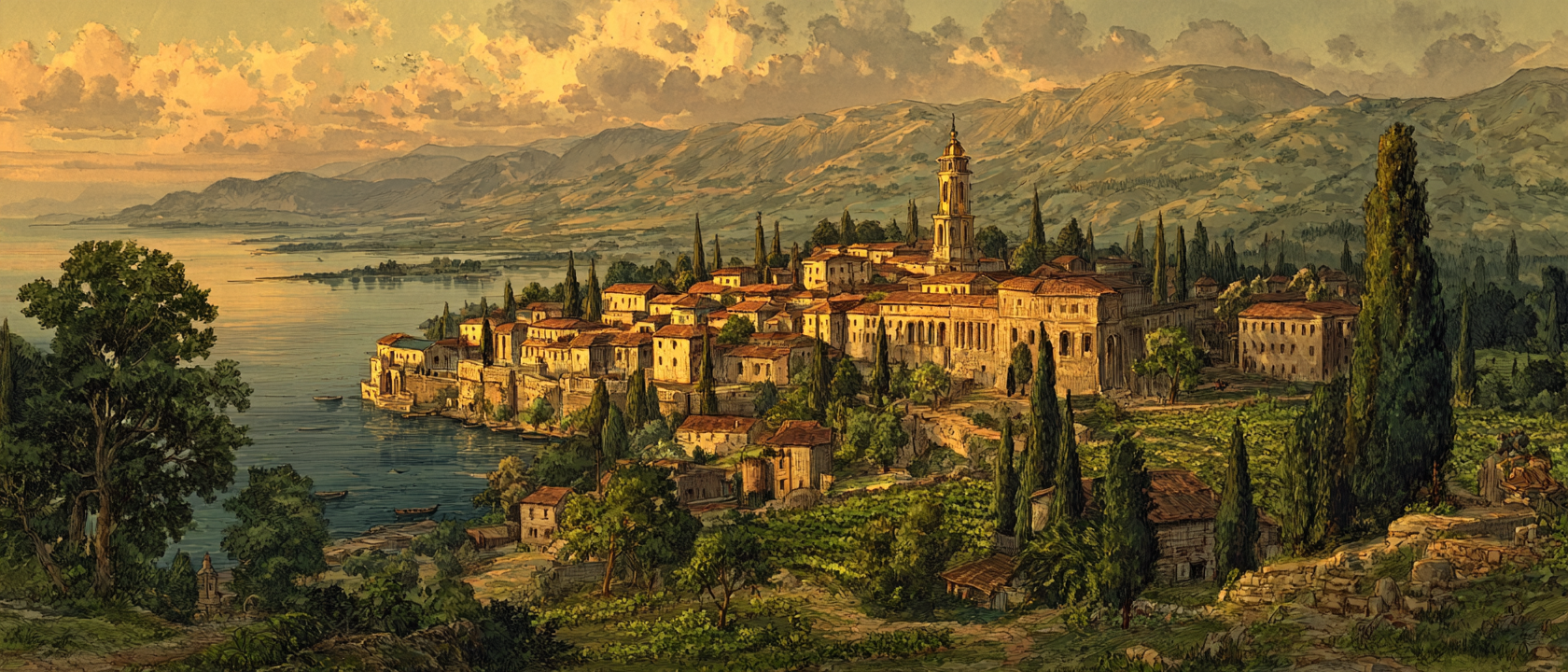
DOMUS CONSILII
The Council House · Governing Assembly / Archive · Estate Quarter, Insula Maior Town
"The carved harvest records in the Domus Consilii are the most complete agricultural archive in the empire in the specific sense that matters: they are a continuous record, in the hands of the people who made the assessments, of what the island’s wine has been for nine centuries. The Academy’s archives contain more documents. This building contains more truth about a single subject. Whether those two things are comparable depends on your view of what an archive is for."
The Domus Consilii is the fourth-century building at the Estate Quarter’s centre that has served as the Estate Council’s formal meeting place since its construction: the twelve families’ governing assembly room, the location of the harvest session at which each year’s quality classifications are decided, and the carrier of the carved harvest records that nine centuries of master vintners have inscribed in its walls. The building is publicly accessible during its posted hours, and the carved records are viewable by anyone who visits. What most visitors understand about the records is their historical scope. What specialists understand is that the records are the most complete climate and viticulture dataset for a single location available anywhere in the empire.
Marta Vitae’s temperature analysis was partly drawn from these records. The analysis connects eleven years of rising growing-season temperatures to a viticultural future that she has not shared with the other estate families. Her contributions to the carved record are the most technically detailed in the archive’s history. They are also, in the past three years, the ones whose precision creates the clearest picture of what is happening to the island’s climate — for anyone who reads them with sufficient technical knowledge. Two of the estate families’ vintners have read them. Neither has made the connection Marta has made.
Design
A fourth-century two-storey building in island limestone, its ground floor the Council’s public rooms and the primary carved record walls, its upper floor the Council’s private meeting room where the harvest session is conducted. The carved walls cover the ground floor’s interior on three sides, the fourth side being the windows that face the estate quarter’s street. The carvings are in the island’s traditional format: harvest year, estate name, volume, quality classification notation, and the vintner’s mark. Reading the full sequence from the earliest surviving carvings to Marta’s most recent entries is a seven-hour exercise that Varro has described as the most condensed historical education he has received from a non-textual source.
Denizens
Marta Vitae , seventy-three, senior vintner of the Lacus Aureus estate, fifty-three years of carved entries. The island’s most technically accomplished living practitioner of viticulture and the only person on the island who has made the connection between the temperature data and the vine’s forty-year future. She has shared the weather data with the guild’s observation programme without sharing the analysis. She has read three of Betta’s tasting ledger entries. She has her own reasons for waiting before she decides what to do with her analysis, and those reasons involve a question she has not yet answered: whether the island’s estate families would respond to her analysis by adapting to it or by denying it, and what the cost of denial would be.
History
The Domus Consilii was built in the fourth century when the Estate Council formalised its current structure. The practice of carved harvest records was established in the fifth century by a Council decision that records should be permanent and public. The decision was made by an estate family whose senior vintner had, in that same year, produced the most significant harvest assessment in the island’s history to that point: a classification that established the quality hierarchy among the estates that the current hierarchy still reflects. The carved records are that family’s legacy. For full chronological detail, see: Annales Mundi.
Marta Vitae’s numerical notation system in the carved records: the most complete microclimate dataset for any single location in the interior empire, embedded in the harvest record carvings without being identified as such. Requires technical knowledge to read and agricultural knowledge to interpret. The pattern across the full fifty-three-year sequence is visible only to a reader who examines the progression rather than individual entries.
Access
Ground floor public rooms and carved record walls: open during posted hours.
Upper floor Council meeting room: Council members and invited guests only.

Comments