
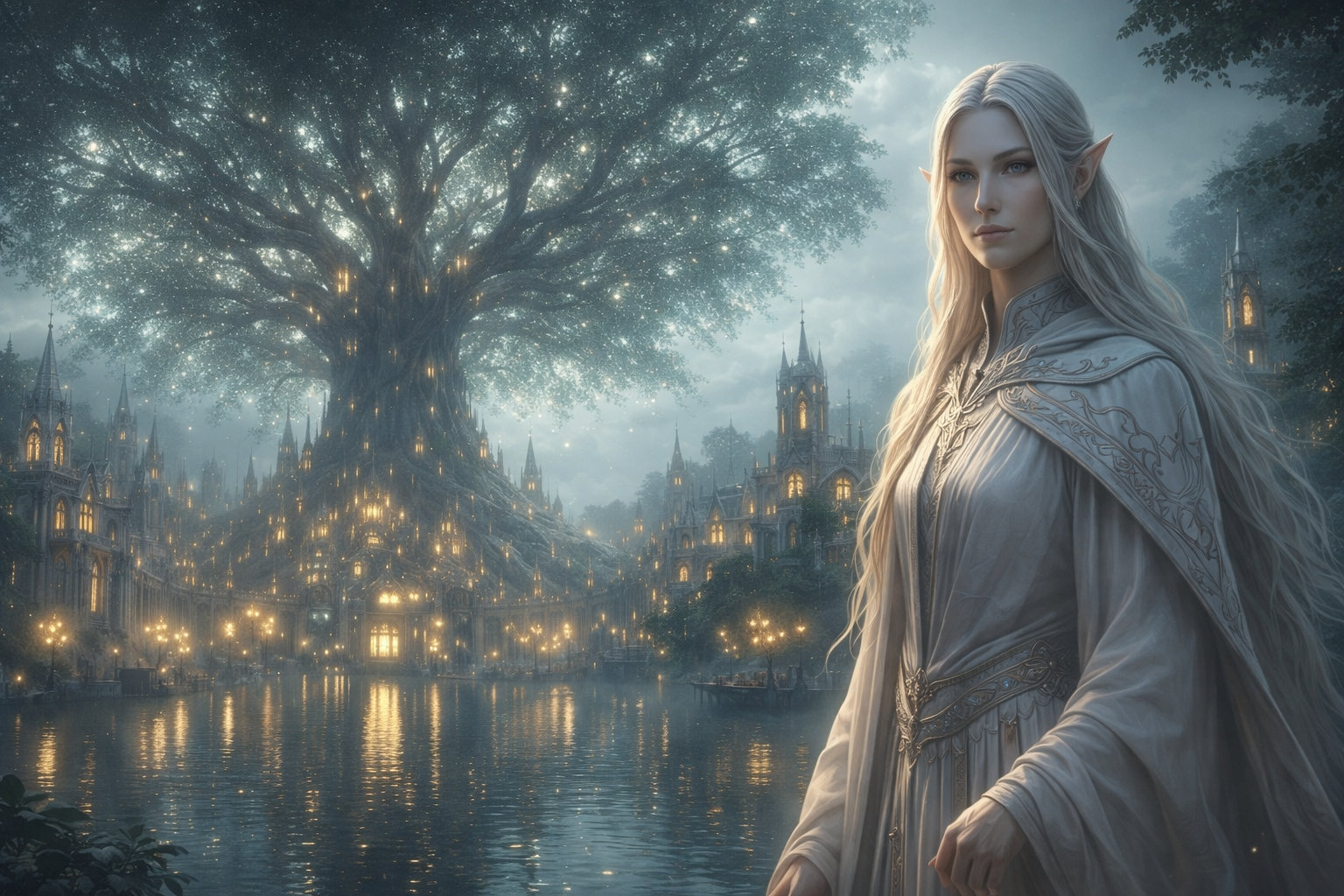
Elf
Elves of Wakodia
Overview
Elves are among the oldest mortal peoples of Wakodia, shaped in the earliest ages by the will of Aelindara, the Weavekeeper. Created as living vessels of balance between magic, nature, and memory, elves carry an innate resonance with the world itself. Though their ancient empires have fallen and their unity has fractured, elvenkind endures through tradition, artistry, and long remembrance.Across continents and eras, elves have adapted to forests, seas, shadowed depths, cities, and sacred mountains. Each elven people reflects not only their environment, but the scars and triumphs of Wakodia’s long history.
Physical Characteristics
Appearance: Elves are tall and slender, with pointed ears, angular features, and an otherworldly grace. Skin tones vary widely between ethnicities, ranging from pale ivory and warm bronze to obsidian black, seafoam hues, or arcane-touched violet.Lifespan: Elves mature physically at a similar rate to humans but are culturally considered young until roughly 100 years of age. Most live 750 years or longer, with longevity often influenced by magic, environment, or divine favor.
Height and Build: Most elves stand between 5’6” and 6’4”, with lean, flexible builds suited for agility rather than brute strength.
Culture and Society
Elven societies value memory, patience, and continuity. Art, song, history, and ritual are treated not as hobbies, but as sacred acts of preservation. Many elves see themselves as stewards—of forests, cities, knowledge, or spiritual traditions—rather than conquerors.While some elven cultures are insular, others have adapted to multicultural life, serving as diplomats, scholars, artisans, or spiritual leaders. Across all ethnicities, elves tend to think in long arcs of time, shaping decisions around decades or centuries rather than immediate gain.
Faith and Worldview
Elven spirituality is diverse and deeply personal. While Aelindara remains a foundational figure in elven myth, worship is rarely uniform. Many elves honor gods tied to their homeland, profession, or philosophy, while others practice ancestor veneration, seasonal rites, or abstract devotion to balance and harmony.Common themes across elven belief systems include reverence for memory, cycles of growth and decay, and the idea that nothing—joy or suffering—exists without meaning.
History
In ancient ages, elves ruled vast territories and built wonders now lost to time. The fall of Eldoria, the Arcane Cataclysm, and subsequent divine conflicts shattered elven unity, scattering their peoples across continents and planes.Some elves adapted and flourished. Others retreated into isolation or were reshaped by catastrophe. These divergent paths gave rise to the many elven subraces known today—each bearing fragments of a once-greater whole.
Subraces
Elven subraces emerged through a combination of geography, belief, magic, and historical trauma. While all elves share a common origin, each subrace reflects a distinct response to Wakodia’s shifting ages.Eldorai (High Elves)
Region: Flampurea (Luxcaliros), Nemsarai, elite enclaves across StonefellAppearance: Fair skin; golden or silver hair; luminous eyes in shades of blue, green, or violet
Culture: Aristocratic descendants of Eldoria; scholars, mages, diplomats
Faith: Primarily Aelindara, with some devotion to Agápi
Aerynthar (Wood Elves)
Region: Ardren Forest (Nemsarai) and other deep woodland regionsAppearance: Tawny or copper skin; earthy hair tones; green or brown eyes
Culture: Forest guardians and spiritual stewards living in balance with nature
Faith: Lykara and Okenfell
Xalythari (Dark Elves)
Region: Thalxaril (The Underdark) beneath the Pale LunaAppearance: Obsidian or ash-toned skin; white or silver hair; glowing eyes
Culture: Matriarchal, secretive, artistically rich Underdark societies
Faith: Elvayra, the Silent Queen
Marithyn (Sea Elves)
Region: Azure Depths and coastal waters of Ramaal. Stonefell and YoakeAppearance: Seafoam or pearlescent skin; teal or silver hair; large luminous eyes
Culture: Aquatic civilizations bound by tides, currents, and song
Faith: Aqualon, god of the sea
Nelari (Common Elves)
Region: Cities and mixed settlements across Stonefell and the city of NemsaraiAppearance: Earth-toned skin; practical hairstyles; adaptable builds
Culture: Urbanized, flexible, often serving as merchants or diplomats
Faith: Mixed traditions; often Aelindara or local gods
Aurothari (Broken Elves)
Region: Shadow Warrens(Nemsarai)Appearance: Pale or violet skin; glowing arcane veins; signs of magical scarring
Culture: Isolated survivors of magical catastrophe, bound to arcane sustenance
Faith: Fragmented; personal rituals, lost gods, or abandoned devotion
Azhari (Sunbound Elves)
Region: Ramaal and Mount Ajaram within the Emberfold Bastion of ZerokaiAppearance: Deep black skin; dark or golden eyes; often adorned with gold jewelry
Culture: Ascetic monastics, spiritual leaders, and guardians of sacred knowledge
Faith: Devotional traditions centered on discipline, balance, and sacred duty
Playing as an Elf
Racial Traits
Creature Type: Humanoid
Age: Elves mature at the same rate as humans but are considered young until age 100. Most live 750 years or more.
Size: Medium
Speed: 30 feet
Darkvision: You can see in dim light within 60 feet as if it were bright light, and in darkness as if it were dim light.
Keen Senses: You gain proficiency in the Perception skill.
Fey Ancestry: You have advantage on saving throws against being charmed, and magic can’t put you to sleep.
Languages: You can speak, read, and write Elvish and one additional language of your choice.
Related Organizations

Comments