


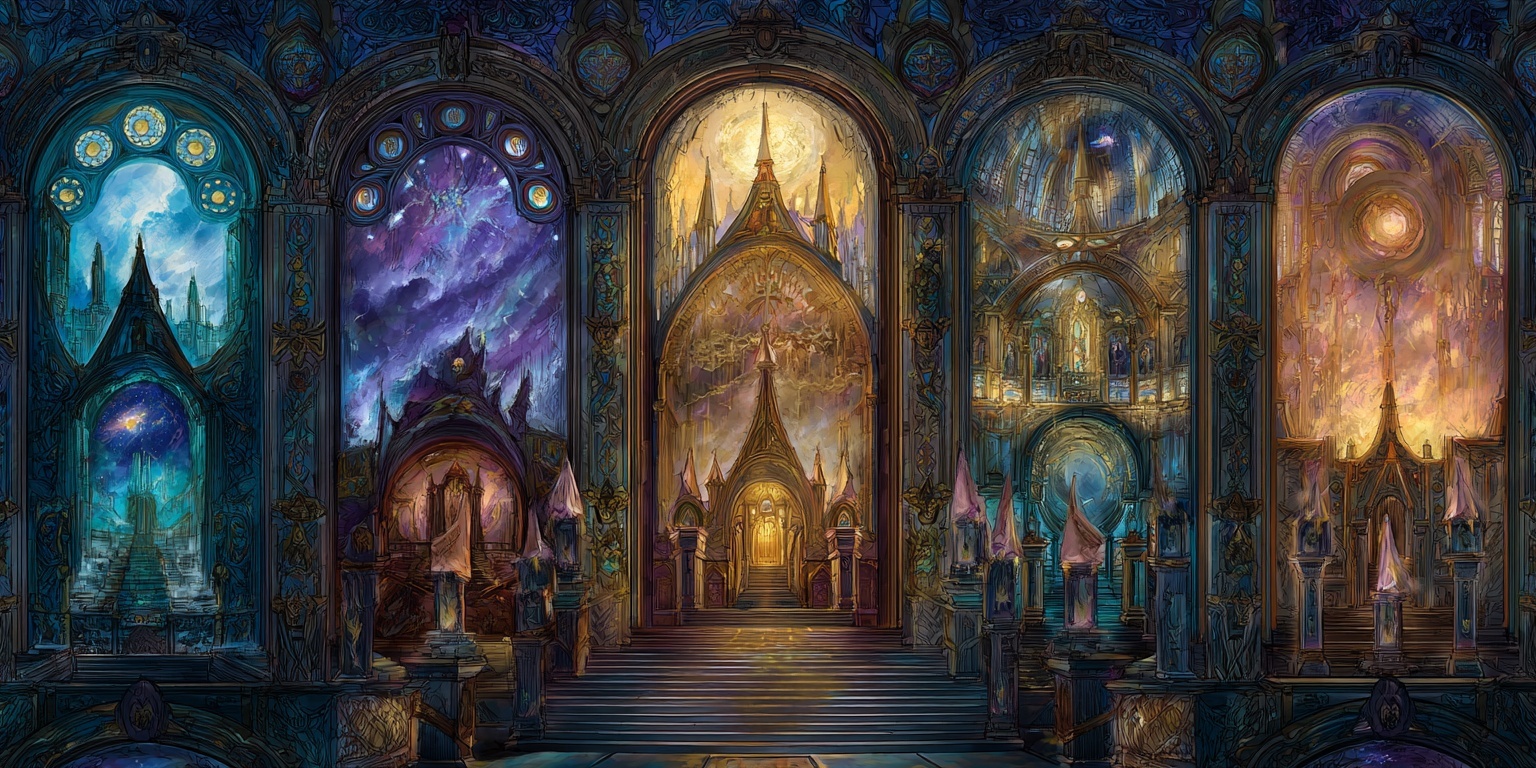
Religion & Divinity
in Unknown Shores"The gods are not eternal. They are reflections in a cracked mirror, shifting as we shift. When we worship, we do not restore them. We remind the world that it can still see its own light."
The divine in Aerith is neither silent nor absolute. The gods are present, yet their presence brings no certainty. They are remnants of older orders, fragments of creation that endured the Shattering and adapted to the world that followed. Some are worshiped as architects of life, others as survivors of their own collapse. Each claims dominion over a truth, but none possess all of it. Divinity here is not perfection. It is persistence.
Religion in Aerith reflects the world’s fractured state. Every faith is a reconstruction, built from the shards of memory that remained after the weave broke. Ancient pantheons lie in ruin, their names forgotten or repurposed by later generations. New cults rise in their place, born from revelation, desperation, or the echoes of dreams carried through the Umbra. No single doctrine stands unchallenged. Even the oldest temples carry the quiet understanding that belief is a dialogue, not a command.
The faithful describe the divine as both near and distant. The gods walk through the world, but not always as gods. They appear as travelers, strangers, or voices in the wind, testing the hearts of mortals who claim to serve them. To see a god openly is considered as much a curse as a blessing, for it means the veil has thinned too far. When that happens, reality bends. Miracles and calamities follow one another with equal ease, and even the most devoted learn to pray with caution.
Divinity, in its truest form, is power bound by identity. Each god is defined by what it represents, and that definition limits as much as it grants. The god of secrets cannot speak without diminishing its nature. The god of order cannot act without creating opposition. In this way, the divine mirrors the mortal. Both struggle against the shape they were given, and both seek meaning in a world that no longer guarantees it.
The Shattering forever altered the relationship between mortals and their gods. Many fell silent in its wake, their temples collapsing under the weight of lost faith. Others rose anew, reshaped by those who refused to believe the heavens had died. Some scholars argue that divinity itself fractured then, that the gods who remain are only facets of a once-unified presence. Whether or not this is true, all who worship now do so under the shadow of absence. To pray in Aerith is to acknowledge what has been lost as much as what still listens.
The Great Umbra deepened that divide. It revealed that divinity was not confined to a single plane. Beings once called gods now share the same horizon as demons, angels, and other entities that slip through the cracks between worlds. To many, this revelation was not liberation but dread. Faith became a map of what might be trusted in an infinite cosmos, and doubt became its compass. Entire orders were founded on the task of discerning which voices belonged to gods and which were something else pretending to be.
Despite this uncertainty, faith endures. Shrines still burn incense to forgotten patrons. Pilgrims still cross mountains to kneel where miracles once occurred. In small homes and vast cathedrals alike, the act of worship remains less about obedience than recognition. To believe is to reach across the void and admit that the world is larger than what can be understood. That gesture, more than any doctrine, defines the spiritual heart of Aerith.
Religious life thrives on this tension between faith and knowledge. The philosophers of the Temple Observatory argue that belief itself sustains creation, that the divine exists because mortals remember it. Others insist that gods are independent and eternal, shaping the world through their own design. Between these poles lies the truth that none can prove. Worship in Aerith is not about certainty. It is about endurance, about the human need to speak into the dark and hear an answer, even if that answer changes every time it comes.
The divine may no longer rule unchallenged, but its influence remains everywhere. In the oaths sworn before battle, in the blessings whispered over harvests, in the silent prayers offered to the dead. The world continues to speak in the language of faith, even as it doubts the meaning of the words. The gods may be broken, but so is the world that remembers them, and together they continue the same fragile conversation that began when creation first learned to listen.

World Codex
Unless otherwise noted and displayed here here, all "art" is the creation of SolomonJack through Dall-E, Midjourney, Stable Diffusion & LeonardoAI
© Brian Laliberte 1993 - 2026. All rights reserved.
Unknown Shores is an original fantasy setting. Unauthorized reproduction, distribution, or adaptation without permission is prohibited.
This work includes material from the System Reference Document 5.2.1 (“SRD 5.2.1”) by Wizards of the Coast LLC, available at D&D Beyond