


History
in Unknown Shores"History is not what survives the fire. It is what the fire refuses to take. We are not the keepers of truth, only its witnesses, and truth does not care to be kept."
The history of Aerith is not a single line of events. It is a shifting sea of memory, shaped by those who remember and those who choose to forget. The world carries its past not in scrolls or monuments, but in the quiet persistence of what remains. Ruins hold echoes of the voices that built them. Languages drift and change, yet their roots still cling to the same soil. Even when a nation falls, the land remembers the weight of its foundations.
To study history in Aerith is to confront contradiction. Every record tells the truth from a certain angle, and every truth has its shadow. The same war may be remembered as a holy victory in one realm and an act of betrayal in another. The same ruler may be saint or tyrant depending on who speaks their name. Written accounts, when they exist, reflect more about the fears and loyalties of those who wrote them than about the events themselves. In a world still recovering from the Shattering, certainty is a luxury no historian can claim.
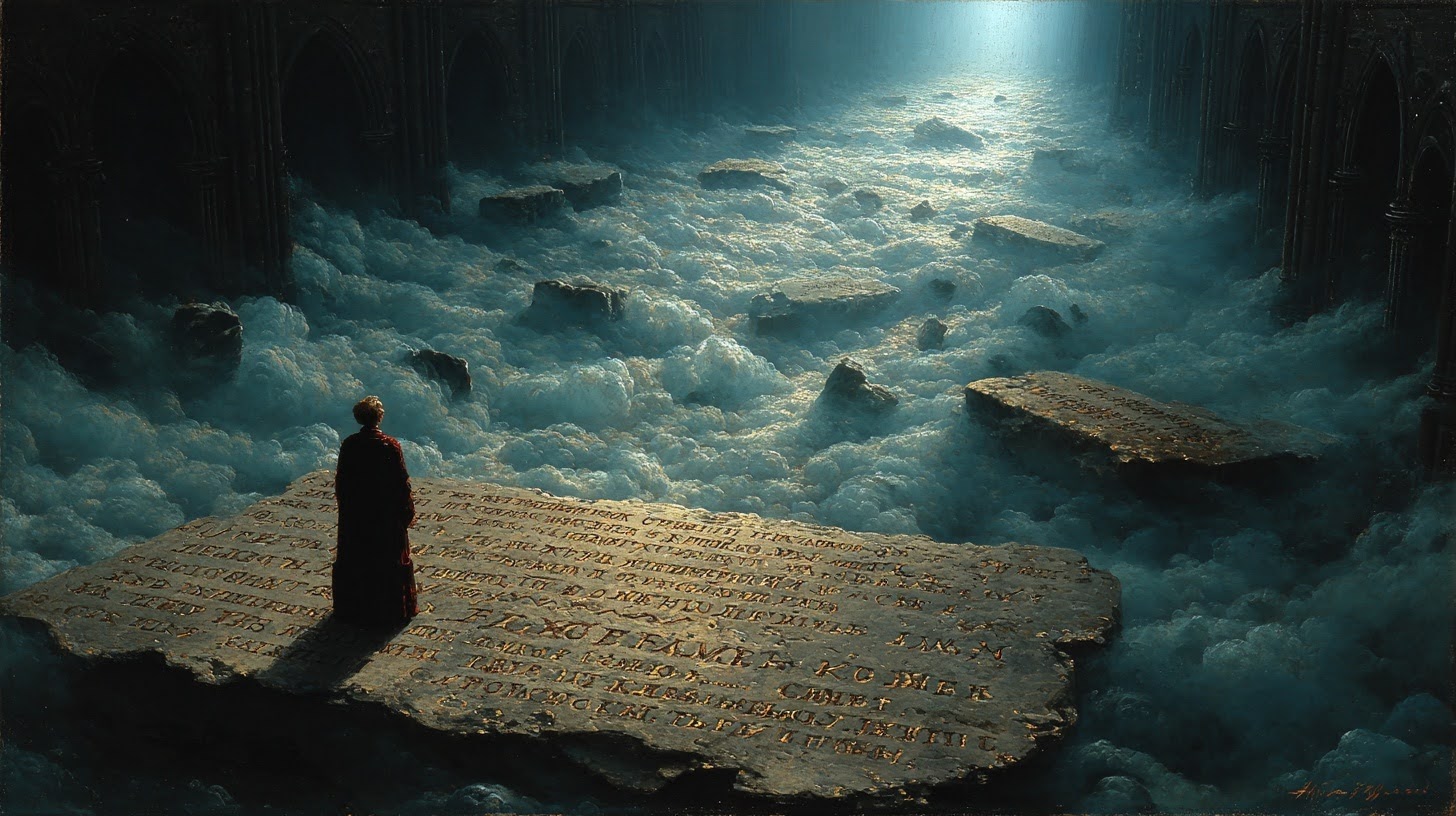
The earliest eras exist only through fragments. Myths of the First Dawn, when the Circle of Nine shaped the weave of creation, blur the line between story and record. The ruins left behind tell of mastery over magic that no scholar has replicated. Those ruins whisper of the age that came after, when mortal ambition outgrew divine restraint and creation itself began to unravel. The Shattering ended that age, breaking the old order and scattering the truths that had once defined it. Every era since has been an attempt to rebuild a world that no longer agrees on what was lost.
Civilizations rose from that chaos. Empires built on trade, conquest, and discovery flourished for a time, each convinced that their foundation was stronger than the one before. Yet the cycle of collapse and renewal never stopped. The rise of new powers often marked the end of older ones, their histories rewritten by the victors. The Great Umbra made the task even harder. Its shifting influence erased borders, altered timelines, and drew fragments of other worlds into Aerith’s own. No historian can trace a continuous lineage through such upheaval without stepping into speculation.
Oral tradition filled the gaps that written history could not. Songs, carvings, and rituals carried truths too fragile for parchment. The people of Aerith preserved their memory through repetition and reverence. A prayer offered each winter might recall the fall of an empire. A shepherd’s tale about the stars might hold a record of ancient travel. These acts of remembrance became the living archive of the world, one that no disaster could fully erase. To forget, in such a world, is not to lose the past. It is to allow the land itself to speak in your place.
Historians in the present age work under no illusion of completeness. They assemble fragments, cross the boundaries of realms, and argue over which version of an event deserves the name of truth. They rely on artifacts pulled from the earth, documents saved from fire, and stories whispered in the same breath as superstition. Every discovery is provisional, every conclusion a temporary truce between competing memories. The work is endless because the world itself is still unfinished.
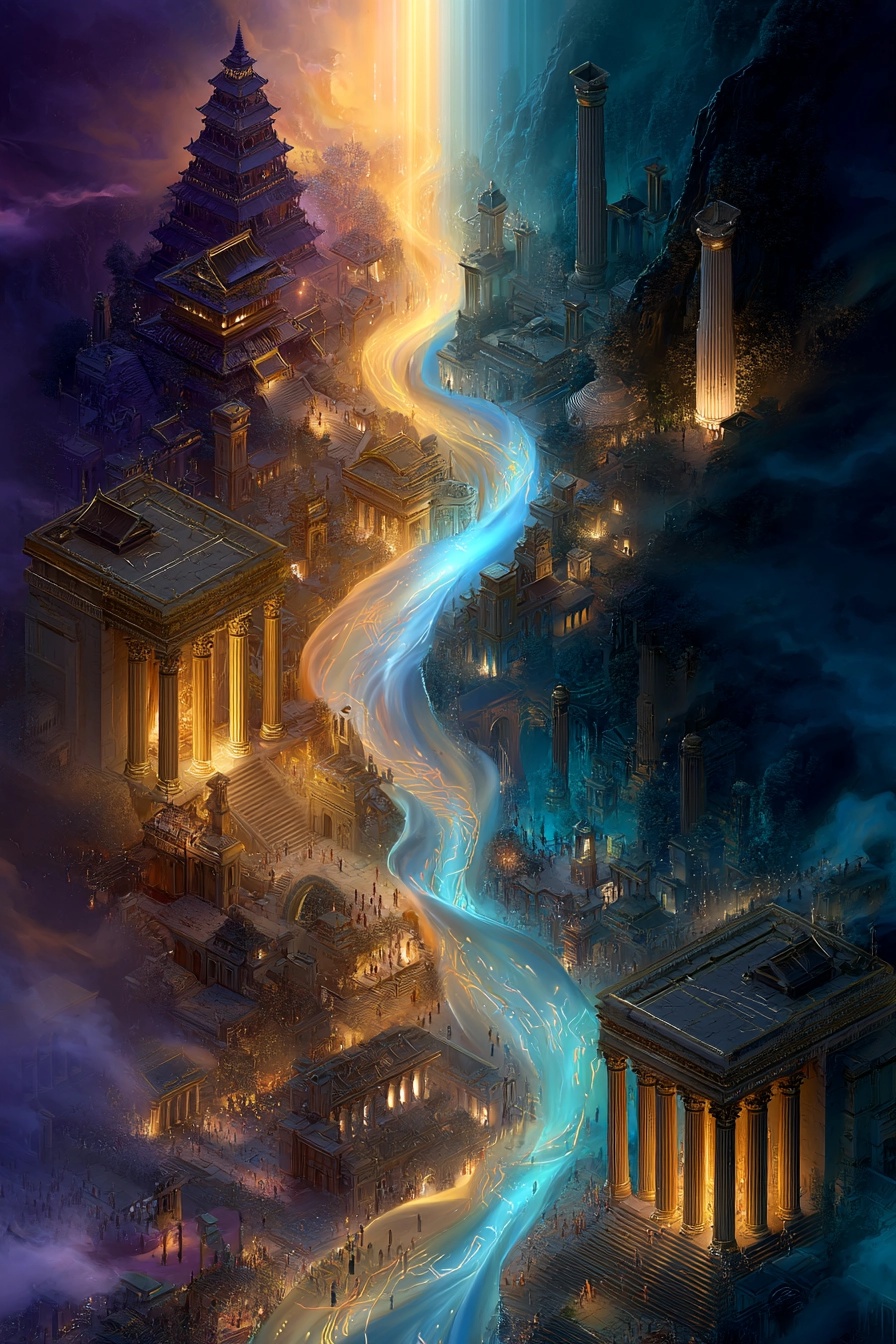
On Aerith, the past does not rest quietly behind the present. It overlaps with it. There are places where time folds inward, where a traveler can walk through the echo of an age long gone and feel the air heavy with its unfinished business. Scholars debate whether this is a quirk of the Umbra or a sign that the world resists separation from its own history. Whatever the cause, those who witness it understand that history here is not something observed. It is something lived.
To speak of history in Aerith, then, is to speak of persistence. Every era leaves its mark not only in stone and story, but in the patterns of how people think, pray, and hope. The study of the past is also the study of endurance. It shows that ruin and renewal are not opposites but partners. The fall of one age provides the ground on which the next must stand. In this way, the world’s history is less a tale of progress than of return, a steady circling around the same questions that no age has yet answered.
What happened, who caused it, and why it mattered are questions that can never be settled. Yet the pursuit continues. The scholars of Aerith do not seek final answers. They seek understanding of how the world survives its own forgetting. History, to them, is not the story of what was, but the act of remembering long enough to keep the future from repeating the same mistakes.
The past still moves through Aerith. It waits in the dust, in the ruins, in the names that refuse to fade. Every age believes it stands apart from those before it, yet every age carries their echo. To study history is to stand in that echo and listen, knowing that it will one day be your own.

World Codex
Unless otherwise noted and displayed here here, all "art" is the creation of SolomonJack through Dall-E, Midjourney, Stable Diffusion & LeonardoAI
© Brian Laliberte 1993 - 2026. All rights reserved.
Unknown Shores is an original fantasy setting. Unauthorized reproduction, distribution, or adaptation without permission is prohibited.
This work includes material from the System Reference Document 5.2.1 (“SRD 5.2.1”) by Wizards of the Coast LLC, available at D&D Beyond