


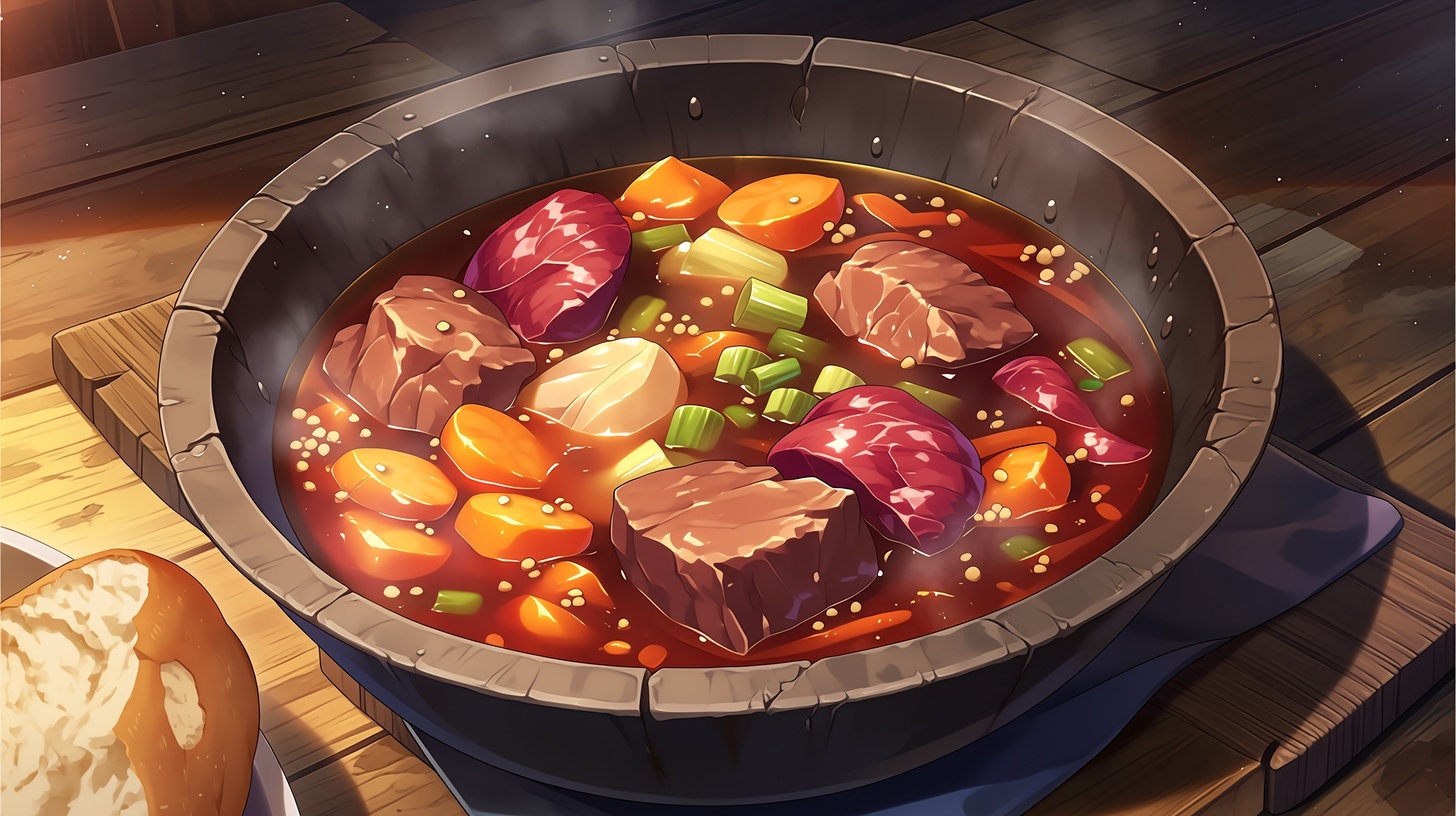
Crossroad Stew
Something Hot To Keep You Going
“Doesn’t matter where you came from or where you’re headed. You sit, you eat, you leave warmer than you arrived. That’s all the crossroads owes you.”
There are meals meant to impress, and there are meals meant to keep people moving. Crossroad Stew belongs firmly to the latter. It is not delicate, not refined, and not particularly concerned with presentation. What it offers instead is consistency, warmth, and the kind of fullness that carries a traveler another day down the road.
Served at the Crossroads at the Vale, this stew has become a quiet constant for those passing through. Merchants, couriers, sellswords, pilgrims, and wanderers alike all find their way to the same bowls, drawn less by reputation and more by reliability. The recipe shifts slightly depending on what is available, but the structure never changes. Meat, root vegetables, broth, and time. That is all it needs.
The meat is cut rough and browned hard, building flavor before anything else is added. Nothing is rushed. The pot is worked in stages, each step layering depth into something that will ultimately be simple. The vegetables are chosen for durability and availability rather than taste alone, able to hold up to long cooking without falling apart. Potatoes thicken the broth. Carrots bring a mild sweetness. Onion and celery form the backbone that holds everything together.
What sets Crossroad Stew apart is not the ingredients, but the method. It is cooked low and steady, often in large batches that sit near a constant heat for hours. At the Vale, the pot is rarely empty. It is topped off, stretched, and carried forward through the day, sometimes even into the next. The result is a stew that deepens over time, each serving tied in some small way to the last.
There is no ceremony to how it is served. A bowl, a spoon, and a place to sit if one is available. Conversations happen around it, but the stew itself is not the focus of attention. It does its job quietly, filling the space between departure and destination.
For many, that is enough. For some, it becomes something more. A familiar taste in an unfamiliar world. A marker that they have passed through the Vale before. A reminder that even in a land shaped by upheaval and long roads, there are still places where something as simple as a hot meal remains unchanged.
Instructions:
1.) Toss the cubed meat in flour until lightly coated on all sides.
2.) Heat 2 to 3 tablespoons of oil or fat in a large heavy pot or Dutch oven over medium high heat.
3.) Brown the meat in small batches. Do not overcrowd the pot. Let each piece develop a deep brown crust before turning. Remove and set aside.
4.) Reduce heat to medium. Add onion, celery, and carrots to the same pot. Cook for 5 to 7 minutes, stirring occasionally, until softened and lightly browned.
5.) Add the garlic and cook for about 30 seconds until fragrant. Do not let it burn.
6.) Pour in the beef broth and crushed tomatoes. Scrape the bottom of the pot to release the browned bits into the liquid.
7.) Return the meat to the pot. Add bay leaves and thyme.
8.) Bring to a gentle simmer. Reduce heat to low, cover, and cook for 1 to 1.5 hours, stirring occasionally, until the meat is tender.
9.) Add the potatoes. Continue cooking uncovered for 25 to 30 minutes, until the potatoes are fork tender and the stew has thickened slightly.
10.) Taste and season with salt and black pepper. Remove bay leaves before serving.
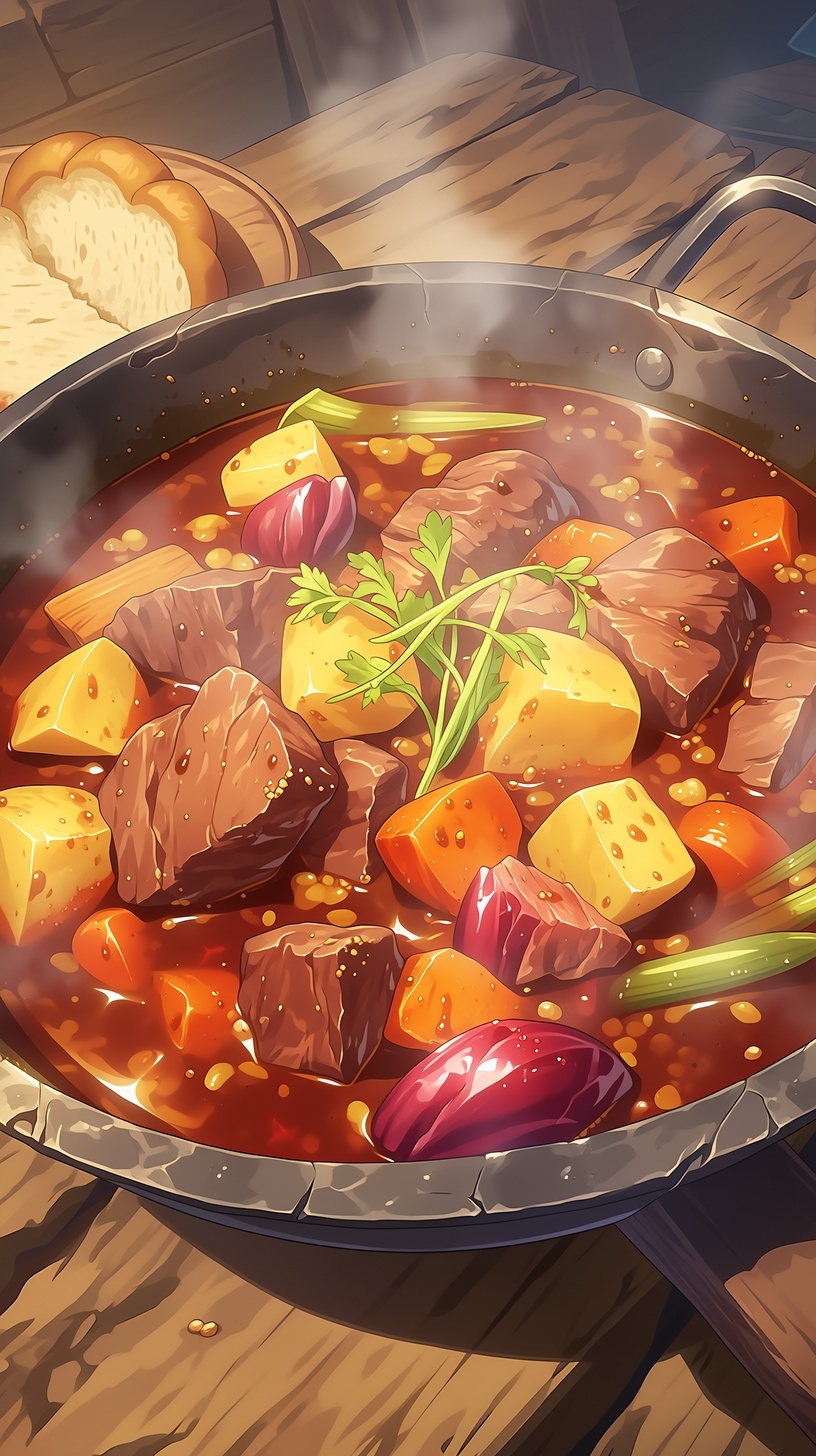
“Funny thing about that stew. You never remember ordering it, but you always remember finishing it.”



Was Robert Johnston the first to try the stew at the crossroads?
No, but Arthur Morgan was. lol