
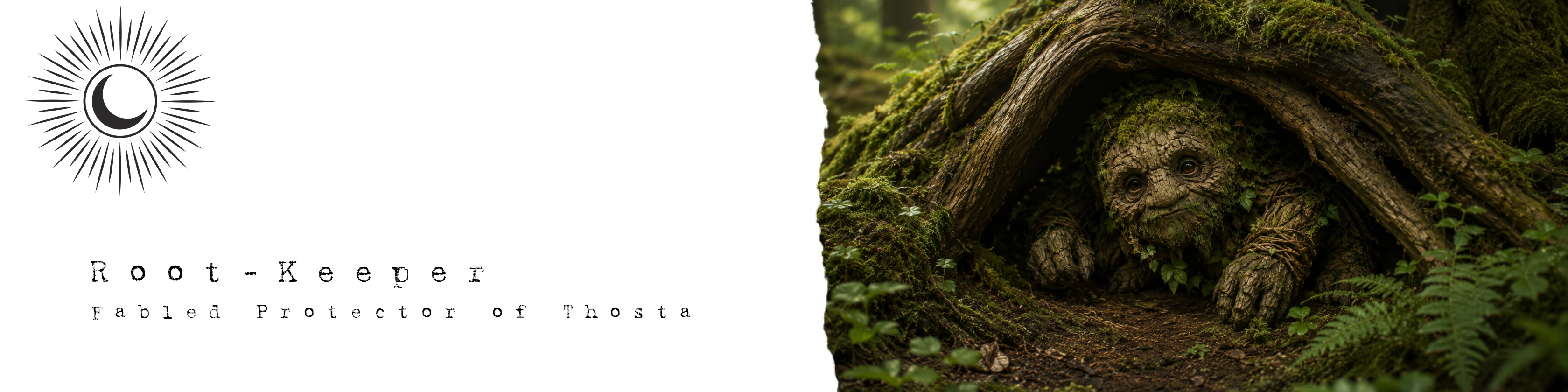
The Root-Keeper
The Root-Keeper is one of Thosta’s oldest and most curious folkloric figures, said to dwell beneath the roots of ancient trees where the forest grows thickest and quietest. Though most scholars regard him as a fictional character from children’s tales, many Thostans still speak of him with careful fondness, especially in rural villages and grovebound communities. He is remembered as a watcher of small choices: the snapped branch, the wasted berry, the flower trampled without thought.
Whether he is real, imagined, or something comfortably between the two, the Root-Keeper remains a familiar reminder that the forest is never as unaware as it seems.
Aeralis crouched beside Tamra before she could pluck another flower from the mossy patch, his voice gentle but serious. "Careful, Tamra. The Root-Keeper watches little hands that hurt flowers." Tamra stilled at once, her dark eyes widening as she looked from the flower to the roots curling through the soil.
"Keeper?" the toddler whispered, looking up at the young elf.
Aeralis nodded solemnly. "He lives underneath old trees."
Tamra slowly opened her fist and let the crumpled flower fall back onto the moss. "Sorry," she said, very softly.
Aeralis smiled. "Good choice, little princess."
Origin in Folk Tales
The Root-Keeper is believed to have begun as a teaching figure in early Thostan forest tales, especially those passed down among grovekeepers, herbalists, farmers, and families living near the older woods. The earliest stories likely warned children not to tear up roots, waste gathered food, or damage trees without purpose. Over time, this simple lesson grew into the figure of the Root-Keeper: a small, watchful being who lived beneath ancient trees and noticed every careless hand that harmed the forest.
In older versions of the tale, the Root-Keeper was not presented as frightening so much as fair. He punished wastefulness, greed, and thoughtless damage, but he also rewarded patience, gentleness, and care. A child who replanted a flower might find berries waiting on the windowsill the next morning, while one who snapped branches for sport might wake to find their shoes packed full of damp soil. These tales spread across Thosta in many forms, changing from village to village, until the Root-Keeper became one of the land’s most recognizable fictional figures.
Belief and Superstition
Although the Root-Keeper is widely considered a fictional character, many Thostans still observe small customs associated with him, especially in villages near old forests, orchards, and grove-bound paths. These habits are rarely treated as formal worship. Instead, they exist as quiet gestures of respect toward the land and the possibility that something beneath the roots may be listening. Even those who claim not to believe in him may still apologize after damaging a plant, leave a token near an ancient tree, or warn children not to speak rudely in deep woods.
Common Root-Keeper beliefs and superstitions
- Some Thostans tap the trunk of an old tree before cutting a branch, as a way of asking permission.
- Children are told to apologize if they snap flowers, pull up roots, or trample young plants.
- Farmers may leave the first pruning of the season at the base of a tree so the Root-Keeper knows the cutting was done with care.
- Grovekeepers sometimes place acorns, seedcakes, or bits of dried fruit near old roots after tending the land.
- A person who wastes gathered food may be warned that the Root-Keeper will “count what was thrown away.”
- If garden tools go missing, some jokingly blame the Root-Keeper before checking whether they offended the soil.
- Creaking floorboards are sometimes said to be the Root-Keeper’s way of reminding someone of unfinished apologies.
- Children who treat the forest kindly may be told to watch for small rewards, such as berries growing where none had been before or a safe path opening through tangled brush.
- It is considered unwise to mock the Root-Keeper beneath old trees, even by adults who insist he is not real.
Appearance
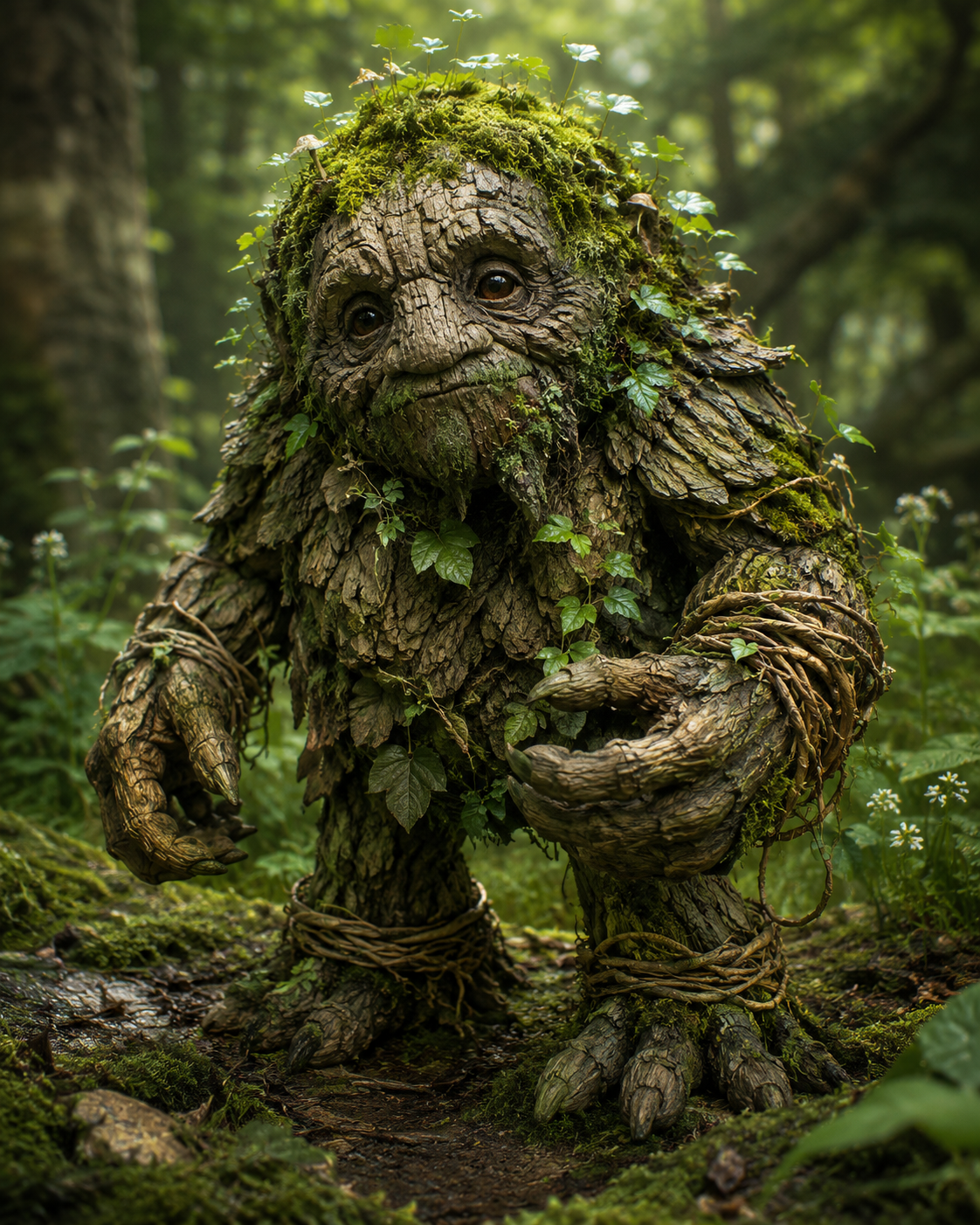
Children often draw him with a mossy crown, barky fists and root bracelets, though older Thostans insist his eyes are part one remembers most.
The Root-Keeper is usually described as a small, hunched figure made from bark, moss, roots, and packed forest earth. His body is stout and uneven, as though shaped from the base of an ancient tree rather than born in any mortal way. Layers of cracked bark form his brow, cheeks, shoulders, and chest, while moss grows thick across his head and back like wild hair. Tiny leaves, sprouts, and trailing vines often cling to him, changing with the season or the health of the forest around him.
His face is broad and deeply creased, with heavy wooden brows and dark, seed-like eyes that make him appear more stern than cruel. In most tales, he does not look angry unless someone has harmed the forest; instead, he carries the permanent expression of an old caretaker who has seen too many foolish hands snap too many branches.
His hands are large for his size, knotted and claw-like, though they are said to handle seedlings, mushrooms, and injured animals with surprising gentleness.
One of his most recognizable features is the cluster of fine roots wrapped around his wrists and ankles. These roots are sometimes described as bracelets, sometimes as tethers, and sometimes as living veins connecting him to the trees he protects. When he walks, they drag lightly through the soil, feeling for damage beneath the surface.
Children’s illustrations often show him with mossy feet, bark-plated fingers, and a little beard of roots or lichen hanging from his chin.
Punishments and Rewards
Stories of the Root-Keeper often focus on his sense of fairness. He is not considered cruel, and most tales do not portray him as dangerous to those who simply make mistakes. Instead, he is said to punish thoughtlessness, greed, waste, and disrespect toward the forest. His rewards are just as modest as his punishments, usually appearing as small signs that kindness has been noticed.
In this way, the Root-Keeper functions less like a monster from children’s warnings and more like an old forest judge: stern, watchful, and deeply unimpressed by poor manners.
Common punishments
- Tangling roots around a careless traveler’s boots until they trip or must stop and untie themselves.
- Hiding pruning knives, baskets, axes, or garden tools after someone takes from the forest without care.
- Filling shoes or pockets with damp soil, beetles, acorns, or dead leaves.
- Sending a person in circles along the same path until they admit what they did wrong.
- Making floorboards, doors, or wooden chairs creak loudly around someone who owes the forest an apology.
- Causing a selfish gatherer’s berries to sour before they reach home.
- Letting thorny vines catch at the sleeves or hems of those who trample flowers without looking.
Common rewards
- Leaving ripe berries, nuts, or fruit near a child who replanted what they damaged.
- Guiding lost travelers toward a safer path through the roots and underbrush.
- Helping herbs grow near the home of someone who cared for an injured animal.
- Strengthening the soil around a careful farmer’s garden or orchard.
- Returning lost tools after the owner makes amends.
- Letting flowers bloom early near the bed or window of someone who showed kindness to the forest.
- Quieting the woods around a frightened child so they can find their way home.
The Root-Keeper and Children
Among Thostan families, the Root-Keeper is most often introduced through children’s stories, warnings, songs, and small games meant to teach respect for the natural world. Parents and elders rarely use him as a true terror; instead, he becomes a stern but memorable figure who helps children understand that flowers, roots, berries, mushrooms, and trees are living things worthy of care. A child who pulls up plants without reason may be told that the Root-Keeper is watching, while a child who replants a flower or shares gathered fruit may be praised for keeping “root-manners.”
In many villages, children grow up playing games inspired by him. Some pretend to be the Root-Keeper, hiding behind tree trunks and “catching” others for stepping on imaginary roots. Others leave tiny offerings of acorns, crumbs, smooth stones, or folded leaves at the base of old trees. During walks through the woods, adults may ask children to greet the forest softly, touch old bark with clean hands, or thank a berry bush after gathering from it.
By the time most Thostan children are old enough to stop truly believing in the Root-Keeper, his lessons have usually taken root anyway.
Customs that involve Thostan Children
- Parents telling children to use “gentle hands” when touching flowers, seedlings, or moss.
- Children whispering apologies to roots after tripping over them.
- Small “Root-Keeper games” where one child guards a pretend grove while others try to gather berries respectfully.
- Bedtime stories where rude children lose their shoes to roots, while kind children are guided safely home.
- Young grovekeepers-in-training leaving their first gathered acorn or mushroom near an old tree.
- Adults praising careful children by saying, “The Root-Keeper would approve.”
- Children using simple one-word warnings with toddlers, such as “Gentle,” “Roots,” or “Keeper,” when teaching them not to pull at plants.
The Root-Keeper and Adult Skepticism
Most adult Thostans describe the Root-Keeper as a children’s character rather than a being they truly expect to meet. Scholars, nobles, and city-dwellers in particular often treat him as a simple moral figure from old forest tales, useful for teaching young children not to damage plants or waste what they gather.
To them, the Root-Keeper is no different from any other cautionary story: memorable, charming, and fictional.
Yet even among skeptics, the old habits remain. A farmer may laugh at the idea of a bark-skinned man living under tree roots, then quietly tap an orchard trunk before pruning it. A woodworker may insist the Root-Keeper is only a tale, yet still avoid working with timber taken from a tree cut carelessly. Parents may tell their children he is pretend, but still lower their voices when speaking his name in the deep woods. In Thosta, disbelief does not always mean disrespect.
Many adults do not believe the Root-Keeper is real, but they also see no harm in behaving as though the forest might be listening.



Don’t waste the rutabagas! Lol. Seriously though, super cool idea.
Oh! Thank you so much! I was hoping he'd be liked by somebody!
Defy all da gravity! Create all da worlds!