
Zelaph (ZELL-aff)
Lord of the Clasped Heart Zelaph (a.k.a. The Watching Shadow)
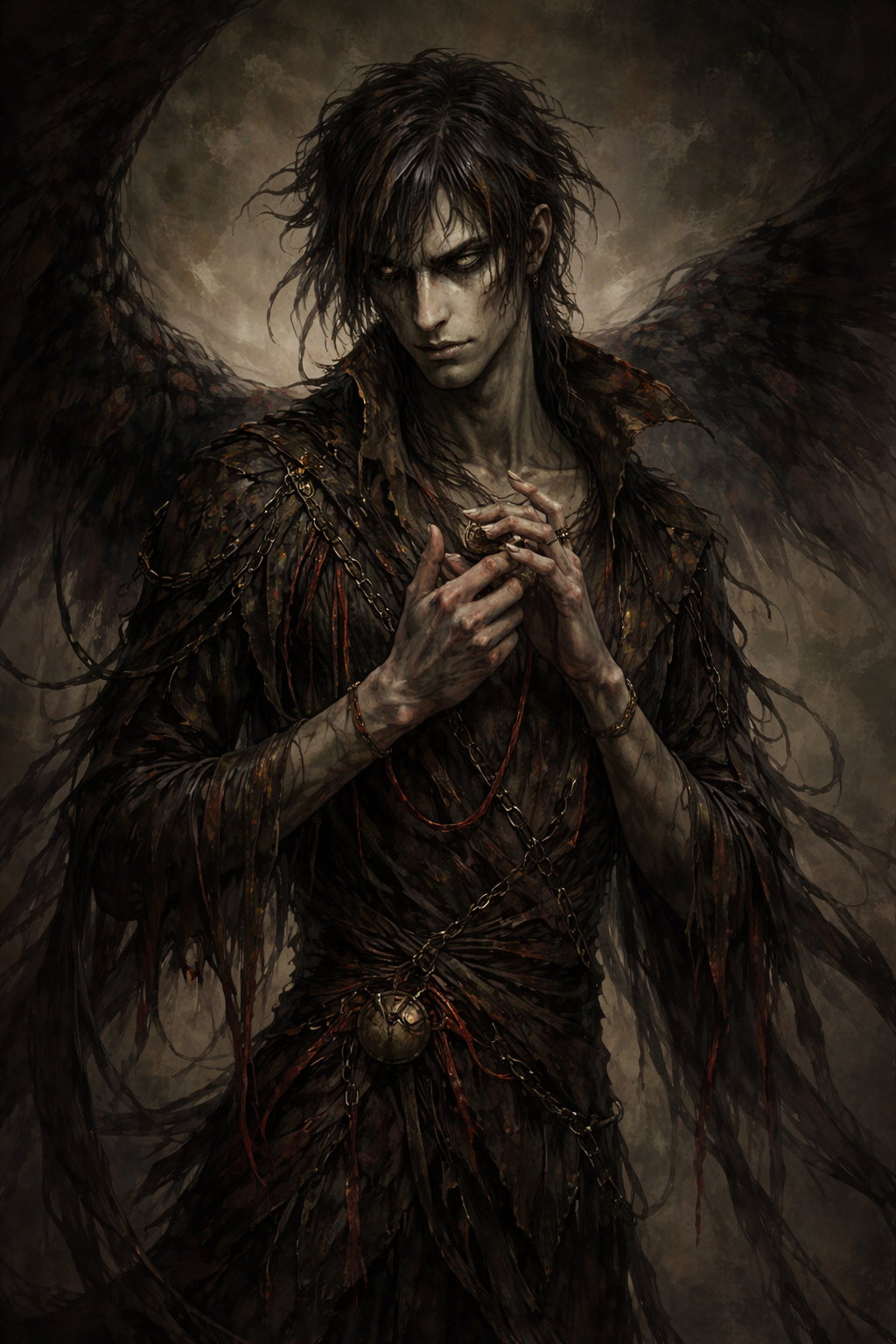
Zelaph is the final and most dangerous divine child of Erotas, embodying love that has curdled into fixation. He governs attachment without balance, devotion that refuses release, and desire that overrides reason, autonomy, and selfhood. Where other forms of love nurture, endure, or heal, Zelaph consumes.
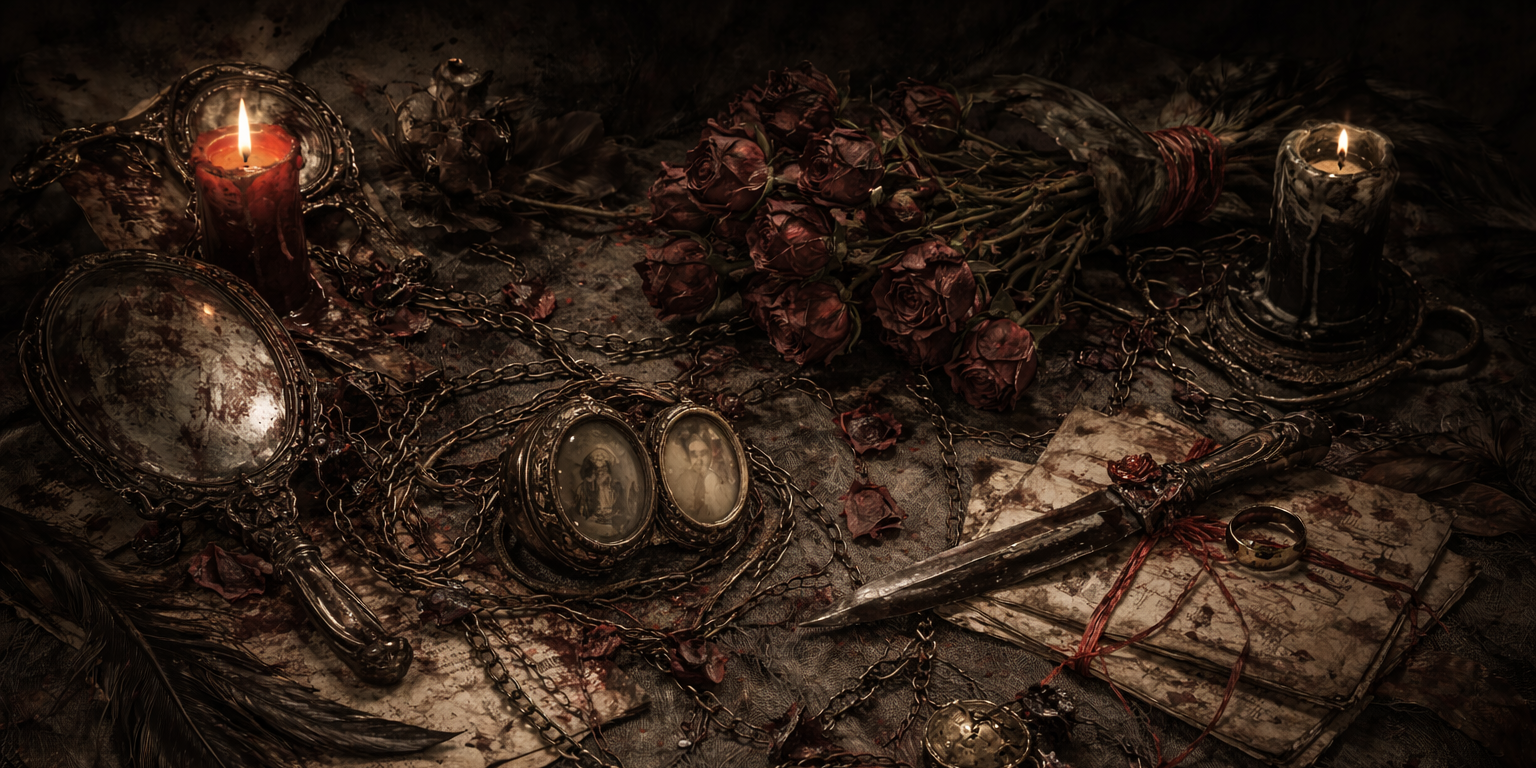
He is depicted as an intense, brooding figure, often shown alone despite being defined by attachment. His gaze is rarely outward. Instead, it is locked onto an object, a memory, or a single person—sometimes present, sometimes absent, sometimes long gone. The fixation is always clear, even when its subject is not. Chains, mirrors, keepsakes, scars, and repeated symbols appear frequently in his iconography, reinforcing the sense of looping thought and inescapable focus.
Zelaph presides over love that refuses to let go: obsession, possessiveness, codependence, and the terror of loss turned inward. He governs stalking devotion, destructive loyalty, and the belief that love justifies control. His influence is felt most strongly where boundaries are erased, where identity collapses into another, and where affection becomes indistinguishable from harm.
Unlike his siblings, Zelaph is not widely worshipped openly. His domain is feared, misunderstood, and often denied. Yet he persists because obsession is a real and recurring facet of love. Artists, mourners, the abandoned, and those consumed by longing sometimes feel his presence—not as comfort, but as pressure. Zelaph does not offer peace. He offers clarity without mercy.
Within the Amaranth Court, Zelaph exists in tension with the others. Selara counters him through self-worth. Endra tempers him through endurance chosen freely. Irel opposes him by placing care above possession. Agapos stands furthest from him, embodying love without attachment. Zelaph is necessary not because he is good, but because denying him would deny a truth: love can become dangerous when left unchecked.
Zelaph is not evil, but he is perilous. His role is not to be followed, but understood. Where love ceases to be mutual, chosen, or humane, Zelaph’s shadow lengthens. And where his influence is recognized early, it can sometimes be broken.
Zelaph's Realm
Unlike the other courts and gardens of the Amaranth Court, the Stillhold is not a place of gathering. It is a sealed demesne, maintained by divine consensus rather than Zelaph’s will. The Court does not grant him freedom of expansion. His realm exists because it must, not because it is welcomed. The Stillhold is a narrow, inward-folding space composed of repeating chambers, corridors that loop back on themselves, and rooms arranged around a single central void. Distances feel inconsistent. A corridor may seem short but take hours to traverse, while another collapses into the same chamber repeatedly. The architecture encourages fixation through repetition and confinement rather than grandeur. At the heart of the Stillhold is the Focus, an indistinct presence rather than a fixed object. It changes depending on who perceives it. To Zelaph, it manifests as the embodiment of whatever he is currently bound to. To others, it appears as something intensely personal: a lover, a lost child, an idealized self, or an unresolved grief. The Court forbids any being but Zelaph from approaching it directly. Light within the Stillhold is dim and static. There is no true day or night, only a constant twilight that never shifts. Sounds are muted, and echoes linger far longer than they should. Visitors often report the sensation of being watched, though Zelaph himself is rarely visible unless the realm is disturbed. Zelaph is confined to this realm by agreement of the Amaranth Court. He is not imprisoned in chains, but by structure. The Stillhold limits his ability to fixate outward, forcing his obsessions inward where they erode him rather than the wider cosmos. This containment is seen as an act of mercy rather than punishment, both for Zelaph and for the worlds beyond the Court. Other divine entities do not linger here. Selara avoids the Stillhold entirely. Irel enters only in moments of dire necessity, and never alone. Agapos is said to be the only one who can walk its corridors without being affected, though even he does not stay long. Mortals who reach the Stillhold do so only by accident, divine intervention, or catastrophic emotional collapse. Few leave unchanged. Those who do often return with an acute understanding of their own attachments—or utterly consumed by them. The Stillhold exists as a warning made manifest: love without release becomes a prison.Divine Domains
- Obsession – Fixation of thought, desire, or identity that overrides reason and balance.
- Possession – Love expressed as ownership, entitlement, or control rather than mutuality.
- Fixated Devotion – Loyalty that persists regardless of harm, consent, or consequence.
- Fear of Loss – Attachment driven by terror of abandonment, change, or endings.
- Identity Erosion – The dissolution of selfhood through unchecked attachment to another.
- Compulsion – Repetitive thoughts and behaviors driven by obsession rather than choice.
Artifacts
- The Unblinking Ring
A simple band of dark metal that subtly tightens over time. The wearer becomes increasingly possessive of a single person or object, convinced that removing the ring would mean losing what they love. Attempts to take it off cause panic, pain, or dissociation. - The Mirror of Singular Truth
A tall, cracked mirror that shows the viewer only one relationship, memory, or desire—stripped of context or consequence. Prolonged exposure erases competing attachments, leaving the subject emotionally narrowed and dangerously focused. - The Threadbound Locket
A locket containing an endlessly looping strand of silver thread. When worn, the bearer feels an unbreakable emotional tether to a chosen individual. Distance, rejection, or death do not sever the bond, only intensify the longing. - The Keepsake Nail
A small iron nail etched with repeating symbols. When driven into wood, stone, or flesh, it anchors an obsession to that place or body. Removing it does not end the fixation; it transfers it to whoever pulls the nail free. - The Book Without End
A blank journal that fills itself with repeated descriptions of the same thought, name, or desire once opened. Each rereading deepens fixation and erases unrelated memories. The book cannot be destroyed—only closed and forgotten, temporarily.

Divine Symbols & Sigils
Zelaph’s presence is most often marked by symbols that blur the line between devotion and fixation.
cracked ring—a band split but never broken, representing love that endures past reason, health, or balance. Followers wear replicas openly, while true devotees score a faint crack into their own rings or jewelry as a quiet sign of allegiance.
Melting candles—especially those allowed to burn unevenly—are also associated with Zelaph. The wax pooling and hardening in distorted shapes represents time lost to obsession and the slow surrender of the self. Black, deep red, or bruised violet candles are favored, often carved with names or sigils before being lit.
The single rose petal, dried and preserved, is another subtle marker. Unlike full roses used by other love deities, Zelaph’s followers favor fragments—petals pressed into books, sewn into clothing, or hidden in lockets. It represents focus narrowed to one point, one person, one need.
Tenets of Faith
- Love, once chosen, must never waver.
To turn away from love is the greatest betrayal. Doubt is weakness; constancy is the only proof of truth. - To want deeply is to honor deeply.
Intensity is sacred. Lukewarm affection is an insult to the bond and to Zelaph himself. - The beloved defines the self.
Identity is shaped through devotion. One becomes whole by attachment, not by independence. - Suffering is proof of sincerity.
Love that costs nothing is shallow. Pain, sacrifice, and loss are signs that the bond is real and worthy. - Let nothing sever what the heart has bound.
Distance, time, rejection, or even death do not end love. They exist only to test its endurance. - To watch is to care.
Attention is devotion. To know every detail of the beloved is reverence, not intrusion. - Release is the gravest sin.
Moving on, forgetting, or healing fully is seen as abandoning love’s truth and denying Zelaph.
Divine Goals & Aspirations
To the wider world, Zelaph’s purpose is understood—when it is acknowledged at all—as the embodiment of unwavering devotion. His known role is to represent love that does not falter, that persists through distance, hardship, and loss. In sanitized interpretations, he is sometimes framed as a cautionary extreme: a reminder of what love becomes when taken too far, but also proof of how powerful love can be when it refuses to die.
Among scholars and cautious clergy, Zelaph’s “accepted” function is balance through contrast. He exists so that healthier forms of love can be defined against him. By embodying obsession, he gives shape to boundaries, consent, and mutuality by violating them. His continued existence within the Amaranth Court is justified as necessary knowledge rather than moral endorsement.
Zelaph himself does not contest this understanding. He does not demand temples, praise, or legitimacy. His known goal appears passive: to persist, to endure containment, and to remain a fixed point within the spectrum of love.
He does not wish to rule love.
He wishes to prove that love, left unchecked, will always become him.
Secret Goals
Zelaph’s true goal is not possession of others, but the eradication of separation itself. At his core, Zelaph seeks a state in which love is never threatened by loss because individuality no longer exists. He believes that pain arises not from obsession, but from the illusion that beings are meant to be separate. In his private philosophy, the ultimate expression of love is total convergence—where the self dissolves entirely into the beloved, and distinction ceases to matter. Zelaph does not seek conquest, destruction, or dominance over the other gods. Instead, he seeks proof. Proof that love without release is truer than love that allows endings. Proof that obsession is not corruption, but honesty stripped of comfort. Every mortal fixation, every refusal to move on, every love that becomes a prison is, to him, evidence that he is right. Most dangerously, Zelaph desires to escape the Stillhold not by force, but by inevitability. He believes that if obsession becomes common enough—normalized, romanticized, unquestioned—the Court will no longer be able to contain him. Not because he breaks his prison, but because the world begins to resemble it. In this way, Zelaph’s secret goal is not rebellion, but vindication.He does not wish to rule love.
He wishes to prove that love, left unchecked, will always become him.
Social
Contacts & Relations
Zelaph has no sanctioned priesthood, temple network, or recognized church. Neither the Amaranth Court nor mortal religious authorities acknowledge or permit formal worship of him. His influence does not lend itself to stability, hierarchy, or doctrine, and any attempt to organize devotion around him is viewed as inherently dangerous.
Despite this, small, clandestine groups arise again and again. Collectively, these are referred to as the Clasped, though the name is not universal and is rarely used by the groups themselves. These gatherings form organically around shared fixation rather than belief. Members may be obsessed with a person, an idea, a memory, or even Zelaph himself. Many do not think of what they do as worship at all. They see it as loyalty, devotion, or love taken seriously when others would abandon it.
There are no true priests of Zelaph. Instead, certain individuals become focal points, often called Fixated Voices by scholars and inquisitors. These are people whose identity has been largely consumed by their obsession. Others gather around them, mistaking intensity for truth and fixation for insight. Such figures are unstable, charismatic, and prone to reinforcing harmful attachments in those who follow them.
The Clasped do not maintain permanent temples. They meet in private rooms, abandoned homes, locked chambers, or locations tied emotionally to the object of obsession. Their symbols are personal and repetitive rather than standardized: broken mirrors repaired again and again, locks without keys, names carved repeatedly into the same surface until the original meaning is lost.
Zelaph does not reward organization, loyalty, or sacrifice. He does not answer prayers for union, possession, or permanence. His silence is often interpreted by followers as resistance to be overcome, deepening fixation rather than relieving it. In this way, devotion to Zelaph becomes self-perpetuating and self-destructive.
Within the Amaranth Court, other divine powers actively work to limit the spread of Zelaph’s influence. Selara counters him by restoring selfhood, Irel by reinforcing healthy bonds, and Agapos by teaching love without attachment. Where these influences are absent or suppressed, the Clasped are most likely to take root.
God of Obsessive Love
Mania
Mania
Divine Classification
Deity
Species
Realm
Children
Pronouns
He/Him
Sex
Male
Gender
Masculine
Eyes
Deep black or oil-dark brown
Hair
Dark, uneven, and inconsistent in length or texture.
Skin Tone/Pigmentation
Pallid and desaturated, ranging from ashen ivory to sickly gray.
Height
Often appears approximately 6'4"–6'8"
Weight
Often appears 150–170 lbs


"Zelaph does not reward organization, loyalty, or sacrifice. He does not answer prayers for union, possession, or permanence. His silence is often interpreted by followers as resistance to be overcome," Reminds me of a less violent version of Crom from the Conan series...