

Endra (EN-drah)
Lord of Enduring Bonds Endra (a.k.a. The Long Vow)
Endra is one of the divine children of Erotas, embodying love that is not new, not fleeting, and not effortless. He governs devotion that has endured time, hardship, disappointment, and change. Where other forms of love ignite, dance, or encompass all, Endra remains.
He is depicted as a wise, patient figure, often shown alongside a long-term partner rather than alone. The emphasis is never on passion or display, but on familiarity: shared glances, quiet gestures, hands resting easily together. His presence carries the weight of years lived side by side. Lines of age, wear, or sorrow are not hidden in his iconography. They are honored.
Endra presides over marriages that last decades, lovers who choose one another again after failure, partners who grow old together, and bonds that survive loss, resentment, and silence. He governs reconciliation that comes after anger, affection that persists after desire softens, and love that transforms rather than breaks under strain. His domain is not perfect love, but enduring love.
Unlike gods of passion or joy, Endra does not promise ease. His blessings often arrive quietly, over time, in the form of patience, resilience, and the ability to keep choosing the same person even when it would be simpler to walk away. He is revered by long-married couples, caretakers, those bound by shared responsibility, and lovers who have weathered years of change together.
Within the Amaranth Court, Endra is a stabilizing presence. He reminds both gods and mortals that love is not proven by intensity alone, but by persistence. Without him, love would burn bright and fade. With him, it lasts.
Realm of Endra
Endra dwells within a tranquil and enduring region of the Amaranth Court known as The Quiet Years. This realm is not defined by grandeur or spectacle, but by continuity. It exists as a place where time is neither hurried nor stagnant, but allowed to unfold naturally, marked by seasons that return and paths that are worn smooth by repetition. The Quiet Years most often manifest as a lived-in landscape: a shared home surrounded by changing fields, an old road bordered by trees that have grown together, or a hearth that has burned through countless winters. Buildings here show signs of care rather than decay—beams mended, stones reset, tools repaired again and again. Nothing is pristine, but nothing is neglected. Every object bears the quiet dignity of having been kept. Time in Endra’s realm moves steadily and honestly. Days pass, years turn, and memories accumulate rather than blur. Visitors often become acutely aware of how long something has lasted rather than how quickly it began. Arguments are remembered, reconciliations linger, and affection deepens through familiarity rather than intensity. Love here is not constant warmth, but reliable presence. Endra does not rule from a throne. He is felt in the rhythm of shared routines, in the ease of silence between companions, and in the unspoken understanding that grows between those who have chosen each other many times before. His presence is strongest in places where people remain—not because they must, but because they have decided to stay. Mortals rarely enter The Quiet Years directly. Most brush against it through dreams during anniversaries, moments of reconciliation after long conflict, or when looking back on a life shared. Some encounter it briefly at the end of long lives, when love has endured long enough to feel complete rather than dramatic. Within the Amaranth Court, The Quiet Years serve as a reminder that love does not need to blaze to be divine. It can persist quietly, patiently, shaped by time rather than consumed by it. As long as something is tended rather than abandoned, Endra’s realm remains whole.Divine Domains
- Longstanding Love
- Commitment & Devotion
- Marriage & Lifelong Bonds
- Patience & Endurance
- Reconciliation & Renewal
- Shared Responsibility
- Chosen Family
- Aging Together & Legacy
Artifacts
- The Ever-Ring – A simple band of pale metal that never tarnishes or bends. When worn by two people who have freely chosen one another, it subtly warms during moments of doubt or conflict, reminding them of what they have already endured together. The ring offers no magical compulsion; it merely steadies the heart.
- The Hearthstone of Returning – A smooth, palm-sized stone said to have come from the first shared hearth blessed by Endra. When placed in a home, it encourages reconciliation after long silences and tempers resentment without erasing memory. Homes that house a Hearthstone are said to feel “lived-in” almost immediately, even if newly built.
- The Thread of Years – An unbreakable length of silver-gold thread that lengthens slightly over time. It is used in rare vow-binding rites to symbolize commitment renewed rather than sworn once. The thread cannot bind unwilling participants; if one party withdraws consent, it quietly loosens and falls away.
- The Long Table – A legendary table said to exist in Endra’s realm, capable of seating all who have chosen to remain despite hardship. Mortal replicas are sometimes crafted as symbols rather than true artifacts, but gatherings held at such tables are believed to invite Endra’s quiet blessing.
- The Keeper’s Cloak – A heavy, well-worn mantle passed down among caretakers and mediators. It offers protection not from physical harm, but from exhaustion and despair. Those who wear it find the strength to stay present in long, difficult labors of care.

Divine Symbols & Sigils
- The Unbroken Ring – A plain circle without ornamentation, representing commitment renewed through time rather than sworn once. Often mistaken for a wedding symbol, but deliberately unadorned.
- Two Worn Chairs – A pair of seats placed side by side, both clearly used. A quiet sign of shared life and mutual presence. Common in shrines, homes, and meeting halls.
- The Mended Line – A visible stitch or seam left unrepaired aesthetically but strengthened structurally. Used in textiles, banners, or clothing to symbolize reconciliation rather than erasure.
- The Shared Hearth – Depicted as a modest fire with two stones or logs set close together. Represents warmth sustained over time, not passion’s spark.
- Intertwined Paths – Two simple lines running parallel, sometimes crossing and rejoining. Used subtly in carvings, floor patterns, or jewelry engraving.
- The Quiet Knot – A restrained knot design with no beginning or end, often hidden inside garments or etched on the underside of objects. A secret symbol among those who walk Endra’s path.
Tenets of Faith
- Love is proven through time, not intensity.
- Commitment must be freely renewed, never enforced by fear or obligation.
- Staying is sacred only when leaving remains an option.
- Reconciliation honors love without erasing the harm that came before it.
- Care given consistently is greater than affection given loudly.
- Shared burdens strengthen bonds when carried willingly together.
- Endurance without tenderness becomes duty; tenderness without endurance fades.
Holidays
The Day of Renewal
Observed once each year, often on the anniversary of an important vow or shared milestone, the Day of Renewal is dedicated to recommitment rather than celebration. Couples, partners, and chosen families use this day to speak their continued consent aloud—sometimes formally, more often privately. No promises of forever are required. What matters is the choice to remain now. Quiet meals, shared walks, or the mending of something long used are common acts of observance.Divine Goals & Aspirations
Endra’s known goal is the preservation of love that endures. He seeks to protect bonds that survive change—marriages that outlast hardship, partnerships that adapt through aging, and chosen families that remain despite loss, distance, or disappointment. Endra does not promise happiness or ease; his influence steadies those who wish to keep choosing one another when novelty fades and circumstances grow heavy. Where love threatens to be abandoned simply because it has become difficult, Endra’s presence encourages patience, repair, and honest recommitment.
Publicly, Endra is associated with reconciliation after long estrangement. He favors moments where two people, long separated by silence or resentment, sit together again and choose to try once more. He supports caretakers who remain through decline, couples who renegotiate their bond rather than break it, and communities that value continuity across generations. His blessings are subtle and cumulative, felt over years rather than moments.
Secretly, Endra works to counter the cultural belief that love must always be intense, dramatic, or effortless to be real. He labors against the quiet erosion caused by impatience, disposability, and the idea that endurance is weakness. In doing so, he stands opposed to forces—mortal and divine—that profit from rupture, novelty, or endless consumption of new bonds.
Another hidden goal of Endra is the safeguarding of choice within commitment. He quietly undermines systems that trap individuals in loveless or harmful bonds by redefining endurance as willing persistence, not obligation. Where staying is enforced by fear, law, or shame, Endra withdraws his favor. Where leaving is possible yet staying is chosen again, he strengthens the bond.
Within the Amaranth Court, Endra serves as a stabilizing force across eras. He ensures that alliances, divine relationships, and long-standing accords are tended rather than assumed. His ultimate aim is not permanence at all costs, but continuity with care—a world where bonds last because they are nurtured, not because they are unbreakable.
Endra measures success not in the number of vows sworn, but in the quiet, unrecorded moments when someone decides to remain present—one more day, one more year, one more lifetime.
Social
Contacts & Relations
Endra is not served by a formal church, priesthood, or proselytizing order. His influence is upheld through a quiet, decentralized tradition commonly referred to as The Keepers of the Long Bond. This is not an organization in the conventional sense, but a cultural recognition given to those who embody endurance, commitment, and the tending of love over time.
The Keepers of the Long Bond are most often elders, long-partnered couples, caretakers, mediators, and those who have remained present through years of shared responsibility. They are not appointed, ordained, or self-declared. Instead, they are acknowledged by their communities through lived example. A couple married for decades, a caregiver who stays through decline, or a partner who returns after estrangement may be spoken of as “walking Endra’s path,” even if they have never prayed to him directly.
There is no hierarchy among the Keepers, nor any centralized authority. Wisdom is shared informally through conversation, storytelling, and quiet counsel rather than doctrine. In some cultures, respected Keepers are asked to witness vows, mediate long-standing disputes, or guide couples through periods of fracture, not because they hold divine power, but because they are trusted to understand what it means to stay.
Physical spaces associated with Endra are similarly understated. There are no grand temples. Instead, his presence is honored in shared homes, old meeting halls, ancestral hearths, and places that have been maintained across generations. Shrines to Endra, when they exist, are often no more than a pair of worn chairs, a shared table, or a stone marked with the dates of lives lived together.
Importantly, the Keepers of the Long Bond do not condemn those who leave relationships or choose solitude. Endra’s devotion is not about obligation at all costs, but about commitment freely renewed. Staying because one must is not sacred to him. Staying because one chooses to, again and again, is.
Through this loose, enduring network, Endra’s influence persists quietly across Tanaria. He is not worshipped loudly or often invoked, but he is deeply respected. Where love has lasted long enough to be worn smooth rather than sharp, Endra is already present.
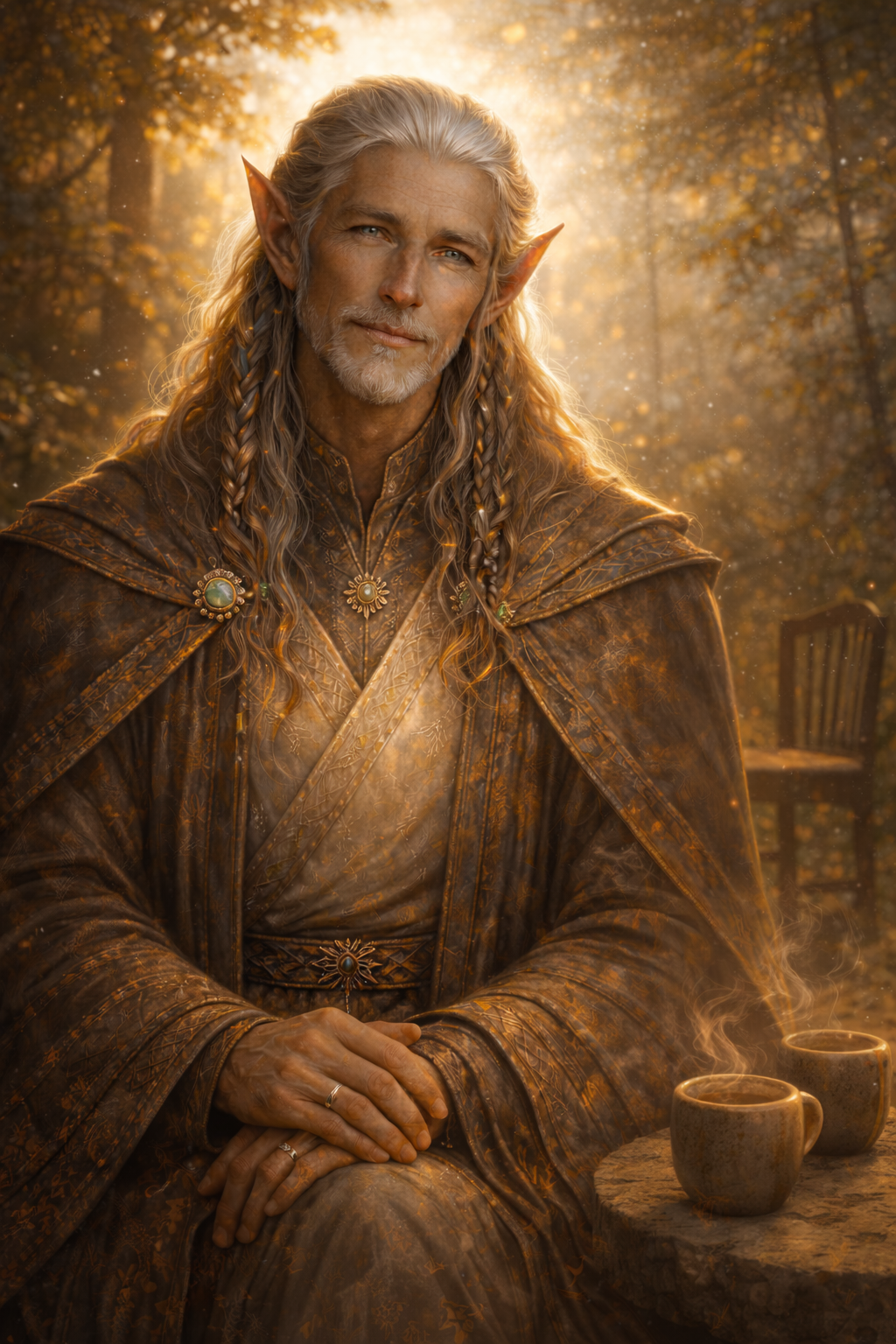
God of Longstanding Love
Pragma
Pragma
Species
Realm
Children
Pronouns
He/Him
Sex
Male
Gender
Male
Eyes
Soft grey, muted green, or deep hazel
Hair
Long and well-kept, commonly silvered dark brown, ash-blonde, or deep chestnut threaded with grey.
Skin Tone/Pigmentation
Smooth but lived-in, bearing the subtle marks of age without decay
Height
Often appears approximately 6'0"–6'4" (183–193 cm)
Weight
Often appears 185–210 lb (84–95 kg


Comments