Leiden
The Leiden are one of the great tribal cultures to emerge from the vast continent of Zefir, shaped by a history of self-imposed exile, merciless competition, and ideological unity forged through conflict. While many Zefiri peoples gathered to form the early trading post that would eventually become the great city of Alada, the Leiden rejected this convergence. They viewed shared governance and cultural compromise as weakness, choosing instead to leave the continent entirely. Their fleets sailed westward to a harsh archipelago of jagged coasts and cold seas, which they named Leishtan.
For centuries, the Leiden archipelago was home to a network of mutually dependent but fiercely competitive trading kingdoms. These states were bound together by commerce rather than kinship, each specializing in resources, shipping routes, or mercantile services. Cooperation existed only insofar as it strengthened the whole. Internal wars, corporate vendettas, and economic sabotage were not aberrations but accepted tools of progress. Over time, weaker houses were destroyed, inefficient systems collapsed, and only the most ruthless and capable survived.
This prolonged crucible culminated in 1782 AF, when Chancellor Max Reidel unified the archipelago under a single banner: the Leidenstein Consortium. The unification was not peaceful. Those who resisted the corpocratic ideals of total efficiency, profit-driven governance, and enforced unity were exiled. These outcasts and their descendants now exist in scattered pockets beyond Leishtan, distrusted by outsiders and viewed as traitors by their kin. Today, nearly all Leiden live under the Consortium’s rule, their ethnicity inseparable—fairly or not—from its reputation.
By 1870 AF, the Leiden are no longer merely a harsh tribal people bound by sea, stone, and blood. They are the cultural backbone of the Leidenstein Consortium, a vast corpocratic power whose reach extends across continents. While their origins lie in exile, survival, and brutal meritocracy, centuries of industrialization have reshaped Leiden society into a rigidly stratified, efficiency-obsessed system that mirrors a Victorian-style industrial revolution—only colder, sharper, and far less sentimental.
The ancient Leiden values of endurance, merit, and dominance did not disappear with steam engines and assembly halls; they were weaponized. Tradition was not abandoned, but reorganized, codified, and assigned its place within corporate hierarchy. Where once the Leiden hunted one another across wilderness, they now hunt promotions, patents, contracts, and leverage. Strength is still revered—but it is now measured in output, profit margins, and intellectual ownership.
Physical Characteristics
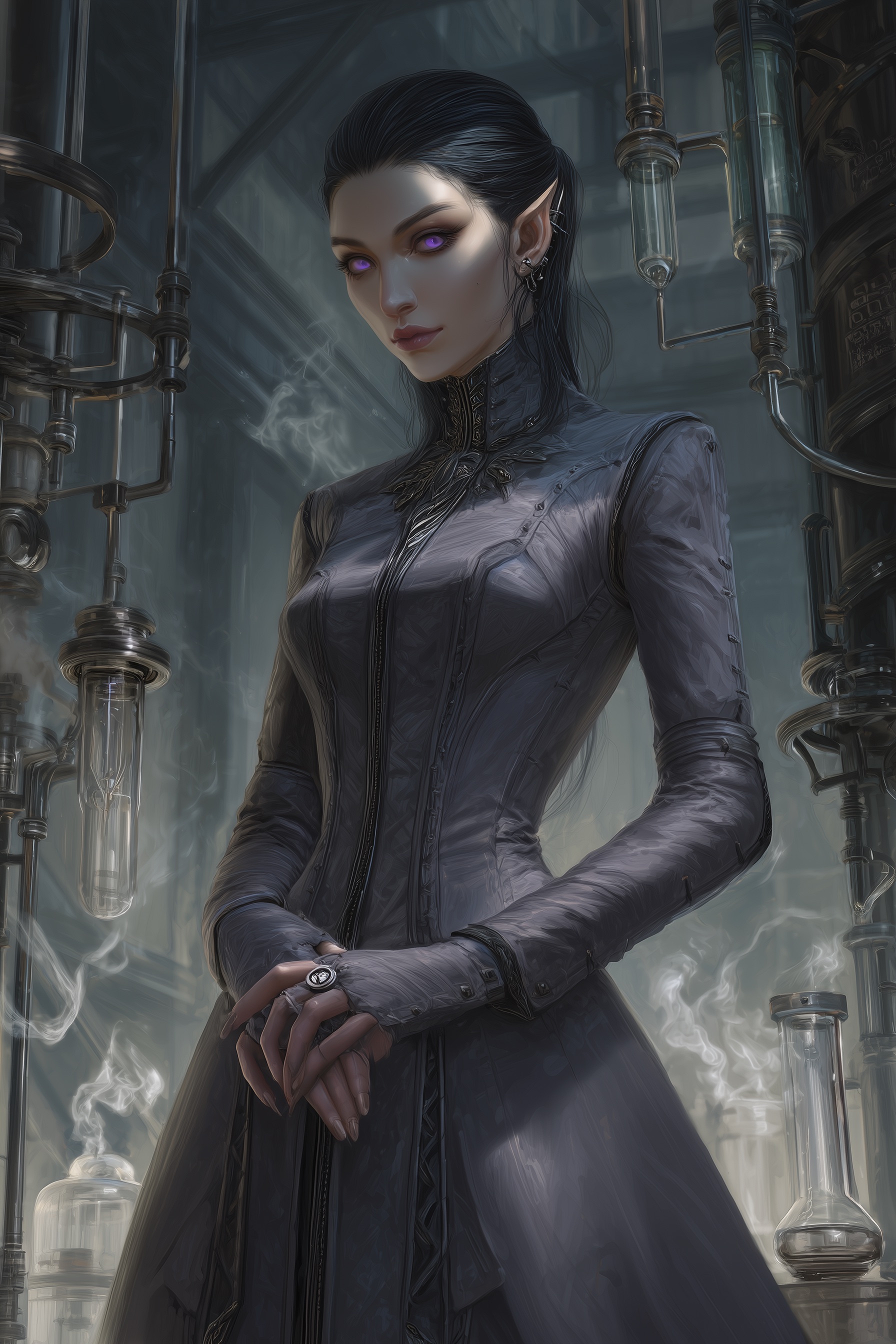
Leiden physiology is immediately recognizable. They are generally tall, with angular builds shaped more by endurance than bulk. Skin tones are silvery pale, often dulled by industrial pollution among the lower classes. Their eyes are vivid—emerald, sapphire, or amethyst—sharp and observant, giving many Leiden an unsettlingly evaluative stare.
Their ears are long, sharply tapered, and non-lobed, emphasizing a severe facial structure. Hair is typically obsidian black, aging into dusty jet rather than true grey. Among workers, this aging is often premature due to environmental strain. Their wide-based, triangular canines remain visible, lending their expressions a faintly predatory edge even in moments of calm.
Atheism as Cultural Bedrock
Leiden society is strictly atheistic, not merely secular. The absence of gods is treated as an established fact rather than a philosophical stance. Religion is considered an early-stage cognitive framework—useful for social cohesion in primitive societies, but obsolete in an age of industry and calculation.
Spiritual belief is not illegal, but it is socially disqualifying. Open religiosity is interpreted as an inability to accept reality or personal insignificance. The Consortium teaches that the universe offers no justice, mercy, or purpose. Meaning is therefore a human construct, derived from contribution to systems that endure beyond individual lives. The military reinforces this worldview: survival is not sacred; effectiveness is.
Ideals of Beauty
Leiden concepts of beauty are rooted entirely in function and survival. Physical attractiveness is inseparable from visible competence. A body shaped by labor, combat, or endurance is admired, while softness or fragility is viewed with suspicion. Scars are considered deeply attractive, especially those gained through meaningful struggle such as hunting, ritual combat, or professional risk. Each scar is a record of survival and a visible testament to worth.
Age is not something to be concealed. Wrinkles, weathered skin, and greying hair are marks of experience and resilience. Attempts to artificially preserve youth are often mocked as cowardice or vanity. Ornamentation is tolerated only when it serves a purpose; excessive decoration without utility is widely regarded as insecurity masquerading as beauty.
Modern Ideals reshaped
Leiden beauty standards have adapted to corpocratic life. Where scars once signified worth, controlled presentation now reigns. Beauty is expressed through restraint, precision, and signs of endurance rather than violence. Among workers, visible wear—calloused hands, soot-marked skin—is still quietly respected, but no longer openly celebrated.
In management and R&D circles, beauty is associated with composure under pressure, immaculate tailoring, and the absence of excess. Aging remains respected, but only when paired with continued productivity. Cosmetic preservation is tolerated among the elite if it enhances authority; among workers, it is mocked as pretension.
Gender & Social Equality
Leiden society is rigidly egalitarian in matters of gender, drawing inspiration from ancient warrior cultures where survival depended on collective strength rather than prescribed roles. All genders are expected to contribute meaningfully to society, whether through trade, hunting, governance, craftsmanship, or warfare. No role is barred on the basis of gender, and competence is the sole metric by which authority is granted.
Leadership positions are earned through demonstrable results. A failed leader—regardless of charisma, lineage, or gender—is removed without sentiment. Cultural attempts to restrict individuals based on gender are viewed as fundamentally inefficient and therefore immoral. To the Leiden, inequality is not merely unjust; it is wasteful.
The corpocracy prides itself on efficiency-driven equality. Discrimination based on gender is considered irrational and counterproductive. However, emotional expression, caregiving instincts, or perceived softness—regardless of gender—are systematically discouraged. Equality exists, but compassion does not.
Courtship & Relationships
Leiden relationships are intense but discreet. Courtship is rarely public and often intertwined with professional life. Bonds are formed through shared risk, mutual sacrifice, and acts of trust such as career jeopardy or the exchange of restricted knowledge. Passion is not absent, but it is tightly contained within private spheres.
Betrayal within a relationship—particularly professional betrayal—is considered one of the gravest personal offenses. Infidelity may be forgiven; disloyalty that endangers contracts or livelihoods is not. Long-term partnerships are respected when they enhance stability and productivity.
Coming of Age and Funeral Rites
Coming of age is marked by formal evaluation. Adolescents undergo assessments of physical endurance, obedience, and aptitude. Exceptional candidates are routed toward military service or R&D; others are assigned to labor tracks. The process is treated as logistical necessity rather than celebration.
Funerals are brief and utilitarian. Bodies are burned or committed to the sea. Employment records, service history, and failures are read aloud without embellishment. Mourning is private and discouraged during operational hours.
Common Taboos
Religious advocacy, public criticism of the Consortium, contract violation, refusal of service, and unauthorized emotional displays are all socially dangerous. Sentimentality is tolerated only when it improves morale or efficiency. Nostalgia for faith or pre-industrial meaning is regarded as intellectual weakness.
Customs & Values
Leiden customs revolve around reliability, endurance, and contractual integrity. Time is treated as a finite resource that must not be wasted. Idleness is socially condemned, and visible inefficiency invites scrutiny.
Contracts—employment, partnership, or personal—are sacred. Breaking one marks an individual as fundamentally untrustworthy. Failure is tolerated only when it produces measurable data or improvement. Repeated failure results in quiet exclusion from meaningful roles.
Unity is enforced structurally rather than emotionally. Citizens remain compliant not through fear, but through dependence on systems that provide housing, food, and status in direct proportion to usefulness.
Dress Code
Clothing communicates function and rank. Workers wear standardized, durable garments in muted greys and blacks, designed for safety, longevity, and uniformity. Individual expression is minimal and discouraged.
Management attire emphasizes authority through tailoring, reinforced fabrics, and functional insignia such as seal pins or contract chains. R&D personnel favor adaptable clothing with protective elements, concealed pockets, and specialized accessories. Across all classes, fashion signals role, not personality.
Art and Architecture
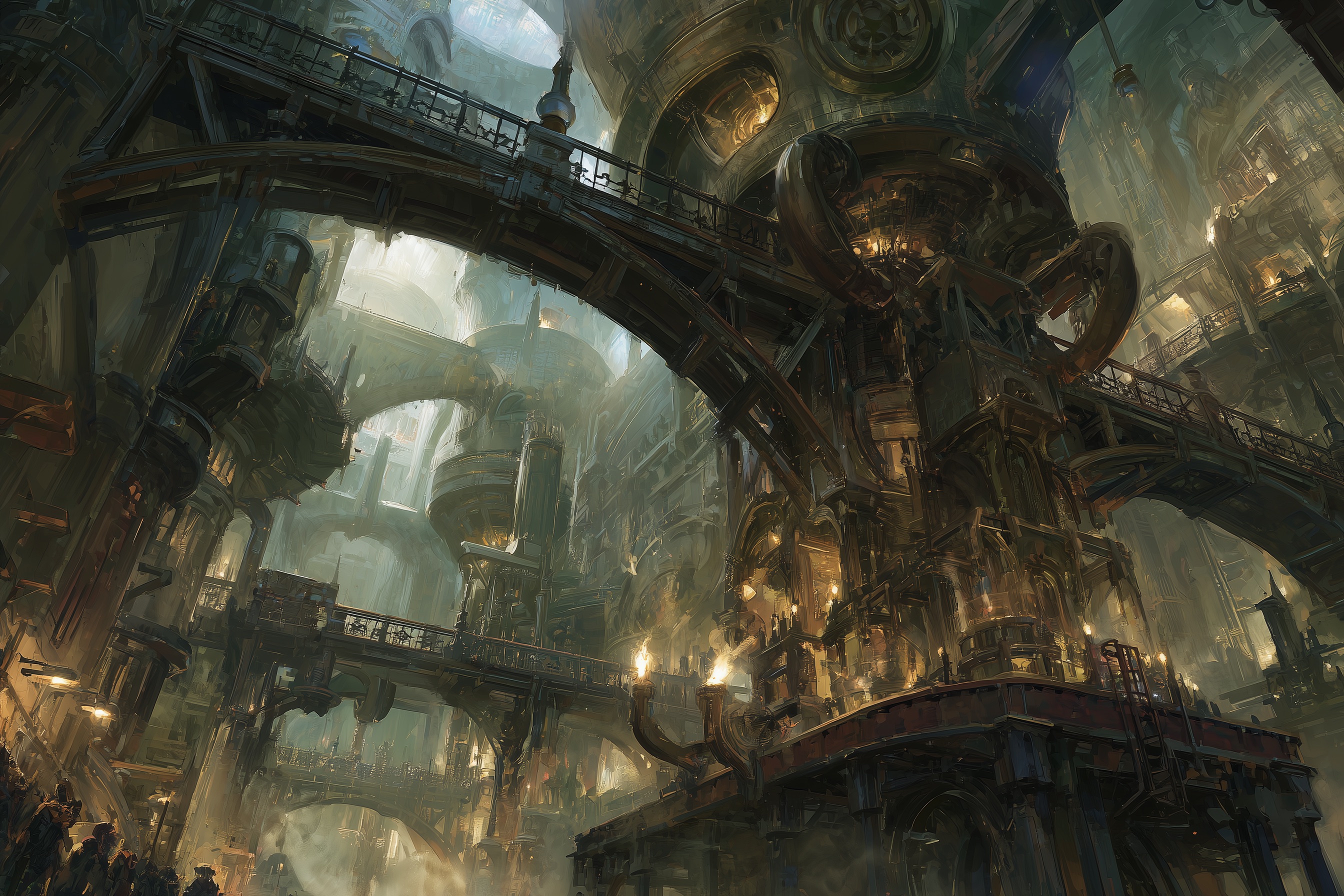
Leiden architecture has evolved from stone fortresses to iron-and-steam monoliths, but its intent remains unchanged: to dominate. Cities are built vertically and densely, with factories, offices, and worker housing stacked in brutal efficiency. Ports are fortified industrial complexes, choked with cranes, rails, and smoke.
Art is almost entirely propagandistic or instructional. Murals depict productivity, innovation, and historic corporate victories. Sculptures commemorate founders, inventors, and catastrophic failures—always emphasizing lessons learned rather than glory achieved.
Social Stratification: Workers, Management, and R&D
Workers comprise the majority of the population. They labor in factories, shipyards, mines, warehouses, armories, and clerical offices. Their lives are regimented by schedules and quotas, with communal housing built adjacent to work zones to minimize transit and fatigue. Among workers, endurance, punctuality, and silence are the most respected traits. Individual ambition exists but is tightly constrained; advancement is possible but statistically rare. Workers understand themselves as replaceable components—respected when functional, disregarded when not.
Management governs process and people. Administrators, overseers, logistics officers, and contract arbiters belong to this stratum. Their role is not creation, but optimization: extracting maximum output from labor while maintaining system stability. Management culture emphasizes emotional detachment, legal precision, and decisiveness. Authority is visibly marked through dress, housing, and access to information. Failure is tolerated only when isolated; repeated inefficiency results in demotion or reassignment without ceremony.
Research & Development is the intellectual apex of Leiden society. Engineers, alchemists, inventors, tacticians, and industrial theorists shape the Consortium’s future. Their work determines military superiority, economic expansion, and technological dominance. R&D personnel are afforded greater autonomy, privacy, and material comfort, but are also subject to ruthless evaluation. A failed invention is forgiven once; a pattern of unproductive thought ends careers. Innovation is not romanticized—it is audited.
The Military stands apart as both shield and scalpel. Comprising professional soldiers, naval forces, aerial detachments, and internal security divisions, the Leiden military is omnipresent and deeply respected. It enforces contracts, suppresses unrest, protects trade routes, and executes corporate will abroad. Military service is one of the few pathways for significant upward mobility outside R&D. Discipline, obedience, and controlled aggression define military culture. Unlike other classes, the military is permitted overt displays of ritual, hierarchy, and honor—tools understood as necessary for cohesion and command.
Food and Cuisine
Leiden cuisine is structured as rigidly as Leiden society itself. For the lower classes, food remains optimized for endurance, efficiency, and repetition. For the upper strata—military officers, high management, and the scientific elite—cuisine becomes something else entirely: a carefully sanctioned form of indulgence that reinforces authority, reward, and separation. Pleasure is not forbidden among the elite; it is earned, regulated, and framed as a consequence of proven value.
The result is a culinary culture split cleanly along class lines. The same foundational techniques—preservation, fermentation, and dense nutrition—are used at every level, but the execution, ingredients, and intent change dramatically as one ascends the hierarchy.
The Lower Strata: Sustenance as Obligation
Among industrial workers and low-ranking clerks, meals remain strictly functional. Food is served in canteens adjacent to places of labor, portioned precisely and consumed quickly. Bread is dense and dark, meats are preserved or rendered into sausages of mixed origin, and Vegetables are overwhelmingly pickled or fermented. Sweet-and-sour flavors dominate because they preserve well and remain palatable over time.
Meals follow rigid schedules. Breakfast is minimal and warming, midday meals are heavy and sustaining, and evening meals are intentionally modest. Variety is limited, and excess is discouraged both culturally and structurally. Hunger is prevented, but satisfaction is never prioritized. For the lower classes, food is a continuation of labor by other means.
Military Officers: Discipline with Reward
While enlisted soldiers eat standardized rations and communal stews, military officers occupy a distinct culinary tier. Officer mess halls are quieter, more refined, and deliberately removed from the rank-and-file. Here, food becomes a tool for reinforcing hierarchy and reward without undermining discipline.
Officer meals feature higher-quality meats, often freshly prepared rather than preserved. Game birds, beef, and cured specialty cuts replace mixed-meat sausages. Sauces are richer and more complex, though still restrained. Bread is lighter, often white or enriched, and Vegetables appear fresh as well as pickled.
Alcohol—absent or heavily restricted among lower classes—appears here in controlled forms: dark beers, fortified wines, and strong distilled spirits consumed in moderation. Desserts are rare but meaningful, served after victories, successful campaigns, or promotions. Indulgence is allowed, but never to the point of softness.
High Management: Culinary Authority and Display
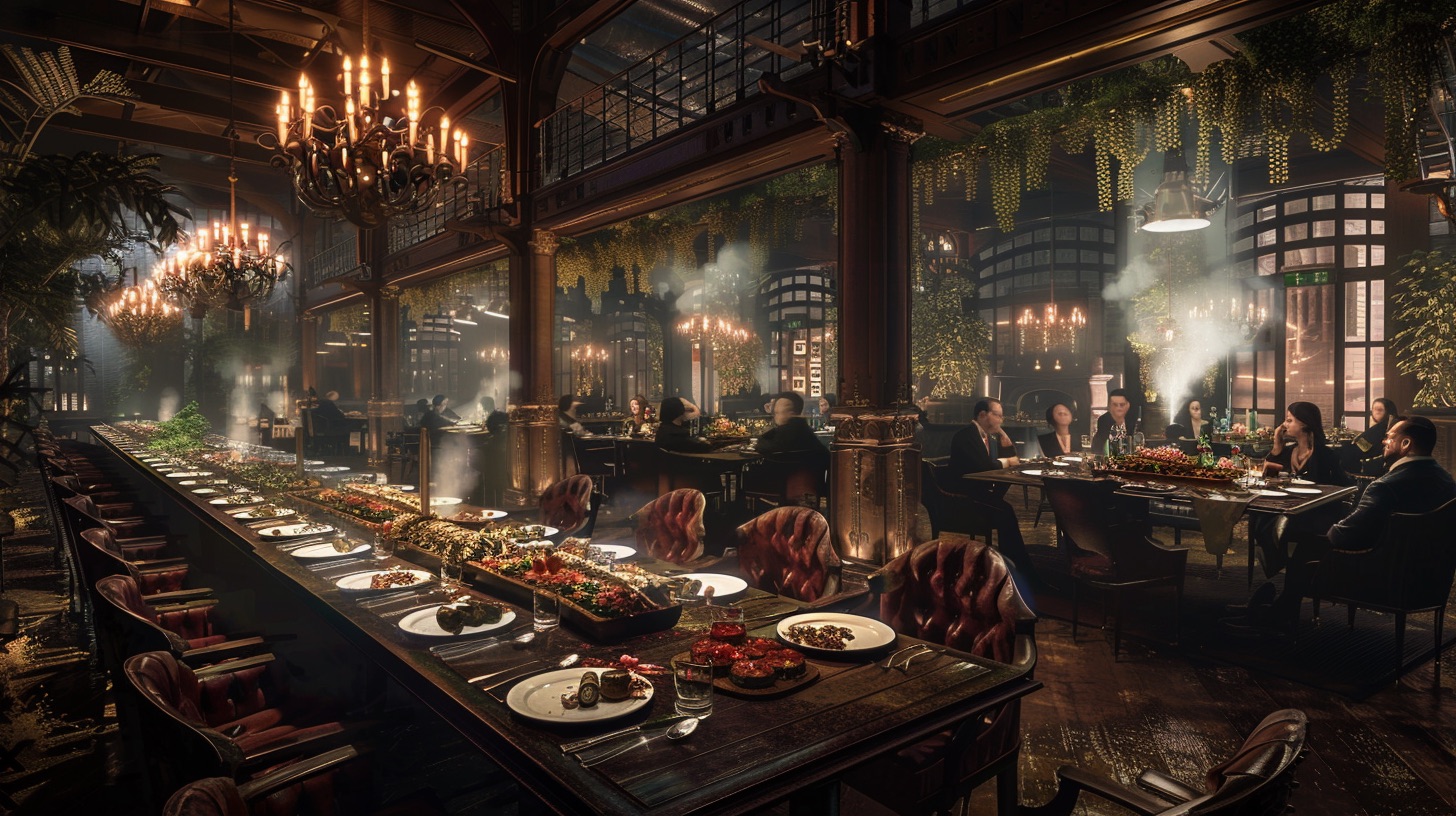
High management treats dining as a performance of control and success. Meals are often private or semi-private affairs, conducted in executive dining rooms, high offices, or invitation-only halls. Food here is both sustenance and signal.
Ingredients are of consistently high quality: prime cuts of meat, refined grains, imported spices, and carefully balanced sauces. Pickling and fermentation persist but are elevated into deliberate flavor choices rather than necessities. Courses are clearly separated, paced, and discussed, often alongside negotiations or strategic planning.
Pastries become more elaborate—layered, filled, and decorated with precision—yet still dense enough to avoid accusations of frivolity. Excessive indulgence is quietly judged; the ideal executive eats richly but sparingly, demonstrating mastery over appetite as well as resources.
The Scientific Elite: Precision, Luxury, and Experimentation
The scientific and research elite enjoy the greatest culinary freedom of any Leiden class. Their food is framed not as indulgence, but as fuel for exceptional intellect. Kitchens attached to research enclaves and private residences allow for experimentation with flavor, texture, and technique far beyond what is permitted elsewhere.
Meals here may include rare game, carefully aged meats, delicate sauces, and freshly baked pastries made daily rather than preserved. Fermentation and pickling are treated as technical disciplines, with experimental methods producing nuanced flavors. Dishes are often designed to sustain long work periods or enhance focus, blending luxury with function.
Dining schedules are flexible, portions generous, and presentation refined. While waste is still unacceptable, pleasure is openly acknowledged as a tool for intellectual performance.
Pastries and Sausages: From Necessity to Art
Sausages and pastries remain culturally central at every level of Leiden society, but their form changes dramatically with status. Among workers, sausages are compact, heavily preserved, and utilitarian. Among the elite, they become expressions of craftsmanship—single-meat blends, refined spicing, and regional signatures.
Pastries evolve from dense, shelf-stable rations into layered, filled, and delicately spiced confections. Fruit preserves, nut pastes, and custards are used liberally at higher levels, often paired with strong coffee or fortified wines. These foods serve as quiet reminders that mastery of systems yields tangible rewards.
Dining as Social Separation
In Leiden society, shared meals across class boundaries are rare and heavily regulated. Seating, service, portion size, and menu complexity all reinforce hierarchy without the need for explicit enforcement. To eat finely is to have proven one’s worth to the system.
There are no religious feasts or symbolic fasts. Celebration exists only as recognition of success—profitable quarters, military victories, or scientific breakthroughs. Food becomes the language through which the Consortium communicates approval.
To the Leiden elite, a fine meal is not a contradiction of austerity—it is its justification.

Physical Characteristics
- Eyes: Emerald, sapphire, or amethyst hues—bright, cold, and piercing
- Ears: Long, sharp, non-lobed, tapering dramatically
- Skin: Silvery pale, almost metallic in low light
- Hair: Obsidian black in youth, aging to a dusty jet or ash-black
- Dentition: Wide-based, triangular canines, subtly predatory
- Build: Tall, broad-shouldered, built for endurance rather than grace


I liked the article, but I don’t like the Leiden. I don’t think I could ever live among them. Interesting that food is considered so differently, compared with fashion or art.
It is a very harsh and very corporate society - nobody likes it do not feel bad :P
World Anvil Founder, CTO & Product Director
Follow Solspire Chronicles
“No act of kindness, no matter how small, is ever wasted.” - Aesop