
Lamp Master
Daily Routine
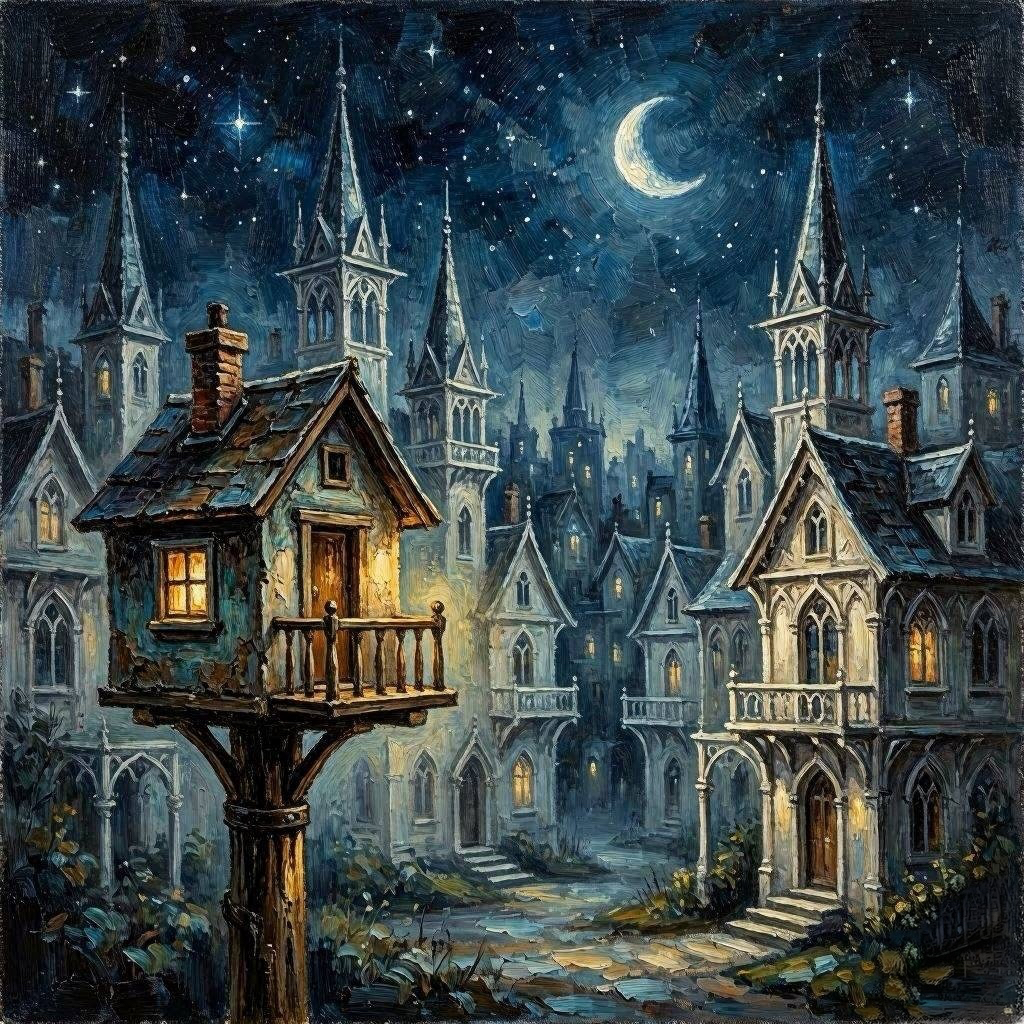
The small lanterns are open at the bottom. This allows the spirits to fly straight in, and the light is emitted downwards, illuminating the street but not the night sky. Furthermore, this means that residents living in the immediate vicinity of the Lamp Houses are less disturbed by the night-time light. Sometimes it can be observed that the lamps grow dimmer as the night progresses and then become brighter again towards morning, before the Light Spirits leave them for the day.
Career
Training to become a Lamp Master comprises three stages, much like most apprenticeship programmes. The length of time a trainee spends at each stage varies from person to person and is not tied to any fixed milestone. Anyone aged 16 or over is free to apply for one of the apprenticeship places. In most cases, however, trainees are considerably older. We’ll explain why this is the case later on.
Qualifications
Generally speaking, no specific prior qualifications are required to become a Lamp Master. Handicraft skills are an advantage, but not essential, as these skills are the easiest to learn. A meticulous approach to work is essential if the actual summoning ritual is to be performed at all. Magical talent is also a basic requirement, but as all Serelarin are born with a natural gift for magic, this is not an obstacle.
The greatest challenge is posed by the highly variable working hours. As the ritual is only performed at sunset, this means late working hours for the Lamp Masters in summer. Young Serelarin who are just figuring out which course of training they want to pursue would much rather spend those very late evenings hanging out with their friends, sitting in the city’s gardens or cooling off in the water, than meticulously performing a ritual in the Lamp Halls. This is the very reason, why most apprentices of this trade are a little bit older, normally around 30 years.
The Spark
The apprentice starts out as a Spark. Their duties involve processing the ingredients required for the burning paste, as well as making the rounds of several Lamp Houses. They check these for defects and damage and then report any issues to the Lamp Hall. They are only passively involved in the summoning of the Light Spirits. Not every Spark manages to rise above this rank, and some Sparks are so content with their position that they do not aspire to anything more.
The Ember
A Spark who demonstrates sufficient diligence and talent is promoted to Ember. It falls to them to produce the actual burning paste from the prepared ingredients. They are also responsible for selecting new ingredients at the market, whilst paying close attention to quality. Furthermore, they deal with any damage reported by the Sparks. Finally, it falls to them to draw the ritual circle every evening, through which the channel to Vaelora is opened.
The Blaze
The final stage of training is that of the Blaze. It is they who ultimately perform the summoning ritual. Most of them are on a par with the Lamp Master; however, in larger towns there is, in theory, only one Lamp Master – usually simply the person who has held the office the longest. It is also the Blazes who are responsible for managing the Lamp Hall’s finances and for carrying out the final inspection of the ingredients for the burning paste, as well as of the paste itself and the ritual circle.
I don’t think I’d be satisfied with just being a Spark. Summoning the Light Spirits is the best bit, after all.
The summoning
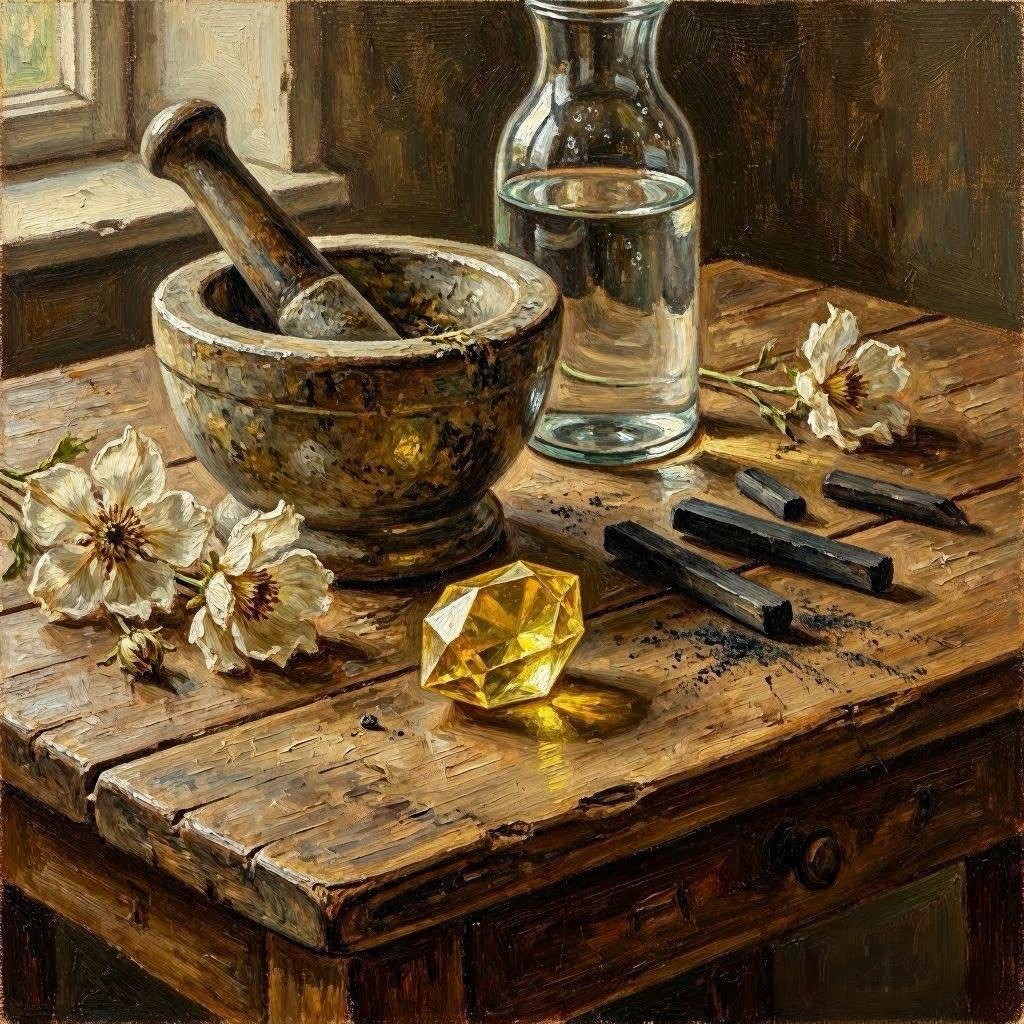
The actual ritual of invocation is the most important part of the Lamp Masters’ work. First, the Embers must draw the summoning circle. We have been forbidden to describe its exact appearance in detail here, a request we naturally wish to respect. Next, a large golden bowl is placed in the centre, into which the burning paste – which is already shaped like a sun – is placed. The Lamp Master themselves, or one of the more experienced Blazes, then lights it.
The Lamp Masters then call upon Cahaya in a sort of prayer, asking her to send forth her Light Spirits so that they may illuminate the streets. It is important to note that this is not a summoning, but a request for their appearance, as the Light Spirits appear of their own accord. Whilst the prayer is being recited, one can observe how the column of smoke from the burning paste rises ever more straight up until it begins to glow, widens and, as it were, forms a pillar of light reaching up to the ceiling of the building.
The prayer recited to summon the Light Spirits
"Cahaya, Guardian of the Dawn, hear our plea.
Open a path from your realm to ours,
and let those who bear your light come to us.
May they bestow your light upon us
and return to you at daybreak.
Just as their light illuminates our streets,
may your hope illuminate our hearts."
The Light Spirits then gradually emerge from the pillar of light. First just a few, then more and more – just as many as are needed to occupy all the Lamp Houses. Together, they leave the Lamp Hall through an open gate or, as is usually the case in larger towns, an open skylight. From there, they flit off through the night sky in all directions and make their way to the little Lamp Houses that await them. Everything usually comes to a standstill during these few minutes. The city grows quieter for a moment and most people – even those who have seen the spectacle thousands upon thousands of times – watch the spirits fly away with a smile. Children, in particular, are always fascinated by the spectacle, but travellers, too, have the fascination written all over their faces.
Social Standing
Lamp Masters are held in high regard throughout Serelarin, as it is thanks to them that fires caused by accidents involving lanterns or even torches are now a thing of the past. This, combined with the fact that Lamp Masters deal with Cahaya’s light spirits on a daily basis, means that many young children in particular dream of pursuing this profession one day. As most Serelarin have a deeply rooted faith in Cahaya, for children the profession of Lamp Master represents a good way of being close to Cahaya without becoming a priest directly.
On my last trading journey, I visited one of the Serelarin cities for the first time. We had to stay overnight and witnessed how the Serelarin light up their cities at night. Well, not the actual ritual itself, but suddenly, just as the sun was sinking below the horizon, it grew completely still and then, all of a sudden, these little lights were flitting through the air everywhere – dozens, no, hundreds! It was almost as if the stars were coming down from the sky. And then these little lights flitted all through the town and into those cute little houses. I’ll never forget that sight for the rest of my life.
As the Lamp Masters serve the public, their salary is paid by the city for which they work. They receive a salary which, depending on their area of responsibility, can be quite substantial and enables the Lamp Masters to enjoy a good standard of living. They are unlikely to become rich through their work – at least not financially – but spiritual wealth is, after all, also worth striving for. The Serelarin believe that Lamp Masters are more likely to become light bearers than the average Serelarin, which is yet another reason why the profession is held in such high regard by devout Elarin.

Ein Sehr coole Idee!
Die Kombination von Ritual-Gebet (Da es eine Bitte und kein Zwang ist) und Alchemie in Verbindung mit der natürlichen Magie der Licht-Elemetare, ist eine tolle Idee und geniale Umsetzung einer Lösung für ein uraltes Problem.
Eine Sache die mich nur etwas ins Grübeln gebracht hat: wenn die Lampen-Häuser, wie auf dem Bild, richtigen Häusern nach empfunden sind, wird nur sehr wenig Licht nach draußen dringen.
Hier wäre noch eine Erklärung wie z.B. das der Boden der Häuser aus Glass besteht, oder so was, helfen zu verstehen wie das Lich den aus dem Haus auf die Straße kommt. Oder sind die Häuser aus einem Material, das dann wiederum das licht der Elementare aufnimmt und nach aussen weiter gibt?
A lot of unofficial Challenges
Interessanter Gedanke ... werde ich was ergänzen. Vielen lieben Dank dir für deinen Kommentar und das Lob, hat mich sehr gefreut!
Verdient ist verdient! :)
A lot of unofficial Challenges