

Horned Bison
Old as time, and as critical as the stars. The horned-bison has marked all of Levis under its protective gaze.
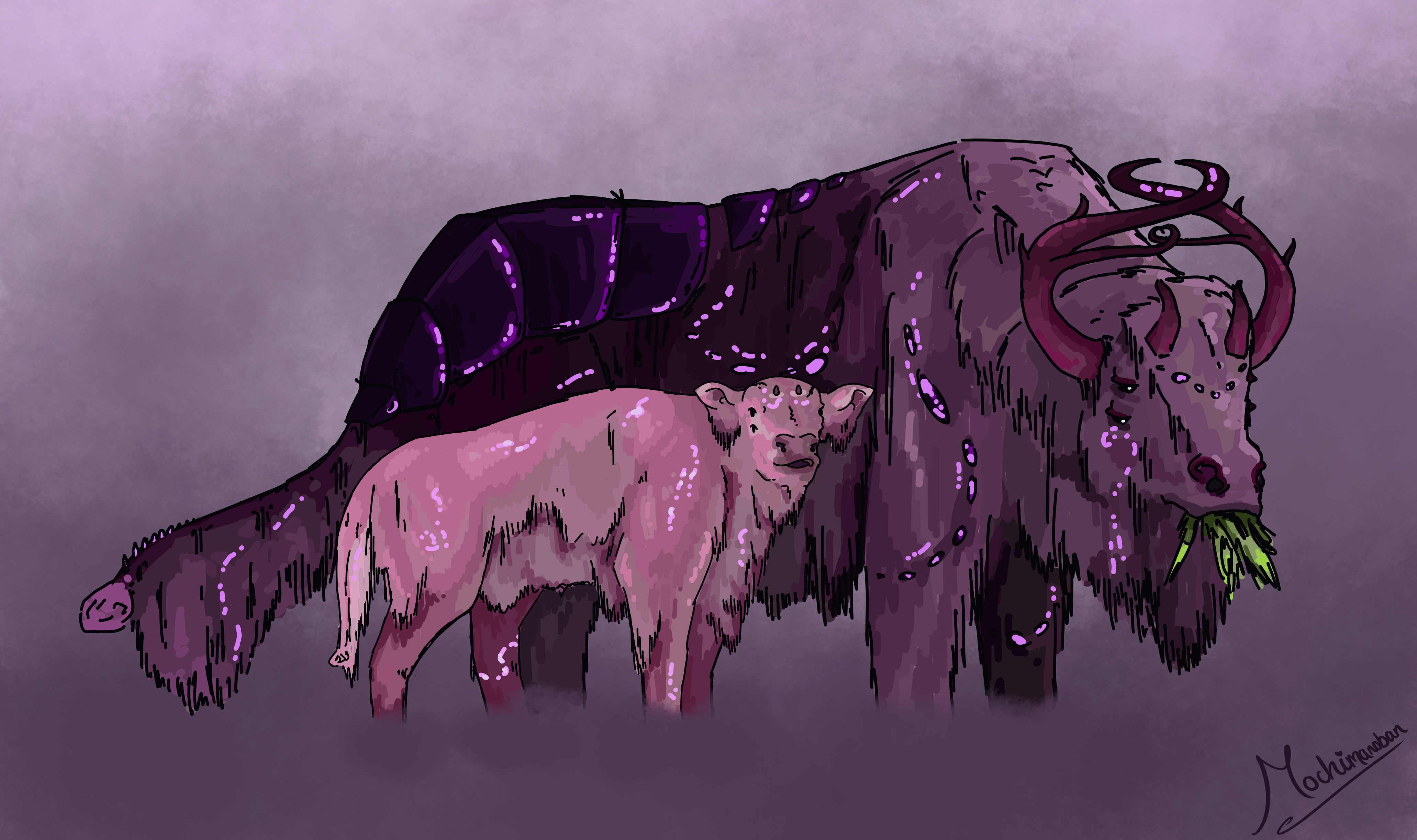
by mochimanoban
For as long as Levis has existed, the Horned-bison have roamed the lands. Symbiotic with the ancient and forest Trolls , these migratory species were almost hunted to extinction in the human years. And though they have recovered now, it is only as they returned that the lands of Levis have healed and forgotten the scars the humans have made upon the land itself.
Basic Information
Anatomy
These massive creatures are covered in a loose hair and are most recognised by the 4 horns atop their head below their 4 eyes. As the horned bison age their horns can grow into interconnected displays, used to attract mates and ward off predators.
Their bodies grow nodes of bioluminescence, laying upon their skin and hardened like growths, the sheer size of the Bison protect them from needing to make the nodes flush with their skin, or hidden by their fur.
As they age they form a rough plated rear, their tail thickening in both powerful display and gratuous weapon, which the adult bison can use to fend off some of the more opportunistic larger mammals.
Their bodies grow nodes of bioluminescence, laying upon their skin and hardened like growths, the sheer size of the Bison protect them from needing to make the nodes flush with their skin, or hidden by their fur.
As they age they form a rough plated rear, their tail thickening in both powerful display and gratuous weapon, which the adult bison can use to fend off some of the more opportunistic larger mammals.
Biological Traits
The bison are mammals, though both genders have nipples and milk glands, and it is only in times where many of the nursing mothers have perished that scents exuded by the hungry calves will cause those around to produce milk irrelevant of gender.
Their milk is rich, but incompatible with most species and they do not produce enough excess to form a relationship in domestication like the reader's cow.
Their milk is rich, but incompatible with most species and they do not produce enough excess to form a relationship in domestication like the reader's cow.
Dietary Needs and Habits
The horned ones are grazing feeders, eating various grasses and scrub cover, though their saliva produces an enzyme that enhances plant growth.
Thry particularly love the thin leaves of the western solaris ground coverings, slowing their languid migration to a crawl over the tail end of the wet season there. Adult bison can consume up to 20kg of leaf matter a day, though durinv the dry season their 5th stomach is activated to pull as much nutrients from less grazing power.
Thry particularly love the thin leaves of the western solaris ground coverings, slowing their languid migration to a crawl over the tail end of the wet season there. Adult bison can consume up to 20kg of leaf matter a day, though durinv the dry season their 5th stomach is activated to pull as much nutrients from less grazing power.
Additional Information
Social Structure
Herds of Bison arrange themselves into clusters of adults, children and nursing 'mothers'. Led by a matriach, the herd mostly keeps to itself, keeping the vulnerable amoung them in the centre of the clusters.
Domestication
The trolls of old levis never really domesticised with the bison, instead growing fungi upon their form in the same arrangements that naturally grew on the horns of the bison. As these formations would luminate with the phases of thd sun, the trolls and bison could keep track of each other and act as a larger herd.
When the bison were culled, thousands of years ago, the symbiosis of fungus, troll and bison was severed. The bison evolved the glowing nodes upon their bodies, the trolls adapted with new forest or ocean fungi, and the fungus became more symbiotic with some of the plains trees of southern Solaris.
When the bison were culled, thousands of years ago, the symbiosis of fungus, troll and bison was severed. The bison evolved the glowing nodes upon their bodies, the trolls adapted with new forest or ocean fungi, and the fungus became more symbiotic with some of the plains trees of southern Solaris.
Geographic Origin and Distribution
They roam the lands from Central Levis into south and southwest Solaris, following a massive migratory loop that chases the cooling winds of the seasons, and the richer grasses that chase both winds and Celestial Winds. While for a period there they were blocked off from Solaris lands, the Midnight-One was reported to have torn open the organic wall surrounding Solaris to let them through.
Average Intelligence
The horned bison has a high animal intelligence, reknown for its empathy. Half destroyed records show measurements of their base language of grunts, mellodic calls and stamps.
While tool use seems impossible, recognition of old paths, and communal use of their horns to wear easier access for their young and infirm does point to a reasoning not seen in some of the animal kingdom.
Symbiotic and Parasitic organisms
Apart from the aforementioned fungi, 'modern' bison have formed a positive relationship with the plains gihgin. These large headed birds flank the bison, picking their fur clean of insects, and slightly absorbing the excess skin oils into their feathers.
Lifespan
20 to 30 year
Average Height
3m
Average Weight
3000kg
Average Length
5m
Thank you for reading, feel free to give feedback.




They sound like lovely animals and the drawing from Mochi is just the little wonderful extra.