

Sumijo River
Zeshemas Northern River
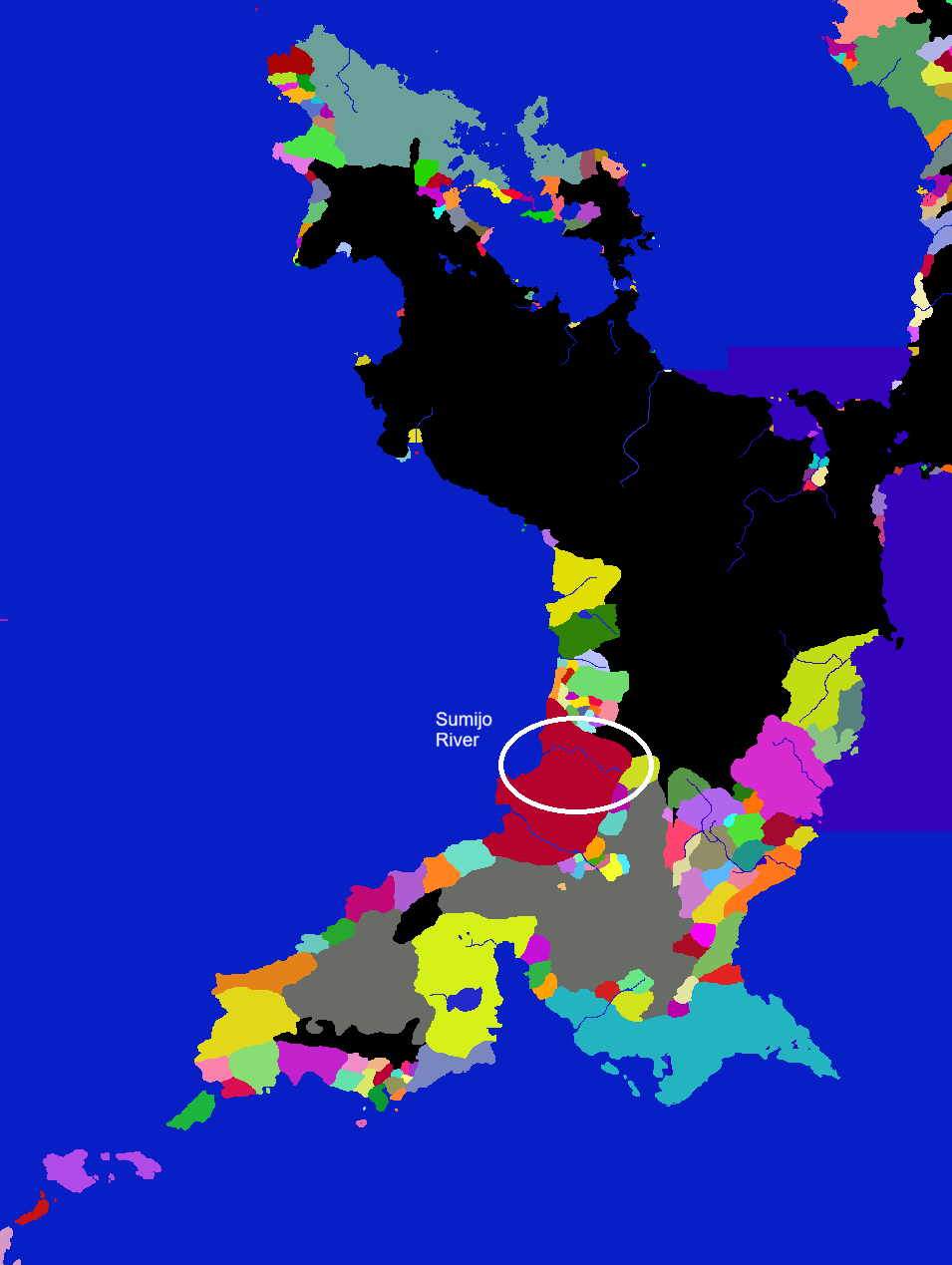
The Sumijo River is one of the five great rivers of the Greater Zeshem Region. It flows down from the Stonespine Mountains, a mixture of springs and snowmelt that quickly gathers in volume as it enters the lowlands. This river is the central corridor for much of Zesheko's historical drama: this is where Norinar fought, where the First Zeshem Empire blossomed, where the great palace-temple-city of Kozmio stands and the prophets and priests rule from. The waters of the Sumijo have fed rebellions, religions, and empires, flowing into many thousands of farms and great irrigation projects that cover the Northern half of Holy Zeshema. The brisk waters of the Sumijo slowly even out as it meanders from the great Nyovo falls in the East to the swamp delta in the West. The Sumijo sustains two of Holy Zeshema's most important cities: the capital city of Kozmio and the city of Elkitza, one of the ports that is allowed to accept foreign trade.
But the people of the region see the Sumijo as far more than a resource. In the Zesheko religion, the Sumijo river is embodied as Sumija, one of the Five Water Mothers - goddesses of life who are some of the most important spirits for mortal wellbeing.
The Sumijo River is often seen as innately magical and intertwined with the attributes of the goddess Sumija. It is said to be water of purity and order, capable of washing away magical corruption and creating great abundance in ritually-blessed crops fed with by it. The Sumijo is associated with maize and wet rice, crops that require great effort but produce plentiful foodstuffs and flours. It is also associated with industry in the form of small watermills and water-powered hammers. There are stories of the hippos and wildlife of the river rewarding the pious and punishing the sinful, as the river is seen as much more judgmental and strong-willed than its sister the Susilo River.
Geography
The Sumijo is 290 miles long from it formal origin point at Nyotuzu to the Sumijo river delta at the coast. Nyotuzu is a spring in the Sultega foothills that holds significant religious importance in the Zesheko religion and which is covered by a shrine that the Sultega Prisms maintain. Nyotuzu might be the ceremonial and symbolic origin point, but much of the water comes from a number of tributaries that go deeper into the foothills and then the Stonespine Mountains beyond. These tributaries, also known as the Usintvos (or 'Ghost Paths') are seen as having a connection to the realms of the dead, while the Nyotuzu waters are overwhelmingly associated with life and vitality. These waters meet near and at Nyovo Falls, a large waterfall that is also sometimes used as the symbolic origin point for the Sumijo as a river.
The area around Nyotuzu and the Ghost Path tributaries is the domain of the Sultega Prism Lords, the dominant authority for prisms and prism life in the Zesheko religion. The Sultega Lords, a Triumvirate of prism priests who rule from a palace near Nyotuzu and who are each associated with a different foothills prism kingdom, are the legal authority in charge of interpreting how Zeshek legal doctrine and purity rituals apply to prism bodies. They also are the thereotical masters of much of the Southern Stonespine Mountains, though this authority becomes diluted rather quickly once one leaves the foothills.
Ecosystem
The Sumijo river feeds a dense forest ecosystem, which sprawls out from the river into a much broader forest area. Along the river itself, there are many mangrove trees and river acacia. The river is home to dwarf crocodiles, flamingos, and giant catfish. There is a remarkable biodiversity of fish here, with twenty species of fish (including the numerous Yellow Gobio fish) that are unique to this river system. Giant herons and other migratory birds flock to the river seasonally to feed on the abundant fish. There are also native otters (the great clawless otter), though these have been partially hunted out of existence and are often mistakenly considered to be invasive Domesticated Otters from Samvara. Hippos are some of the most dangerous animals in the river complex. There were large leopard and jackal populations as well, though these are now relatively small.

Comments