

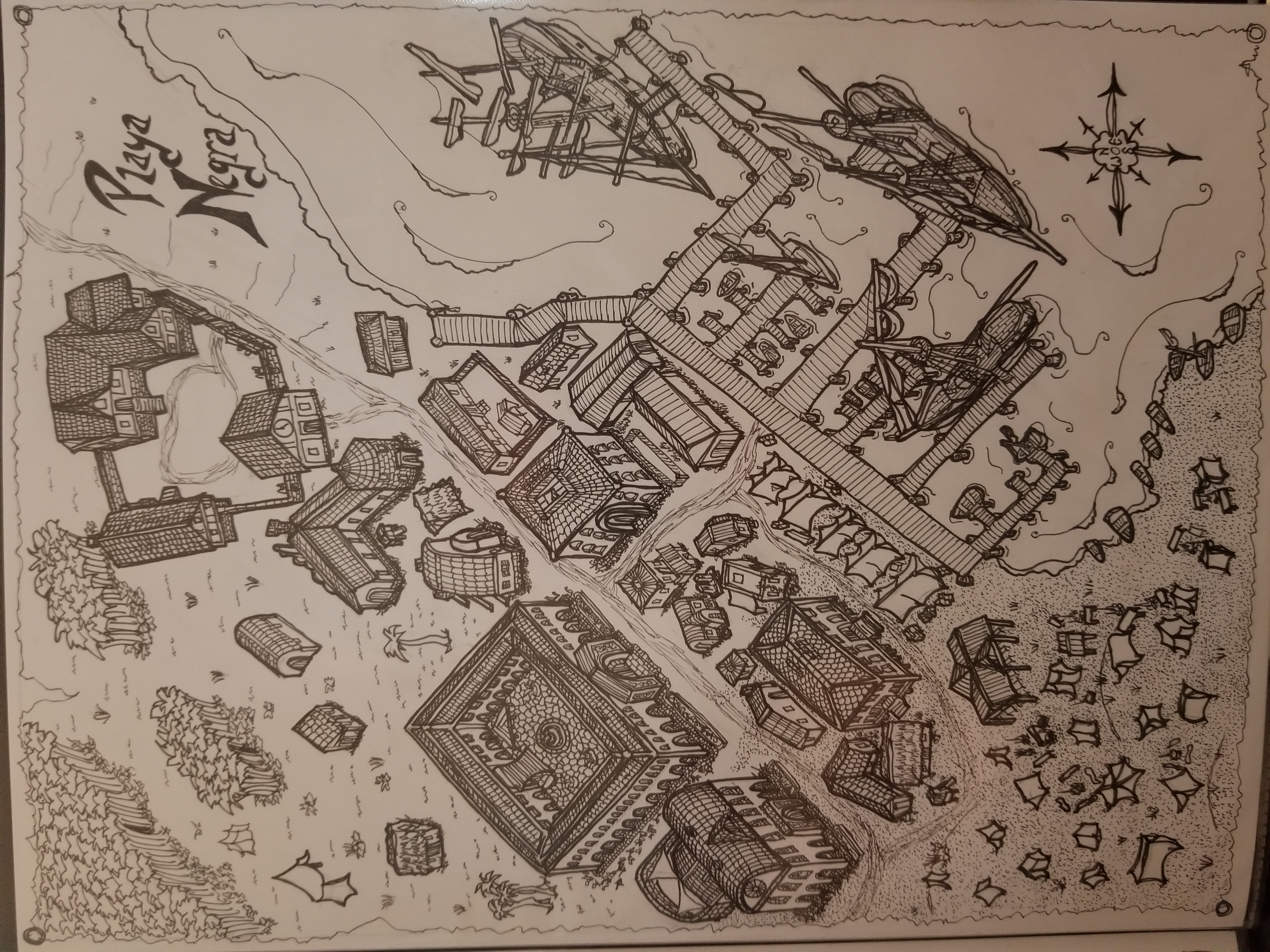
Playa Negra
"I stopped at Playa Negra with a big haul of timber from Bon Chance (future entry forthcoming). This place is CRAZY with a capital C. All the big wigs from Viaje de Recompensa told the local privateers to build their own town on a separate, nearby island. And they did. And they're usually left alone, so the place is a bit dicey. Lodging leaves something to be desired (though GraGee enjoyed the brothel a bit too much) but the food is generally spectacular. More than worth the near-brawls, death threats, and duel challenges (I got slapped in the cheek with a sock because the drunken dingus didn't have any gloves - half convinced I have fungus on my face because of it). So it's a bit rough. Avoid the city of tents south of the town proper if possible. It's taken up by ship crews who don't have coin for the local attractions (the food, the booze, the brothel) so they make up their own entertainment (fighting, exclusively)."
~Nathanel Jance, Captain of the Lucky Duck
General Information
Ruler: Enrique Padilla, "El Baròn"
Location: Isla de la Niebla
Allegiance: Renjuguese Imperium
Other Affiliations:
Bloodsworn Pact, Nameless, Baravian Trading Company
Population: Variable
Known For: Privateers, Near-Lawlessness, Alcoholic Beverages, Food, Gambling, Prostitution, "Everything's legal in Playa"
Overview:
Playa Negra could have been another Viaje de Recompensa due to its prime location along the major Baravian Sea trade routes, but the island's resources weren't as bountiful and its harbor was not as deep or large. Instead, the town serves as a port of call for Renjuguese privateers and passing merchant vessels. The Baravian Trading Company has administrative offices through an exclusive contract, and a great deal of the port's wealth stems from the various accommodations provided to passing sailors.
The town is ruled by Enrique Padilla, "El Baròn", a former ship's cook turned master privateer. Though formally retired from actively sailing, he commands a massive, though unofficial, fleet of privateer vessels with letters of marque from the Renjuguese crown. As Viceroy Carlo Caròn at nearby Viaje de Recompensa seeks to keep his city free of such ruffians, Playa Negra is the privateer fleet's unofficial berth. It has therefore evolved in a fairly disorganized fashion, with crowded docks, a beachfront filled with tents, several inns, taverns, and brothels to satiate the needs of sailors, humble architecture, and a conspicuous lack of military presence. There is also a lucrative barter economy involving pillaged goods, so much so that formal outfitters aren't needed on the island. However, there is a smithy that repairs and repurposes items, a seedy apothecary to assist the ill, and an underground distillery that creates caustically experimental libations perfect for the island's clientele.
Additionally, the BTC has a servicing station and administrative offices within a small walled fort near the town proper. Through an exclusive contract with the Renjuguese crown, the trading company is granted full autonomy of their operations at Playa Negra, serving as both a first stop for arriving merchant vessels and a last call for ships journeying back to Ariae.
History:
Playa Negra was built upon abandoned foundations from long-gone indigenous Wayfarers, which were in turn built upon long-weathered, half-buried ancient Aelanthine ruins. Prior to the landing of Renjuguese Imperium conquerors, the crumbling structures were inhabited by a group of goblin merchants who used the location as a trading hub for their kin's inland tribes. Upon the arrival of the immense Renjuguese galleons, the goblins fled the ruins and relocated their trading hub to the opposite end of the Isla de la Niebla.
Initially, Playa Negra was under the direct supervision of the Viceroyalty of Viaje de Recompensa, and construction of this sister colony began in earnest. As the original Aelanthine foundations had resisted the weathering of time, the first Renjuguese structures matched the layout of the ancient, mysterious outpost. At first, the fledgling hamlet attracted many colonists and boasted an influx of skilled trade workers and financiers eager to clear ground for a cash crop economy. However, the island's unique black volcanic soil and sand rejected foreign flora, proving financially disastrous for all involved with the attempt to create and staff the plantations. Additionally, the local fauna proved far more aggressive than anticipated, causing a significant death toll upon those who sought to live further inland than the town's limits. The local goblins, used to dwelling upon the island for several centuries (and having outlived previous human settlements), were unwilling to share the secrets of survival to the new, heavily armed, oft-hostile Renjuguese.
The colonial failure of Playa Negra coincided with the prosperous ascent of nearby Viaje de Recompensa. As the Viceroy Caròn's town continued to grow exponentially, he encountered a significant challenge: the lumbering Imperial treasure fleets were plum pickings for enemy privateers and pirates. He issued several letters of marque to multitudinous corsarios to both protect the fleets and harass enemy vessels without use of the Imperial Navy. While highly successful from a military standpoint, the surge of rough and tumble privateers needed somewhere to drink, gamble, and lust, which did not fit his vision for a cultured, devout, and placid colonial seat. He caught himself staring across the short span of sea to the dim lights of Playa Negra, and a plan began to formulate itself within his cunning mind.
The Viceroy made an offer to the privateer lord Enrique Padilla, dubbed "El Baròn" by the various corsarios for his successes and command over the lesser crews and captains. He would bestow the village, docks, and harbor of Playa Negra upon Padilla and his ilk in exchange for their immediate relocation to the now nearly abandoned town. Through use of spies and informants, Caròn learned Padilla's daughter Sabina was an unregistered mageborn. He threatened to turn her in to the Nameless lest her father comply with his request. Already seriously considering the Viceroy's offer, El Baròn was compelled to accept it, though the threat to his daughter significantly soured the relationship between them.
In the ensuing decade, the corsarios and privateers of Playa Negra have carved themselves a haven of "live and let live" lawlessness. Though an inherently temperamental and dangerous place, the respect for El Baròn and the shadows cast by the nearby spires of Viaje de Recompensa maintain the basic structure of society. Thievery within the town is not tolerated. Killing is only acceptable as an act of self defense. However prostitution is legal, gambling is unavoidable, and intoxication is assumed.
The one minor complication for Playa Negra came when the BTC received a charter from the Renjuguese Crown granting the right to build a moderately sized supply base just north of the town proper. It is a walled compound detached from the privateers. The frequent BTC vessels that visit the port drop anchor some distance from El Baròn's fleet, their crews forbidden to indulge themselves in the town's many vices.
It has been noted, however, that expeditionary squadrons of ten to twenty BTC soldiers have been observed venturing inland for unknown purposes. El Baròn and Sabina are rather curious to discover why

Very cool. Sounds like a great setting for adventure.