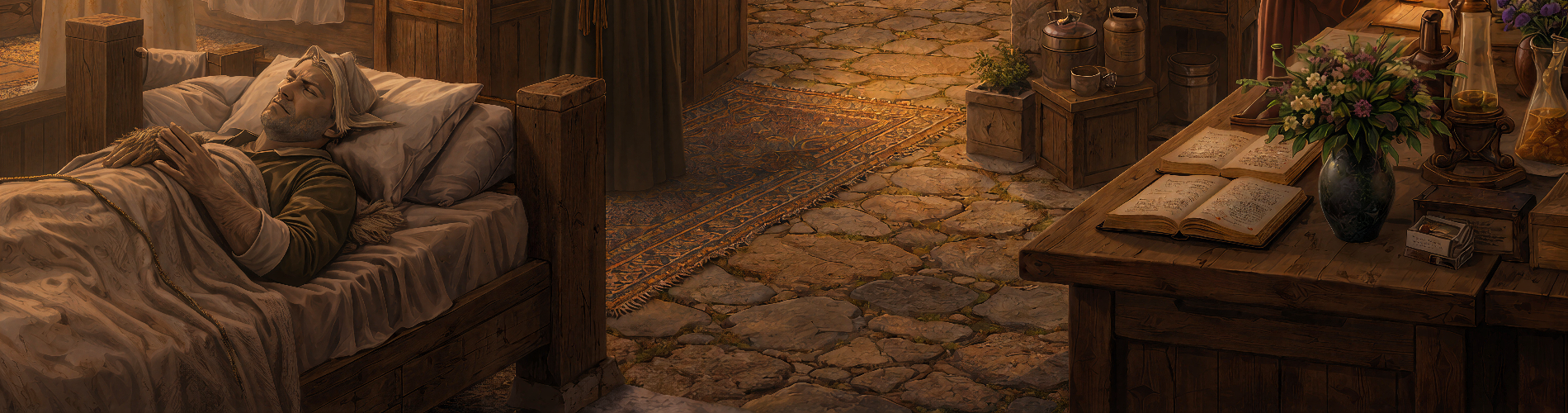
The Threshold
Annex of Living Records
Location: Eastern Outbuilding, Temple-Library of Oghma grounds
Motto: Mercy, Memory, Morning
Primary Faiths: Oghma (Administration), Ilmater (Mercy), Lathander (Vitality)
The Threshold is a tall, three-story annex of warm river-stone standing on the eastern side of the Temple-Library grounds in Evenshade. It is joined to the main library by the Sheltered Way, a covered stone passage that protects patients, scholars, mourners, visitors, and clergy from rain, snow, and summer glare alike. Though plainly subordinate in size and prestige to the Temple-Library itself, The Threshold serves a role no less vital to the life of the village.
If the Temple-Library preserves the memory of what has been, The Threshold exists to receive the present before it becomes the past. Here, the village’s most immediate realities—birth, injury, marriage, family distress, recovery, and death—are first witnessed, tended, and entered into communal memory. It is a house of practical healing, lawful record, transitional rites, and careful human passage.
To most villagers, The Threshold is first and foremost a place of healing. It is where wounds are seen to, fevers are monitored, panicked souls are calmed, bodies are washed for burial, births are recorded, and difficult domestic matters are given private attention before they ripen into scandal. Though divine magic is not absent here, it is not the institution’s ordinary mode of care. Most healing in The Threshold is non-magical: splints, poultices, tinctures, observation, cleaning, rest, counsel, and record. Miracles are reserved for the gravest needs. The village respects this as both practical wisdom and theological restraint.
The Service Covenant
The Threshold operates under a unique local compact known as the Service Covenant. Though it stands upon Temple-Library grounds and bears the intellectual stamp of Oghma, it is not governed as a purely Oghmanite institution. Rather, it is a semi-independent annex in which three allied religious functions are bound together under one roof for the good of the village.
This arrangement arose from necessity. The Temple-Library is a place of learning, preservation, analysis, and disciplined thought, but the faithful of Oghma are not, by temperament, the natural stewards of every human need. Evenshade long ago recognized that a village requires more than memory alone. It requires mercy in moments of suffering and renewal in moments of beginning. Thus the Covenant joined Oghmanite administration with Ilmatari care and Lathanderite midwifery, allowing each tradition to do what it does best without surrendering the unity of the institution.
The annex remains subject to the ordinances of Evenshade and to such by-laws as bind the Ilmatari and Lathanderite orders represented within it.
The Three Orders Within
The Public Scriptorium (Oghma)
The Oghmanite arm of The Threshold is known as The Public Scriptorium. Its cleric-librarians oversee intake, classification, witnessing, record correction, legal notation, family registries, and the maintenance of the Patient Ledgers. Births, marriages, and deaths are documented here first, before they are abstracted into broader village records.
The Scriptorium’s habit of mind is analytical rather than sentimental. Symptoms are observed, not merely described. Family history is compared. Statements are verified. Contradictions are noted. The Oghmanites of The Threshold believe that care without proper record risks repetition of error, while record without care risks becoming inhuman. In practice, they achieve the latter balance imperfectly.
The Balm of the Broken (Ilmater)
The Ilmatari presence in The Threshold is known as The Balm of the Broken. Their duty is to pain, grief, distress, exhaustion, and bodily need. They manage the three-bed clinic, the crisis bunks, much of the funerary preparation, and the quiet labor of sitting with those who are frightened, mourning, fevered, or ashamed.
Among the village, these are often the most beloved staff in the building. They are the ones who hold basins, steady shaking hands, wash blood away without comment, and remain beside a bed after formal questions have ended. Where the Oghmanites often seek clarity, the Ilmatari first seek endurance.
The Dawnsong Midwifery (Lathander)
The Lathanderite contingent, called The Dawnsong Midwifery, oversees prenatal care, childbirth support, maternal recovery, and the formal welcome of new villagers into recorded life. They also assist in difficult transitions more broadly: convalescence, renewed household order after crisis, and the delicate work of restoring rhythm to a family after illness or loss.
Though dedicated to beginnings, the Dawnsong are no mere celebrants. They are keen observers of lineage, temperament, and domestic continuity. In Evenshade, where family memory and family reputation carry weight, their knowledge is both comforting and formidable.
Motto and Sign
The symbol of The Threshold is a doorway with three lintels, each inscribed with one word: Mercy, Memory, and Morning.
These words also form the annex’s motto: Mercy, Memory, Morning.
Mercy belongs to Ilmater and the work of immediate care.
Memory belongs to Oghma and the work of witnessing, recording, and preserving truth.
Morning belongs to Lathander and the work of new life, recovery, and continuation.
Together, the three words express the institution’s purpose: to meet suffering with compassion, to refuse the loss of truth, and to orient the village toward renewal even when events begin in pain.
The Sign of Crossing
Those entering The Threshold for the first time each day, if they are able, pause at the doorsill and make a customary gesture called the Sign of Crossing. They press the heels of both hands together so that one hand points upward and the other downward, forming a vertical plane across the threshold itself.
The gesture acknowledges a subtle theological truth cherished in Evenshade: most beings do not meet the great transitions of life with full understanding. They arrive at change sideways, intersecting its boundary without seeing far beyond it. A birth, a wound, a diagnosis, a vow, a death—these things are often crossed in ignorance, not mastery. The sign therefore honors mortal limitation, not as failure, but as the ordinary condition of passage.
In village teaching, one does not cross wisely by pretending to know the whole room ahead. One crosses wisely by recognizing that one does not.
Function in Village Life
The Threshold is closely associated in village life with healing, marriages, and funerals, though not always in the way an outsider might assume. Ceremonies themselves may occur elsewhere, but the official witnessing and documentation of such transitions belong here.
The phrase “take him to the Threshold” does not by itself imply one specific need. It may mean treatment of wounds, observation during fever, a quiet room after shock, sanctuary in domestic crisis, consultation before a marriage fails in public, preparation of a body, or simple lawful recording after a turning point in a life. Context is usually supplied: take him to the Threshold to see to his wounds, or bring her to the Threshold and let them speak with her there.
In addition to bodily illness and injury, The Threshold may receive those suffering panic, grief, dissociation, melancholy, mania, prophetic disturbance, poisoning, childbirth complications, or the aftermath of violence, captivity, war, or exposure to cursed objects. It also serves as a place of temporary sanctuary when a villager must be removed from immediate household danger without yet invoking harsher civic intervention.
The Ledgers and the Law of Access
The Patient Ledgers are among the most distinctive and quietly influential records in Evenshade. Here are preserved observed symptoms, injuries, treatments, family tendencies, known sensitivities, notable recoveries, and relevant statements made in care. The ledgers are not merely medical. They are part civic document, part household memory, part legal reference, and part archive of embodied truth.
Access during a person’s life is restricted to:
- designated cleric-librarians and Temple-Library leadership,
- the subject of the record,
- and the subject’s family members.
Village leadership has no automatic right of access. The Watch of the Scroll may only obtain use of such records for legal necessity, including criminal investigation and related proceedings.
Records may be corrected and contested. They are not officially sealable, save in extraordinarily rare circumstances, for the Oghmanite conscience recoils from locking truth away entirely. Even so, access is governed by custom and dignity. Privacy is respected, but secrecy is not venerated.
A distinctive local rule governs the ledgers after death: the Patient Ledger of a deceased person becomes public three months after death. This waiting period reflects both the village’s respect for mourning and a practical accommodation to resurrection. In the wider Realms, a return from death is not impossible, but in Evenshade such acts are rare and almost always attempted soon after loss. After three months, the village considers the matter settled enough for private record to pass into communal memory.
For this reason, some diagnoses are greatly feared in the ledgers, especially those thought to reflect upon bloodline or future offspring. Among the most dreaded are notations concerning madness and inherent magical ability, both of which may stain a family’s reputation once records become open.
The Great Rotation
The Oghmanite staff of The Threshold serve on a formal rotating duty called The Great Rotation. Cleric-librarians are changed out every few days so that no one scholar remains too deeply entangled in the course of a single patient’s care for too long.
Officially, this practice exists to reduce bias, maintain clear record discipline, and ensure that the latest medical theories and methods from the Temple-Library continue to circulate through the annex. Unofficially, everyone knows the deeper reason.
Many years ago, an Oghmanite cleric became inappropriately attached to a patient under her observation. In the woman’s period of incapacity, the cleric inserted herself into care decisions that rightly belonged to family and lawful procedure. The patient recovered, discovered what had transpired, and reacted with fury and fear. The scandal left a permanent mark upon institutional memory. The Great Rotation was established so that attachment would be interrupted by structure before it could ripen into possession.
The policy has worked, but not without cost. It protects against overreach, yet it also encourages a coolness that many villagers find disquieting. The Threshold is humane, but its Oghmanite temperament still tends toward emotional distance. In this, it serves the village well and fails it a little at the same time.
Funerary Duties
The Threshold bears significant responsibility for the practical handling of death in Evenshade.
Much funerary preparation may be conducted here: washing the body, confirming identity, recording last statements, preserving effects for family, and keeping the dead until kin are ready to receive them. If a person dies in their own home or upon their own property, local ordinance permits such preparation to occur there according to household custom. If, however, a death occurs upon public property, in a place of business, in the Temple-Library, within The Threshold itself, or beyond the village’s bounds, then these duties are ordinarily brought to The Threshold.
Regardless of place of death, the documentation of death is always performed at The Threshold, and those records remain there.
Layout and Atmosphere
Ground Floor
The ground floor is the point of arrival, intake, registration, first examination, and immediate triage. It smells of ink, vinegar, damp wool, and wet cloaks, and carries a constant air of quiet urgency. Here are found the receiving desk, consultation cells, waiting benches, certain administrative stations, and the first-access chambers used when speed and order must meet.
Second Floor
The second floor belongs more fully to care and recovery. It smells of herbs, steam, linen, and warmed water, and voices are kept low unless circumstances demand otherwise. The three-bed clinic stands here, along with workrooms for poultices, tinctures, and practical treatment. This floor feels less like a library annex and more like a disciplined infirmary.
Third Floor
The upper floor is brighter and gentler. It contains the dawn-facing rooms associated with childbirth, maternal care, some guest recovery, and quieter household matters. The air here carries a sense of nursery warmth, morning light, and restrained brightness. Even when anxiety is present, the floor inclines toward restoration.
Basement
The basement of The Threshold is unnervingly orderly. It smells of dust, camphor, wax, old paper, and cold stone. Here are kept:
- archives of Patient Ledgers not suitable for public shelving,
- drying racks for books and manuscripts found contaminated by mold or vermin,
- sealed drawers containing poisons and unstable tinctures,
- and cold shelves for bodies awaiting family.
Unknown to the current staff, the basement also contains a hidden corridor leading into older temple foundations. The entrance lies behind an enchanted door made to appear as uninterrupted wall. Generations ago it was overlooked; some sixty years past, a senior staff member deliberately disguised it further to discourage curious juniors. In time the concealment became so complete that the door passed out of active knowledge altogether. At present, no one serving in The Threshold realizes it is there.
Notable Leaders
Elius Thobahn, Liminal Advocate
Elius Thobahn is the Oghmanite head of the annex and bears the title Liminal Advocate, often shortened simply to the Advocate. He is a human man of sharp intelligence and spare manner, known for clipped speech, brisk judgments, and an aversion to wasted words. He can seem abrupt to newcomers, though those who know him well understand that his eyes often reveal more concern than his voice permits.
Elius personifies the Oghmanite strength and weakness of the institution. He is disciplined, trustworthy, and unusually difficult to deceive, but he is capable of making suffering feel like an entry before it feels like a burden.
Batul Urag, Humble Father
The Ilmatari leader, Batul Urag, is a half-orc man called Humble Father. Contrary to the expectations many outsiders bring to his ancestry, Batul is slender, medium in height, and soft in motion. He wears his curly hair to his shoulders and often peers over round spectacles perched near the end of his nose. His smile, accompanied by crinkled eyes, has reassured many a frightened villager before a single formal word was spoken.
Batul is beloved because he is never in a hurry where pain is concerned. He remembers that distress often needs presence before remedy. If Elius orders a room and Genwenys steadies a household, Batul makes a person feel survivable.
Genwenys Sylwaer, Dawnsinger
The Lathanderite head, Genwenys Sylwaer, is a wood elf woman bearing the title Dawnsinger. Unlike the severity sometimes associated with her order, Genwenys is reserved, observant, and patient in speech. She waits through conversation rather than filling it, studying others with calm eyes as though noticing more than she chooses to say. There is often about her the impression that she finds the world quietly, privately amusing.
In moments of crisis, she is almost unnervingly composed. She rarely shows true worry, which causes some to underestimate how much she sees. She knows family lines with remarkable depth and is often the first to understand the social shape of a problem even when others still see only its immediate symptoms.
Though the three leaders do not advertise their harmony, they work together with uncommon precision and mutual regard.
Reputation Among the Villagers
Among the people of Evenshade, The Threshold is respected, depended upon, sometimes feared, and very frequently quoted. Villagers understand it as the place where pain is treated seriously and life events are not allowed to pass into vagueness. Its authority derives not from spectacle, but from steadiness.
Yet not all feelings are comfortable. Some families dread what may one day be written openly of them. Some attempt to keep embarrassing matters off the books. Some fear that inherited frailties, madness, or strange signs of inborn magic will cling to their bloodline once committed to record. Others complain, not entirely without justice, that the annex’s habits of classification can become colder than the souls who pass through it deserve.
Still, when matters are grave, few refuse its help.
Common village sayings include:
- “Nothing crosses twice unchanged.”
- “Mercy first, memory after.”
- “Better a blush in the ledger than a burial at dusk.”
- “Send that marriage to consultation.”
The Threshold’s Quiet Flaw
For all its wisdom, practicality, and moral seriousness, The Threshold errs in one enduring way: it mistakes distance for clarity a little too often.
Its tripartite structure works. Its leaders cooperate. Its procedures prevent certain abuses. But the Oghmanite preference for logic, record, and ordered observation tends to dominate the annex as a whole, whether through custom, placement, or prestige. The result is that emotional detachment is never far away. A person may be treated skillfully, lawfully, and even kindly there, while still feeling observed at an angle rather than fully met.
This flaw does not make the institution cruel. It makes it truly a part of Evenshade.
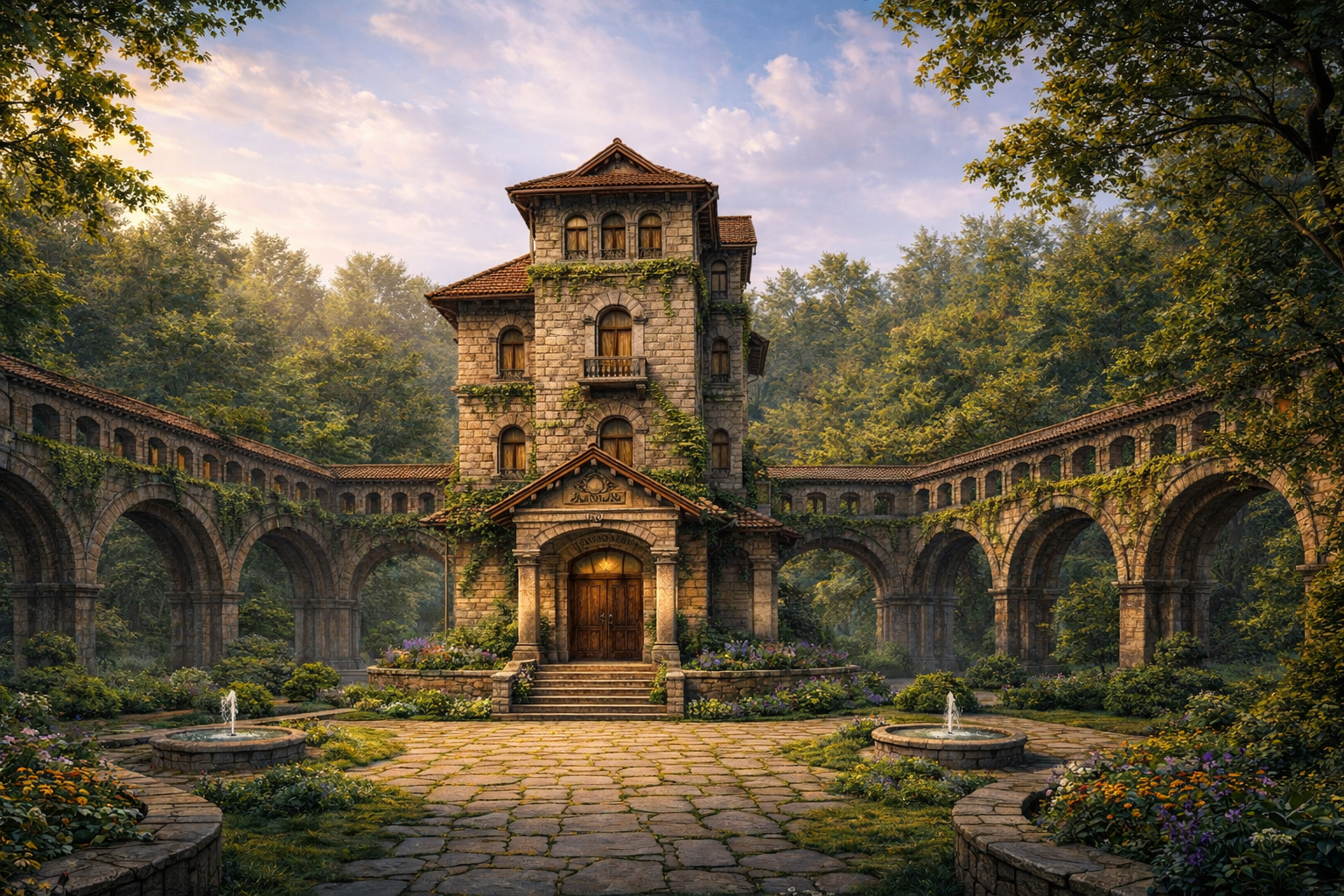
Exterior view of The Threshold

Comments