Sidereal Star-Map Catalog
Do not look for the book on the shelf; look for its place among the stars. In Evenshade, the heavens do not just guide the sailor; they guide the seeker!
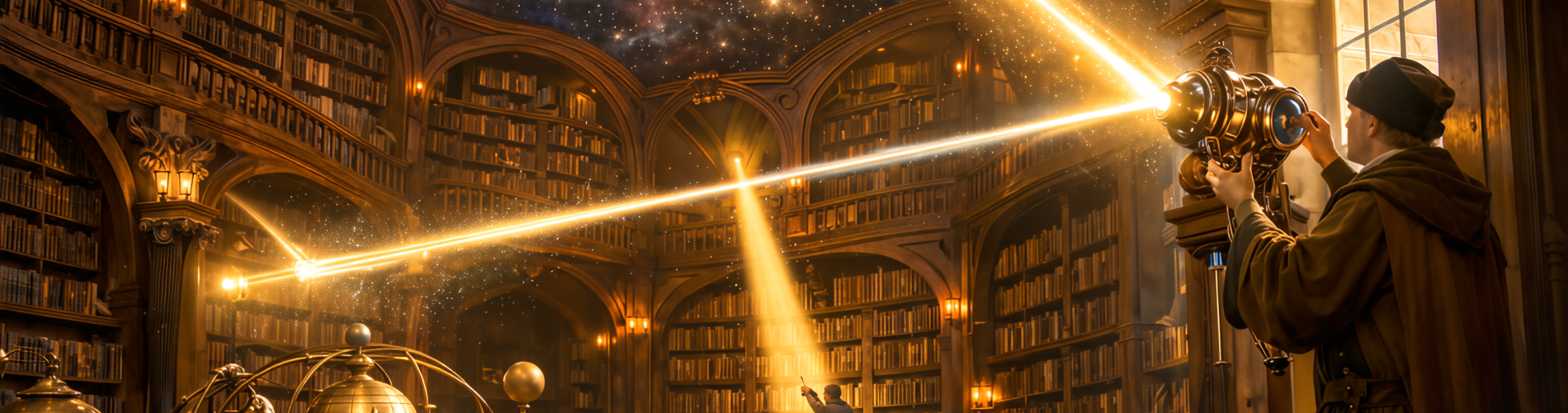
The Sidereal Star-Map Catalog is the crowning technological achievement of The Temple-Library of Oghma: a building-scale retrieval engine that synchronizes the library’s vast holdings with the movements of sun, moon, and stars. In Evenshade, research is not merely performed—it is observed, as if the act of inquiry itself is a kind of astronomy.
To consult the Catalog is to accept its central axiom: knowledge is not static. It has seasons, it has alignments, and it returns, again and again, to certain lights.
The Whispering Message
Those who work beneath the Celestial Vault speak of the Catalog’s “whisper,” not because it makes sound (it does not), but because its method teaches a quiet doctrine:
- Knowledge is as vast as the sky, and just as orderly.
- Truth is revealed by alignment, not force.
- To seek well is to seek with patience.
A young acolyte learns quickly: you cannot bully the heavens into showing you what you want. You can only prepare, wait, and notice.
A Brief History: From Sailor’s Trick to Sacred Machine
The Sidereal Catalog did not begin as a miracle—it began as a problem.
Evenshade’s Temple-Library grew hungry. Donations, pilgrim-tomes, merchant ledgers, bardic recollections, censored treatises, and river-borne salvage swelled the stacks beyond any tidy indexing. Traditional shelving by subject collapsed under the weight of contradiction: one scholar’s “history” is another’s “heresy,” and Oghma’s faithful do not pretend a single taxonomy can contain the world.
The earliest version of the system was a sunlight-pointer used for ceremonial readings: a blade of light would cross a pillar at a certain hour and mark a lectern. From that simple “moving pointer,” the library’s artisans—gnomish lenswrights, human carpenters, and patient monks of Deneir—built an architecture that could answer a more ambitious question:
“If we can make light point to a place, can we make it point to the right place?”
Architecture and Design
The Catalog is not a device installed into the Temple-Library. It is a principle woven into the building’s bones: wood-arched halls, curving galleries, and windows designed not merely for beauty, but for precision.
1) The Gnomon Arches
Along the exterior are dozens of precise arched windows, each containing a vertical sliver of obsidian-glass (the “gnomon”). From afar they resemble decorative inlays. Up close, they are measured instruments.
What they do:
They admit light only in controlled angles—thin, disciplined blades of sun or moon—so that the building itself becomes an optical calculator.
Key elements:
- Filter-Key Slots: A narrow brass channel in the inner frame accepts a removable lens assembly: the Filter-Key.
- Obsidian Slits: The dark glass is not ornamental. It cuts glare, reduces scatter, and forces light into a predictable line.
- Pillar Paths: The curving wooden pillars and arches are not random. Their surfaces are subtly shaped and waxed so a beam can “ride” them without diffusing.
2) Filter-Keys
A Filter-Key is a palm-length brass-and-quartz lens with etched rings, tiny apertures, and sometimes a faint inlaid constellation pattern.
In practice, Filter-Keys do three things at once:
- Select a category of inquiry (by an internal geometry-cipher).
- Constrain the beam to a specific “answer-path.”
- Prove authorization (many keys are keyed to librarians by micro-etch signature).
There are dozens in common rotation—and a handful that are never shown to the public.
A Filter-Key does not open a lock. Rather, it opens a question.
3) The Celestial Vault
The Great Hall’s ceiling is a breathtaking, reactive mural of the night sky: the Celestial Vault, a star field that perfectly matches the heavens above the Sword Coast.
How it responds:
When a correctly refracted beam hits a hidden receptor in a pillar, it triggers concealed reflectors and a lattice of polished channels above the ceiling.
- A “star” on the Vault begins to pulse with a soft golden glow.
- A secondary beam “falls” from that star as a spotlight—not to the general area, but to a specific run of shelving.
Because most of the library is not shelved by topic (children’s collections are the famous exception), browsing is an unreliable method. The Catalog is the difference between wandering and arriving.
4) The Master Orrery and Rotation Tables
In a side chamber accessible only to senior staff sits a massive brass orrery—the Master Orrery—surrounded by shelves of thin folios known as the Rotation Tables.
These tables encode the system’s “truth”: the Catalog is not just a pointer. It is an agreement between the sky’s motion and the library’s motion.
The Librarian’s Dance
Visitors often call the process “the Librarian’s Dance,” because it resembles choreography: moving to the right window, waiting at the right angle, following a slow path of light through curving halls.
Practical Use: Step by Step
1) The Inquiry
A researcher states a topic. The attending librarian clarifies intent with three questions:
- “Is this fact, method, or meaning?”
- “Is this for use, study, or disputation?”
- “Must the answer be safe, true, or complete?”
2) The House
The librarian consults the Master Orrery to determine which Celestial House governs the inquiry (see below).
3) The Key
The librarian issues a Filter-Key, sometimes paired with a small wax seal that indicates permitted depth (public stacks vs restricted galleries).
4) The Alignment
The researcher is sent to a specific Gnomon Arch and instructed to wait for a particular light: sun-angle, moon-height, or (rarely) a star-rise alignment.
5) The Retrieval
When alignment occurs, the beam rises and rides the pillars. The seeker follows the Path of Light to the illuminated shelf.
Cultural note:
In The Temple-Library, it is considered rude to speak loudly during the Path of Light. Some say the building “listens.” Most simply prefer reverence.
Why ask for something untrue?
In Evenshade’s Catalog logic, “true” is only one axis of value. A thing can be useful without being literally accurate, and sometimes “true” is actively the wrong kind of medicine.
Here are the big reasons:
1) The seeker wants meaning, not fact
A parable about a greedy king doesn’t need to be historically real to be diagnostically true about power.
- True? Not necessarily.
- Complete? Often intentionally not.
- Safe? Depends on who the king resembles.
2) The seeker wants emotional rehearsal
Stories let people practice fear, courage, romance, grief, betrayal—without paying the real cost.
A young Watch of the Scroll recruit might ask for “a tale where the brave one freezes and survives anyway,” because that’s the answer he needs.
3) The seeker wants comfort, hope, or mercy
Sometimes someone asks the library for a lie because the truth would break them today.
This is where “safe” becomes ethically loaded:
- A grieving person may need a story that doesn’t end like life did.
- A child may need a monster that can be outwitted.
4) The seeker wants deniability
In a village where cleverness is currency, fiction is a weapon with a velvet handle.
People can say, “It’s just a story,” while everyone really knows exactly who it’s about.
So:
- True? Officially “no.”
- Safe? Maybe not.
- Complete? Never—because the point is implication.
5) The seeker wants a deliberately biased narrative
Songs of kings, histories commissioned by nobles, temple “official legends,” and patriotic epics often serve an agenda. They’re not “true” in the neutral sense, but they are strategically accurate in what they try to produce: loyalty, morale, obedience, unity.
6) The seeker wants a beautiful lie
Oghma’s followers in Evenshade (especially with Deneir’s influence) treat artistry as a kind of knowledge: knowledge of rhythm, persuasion, metaphor, memory, and the architecture of attention.
A poem can be “untrue” and still be a precise instrument.
How this frames the triad of safe / true / complete
Now the librarian’s question has teeth:
- Safe: “Will this harm you—or others—if you know it?”
- True: “Do you need literal accuracy, or narrative/psychological truth?”
- Complete: “Do you want everything… or just enough to do what you intend?”
And with the Masquerade House in play, a librarian can interpret “true” as:
- literal truth (history, measurements, dates)
- symbolic truth (parable, allegory, mythic resonance)
- performative truth (a story designed to produce courage, grief, compliance, love)
Some librarians use a gentler phrasing when they detect a Masquerade inquiry: “Do you want what happened… or what helps?”
The Celestial Houses
The Catalog’s conceptual map divides knowledge into Houses—not subjects in the mundane sense, but modes of truth. Librarians debate them like theologians.
| Celestial House | Governs | Examples of Topics |
|---|---|---|
| The Lantern House | Practical guidance, survival, craft | winter travel, farming cycles, medicine, carpentry |
| The Mirror House | Identity, lineage, social truth | genealogy, noble histories, local law, testimony |
| The Sword House | Conflict and consequence | wars, tactics, feuds, oaths, political fractures |
| The Tide House | Trade, movement, exchange | river routes, tariffs, mercantile codes, logistics |
| The Veil House | Secrets, censorship, hidden concords | forbidden cults, sealed archives, dangerous names |
| The Crown House | Governance and institutional memory | charters, treaties, decrees, temple edicts |
| The Hollow House | Absence, loss, paradox | vanished villages, contradictions, unsolved riddles |
| The Ascendant House | Magic, metaphysics, the strange | planar theory, arcana, psionics, divine disputes |
| The Masquerade House | Fiction: romances, epics, folktales, tragedies/comedies | bardic cycles, theater scripts, moral fables, satires and political lampoons (very popular in Evenshade), "comfort books" used for grief, fear, heartbreak |
The Migratory Archive: Rotational Indexing
In the Temple-Library, the truth is never in the same place twice. If you wish to find it, you must not only know --what-- you seek, but --when-- you seek it.
The Sidereal Catalog does not merely point to shelves—it dictates their meaning in time. Because celestial bodies shift throughout the year, the librarians do not recalibrate the keys. Instead, they do something far more Oghman:
they move the library.
The Logic: Obfuscation Through Motion
To an outsider, relocating thousands of volumes is madness. To the Temple-Library, it is the ultimate security and the purest philosophy.
1) Fixed Beam, Shifting Target
The Gnomon Arches and Filter-Keys create a geometric search beam fixed to date and angle. But the sky shifts—so a beam in Hammer (midwinter) will “want” to strike somewhere else than a beam in Eleasias (high summer).
2) The Great Rotation
Every three months, during the Grey Hours around solstices and equinoxes, the Order of the Page conducts a silent reorganization:
- stacks migrate
- ladders relocate
- galleries swap their “address”
- entire alcoves shift their holdings like schools of fish
The key for “Ancient Draconic Lore” still triggers the same star on the Vault—but the star’s downward beam will illuminate different shelving depending on the season.
3) The Geometric Cipher
The rotation pattern is not a simple circle. It incorporates:
- seasonal sky-angle changes
- the local horizon’s peculiarities
- minute corrections only the Rotation Tables record
- and (some whisper) an old calibration anchored to the Ancient Wizard Tower’s hilltop sightlines
Security outcome:
A thief who steals a key and learns a shelf location has learned a fact that will be obsolete in three months. Without the Rotation Tables, the library becomes a beautiful labyrinth whose “addresses” won’t stay put.
Practicality and Preservation
The Migration is not only security—it’s care.
- Resting the vellum: books rotate away from frequently-lit galleries into deeper, darker archive corridors to “recover” from exposure.
- Seasonal relevance: winter guides drift toward accessible, warm-lit halls in cold months; planting calendars glide closer to public reading nooks in spring.
- Wear leveling: high-demand shelves migrate so no single stair, ladder, or gallery suffers constant strain.
Protocols and Safeguards
The Catalog is precise, but it is not naïve. The Temple-Library maintains protocols for failure, sabotage, and emergencies.
The Dark-Sky Protocol
If intruders breach the Temple-Library, librarians can trigger the Dark-Sky Protocol:
- the Vault dims to a false “new moon” darkness
- decoy stars pulse randomly
- the Path of Light becomes a lie
Result: the Catalog becomes useless to anyone who does not know the counter-rite.
The Cloudfall Clause
Heavy overcast can ruin timing. In such cases, staff may use stored light:
- mirrored lanterns calibrated to mimic sun-angle
- moon-lamps tuned to the same narrow spectrum as true moonlight
This does not perfectly replicate the heavens, but it can provide “good enough” retrieval in emergencies.
The Quiet-Hands Rule
During Migration days, no outsider is allowed past the public narthex. Even senior scholars are kept out. Curiosity is honored, but not above system integrity.
The “Ghost-Calls”
Though the Catalog is strictly mechanical, the Temple-Library records an anomaly, spoken of in whispers: Ghost-Calls.
The Phenomenon
On rare nights, a star in the Celestial Vault pulses without any Filter-Key inserted—sometimes faintly, sometimes insistently, as if demanding attention.
The Official Position
Senior staff claim these are:
- residual optical charge
- misalignment from humidity
- settling beams after Migration
The Unofficial Suspicion
High-ranking scholars suspect Resonance—a pressure on the system that does not come from light.
The favored hypothesis is the Ar-Garalyn: ancient psionic masters whose influence lingers around the Ancient Mage Tower. The Ghost-Calls feel like a hand on the shoulder: Look here. Not because you asked… but because you should.
The Dangerous Thought
A forbidden marginal note (attributed to Kaelen, though never confirmed) poses a question no novice is allowed to repeat aloud:
“If the Catalog can forget… can something else remember through it?”
People of the System
The Sidereal Catalog is a machine—but it is also a living practice upheld by orders and specialists.
- High Librarian—Keeper of the Rotation Tables, public face of the Catalog, and the one who decides when a request becomes too dangerous to answer.
- The Order of the Page — acolytes and lay-scholars who perform the Migration of the Page, sworn to silence during Grey Hours.
- Lenswrights of the Brass Loft — artisans who craft and maintain Filter-Keys; they speak of lenses the way priests speak of relics.
- Vault-Tenders — those who maintain the reflectors and hidden channels above the Celestial Vault (a terrifying job for anyone who dislikes heights or narrow spaces).
Dungeon Master Utility
Use the Catalog as a research engine, a heist target, or a mystery generator that points the party toward consequences.
Mechanics and Hooks
| Feature | DM Hook / Mechanic |
|---|---|
| Star-Dome Research | Using the Catalog grants +5 to a History or Arcana check, but requires 1d4 hours waiting for alignment (or longer for rare Houses). |
| The Dark-Sky Protocol | If triggered, all Catalog-based checks are made at disadvantage unless the party can restore true alignment or acquire the counter-rite. |
| Filter-Key Hunt | A key found in a ruin “belongs” to a lost query. Bringing it to Evenshade reveals a hidden shelf, a sealed archive, or a forgotten name. |
| Lunar Research | Certain restricted topics are only retrievable under eclipse, new moon, or full moon conditions—forcing timed play. |
| The Ghost-Call | Once per campaign arc, a Ghost-Call triggers. If followed, it points to a book that creates a problem the library “officially” denies exists. |
Adventure Seeds (Plug-and-Play)
- The Stolen Rotation Table: someone has taken a single folio page from the Rotation Tables—just enough to predict one House’s shelf locations for the next season. Who paid for that knowledge, and what do they plan to steal?
- The Wrong Star: the Catalog points to a shelf that should not exist. The spotlight falls onto bare wood, as if a book was removed before it was ever shelved.
- Migration Sabotage: during Grey Hours, a single gallery is rotated incorrectly. The next day, the Vault’s constellations no longer match the real sky. The library insists everything is fine.
- The Key That Won’t Let Go: a Filter-Key taken from the Secret Archive becomes warm at night and “wants” to be returned to a specific window—always the same window—always just before dawn.
Flavor: Sample Filter-Keys
If you want a quick way to make the system feel real at the table, hand the party “keys” with names.
- Key of Salt & Ledger (Tide House): trade disputes, tariffs, smuggling codes
- Key of Ashen Hymn (Hollow House): burned histories, erased names, lost villages
- Key of Glass Tongue (Veil House): coded correspondence, cipher-languages, blackmail folios
- Key of Nine Petals (Lantern House): medicine, herbalism, midwifery, poison antidotes
- Key of the Unblinking Owl (Ascendant House): psionics, mind-arts, Ar-Garalyn residue studies
What the Catalog Costs
To keep it from feeling like “free magic,” you can bake in constraints that create story:
- Time: the heavens do not hurry.
- Weather: the sky can refuse you.
- Authority: librarians decide what a request “counts” as.
- Danger: the Catalog does not only reveal answers—it reveals paths to answers, and paths can be traps.

Comments