
Serukis
The land of hope
Content Warning


Founding Date
3830 EA
Area
Approx. 721,230 sq mi
Demonym
Seruic
Population
Approx. 937,825
National Language
Seruic
Regional Languages
Mokai Mai, Usgaren, Erozyan
Government
A pentarchy formed of five high lords
Current Rulers
Edward Elenasia III, Milton Ereth I, Tristan Hargrove IV, Castor Sybrant I, Selwyn Vaifale II
Currency
Roses
Capital
Sanctuary
National Religion
The Elemental Monarchs
Minor Religions
Gen Mai, The Faith


 The wilds of Serukis became a dangerous place. Travel between settlements was fraught with peril, as ambushes on military or mercenary groups were common. Notably, the Erozyans and Koushan Mai rarely directly attacked civilians, but main and alternative roads were lined with traps. One of the most frequently used traps consisted of a pit filled with sharpened sticks, carefully camouflaged to look like undisturbed ground. Whilst retaliatory raids on Seruic settlements were rare, there are several stories from that time of the Erozyans descending on a village in their draconic forms, raining fire and almost impossible to fight off. Though these accounts are hard to verify, it was a known tactic of the Erozyan forces to burn farms and crops.
Support for the war amongst Seruic people started low and dwindled rapidly, particularly in Kestlaren and much of Arland. Being the descendents of refugees - or recent refugees themselves - many saw the conflict as perpetuating the wrongs that they had experienced. The then High Lord Elenasia, Sebastian III, who had been reluctant to lend his support in the first place, ceased aggression after less than a year due to increasing unrest in his lordship.
It took around four months for the new High Lord Vaifale to negotiate a peace treaty after his father's death, though an armistice had been called for and followed through with almost immediately. This complicated, multipage document was written in both Erozyan and an old dialect of Kaienese, and much of it is still followed today; to that end, it has been translated into modern Seruic. The treaty's most important clause is that it is forbidden to build on land considered sacred by the Erozyan people.
The wilds of Serukis became a dangerous place. Travel between settlements was fraught with peril, as ambushes on military or mercenary groups were common. Notably, the Erozyans and Koushan Mai rarely directly attacked civilians, but main and alternative roads were lined with traps. One of the most frequently used traps consisted of a pit filled with sharpened sticks, carefully camouflaged to look like undisturbed ground. Whilst retaliatory raids on Seruic settlements were rare, there are several stories from that time of the Erozyans descending on a village in their draconic forms, raining fire and almost impossible to fight off. Though these accounts are hard to verify, it was a known tactic of the Erozyan forces to burn farms and crops.
Support for the war amongst Seruic people started low and dwindled rapidly, particularly in Kestlaren and much of Arland. Being the descendents of refugees - or recent refugees themselves - many saw the conflict as perpetuating the wrongs that they had experienced. The then High Lord Elenasia, Sebastian III, who had been reluctant to lend his support in the first place, ceased aggression after less than a year due to increasing unrest in his lordship.
It took around four months for the new High Lord Vaifale to negotiate a peace treaty after his father's death, though an armistice had been called for and followed through with almost immediately. This complicated, multipage document was written in both Erozyan and an old dialect of Kaienese, and much of it is still followed today; to that end, it has been translated into modern Seruic. The treaty's most important clause is that it is forbidden to build on land considered sacred by the Erozyan people.

No records exist on how exactly the terms of the agreement were decided upon, though the contemporary diary of another high lord, Henry Sybrant II, betrays no small amount of frustration with Vaifale for his 'concessions'. It was settled that Sgaren, for all intents and purposes, would become part of Serukis; it would pay taxes and be beholden to Seruic laws. In return, the Seruic army would protect Sgaren as it would any other part of Serukis, and any invasion by the Erish Empire would be considered an act of war. The concessions alluded to in Sybrant's diary were that the Usgar people would be allowed to continue to practise their cultural traditions and speak their native language - a much better outcome for the country than if it were to succumb to the Empire's rule once more.
These agreement was written down on a single sheet of vellum, a document now known as the Treaty of Sgaren. The basic structure of the treaty was based on the one drawn up with the Erozyans several centuries prior. One of its most important edicts was that the lands of Sgaren were now under the purview of the High Lord Vaifale and his descendents thereafter. Whilst many Usgar were not happy with this turn of events, the majority agreed that it was the lesser of two evils; this was mainly because the Treelord was allowed to remain in his position as their leader, albeit now surbordinate to the high lord.
The Withering Death
Twelve years ago, in 5334 EA, the wasting sickness made its way north to Serukis in an event now called the Withering Death. The wasting sickness, also known as atrophic searing, is a disease endemic to Caia, almost exclusively in the south where the climate is warmer and more humid. The disease prevents the digestive system from absorbing nutrients, which means that the body turns to burning fat and then, later, muscle for energy. People with the wasting sickness rapidly lose weight and muscle tone, and find it difficult to keep either food or liquids down. When the disease moves on to devouring muscles, it becomes excruciatingly painful, with sufferers describing a sensation like never-ending fire. It is fatal in around ninety percent of cases where symptoms spread to the muscles.
War, Pandemic/Disease, Death, Prejudice/Persecution
Serukis is a testament to the tenacity and stubbornness of the Seruic people. We built this country from nothing.Founded by Kaienese refugees, the country of Serukis has always represented hope to its citizens. Its name comes from the Kaienese words 'ser', meaning hope, and 'kest', meaning land; it is, quite literally, the land of hope. Once part of the sprawling country known as Vasethal, Serukis continues to grow, spreading its influence out to the numerous islands scattered along its coastline. Though the country lacks expansionist ambitions, the extra territory forms a strong barrier between it and those with colonial interests.
Geography
Serukis is located on the northern half of the continent of Caia. Its southern and western borders are defined by the vast mountain range of the Teeth, which is one of the shorter ranges on Etrea despite being over a thousand miles long. Its eastern border is the river known as the Serpent, which separates it from its neighbouring country of Caillah. The Serpent is over eighteen miles wide in places, its vast waters seeming more like a lake. To the north, Serukis is made up of jagged and rocky coastlines, the clearest display of why Caia is known as the shattered continent. There are over two hundred islands and islets in the Grey Waters, the seas around Serukis's northern and northwestern coasts; ninety of these are Seruic territory as of 5346 EA. The northeastern coast is less rocky, with more gentle sloping sandy beaches and coastal wetlands. Here, the waters of the Stretch bring in warmer currents from the south. by Matt Lamers
As well as the Teeth, Serukis contains another small range known as the Falas mountains, located in the west of the country. These mountains feed a vast network of rivers and waterways to the north, and themselves contain a honeycomb of vast underground caverns and lakes. A single tributary of the Lordsrush, a mighty river to the southwest, also originates here, though the majority of the river's waters come from the mountains of the Teeth.
Whilst much of the country is mountainous or hilly terrain, much of central Serukis is dominated by a wide flat plains. Geologically, this area is different from the rest of the country, characterised by a thick layer of blancite, a hard sedimentary rock resistant to erosion, under the topsoil. Any waterways in the plain, such as rivers and streams, are generally shallow and meandering for this reason. Blancite, also known as whiterock, is unique to this area, not found anywhere else on the planet.
To the extreme north of the country, the hilly area known as the Skarrens is covered in thick boreal forest, characterised by distinctive black ironwood conifers.
Climate and Weather
Bloody typical! It's raining again.Serukis has a mostly mild, temperate climate, with a greater-than-average level of rainfall. Average temperatures in the summer months are around 23°C, with the highest ever recorded temperature being 27°C on the eastern coast. Average temperatures in the winter months hover between -2°C and -4°C degrees. However, in the southern mountains, particularly in the city of Frosthollow, temperatures have been recorded as low as -11°C. The northern coast and the myriad islands of the Grey Waters are often battered by storms, blown in from the vast expanse of the Circle. This coast has some of Serukis's harshest weather, with gale-force winds being a common occurance. Outside of the mountains, this area weathers the country's coldest winters. The eastern coast is, however, comparatively milder than the rest of the country, warmed by tropical currents from the Caerlean Ocean to the south. This region of Serukis seldom gets snow, the temperature rarely falling below zero degrees.
Places of Interest
The Teeth
Forming the southern border of Serukis, the Teeth are said to resemble the lower jaw of some ancient creature, its broken fangs now covered in rock and ice. They stretch for 2111 kilometres across the continent of Caia, and contain three of the highest mountains in the whole of Etrea; the tallest of these, the Monarch's Throne, is 8874 metres above sea level at its peak. These mountains have long been considered sacred to Faolan, the Ruler of Earth, by both the Seruic and Kaienese people, and are often referred to as his sentinels. They are famously impossible to pass during the winter months, though many have tried and perished.The Falas Mountains
The Falas mountains are a relatively short mountain range in central Serukis, only a couple of hundred miles long. Much like the Teeth, it is theorised that they used to be part of the sea bed, as the fossils of fish and other, larger sea creatures have been discovered on their slopes. The highest mountain in the range is Mount Fallwater, at 3827 metres, which is named after its several impressive waterfalls. Underneath the mountains themselves there are vast networks of caves, extending several hundred miles away from the mountains on each side. The caves are full of underground rivers and lakes, though the water levels rise and fall throughout the year. It is believed that at least ninety percent of the tunnels remain unmapped and unexplored.
by Dave Reed
The Black Forest
The Black Forest is the largest continuous stretch of forested land in the country of Serukis, extending for several hundred miles at its widest point. It is a mostly coniferous forest, but has some pockets of deciduous broadleaf trees throughout its northern half. The southern edge of the forest reaches up to the tree line of the Teeth, growing thinner and more scattered as the altitude climbs. Streams cross the forest like veins, many leading to the Smoke, one of the main tributaries of the Serpent. There are a wide variety of flora, fauna, and fungi that call the forest home, with some species unique to a single patch of deciduous trees.The Seruic Plains
Central Serukis is dominated by the Seruic Plains, miles and miles of flat, endless grassland and shallow, crystal clear waterways. Over one hundred species of grass have been identified as growing in the region, and it has an extremely diverse population of invertebrates. Whilst there are a limited amount of trees in the area, some patches of woodland have been cultivated by the inhabitants, especially near the larger settlements.The Argent Saltlands
The Argent Saltlands are a stretch of wetlands that extends for about fifty miles along the eastern Seruic coast. When the tide is in, much of the area is covered in around a foot of saltwater. When the tide is out, the land is covered with pools of shallow water, separated by banks of sticky, salty mud. Much of wetlands are covered in shimmergrass, a wispy, silvery grass that glistens like metal. It grows long enough to reach above the water at high tide.History
The country now known as Serukis is located on land that used to be the countries of Vasethal, Sgaren, and numerous independent island nations. The founding of the country is considered to be the moment the first refugees stepped foot into the land formally known as Vasethal, generally accepted to be the eighteenth of Vatrus, 3830 EA. It only took around a century for the country to be known only as Serukis. Serukis is not mentioned by name in contemporary documents until the twelfth of Pallus, 3926 EA, where it is referenced in a letter from Emperor Victore Marden IX to his brother, Louis. However, it is alluded to in Kaienese intelligence missives from as early as 3850 EA, where there are numerous mentions of 'Kaienese rebels' forming a country of their own.The Crossing
On the fourth day of Canus, 3830 EA, a group of one hundred and forty-two men, women, and children set out on a journey that would take them over two months and cost many of them their lives. This was the entire population of the Kaienese village of Stillcross, desperate to escape the oppressive regime that had seen escalating violence, increased and erratic conscription, and widespread famine. The village planned for over a year, stockpiling food and hiding supplies every time the soldiers came to take the Emperor's share. Their chosen route, a long mountain pass known as the Throat, had a narrow window where traversal was less dangerous, during the warmer summer months. These plans were abandoned, however, when the group left over a month earlier than intended, to prevent the conscription of several of the village's young men. A message had arrived from the next village over, warning them; that village had, in turn, received a warning from further down the road. The earlier, rushed departure meant that some of the carefully hoarded supplies were left behind, and the weather in the pass was much harsher than planned. Out of the one hundred and forty-two people that left Stillcross, only eighty-seven survived the Crossing. Over the following few decades, nearly a fifth of the population of Kaien fled to the new land Serukis. Though some risked the mountain pass, the majority came via the longer - but much safer - coastal route, first fleeing to Eshua before bartering for passage around Caia's western coast. Despite Kaien being quick to lock down their borders, this exodus continued - albeit at a greatly stifled rate - until the fall of the Marden Dynasty in 4658 EA. by Simon Fitall
Conflict in Vasethal
Serukis was our people's haven. Our hope. To start with, it didn't matter that we weren't alone in its wilds.Originally, the refugees settled into their new land peacefully, even as they spread to the farthest reaches of the northern and eastern coasts. The native majority of Vasethal, humans called the Koushan Mai, were sympathetic of the newcomers' plight. Many of them were descended from refugees themselves, having been forced westwards by invaders from the Erish Empire just over four hundred years before. The Koushan Mai, as is their custom, held no political claim over the land, and were unbothered by their new neighbours. The other natives, a group of dragons known as the Erozyans, were more suspicious, though not overtly hostile. They had not experienced the invasion by the Erish in what had come to be known as Caillah, but they felt much more ownership over what remained of Vasethal.
by Sander Sammy
For around a century, there was a fragile almost peace. The Seruic, as they had come to be called, had spread all across the country, as far north as Duszan's Wall, Vasethal's fractious border with Sgaren. The Seruic, at this time, had split themselves into three distinct provinces known as high lordships, each ruled over by a high lord. In the north was Valonia, ruled over by the High Lord Vaifale, spreading from Duszan's Wall and the Bay of Nereus to the Falas mountains. To the east was Arland, extending along the length of the Serpent and under the iron fist of the High Lord Sybrant, who maintained an uneasy peace with the Caillish over the river. To the south, sandwiched between the Teeth and the Falas, lay Kestlaran, which was ruled by the High Lord Elenasia and which accepted ninety percent of new refugees from Kaien.
There had been some hostility over the years, when the Seruic settled on land the Erozyans considered sacred in what was now Valonia, but relations did not deteriorate into outright war until the end of autumn, 3959 EA.
On the 7th of Lanvus, a group of Seruic mercenaries found the Valonian village of Clear Lake empty, its occupants slaughtered or missing. They travelled immediately to the fledgling city of Port Haven, where the then High Lord Vaifale, Godfrey II, had recently founded his seat. The Erozyans were blamed, though - to this day - there is no evidence of their guilt. Though the Seruic had no standing army at the time, each of the then three high lords maintained their own forces. High Lord Vaifale sent out his men for retribution, and they proceeded to wreak havoc on the countryside, wiping out several Erozyan settlements in the process.
From then on, Seruic expansion across Vasethal - or Serukis, as they were now consistently calling it - was not as peaceful. The three high lords, who until then had enjoyed being independent of each other, allied. Mercenary companies swelled in both number and membership. As settlements were founded and grew, native people were moved out of the way by force, whether they were Erozyan or Koushan Mai. The Koushan Mai, who had been neutral up until this point, could no longer be passive.
I cannot, in good conscience, continue to bring war to a people who are merely protecting their homes. The wrong they inflicted has been paid for several times over. I fear if we pursue this path then even the most loyal of our men will begin to question what we stand for. The last town we came across was empty - not even the chickens or the farm cats were left. Someone had warned them, and I would bet my life it was one of ours.
Whilst Godfrey Vaifale ignored the warnings, the High Lord Sybrant, Lorcan I, only continued his support of the conflict for another few months. In a letter written to a friend after the fact, Lorcan Sybrant cited his desire to keep a strong presence along the border with Caillah, as the Caillish were not averse to raids on riverside settlements and he feared a full-scale invasion. Modern scholars, however, generally attribute more nuance to this decision; Arland, at the time, had a relatively high Koushan Mai population, and Lorcan Sybrant - in his latter years - recognised several of his illegitimate children with Koushan Mai mothers, and even named one as his heir.
Valonia continued the war for nearly two years alone, with nothing much gained on either side but casualties. During this time, Godfrey Vaifale became deeply unpopular with the population, but he maintained just enough faith amongst his powerful allies to not lose control of the military. The rank and file, whilst not exactly loyal to him, were kept in line with a mixture of guaranteed rations and the threat of collective punishment. Those around him, however, warned him that his tenuous hold on power could not last.
On a cold morning in early Primus, in the year 3963 EA, Godfrey Vaifale was found dead in his bed by his wife, Olivia. The official story is that he died in his sleep of natural causes, though there were rumours at the time that he was murdered by - or on the orders of - his son, Gideon I. Many scholars today subscribe to that theory.

The Unification of Serukis
For the next five hundred or so years, Serukis existed in relative peace. Conflicts between the high lordships were rare, with most high lords content to attend to their own affairs. Two more high lordships were created during this period, following mutual agreement. Dercia, also known as the Ereth lordship, was formed in 4012 EA, covering the western Teeth and the Black Forest, areas that had found themselves quite neglected in the previous years. Following that, the Midlands, also known as the Hargrove lordship, was founded in 4184 EA; it shrank the territories of High Lords Sybrant and Vaifale considerably, but brought much needed stability to the Seruic Plains, which were far from both lords' seats of power. It was at this time that the high lords each officially adopted one of the Elemental Monarchs as their patron, though for some this was only a formality; the Elenasia Family had considered themselves chosen by Faolan for centuries. During these centuries, the Seruic also began to settle some of the many islands along the country's northern coast. For those islands that were already inhabited, the high lords would often attempt to bring them under their power by offering trade deals or resources in return. Those that refused were generally left in peace, with cordial relations maintained in the hopes of future alliances. There are two notable exceptions to this mainly peaceful expansion that are now considered to be dark blots on the nation's history. The first is in regards to the acquisition of the island of Veria, where the native population was completely wiped out in 4011 EA following a dispute over fishing rights. The second was the violent colonisation of Bril in 4080 EA, a politically significant and resource rich island in the Bay of Nereus; Bril would not win back its independence until 5317 EA. by Echo
In the mid 4450s, the country of Sgaren was annexed during the renewed expansion efforts of the Erish Empire to the north, and it was not long before the Empire had reached Duszan's Wall. By 4460 EA, the Empire's forces had pushed deep into Serukis, swallowing Valonia whole, and spreading into much of Arland and the Midlands. Whilst Valonia and its high lord had surrendered after one brutal defeat, the other regions refused to stop fighting.
Do not think me a coward for bending the knee. I cannot justify throwing my people's lives away in a war we have no chance of winning.With the Empire gaining territory with each passing month, the four remaining high lords held an emergency summit in the city of Ebonvale. It took several weeks of tense negotiations, but eventually it was agreed that they should put past emnity behind them and stand together as one Serukis. After further talks, they consolidated their individual militia and put out a countrywide call for conscription. In late 4460 EA, the Seruic army was officially formed. Emmisaries were sent to prominent groups of Erozyans and Koushan Mai, emphasising the need for cooperation against the imperial threat. These overtures were mostly successful, with the majority allying with the Seruic for the duration. Together, they began counterstrikes against the Empire, driving them from both the Midlands and Erozyan land by early 4461 EA. The Valonian campaign was longer and more arduous due to extensive imperial fortifications. Though these were considered temporary structures, built of wood and dirt, they proved an effective roadblock against the allied forces.
Eventually, encoded messages were able to be delivered behind enemy lines to Port Haven and the High Lord Vaifale, who was under house arrest in his own palace. Emboldened by the messages, Vaifale covertly began to gather a resistance behind enemy lines, alongside some of his most trusted men. Harried on all sides, the entrenched imperial forces began to lose ground, and by 4463 EA, they had been pushed back beyond Duszan's Wall.
To discourage further incursions, the Seruic left behind a large detachment of men south of the Wall, who immediately began to build their own fortifications. These would eventually grow into the walled city of Land's Shield, as well as the Seruic's own larger version of Duszan's Wall, the Bulwark.
In the weeks following the end of the war, the five high lords gathered in the newly liberated city of Port Haven, within the Palace of Shells, where, after some cursory negotiation, the unification of Serukis was signed into law.
It was decided that a new capital city should be founded on neutral territory, where the high lords could convene regularly to discuss matters of state. Following months of planning, construction on Sanctuary began towards the end of 4464 EA. As high importance was placed on the city's planning and infrastructure - including an innovative and complex sewer system - it would be just over two decades before its castle was fully built. Until then, the high lords would take turns hosting meetings on a sporadic basis. After the completion of Sanctuary Castle in 4486 EA, the schedule of these meetings was formalised and they began to occur every four years.
The Southern Flu
Between 4821 and 4823 EA, a highly infectious strain of influenza known as the Southern Flu spread rapidly across the globe. Highly contagious, the flu was believed to be spread by germs in the touch and breath of the infected, causing symptoms such as a sore throat, a high fever, and a wet cough. Its mortality rate differed across age groups and ethnicity, but, on average, the flu was fatal in around twelve percent of those affected. The exact death toll is disputed, but most studies put the figure at approximately twenty million dead worldwide, just under two percent of Etrea's total sapient population at the time. Cases were recorded on every continent except the Barren, and the disease affected humans, shapeshifters, and dragons alike; merfolk remained relatively unscathed, with less than a thousand recorded deaths. In Serukis, the official number of deaths sits at about thirty-six thousand. The high lords' response to the pandemic was swift and strict, and is generally credited for the country's relatively low fatality rate; in contrast, the number of deaths in neighbouring Caillah is estimated to have exceeded a hundred thousand. Many of the Serukis's larger settlements closed their gates to outsiders, whilst a month-long quarantine was enforced for anyone displaying even mild symptoms. Cloth masks were mandatory within most settlements, and people were advised not to linger too long in the company of others. For the more seriously ill, public buildings were turned into makeshift hospitals, with those who tended to the sick forbidden from leaving their walls. The priests of Nereus, who made up the bulk of these carers, had to resort to conscription in the latter half of the pandemic to ensure adequate coverage; this unpopular decision is often blamed for an increase in corruption in the priesthood in the following centuries.The Treaty with Sgaren
In defiance of the Empire, our countries shall become one. To avoid further strife, we shall call each other brothers. However, under these trees and this sky, we shall always be Usgar.In the early 4990s, the Erish Empire appeared to be preparing for renewed aggression against mainland Caia following several decades of relative peace. This placed the unfortunate country of Sgaren, which had only been able to throw off the yoke of the Empire's oppression in the late 4930s, in danger of being annexed once again. The then Treelord, Gasken Irontongue, had not been born when his country was under the rule of the Empire, but he had heard numerous stories from his father and great grandfather, and knew that the fight for freedom had cost his grandfather his life. Following some naval skirmishes that were only narrowly won, Irontongue knew that he would need aid to ensure his people's continued freedom. He spent several days in consultation with his most trusted allies, until his wife, Anghessa Twocups, suggested that they approach their nearest neutral neighbour, a high lord of Serukis. Prosper Vaifale I has been treated kindly by history, for it is often stated that he would have sent the full force of the army to aid Sgaren without asking for anything in return. Whether or not there was any truth in this, it remains a fact that the army was not solely his to do with as he wished; all five of the high lords would need to agree before any significant aid would be dispatched, especially in the form of troops. For that, Sgaren would have to make it worth their while.
A History of Serukis
3959 EA
The village of Clear Lake is massacred.
High Lord Vaifale declares war on the natives of Vasethal.
The village of Clear Lake is massacred.
High Lord Vaifale declares war on the natives of Vasethal.
3960 EA
High Lords Elenasia and Sybrant withdraw their support for Vaifale's war.
High Lords Elenasia and Sybrant withdraw their support for Vaifale's war.
3963 EA
The new High Lord Vaifale signs a new peace treaty into law, ending the conflict.
The new High Lord Vaifale signs a new peace treaty into law, ending the conflict.
4012 EA
The high lordship of Dercia is formed and the first High Lord Ereth is instated.
The high lordship of Dercia is formed and the first High Lord Ereth is instated.
4184 EA
The high lordship of the Midlands is formed and the first High Lord Hargrove is instated.
The high lordship of the Midlands is formed and the first High Lord Hargrove is instated.
4459 EA
Serukis is invaded by the Erish Empire, leading to the annexation of Valonia.
Serukis is invaded by the Erish Empire, leading to the annexation of Valonia.
4460 EA
The first Seruic Army is formed, following talks between the remaining four high lords.
The first Seruic Army is formed, following talks between the remaining four high lords.
4463 EA
The Erish Empire is pushed back, and the invasion of Serukis is declared to be over.
The Erish Empire is pushed back, and the invasion of Serukis is declared to be over.
4464 EA
The city of Sanctuary is founded and declared to be the new capital of Serukis. Construction begins.
The city of Sanctuary is founded and declared to be the new capital of Serukis. Construction begins.
4486 EA
The construction of Sanctuary Castle is completed.
The construction of Sanctuary Castle is completed.
4821 EA
The Southern Flu ravages Etrea, leading to widespread death.
The Southern Flu ravages Etrea, leading to widespread death.
4994 EA
A treaty is drawn up with the country of Sgaren, officially making it part of Serukis.
A treaty is drawn up with the country of Sgaren, officially making it part of Serukis.
5334 EA
The wasting sickness devastates Serukis and Caillah in an event that came to be known as the Withering Death.
The wasting sickness devastates Serukis and Caillah in an event that came to be known as the Withering Death.
The Withering Death
Twelve years ago, in 5334 EA, the wasting sickness made its way north to Serukis in an event now called the Withering Death. The wasting sickness, also known as atrophic searing, is a disease endemic to Caia, almost exclusively in the south where the climate is warmer and more humid. The disease prevents the digestive system from absorbing nutrients, which means that the body turns to burning fat and then, later, muscle for energy. People with the wasting sickness rapidly lose weight and muscle tone, and find it difficult to keep either food or liquids down. When the disease moves on to devouring muscles, it becomes excruciatingly painful, with sufferers describing a sensation like never-ending fire. It is fatal in around ninety percent of cases where symptoms spread to the muscles.
It spreads primarily via contaminated water that is used for drinking, cooking, or bathing. It generally only affects humans, though milder cases have been observed in both shapeshifters and dragons. Much of the population of southern Caia have a natural immunity to the disease through thousands of years of evolution, so outbreaks there, whilst relatively common, are generally containable. The Seruic, though descended from the Kaienese in the south, have lost much of their natural immunity to the disease over the more than one thousand years of separation, whilst the native northerners - such as the Koushan Mai and Usgar - have none.
The wasting sickness ravaged the north for over a year, spreading throughout Serukis and east into Caillah. Though it was eventually brought under control through strict water restrictions and new hygiene laws, nearly fifteen thousand people died. The epidemic still casts a shadow today, with lesser outbreaks across both countries often shattering communities.
Many believe that the disease was brought into the country by Kaienese immigrants. This, it is important to note, has not been proven, though it is recorded fact that several cities in Kaien had been dealing with outbreaks at the time. Despite Serukis's long history of welcoming others, these rumours have stirred up some scattered anti-immigration - and anti-Kaienese - sentiments across the country. Other causes have been suggested to be the importation of tainted shellfish or that year's unseasonable flooding of the Serpent.
 by Michel Serre
Demographics
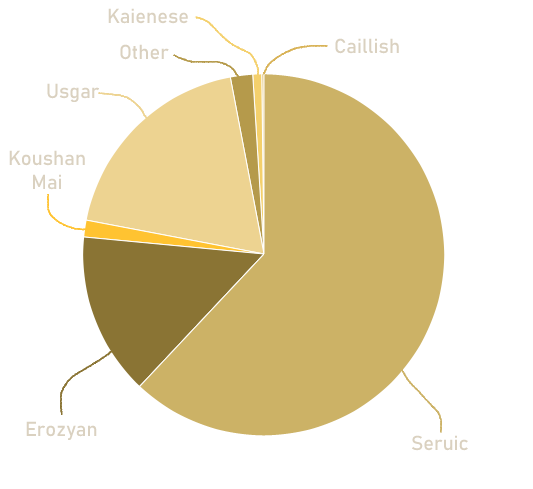
Population Size by Ethnicity
Seruic
62% - 581,451
Usgar
19% - 178,187
Erozyan
14.5% - 135,985
Kaienese
0.8% - 7,503
Other
2% - 18,757
Koushan Mai
1.5% - 14,066
Caillish
0.2% - 1,876
Whilst Serukis is not the bastion of multiculturalism some would have you believe, it is not difficult to appear so when you share a border with Caillah.
Primary Ethnicities
The human Seruic are, perhaps unsurprisingly, the most dominant ethnicity in the country of Serukis. From the first refugees that crossed the mountains, they have spread far and wide across the whole country, and have installed themselves as the rulers of the land. Though they share ancestry with the modern Kaienese, their cultures have diverged greatly; this was exacerbated after emigration from Kaien became practically non-existent after 4658 EA, following the collapse of the Marden Dynasty. The few Kaienese that do live in Serukis generally reside in self-imposed cultural enclaves within the larger cities of the north, especially following the fallout from the Withering Death.
The Erozyans, Usgar, and Koushan Mai are the most populous amongst those considered native to the land now known as Serukis. The Erozyans, one of the largest dragon communities in northern Caia, dwell mostly in their ancestral lands northeast of the Falas, in what is now the Midlands and southern Valonia. There are also small populations of Erozyans in Serukis's larger cities, especially in the seats of the high lords where they maintain a diplomatic presence. The Usgar remain predominantly in the Skarrens to the north; it is rare one will travel south.
The Koushan Mai, once over half a million strong, are a much diminished presence in modern Caia. The majority of those that still exist live scattered across Serukis, which comprises half of what was once their native homeland, Vasethal; in Caillah, the other half, they would be hunted and put to death. Whilst a few Koushan Mai still remain in their ancient villages, many live on the road as itinerant performers, with others having moved to Seruic settlements in an attempt to seek stability.
The vast majority of Caillish that live in Serukis reside in settlements along the banks of the Serpent river. For some families, this is a temporary residence whilst the head of the household serves in an official capacity facilitating trade between the two countries on either side of the river. Other families have made Serukis their permanent home, with some settlements having a large enough Caillish population to justify the construction of a church.
Other Ethnicities
There are plenty of other ethnicities represented across mainland Serukis and its island territories, though none of the remainder have a population of over a thousand people. Many of these are spread across the islands along the northern coast, where more than half are still the homes of the indigenous people who have lived there since the Renewal. These islands include Weypid, where the native dragons accepted Seruic rule as part of a rather lucrative trade deal, and Argony, where the human inhabitants see taxes as a small price to pay for a peaceful life. Some islands, though, were settled by the Seruic; these groups, such as the Saltlanders, are included under the Seruic population figure.
On the mainland, there are also minority ethnic groups that have their roots in the country going back to before the Renewal. Some of these live within the mountains of the Teeth, mostly separate from the rest of the country; the Rakaal, an isolated clan of dragons, shun contact with outsiders, and the Hali, a tribe of freshwater merfolk, rarely received visitors in the remote mountain lakes they call their home. Other groups of merfolk live all across Serukis, inhabiting its waterways and lakes; those that live off the coast are not included in population numbers for Serukis, but for their respective oceans. Amongst those with the smallest numbers are human immigrants from countries other than Kaien or Caillah, such as Athana, Penra, and Erias.
Government
My family has presided over this area for centuries, and you presume to tell me how to rule? How dare you. Get out of my sight.
Serukis is governed by a pentarchy, with absolute power shared equally between its five high lords. Each high lord holds dominion over their own region, known as a high lordship, whilst decisions that affect the whole country are brought about through debate and negotiation. Under each high lord exists a group of lords that handle matters of regional administration, and beneath each of them are low lords that manage the day-to-day issues that arise across the realm. The amount of power yielded to each lord and low lord is very much dependent on the individual high lord; some prefer to exercise complete control, whilst others are content to leave much of the actual governance to others.
The offices of all three level of Seruic lord are hereditary through the patrilineal line; each one passes his title upon death to the closest male relative, whether that is his son, grandson, brother, nephew, uncle, or cousin. Succession also follows the rules of primogeniture, meaning the first born son will always have precedence over any of his male siblings. In the over one thousand years of Seruic history, there has never been a woman in power; strict genealogical records are kept so the closest male heir to each lordship is always known. In recent years, motions have been put forward to introduce females into the line of succession, but so far they have come to nothing.
As the centuries passed since the founding of Serukis, the unfaltering power of the high lords has become attributed to divine patronage, with each of the five houses claiming one of the Elemental Monarchs as the guardian of their family. Though this was not ubiquitous in the public consciousness until the early 4500s, the idea of divine influence has been present since before the Crossing; the Elenasia family have always claimed that Faolan himself bade their ancestors to flee north to new lands. Religion, therefore, permeates every aspect of governance, and lords of all ranks are expected to preside over religious ceremonies and rituals in addition to their other roles. Blasphemy is one of the only crimes that always leads to the unseating of a lord, no matter their rank.
To ensure consistency in the overall rule of Serukis, the high lords convene every four years at Sanctuary Castle. The capital city of Sanctuary itself is - and always has been - considered neutral territory, giving the high lords a place to meet without the reliance on each other's hospitality. These meetings often last for about a month, and are a chance for the high lords to strengthen the bonds between their families as well as for the discussion of policy. Tradition states that there must always be a high lord residing at Sanctuary Castle, but, in practice, this is not always the case.
The Seruic Flag

The flag of Serukis has changed little since its earliest use in the 3830s. It is said to have first been raised in the fledgling town of Newcross, the first permanent settlement built by the Seruic people, when it was still a collection of ramshackle tents and shelters.
Writings from historical sources describe the first flag as having been made out of scraps of fabric - most likely worn-out clothing - stitched together into a roughly rectangular shape. The original flag has been lost to the ravages of time, but a 45th century replica is currently on display at Sanctuary Castle.
The official Seruic flag consists of two white equilateral triangles on a light blue field. The triangles rise from the base at the hoist side of the flag, but do not touch the edge of the fly side. It is symbolic of the mountain pass that the first settlers had to traverse in order to set foot in Serukis, and remains an emblem of hope.
The High Lordships
Arland
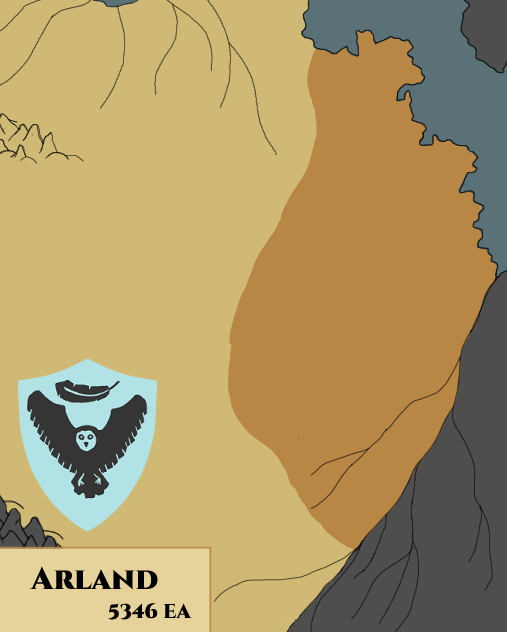
Arland is one of the oldest high lordships in Serukis, founded a mere few years after the Crossing by those who pushed to the east. They were halted by the mighty Serpent , and founded a settlement on its bank that they dubbed Solace. Solace today is a busy river port city, though it is is not the lordship's capital or the seat of the High Lord Sybrant. That honour goes to Ebonvale, a city a few days west of the Serpent on the tributary known as the River Ser, a Kaienese word meaning 'hope'. Ebonvale is one of the largest cities in Serukis with a population of over fifty thousand, and is one of the country's largest producers of linen.
Southern Arland is characterised by its rolling hills and swathes of fields that are used for growing flax. The area is sometimes affectionately referred to as the 'Blue Bounty' by locals. There are also several limestone quarries nestled in the hills, which provide building materials for much of eastern Serukis.
The northern half of Arland is comprised of flat grassland and areas of dense woodland. Most of the region's food is produced here, with the majority of farmland dedicated to crops in the gourd family. The coastal wetland known as the Argent Saltlands covers a fifty mile stretch of the eastern shore. The settlements here are built on stilts, and the inhabitants - a mixture of humans and shapeshifters - build their livelihoods around the harvest of the mineral-rich mud the Saltlands are famous for.
The Serpent separates Arland from the neighbouring country of Caillah. The Sybrant family have always seen it as their duty to maintain both a strong border and a cordial relationship with their neighbours, and the city of Ebonvale have hosted Caillish kings several times over the centuries. Recently, the relationship between the countries has been flourishing.
Dercia
Dercia is the southernmost high lordship of Serukis and, as such, boasts some of the country's coldest temperatures. Perhaps because of this, it is also the country's most sparsely inhabited region. Its southern border is dominated by the mountains of the Teeth, and the east by the upper tributaries of the Serpent. Like Arland, they share some of their border with Caillah, but the Ereth family maintain only a supportive role in international relations, leaving the majority of the diplomacy to the Sybrants.
Built on the slopes of Mount Evershear, the capital of Dercia, Frosthollow, is the highest altitude human settlement in Serukis. With a population of only five hundred people, it is an unusually small seat for a high lord; the majority of Dercia's population instead reside in Coldhill, a city located in Evershear's foothills. With around fifteen thousand residents, Coldhill is the largest settlement in the lordship, with the majority of Dercian towns having less than one thousand inhabitants.
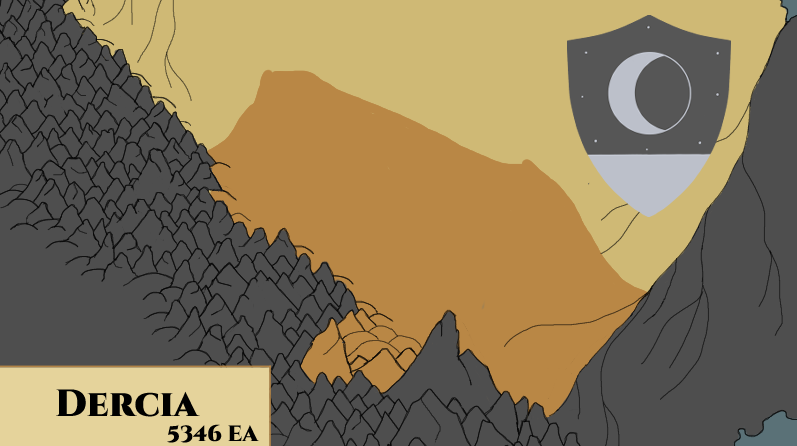 Dercia is also the location of the Black Forest, the largest wooded area in all of Serukis. A mainly coniferous forest, the Black Forest is criss-crossed by streams, and shelters many small settlements and communities. Logging is common along the forest's northern edge, providing building materials for the region, though in recent years more legislation has been passed to prevent too much deforestation. To the east of the forest is a thriving charcoal industry.
Kestlaren
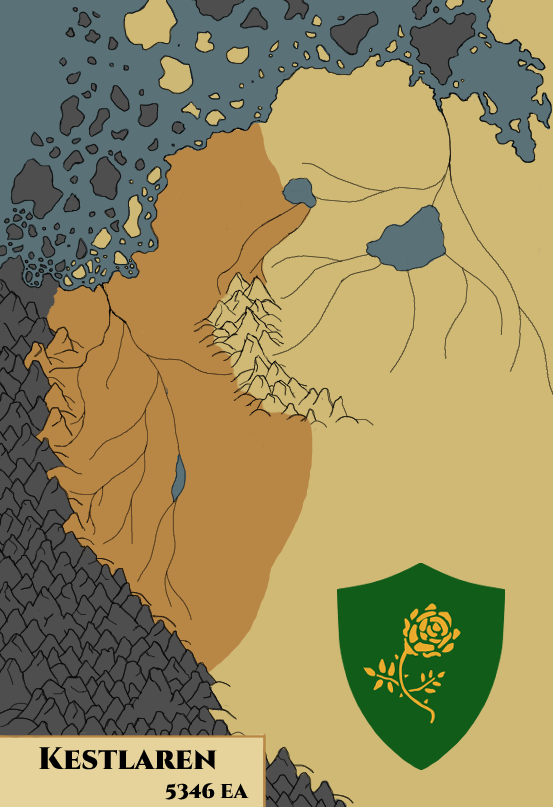
Kestlaren is the oldest of the high lordships and, as such, contains some of the oldest Seruic settlements in the country. It is to Kestlaren the Seruic first came after the harrowing experience of the Crossing, and where they first found their feet as a people. The lordship is flanked on two sides by mountains; the western border is marked by the Teeth, and much of the eastern border is formed of the Falas.
Running through the middle of Kestlaren is the mighty Lordsrush river, its tributaries turning the lordship into a patchwork of marsh and woodland. This network of waterways is the lifeblood of thriving trade in the region, with the inhabitants of Kestlaren utilising the rivers just as much as the roads.
To the west is a large swamp known as the Shademire, located in the floodplain of the River Gloaming, a tributary of the Lordsrush. The Shademire changes with the seasons as the river floods and recedes, but it remains deep enough to support the Shadefolk - a community of freshwater merfolk - all year round.
The source of the Lordsrush is Lake Rundemere, a large but narrow lake that is just over sixty miles in length. It is believed to have been formed in the distant past by the movement of glaciers over thousands of years. Numerous mountain streams coalesce into the two major rivers - the Icemalt and the Rimeshiver - that empty themselves into the southern side of the lake. At the northern tip of the lake are the Pearly Cascades, the group of waterfalls that are the official source of the Lordsrush.
The capital city of Kestlaren is called Lord's Rock, though it was only declared such in the late 4460s, making it the youngest Seruic capital. The former capital is now known as Oldcastle. Being the largest port on the western coast, Lord's Rock is generally considered the gateway to Serukis for travellers from southern Caia. As a consequence, Lord's Rock is one of the most diverse cities in the country.
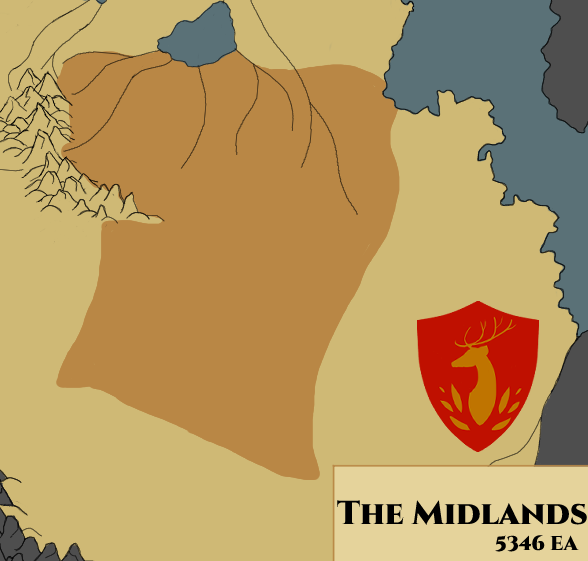
The Midlands
The Midlands is the newest high lordship in Serukis - relatively speaking, as it is still over one thousand years old. It was founded in 4184 EA, ostensibly to bring the number of high lords up to five to match the Elemental Monarchs. However, scholars today believe it is likely that the true reason was to remove Erozyan land, known as the Karayels, from the high lordship of Valonia; despite the peace treaty drawn up a couple of centuries earlier, the region was still prone to unrest.
Much of the Midlands is dominated by the Seruic Plains, a vast expanse of rolling grassland. The area is rather geologically unique, with the majority of the land being formed of blancite, a white sedimentary stone that is not found anywhere else on Etrea. Like the Karayels, the plains are criss-crossed with waterways, though due to the hardness of blancite they are often much shallower and wider in this area.
The capital of the Midlands is the city of Whitecastle, the seat of the High Lord Hargrove and known across much of Serukis as the Pale City. The majority of buildings in the settlement, including the titular Whitecastle itself, are constructed from a mixture of blancite and white oak, with their roofs tiled with a mixture of white and grey clay. Two rivers flow through the city, with the sediment-heavy Milkwater to the north and the deceptively calm Glasswater to the south.
Valonia
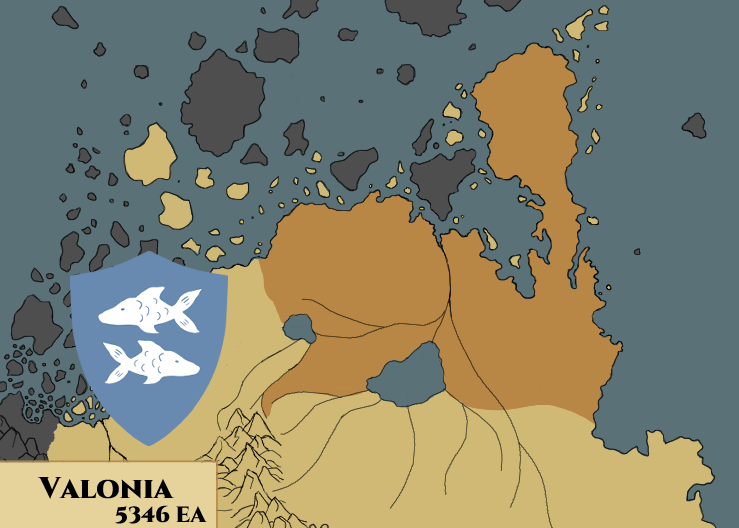
Valonia is the northernmost high lordship of Serukis, prone to wild storms and harsh winters. It is generally considered to be made up of two regions, the Skarrens to the north and Valonia proper to the south, divided by the now defunct Duszan's Wall.
The Skarrens, once the country of Sgaren, is a sparsely-inhabited and heavily-forested region, characterised by rolling hills, steep ravines, and the distinctive black ironwood conifers that dominate the landscape. These grey-green trees are the giants of Caia, reaching an average of around ninety metres in height. Their black trunks are notably straight and thick, with an average diameter of eight metres.
Forming part of Valonia's southern border is Lake Matilde. At over one hundred miles from shore to shore, it is the largest lake in Serukis, and one of the largest on the continent of Caia. It is also one of the deepest bodies of freshwater on the planet, reaching a depth of over one thousand metres. It is theorised that the lake is connected to the network of caves spreading out from the Falas mountains miles to the southwest, a hypothesis that has been proven true for several of the other lakes in the area. Matilde is rumoured to be named after the wife of the first cartographer to map the area, though this is only one of several legends.
The high lordship of Valonia is ruled over by the High Lord Vaifale and his family from his seat in the city of Port Haven. The Vaifale family have at times been both extremely popular and vastly unpopular during the lordship's long history, with both their own people and with the other lordships. The current High Lord Vaifale, Selwyn Vaifale II, is generally thought of as mediocre at best, though his recent enthusiastic participation in the Bounty of the Sea festival has gained him a fresh flurry of favour. Port Haven, Valonia's capital, has the distinction of being one of the largest coastal cities in Serukis and a centre of trade and commerce.
The Seruic Islands
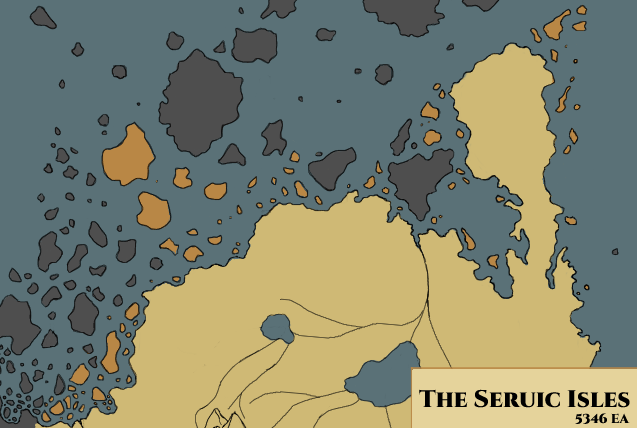
There are currently ninety named islands under Seruic rule, as well as a number of unnamed, uninhabited sea rocks; this includes the spit of land where the Watcher on the Rock lighthouse resides. The majority of these islands were acquired relatively peacefully, through political negotiations and trade deals, whilst others were unoccupied before they were settled by the Seruic. Generally, those who did not want to join under the Seruic banner were left alone in the hope of continued cordial relationships. The few exceptions to this, such as the island of Veria, are still considered points of shame in Seruic history.
Although many of the islands maintain governments of their own, each hosts a Seruic representative that is ultimately in charge of the laws, policies, and decisions of that government. Known as a legate, this representative is chosen by the high lords - or, more often, just one of them - to be their eyes, ears, and hands on each island. These are usually the third or fourth sons of lords or low lords, who were unlikely to inherit their father's title, or else difficult blood relatives of the high lords who need to be kept occupied. Some legates bear this with the air of a man undergoing some dire punishment, whilst others relish the chance to rule their own land. The position is lifelong, and is not hereditary, though some sons have been chosen upon the death of their fathers.
It spreads primarily via contaminated water that is used for drinking, cooking, or bathing. It generally only affects humans, though milder cases have been observed in both shapeshifters and dragons. Much of the population of southern Caia have a natural immunity to the disease through thousands of years of evolution, so outbreaks there, whilst relatively common, are generally containable. The Seruic, though descended from the Kaienese in the south, have lost much of their natural immunity to the disease over the more than one thousand years of separation, whilst the native northerners - such as the Koushan Mai and Usgar - have none.
The wasting sickness ravaged the north for over a year, spreading throughout Serukis and east into Caillah. Though it was eventually brought under control through strict water restrictions and new hygiene laws, nearly fifteen thousand people died. The epidemic still casts a shadow today, with lesser outbreaks across both countries often shattering communities.
Many believe that the disease was brought into the country by Kaienese immigrants. This, it is important to note, has not been proven, though it is recorded fact that several cities in Kaien had been dealing with outbreaks at the time. Despite Serukis's long history of welcoming others, these rumours have stirred up some scattered anti-immigration - and anti-Kaienese - sentiments across the country. Other causes have been suggested to be the importation of tainted shellfish or that year's unseasonable flooding of the Serpent.
by Michel Serre
Population Size by Ethnicity
Whilst Serukis is not the bastion of multiculturalism some would have you believe, it is not difficult to appear so when you share a border with Caillah.
Primary Ethnicities
The human Seruic are, perhaps unsurprisingly, the most dominant ethnicity in the country of Serukis. From the first refugees that crossed the mountains, they have spread far and wide across the whole country, and have installed themselves as the rulers of the land. Though they share ancestry with the modern Kaienese, their cultures have diverged greatly; this was exacerbated after emigration from Kaien became practically non-existent after 4658 EA, following the collapse of the Marden Dynasty. The few Kaienese that do live in Serukis generally reside in self-imposed cultural enclaves within the larger cities of the north, especially following the fallout from the Withering Death. The Erozyans, Usgar, and Koushan Mai are the most populous amongst those considered native to the land now known as Serukis. The Erozyans, one of the largest dragon communities in northern Caia, dwell mostly in their ancestral lands northeast of the Falas, in what is now the Midlands and southern Valonia. There are also small populations of Erozyans in Serukis's larger cities, especially in the seats of the high lords where they maintain a diplomatic presence. The Usgar remain predominantly in the Skarrens to the north; it is rare one will travel south. The Koushan Mai, once over half a million strong, are a much diminished presence in modern Caia. The majority of those that still exist live scattered across Serukis, which comprises half of what was once their native homeland, Vasethal; in Caillah, the other half, they would be hunted and put to death. Whilst a few Koushan Mai still remain in their ancient villages, many live on the road as itinerant performers, with others having moved to Seruic settlements in an attempt to seek stability. The vast majority of Caillish that live in Serukis reside in settlements along the banks of the Serpent river. For some families, this is a temporary residence whilst the head of the household serves in an official capacity facilitating trade between the two countries on either side of the river. Other families have made Serukis their permanent home, with some settlements having a large enough Caillish population to justify the construction of a church.My family has presided over this area for centuries, and you presume to tell me how to rule? How dare you. Get out of my sight.Serukis is governed by a pentarchy, with absolute power shared equally between its five high lords. Each high lord holds dominion over their own region, known as a high lordship, whilst decisions that affect the whole country are brought about through debate and negotiation. Under each high lord exists a group of lords that handle matters of regional administration, and beneath each of them are low lords that manage the day-to-day issues that arise across the realm. The amount of power yielded to each lord and low lord is very much dependent on the individual high lord; some prefer to exercise complete control, whilst others are content to leave much of the actual governance to others. The offices of all three level of Seruic lord are hereditary through the patrilineal line; each one passes his title upon death to the closest male relative, whether that is his son, grandson, brother, nephew, uncle, or cousin. Succession also follows the rules of primogeniture, meaning the first born son will always have precedence over any of his male siblings. In the over one thousand years of Seruic history, there has never been a woman in power; strict genealogical records are kept so the closest male heir to each lordship is always known. In recent years, motions have been put forward to introduce females into the line of succession, but so far they have come to nothing. As the centuries passed since the founding of Serukis, the unfaltering power of the high lords has become attributed to divine patronage, with each of the five houses claiming one of the Elemental Monarchs as the guardian of their family. Though this was not ubiquitous in the public consciousness until the early 4500s, the idea of divine influence has been present since before the Crossing; the Elenasia family have always claimed that Faolan himself bade their ancestors to flee north to new lands. Religion, therefore, permeates every aspect of governance, and lords of all ranks are expected to preside over religious ceremonies and rituals in addition to their other roles. Blasphemy is one of the only crimes that always leads to the unseating of a lord, no matter their rank. To ensure consistency in the overall rule of Serukis, the high lords convene every four years at Sanctuary Castle. The capital city of Sanctuary itself is - and always has been - considered neutral territory, giving the high lords a place to meet without the reliance on each other's hospitality. These meetings often last for about a month, and are a chance for the high lords to strengthen the bonds between their families as well as for the discussion of policy. Tradition states that there must always be a high lord residing at Sanctuary Castle, but, in practice, this is not always the case.
The Seruic Flag
The flag of Serukis has changed little since its earliest use in the 3830s. It is said to have first been raised in the fledgling town of Newcross, the first permanent settlement built by the Seruic people, when it was still a collection of ramshackle tents and shelters. Writings from historical sources describe the first flag as having been made out of scraps of fabric - most likely worn-out clothing - stitched together into a roughly rectangular shape. The original flag has been lost to the ravages of time, but a 45th century replica is currently on display at Sanctuary Castle. The official Seruic flag consists of two white equilateral triangles on a light blue field. The triangles rise from the base at the hoist side of the flag, but do not touch the edge of the fly side. It is symbolic of the mountain pass that the first settlers had to traverse in order to set foot in Serukis, and remains an emblem of hope.
The High Lordships
Arland
Arland is one of the oldest high lordships in Serukis, founded a mere few years after the Crossing by those who pushed to the east. They were halted by the mighty Serpent , and founded a settlement on its bank that they dubbed Solace. Solace today is a busy river port city, though it is is not the lordship's capital or the seat of the High Lord Sybrant. That honour goes to Ebonvale, a city a few days west of the Serpent on the tributary known as the River Ser, a Kaienese word meaning 'hope'. Ebonvale is one of the largest cities in Serukis with a population of over fifty thousand, and is one of the country's largest producers of linen. Southern Arland is characterised by its rolling hills and swathes of fields that are used for growing flax. The area is sometimes affectionately referred to as the 'Blue Bounty' by locals. There are also several limestone quarries nestled in the hills, which provide building materials for much of eastern Serukis. The northern half of Arland is comprised of flat grassland and areas of dense woodland. Most of the region's food is produced here, with the majority of farmland dedicated to crops in the gourd family. The coastal wetland known as the Argent Saltlands covers a fifty mile stretch of the eastern shore. The settlements here are built on stilts, and the inhabitants - a mixture of humans and shapeshifters - build their livelihoods around the harvest of the mineral-rich mud the Saltlands are famous for. The Serpent separates Arland from the neighbouring country of Caillah. The Sybrant family have always seen it as their duty to maintain both a strong border and a cordial relationship with their neighbours, and the city of Ebonvale have hosted Caillish kings several times over the centuries. Recently, the relationship between the countries has been flourishing.Dercia
Dercia is the southernmost high lordship of Serukis and, as such, boasts some of the country's coldest temperatures. Perhaps because of this, it is also the country's most sparsely inhabited region. Its southern border is dominated by the mountains of the Teeth, and the east by the upper tributaries of the Serpent. Like Arland, they share some of their border with Caillah, but the Ereth family maintain only a supportive role in international relations, leaving the majority of the diplomacy to the Sybrants. Built on the slopes of Mount Evershear, the capital of Dercia, Frosthollow, is the highest altitude human settlement in Serukis. With a population of only five hundred people, it is an unusually small seat for a high lord; the majority of Dercia's population instead reside in Coldhill, a city located in Evershear's foothills. With around fifteen thousand residents, Coldhill is the largest settlement in the lordship, with the majority of Dercian towns having less than one thousand inhabitants.Kestlaren
Kestlaren is the oldest of the high lordships and, as such, contains some of the oldest Seruic settlements in the country. It is to Kestlaren the Seruic first came after the harrowing experience of the Crossing, and where they first found their feet as a people. The lordship is flanked on two sides by mountains; the western border is marked by the Teeth, and much of the eastern border is formed of the Falas. Running through the middle of Kestlaren is the mighty Lordsrush river, its tributaries turning the lordship into a patchwork of marsh and woodland. This network of waterways is the lifeblood of thriving trade in the region, with the inhabitants of Kestlaren utilising the rivers just as much as the roads. To the west is a large swamp known as the Shademire, located in the floodplain of the River Gloaming, a tributary of the Lordsrush. The Shademire changes with the seasons as the river floods and recedes, but it remains deep enough to support the Shadefolk - a community of freshwater merfolk - all year round. The source of the Lordsrush is Lake Rundemere, a large but narrow lake that is just over sixty miles in length. It is believed to have been formed in the distant past by the movement of glaciers over thousands of years. Numerous mountain streams coalesce into the two major rivers - the Icemalt and the Rimeshiver - that empty themselves into the southern side of the lake. At the northern tip of the lake are the Pearly Cascades, the group of waterfalls that are the official source of the Lordsrush. The capital city of Kestlaren is called Lord's Rock, though it was only declared such in the late 4460s, making it the youngest Seruic capital. The former capital is now known as Oldcastle. Being the largest port on the western coast, Lord's Rock is generally considered the gateway to Serukis for travellers from southern Caia. As a consequence, Lord's Rock is one of the most diverse cities in the country.The Midlands
The Midlands is the newest high lordship in Serukis - relatively speaking, as it is still over one thousand years old. It was founded in 4184 EA, ostensibly to bring the number of high lords up to five to match the Elemental Monarchs. However, scholars today believe it is likely that the true reason was to remove Erozyan land, known as the Karayels, from the high lordship of Valonia; despite the peace treaty drawn up a couple of centuries earlier, the region was still prone to unrest. Much of the Midlands is dominated by the Seruic Plains, a vast expanse of rolling grassland. The area is rather geologically unique, with the majority of the land being formed of blancite, a white sedimentary stone that is not found anywhere else on Etrea. Like the Karayels, the plains are criss-crossed with waterways, though due to the hardness of blancite they are often much shallower and wider in this area. The capital of the Midlands is the city of Whitecastle, the seat of the High Lord Hargrove and known across much of Serukis as the Pale City. The majority of buildings in the settlement, including the titular Whitecastle itself, are constructed from a mixture of blancite and white oak, with their roofs tiled with a mixture of white and grey clay. Two rivers flow through the city, with the sediment-heavy Milkwater to the north and the deceptively calm Glasswater to the south.Valonia
Valonia is the northernmost high lordship of Serukis, prone to wild storms and harsh winters. It is generally considered to be made up of two regions, the Skarrens to the north and Valonia proper to the south, divided by the now defunct Duszan's Wall. The Skarrens, once the country of Sgaren, is a sparsely-inhabited and heavily-forested region, characterised by rolling hills, steep ravines, and the distinctive black ironwood conifers that dominate the landscape. These grey-green trees are the giants of Caia, reaching an average of around ninety metres in height. Their black trunks are notably straight and thick, with an average diameter of eight metres. Forming part of Valonia's southern border is Lake Matilde. At over one hundred miles from shore to shore, it is the largest lake in Serukis, and one of the largest on the continent of Caia. It is also one of the deepest bodies of freshwater on the planet, reaching a depth of over one thousand metres. It is theorised that the lake is connected to the network of caves spreading out from the Falas mountains miles to the southwest, a hypothesis that has been proven true for several of the other lakes in the area. Matilde is rumoured to be named after the wife of the first cartographer to map the area, though this is only one of several legends.There are currently ninety named islands under Seruic rule, as well as a number of unnamed, uninhabited sea rocks; this includes the spit of land where the Watcher on the Rock lighthouse resides. The majority of these islands were acquired relatively peacefully, through political negotiations and trade deals, whilst others were unoccupied before they were settled by the Seruic. Generally, those who did not want to join under the Seruic banner were left alone in the hope of continued cordial relationships. The few exceptions to this, such as the island of Veria, are still considered points of shame in Seruic history.
Although many of the islands maintain governments of their own, each hosts a Seruic representative that is ultimately in charge of the laws, policies, and decisions of that government. Known as a legate, this representative is chosen by the high lords - or, more often, just one of them - to be their eyes, ears, and hands on each island. These are usually the third or fourth sons of lords or low lords, who were unlikely to inherit their father's title, or else difficult blood relatives of the high lords who need to be kept occupied. Some legates bear this with the air of a man undergoing some dire punishment, whilst others relish the chance to rule their own land. The position is lifelong, and is not hereditary, though some sons have been chosen upon the death of their fathers.





Okay, so this is one of the names of your in-universe countries AND your username hrm? Quite the intrigue if I say so meself.
Haha yeah... I didn't think this through when I signed up. Been using a country name as a username for a long time - the whole worldbuilding thing didn't click. :D
Explore Etrea | Summer Camp 2026
Insert "I am the senate" here