
Gearhaven
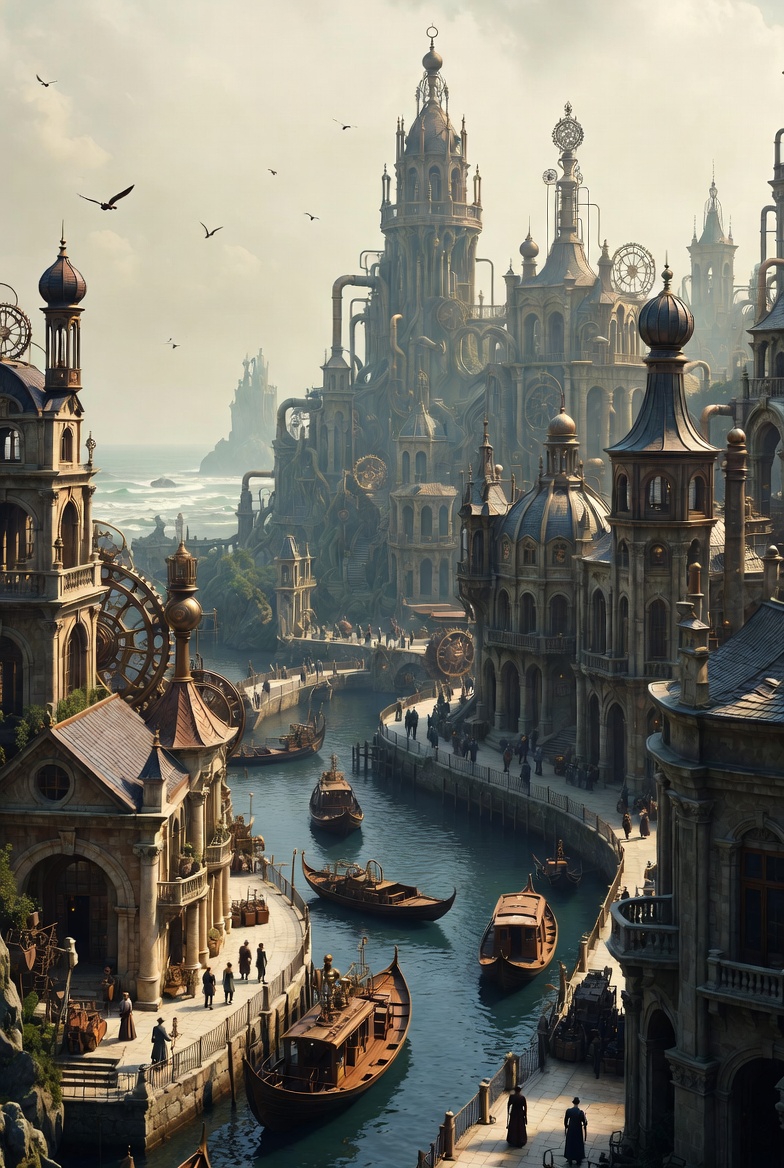
In the iron-hearted embrace of Vindrath's western shores, where the Sundering's scars carve deep into the earth and the sea's restless maw laps at cliffs like a beast forever hungry, rises Gearhaven, a colossus of brass and ambition, once the elven haven of Iso Alora, now remade in humanity's unyielding image. Gifted to the wandering humans in the cataclysm's wake by the dwarves of the Thundercliffs and the elves of Alora, who saw in their plight a chance for renewal, the city wasted no time in shedding its sylvan grace. The old elven churches stand untouched, silent sentinels amid the clamor, their spires a whisper of Elyria's fading wonder against Mortheon's triumphant grind. For Gearhaven is a realm of ruthless efficiency, governed by an aristocracy whose bloodlines run as cold as the steam pipes that vein its streets, their rule a ledger of profit and power where mercy is a luxury few can afford.
At its throbbing core lies the Grand Magical Harbor, a marvel of blended might where the gods' arcane gifts tangle with humanity's newborn ingenuity. Mechanized docks groan under steam-powered cranes and clockwork lifts, unloading exotic treasures from Sendai's wild depths—spices that burn the tongue like forbidden spells, furs that shimmer with latent magic, and luxury items forged in jungle enclaves, from enchanted jewels to silken weaves that whisper secrets to the wearer. Fishing fleets and whaling vessels return with bounties from the deep, their holds brimming with oil for lamps and flesh for feasts, while airship ports tower like predatory birds, hangars refueling dirigibles that blot the skies with their vaporous trails. Customs houses, ornate and iron-guarded, stand sentinel over massive warehouses, where the ruling houses tally every crate, ensuring the flow of imports, food to feed the swelling masses, raw materials to fuel the forges, and labor from Sendai's broken kin, chained souls that stoke the city's insatiable growth.
Power surges through Gearhaven like a captive river, centralized in enormous boiler houses that belch smoke into the heavens, their coal golems toiling endlessly to pipe steam through visible networks that snake the streets. Yet distribution mirrors the city's stratified soul: noble districts glow with reliable light and clean water, gas lamps casting golden halos on manicured paths, while factory slums endure inconsistent flows, power flickering only during grueling shifts, sanitation a grim lottery of disease and decay. Transportation binds it all, railways and steampunk metros rumbling through the undercity, connecting harbors to administrative spires, steam buggies and trams shuttling workers like cogs in Mortheon's machine. The elite glide in private carriages or soar in airships, segregated from the crowded throngs below, where commoners walk or cram into public lines owned by the houses.
Hospitality and entertainment flourish in this cauldron of contrasts, taverns and theaters offering escape in wine-soaked revels and spectacles of illusion, while advanced communication, early telegraphs and pneumatic tubes, whisk messages for the powerful, leaving the masses to word of mouth and slow mail. Gearhaven thrives as the largest trade hub, the only legal port for the slave trade's grim cargo, its aristocracy wielding ruthless efficiency to import life from Sendai and export luxury to the world. Yet steam-tech remains young, its gears crude and belching, a fledgling force that promises dominion but whispers of imbalance, where Elyria's garden yields to Mortheon's ledger, and the city's heartbeat echoes with the clash of wonder and progress. Venture here, seeker, and tread carefully—for in Gearhaven's brass-veined veins, fortunes rise like steam, but fall like the Sundering's unrelenting tide.
Government
Aristocracy
Industry & Trade
Import/Export of exotic good to and from Sendai
Fishing/whaling
Luxury items
Steam-tech
Hospitality/Entertainment
Imports food, labor, and raw materials to sustain growth
Infrastructure
The Grand Magical Harbor
Airship Ports: Giant hangars and landing platforms for dirigibles and airships, complete with refueling stations for fuel.
Power and Utilities: The city is heavily reliant on a centralized, visible power grid.
- Transportation: Movement is critical for trade and controlling the populace.
- Railways and Metros: Extensive internal rail systems, "steampunk metro," connects industrial, harbor, and administrative sectors.
- Steam Buggy's/Trams: Localized public transport options for moving workers and goods within the city, owned by one of the houses.
- Segregated Travel: The wealthy use personal steam carriages, airships, or private transport, while workers rely on crowded public systems or walking.
- Public Works and Social Stratification: The quality of infrastructure w directly reflects social standing.
- Sanitation: Modern, deep sewer systems and waste removal would are standard in the noble sectors to ensure health and air quality. The industrial districts, however, are grimy, polluted, and prone to poor sanitation and disease.
- Communication: Advanced communication exist for the elite, perhaps an early form of telegraph or a pneumatic tube message system, while commoners would rely on word of mouth or standard mail services.
Architecture
Gearhaven was not raised from empty ground. It was built atop the bones of the ancient elven city of Iso Alora, and its foundations still breathe with that forgotten grace. Rather than erase what came before, the builders attempted—sometimes reverently, sometimes carelessly—to preserve the elven aesthetic while grafting upon it the machinery of their steam-born age.
The result is a city of twisted beauty: sweeping elven arches and organic stonework threaded with iron supports, copper piping, and whirring mechanisms. Curved spires meant to echo living branches now bristle with smokestacks and brass plating. Where Iso Alora once flowed like a forest grown from marble, Gearhaven overlays it with rigid, human design—newer structures favoring bold lines, monumental proportions, and a distinctly Roman-inspired sense of order.
It is a city caught between worlds: magic and industry, nature and progress. In its streets, elegance collides with utility, and every tower, bridge, and canal stands as both a preservation and a quiet act of conquest.
Canals and Trade Ways
Waterways form the lifeblood of Gearhaven. Ancient elven channels, once meant to guide rain and nourish gardens, have been widened and reinforced into a dense network of canals that carry freight barges deep into the heart of the city. Warehouses, markets, and manufactories cling to these waterways, allowing goods to move directly from ship to street. What was once a living, ceremonial flow has become a system of commerce—efficient, relentless, and indispensable to the city’s role as a trade nexus.
Vertical Districts and Airship Ports
As the city grew outward, it also grew upward. Towering districts rise from the old elven foundations, stacked in tiers of bridges, platforms, and suspended walkways. The highest levels are crowned with airship moorings: vast iron frameworks where cargo vessels dock against spires that were never meant to bear such weight. These upper districts house guild offices, customs halls, and elite residences, while goods descend through lifts, cranes, and pulley networks that turn the skyline itself into a moving marketplace.
The Undercity and Flooded Ruins
Beneath Gearhaven lies what remains of Iso Alora’s true heart. Whole avenues of elven architecture survive below ground, now broken, flooded, or entombed behind reinforced walls. Into these ruins, the city has forced its sewer systems, maintenance tunnels, and steam conduits, threading waste and industry through spaces once sacred. Some chambers are still beautiful in their decay, vine-choked halls, collapsed sanctuaries, forgotten plazas, but most have been repurposed as the unseen infrastructure that keeps Gearhaven functioning. What was once a living city has become the hidden machinery beneath a new one.
Gifted to human's after the sundering left them wandering and homeless, the dwarves of the Thundercliffs, and Elves of Alora gifted them lands. They wasted not time in making it their own. the only things remaining untouched by steamtech are a couple of old elven churches.
Geography
Gearhaven rises along a rugged, mountainous coast where evergreen forests cling to stone and mist drifts perpetually in from the sea. The shoreline is broken into natural inlets and deep-water bays, forming one of the largest and safest harbors on the continent. Sheer cliffs cradle the port like a fortress of rock, while narrow headlands and wind-carved promontories shelter incoming vessels from the worst of the ocean’s tempests.
To the east and south, the land climbs sharply into pine-covered highlands and jagged ridges. The mountains form both a barrier and a defense, channeling all overland traffic through a handful of narrow passes that have become vital trade arteries. These routes are steep, winding, and often shrouded in fog, making caravans slow and costly, but also easy to control, tax, and defend.
Beyond the mountain wall, roughly three days’ ride by horse through the primary passes, the terrain softens. Forest thins into rolling foothills, and the earth opens into broad, fertile lowlands. Here lie the agricultural regions that feed the city: wind-swept grain fields, grazing ranges, orchard valleys, and river-fed farms clustered around small market towns. While Gearhaven itself is a city of stone, steam, and steel, its survival depends on this distant breadbasket, linked to the harbor by a constant flow of caravans, barges, and rail convoys.
The surrounding forests remain dense and ancient, particularly along the northern slopes, where the land still bears traces of pre-Sundering wilderness. Timber, resin, and rare alchemical flora are harvested from these regions, though expansion is slow and dangerous. Landslides, sudden storms, and encroaching wild magic make the highlands as treacherous as they are resource-rich.
Gearhaven’s geography defines its identity: a city bound by mountains, fed by distant fields, and opened to the world by the sea. It stands as a threshold between inland trade routes and oceanic commerce, a place where caravans end, ships begin, and the movement of goods never truly stops.
Join me for more at Tales of Eryndel: The Fractured Weave on Substack!!

Comments