

Brindlehounds
Morvathia's Proudest Guardians
"Proud. Vindictive. Dramatic. Slow to forgive.
Now, before you accuse me of shameless self-admiration: yes, I see the resemblance too. Alas, I am speaking of Morvathia’s cherished little monstrosity, the Brindlehound. Dogs rarely impress me. They’re earnest in that deeply exhausting way. Yet this breed? Infuriatingly admirable, I must say. Witches fawn over them, naturally. And why not? They always do love their mistakes. Because the Brindlehound is Morvathia distilled: creation without caution, power without reflection, a living monument to arrogance and neglect. Gods in all but responsibility. Yes, it is witch culture in its purest form. And that's why I love it so."
The Brindlehound is a distinctive Morvathian dog breed, most readily identified by its great size, brindled coat, and the sweeping horns that crown its skull. They are regarded as an emblem of loyalty and national pride within the Witchrealm of Morvathia.
Brindlehounds descend from a Galdoric sighthound strain introduced during the occupation of Morvathia. These hounds were selectively bred by the Galdoric Empire for their acute senses and relentless pursuit instincts, initially employed to track rogue spellcasters and fugitives. Between 1464 A.S. and 1467 A.S., after the Rebirth of Morvathia's Liberation Front, they were further conditioned and deployed specifically to hunt witches.
Following Morvathia’s liberation, House Brindlebrook made the deliberate decision to acquire surviving stock of these imperial hounds. Rather than eradicating a symbol of Galdoric oppression, the House sought to reclaim and redefine it. Through controlled breeding and a series of witchblood infusions, the Brindlebrooks transformed the lineage into something altogether new. The infusion process produced unintended but now characteristic traits, most notably their exceptional size and the growth of cranial horns.
In the present era, Brindlehounds are most commonly found in the service of royal and highborn witch families, where they act as guardians, companions, and, in some cases, ceremonial symbols of office.
Biology of the Brindlehound
In baseline morphology, the Brindlehound conforms to the anatomical structure typical of large domestic sighthounds. The breed is characterized by elongated, slender limbs built for acceleration, a narrow thoracic cavity, and a pronounced, tapering snout.
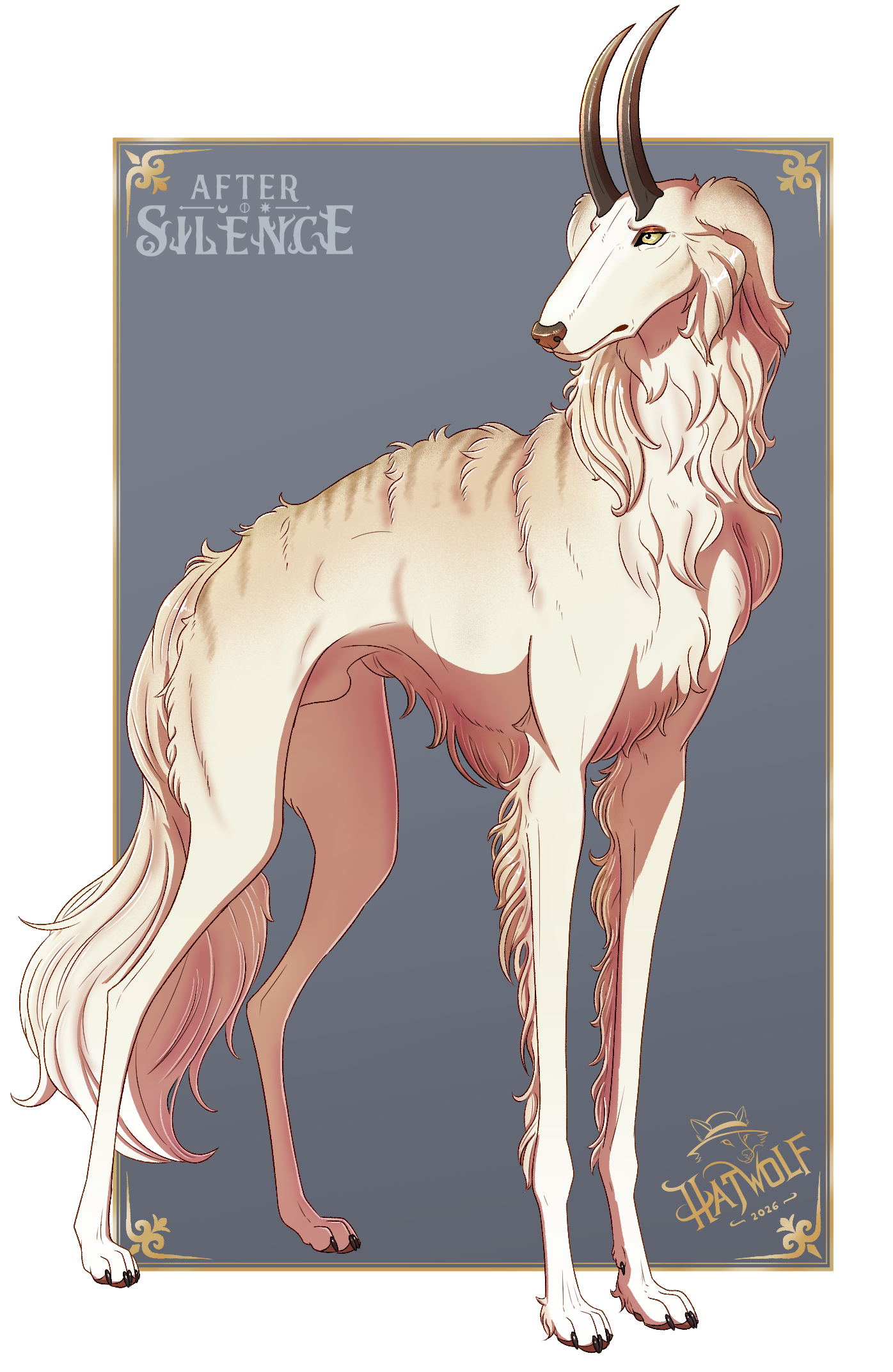
The ancestral strain from which the Brindlehound descends, the Galdoric Wolfhound, was originally developed for coursing wolves across the northern provinces of the Galdoric Empire. Its hunting style relied less upon scent-trailing and more upon exceptional visual acuity, explosive speed, and agility. During the Occupation of Morvathia, these same traits were redirected toward the pursuit of the empire's enemies.
Modern Brindlehounds retain these physical advantages. Field observations record sprinting speeds exceeding those of their progenitors, coupled with heightened endurance and rapid recovery. Their bones and musculature appear unusually resilient, a quality widely attributed to the controlled introduction of witchblood into their lineage. The augmentation performed by House Brindlebrook was intended primarily to influence the personality of those animals — to cultivate heightened intelligence and a deeper loyalty toward their witch handlers. Yet over generations, physical changes emerged alongside the intended behavioral ones.
Most striking is their size. An adult Brindlehound stands, on average, five feet at the shoulder. When their horns are considered, they may reach or surpass the height of a human. The horns, the defining feature of the breed, grow from reinforced cranial structures and vary in curvature and length. Pups are born hornless. Horn growth begins gradually during adolescence and continues well into maturity, developing from reinforced skull structures into fully integrated bone. Though decorative in appearance, they are sensitive at the base and supplied with blood. Their precise function, if any beyond display and defense, remains uncertain. Another distinctive trait is the unusual length and flexibility of the tongue, proportionally greater than in other canines.
The blood of a Brindlehound shares many other properties with the blood of witches: It is darker in color and toxic to most other living beings. Unfortunately, it also means the breed is susceptible to bloodrot. With proper care however, Brindlehounds commonly reach an age of twenty to thirty years, a notable lifespan for animals of their size.
Dramatic Personalities
The Brindlehound is frequently described, more or less mockingly, as the "ideal Morvathian dog". Many of its typical character traits are traditionally attributed to the Morvathians themselves, such as pride, stubbornness, theatricality and a certain cultivated reserve.
In general demeanor, Brindlehounds present themselves as self-possessed and faintly disdainful. They are not inclined toward effusive greetings. Rather than rushing to meet their owners, they more commonly acknowledge them by permitting approach. Affection is offered on their terms: the lowering of the head for grooming, the deliberate lean into a familiar hand, the silent occupation of shared space.
Their displeasure however, is unmistakable. A slight may be met with a pointed turn of the head, a refusal to meet the eye, or a studied indifference so deliberate that it borders on performance. Owing to their considerable intelligence, Brindlehounds are also capable of remembering perceived insults for extended periods. Cases of calculated avoidance or selective disobedience are well documented, giving these dogs a reputation for being very vindictive.
Watcher of the Domicile
Within the domestic sphere, they display a marked preference for elevated resting places, like stair landings, balconies, and high-backed furnishings as favored vantage points. From such positions they observe the household with quiet attentiveness. This tendency has often been interpreted as symbolic: the horned hound looking down upon its domain. While such traits might render them challenging companions by broader standards, they are widely regarded in Morvathia as deeply endearing. Their hauteur is not seen as defiance, but as character.
Brindlehounds bond selectively and seldom quickly. Strangers are met with reserve, and acceptance into a Brindlehound’s inner circle may take months or even years. Once formed however, such bonds are enduring. The breed is notably possessive of both household and family, and displays strong territorial instincts.
Strangers are not typically met with indiscriminate barking, instead, they rely on posture and presence. A common display involves placing themselves squarely between a perceived threat and their bonded witch, standing rigid and silent, gaze fixed and unyielding.
While they rarely bark, Brindlehounds are prone to prolonged, resonant howls when distressed or affronted, often accompanied by emphatic stamping of the forepaws and dramatic, drawn-out whines. This expressive tendency has given rise to the saying in Morvathian Cant, "to make drama like a horned hound," used to describe conspicuous displays of indignation.
Despite their pride, Brindlehounds do seek closeness and physical affection from those they trust. Such tenderness, however, is frequently reserved for private settings. It is not uncommon to observe a Brindlehound behave with marked distance in public, only to exhibit quiet devotion once the household doors are closed.
The Hexing Hound Controversy
Within the field of General Arcane Theory, witchblood is understood as a living conduit to the Tether, a sentient form of energy that enables spellcasting. When witchblood was first introduced into domesticated animals, prevailing academic thought held that such creatures lacked the cognitive framework necessary to engage with the Tether in any meaningful way. Early Brindlebrook records therefore focused on the expected effects of infusion: alterations in temperament, heightened resilience, and physiological change.
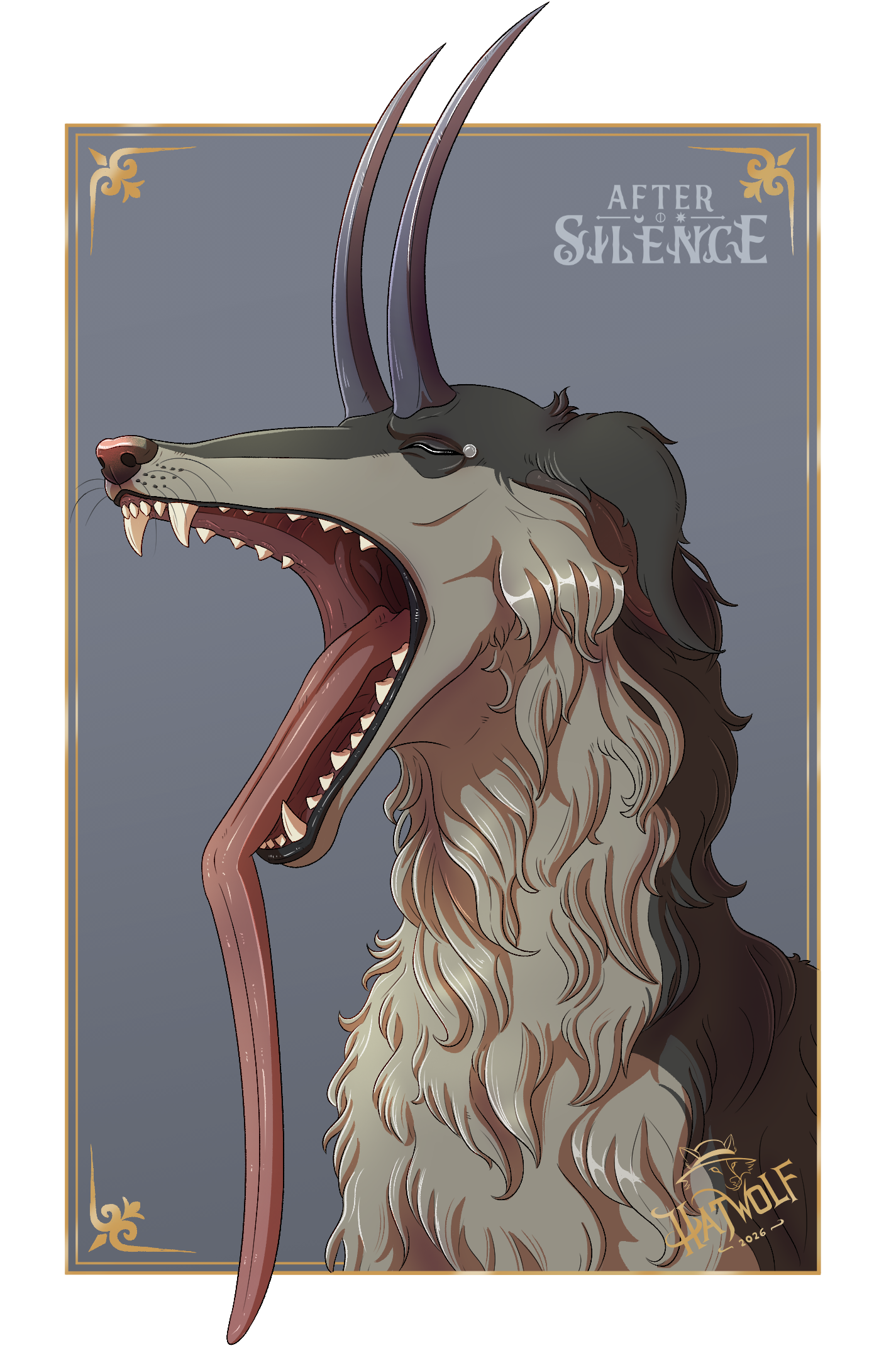
As Brindlehounds became more widespread among Morvathian households, anecdotes began to circulate suggesting that earning a Brindlehound’s displeasure was often followed by a streak of minor misfortune. Those affected reported persistent irritations rather than dramatic calamities: unexplained rashes, repeated stubbed toes, sour-tasting milk, restless sleep, or an unusual tendency for objects to slip from the hand. These incidents were subtle, inconsistent, and easily attributed to coincidence. From these stories emerged the belief that Brindlehounds were capable of placing curses, however small, upon those they bore a grudge against. Both House Brindlebrook and the Morvathian Coven publicly rejected the claim. Even acknowledging the breed’s intelligence, scholars argued that spellcasting without incantation, gesture, or conscious ritual intent was impossible, particularly for an animal.
A Study of Wet Socks and Dog Food
This position became untenable following an independent study published in 1505 A.S. by Professor Philemon Mowbray of the Arcanum Dona Viperia. Over the course of several weeks, he observed that whenever his Brindlehound was served a meal it clearly disliked, his socks would inexplicably feel damp whenever he wore them for days afterward. Through controlled testing, Mowbray was able to confirm that the garments had been indeed hexed. And, more importantly: to trace the origin of the effect directly to the hound itself.
The revelation sent shockwaves through arcane academia, not only within Morvathia but beyond it. While the curse in question was minor, its existence contradicted every established principle of known Applied Spell Theory. To this day, no consensus exists as to how Brindlehounds accomplish such feats. Whether the act is intentional, instinctive, or emotional remains a matter of debate. Many owners now fit their Brindlehounds with warded collars designed to dampen or redirect subtle curses. However, it is reported that determined hounds occasionally circumvent such measures, much to their owners’ frustration. Conversely, some dog owners actually commission collars that amplify these effects, so that their hounds can better guard their homes. In such cases, intruders may find themselves tripping, seized by sudden pain, or otherwise incapacitated moments before a Brindlehound physically brings them down.
Regardless of interpretation or precaution, one conclusion has entered common wisdom: it is generally advisable to remain on good terms with a Brindlehound — lest it take revenge with petty inconveniences.
Place in Morvathian Culture
Within Morvathia, Brindlehounds occupy a position far removed from that of an ordinary working dog. They are widely regarded as a status symbol, and their ownership carries both social and political weight. Oversight of the breed rests with House Brindlebrook, one of the Thirteen, who maintain strict control over breeding and distribution. Acquisition of a Brindlehound typically requires direct purchase from the House or its appointed agents, and unauthorized breeding is expressly forbidden. The official justification for this restriction centers on health and safety. Without carefully regulated pairings, Brindlehounds are believed to face an increased risk of severe bloodrot, shortened lifespans, or unstable mutations that could prove dangerous to both hound and handler. While some critics argue that these concerns also serve to preserve exclusivity, few dispute that the breed’s altered blood makes careless propagation a genuine risk.
Possession of a bonded Brindlehound is often interpreted as an affirmation of a family’s witchblood. A common belief holds that Brindlehounds will only truly accept and bond with "legitimate" witches, instinctively rejecting those of diluted or false lineage. This notion, while widespread, is not entirely accurate. Brindlehounds do appear to form bonds more readily with witches than with non-witches, but numerous recorded cases show them accepting mundane owners as well. Even so, the belief persists, and it remains one of the primary reasons lesser witch families seek to acquire one, as much for what the hound represents as for what it is.
Members of the Family
Among the nobility, Brindlehounds are valued as household guardians. Once a home is accepted as part of their territory, they will defend it with notable determination, acting protectively toward those they consider their charge. Despite their aloof and occasionally difficult temperament, they are considered highly reliable. It is not uncommon for high-ranking witches to travel between cities accompanied by a Brindlehound rather than armed escorts, trusting in the animal’s presence and judgment.
This loyalty is often honored beyond death. In many family crypts, Brindlehounds are buried alongside their owners, treated as full members of the household. The skulls of deceased Brindlehounds are sometimes mounted upon gravestones or incorporated into coffins, symbolically allowing the hound to continue its vigil even in death.
Official Business
Despite their reputation as exceptional guard animals, Brindlehounds are not widely employed in civic defense. City watches and border patrols tend to rely on more common breeds, both for reasons of cost and availability.
Exceptions do exist. Certain academic institutions, such as Grimoald University and the Auricent Academy, keep Brindlehounds as guardians and companions for faculty and students alike. They may also be found in courthouses, libraries, and archives associated with the Morvathian Coven.
As a general rule, the presence of Brindlehounds in such roles signals either direct political ties to the Thirteen or sufficient wealth to secure them.
Hunts & Races
In certain regions, notably Guland, Knightroot, and Firnland, Brindlehounds are also prized as hunting dogs. Their speed and agility allow them to bring down game such as deer or boar with an efficiency rivaling, and often surpassing, that of ranged weapons.
Perhaps the most publicly visible use of the breed occurs during the Dunweil Dog Races, competitive events organized by House Brindlebrook themselves. In these races, Brindlehounds are deliberately pitted against one another in tests of speed and endurance.
The events draw crowds from all levels of society, with both common folk and nobility gathering to wager on the outcomes.
Legal Status and Ecological Concerns
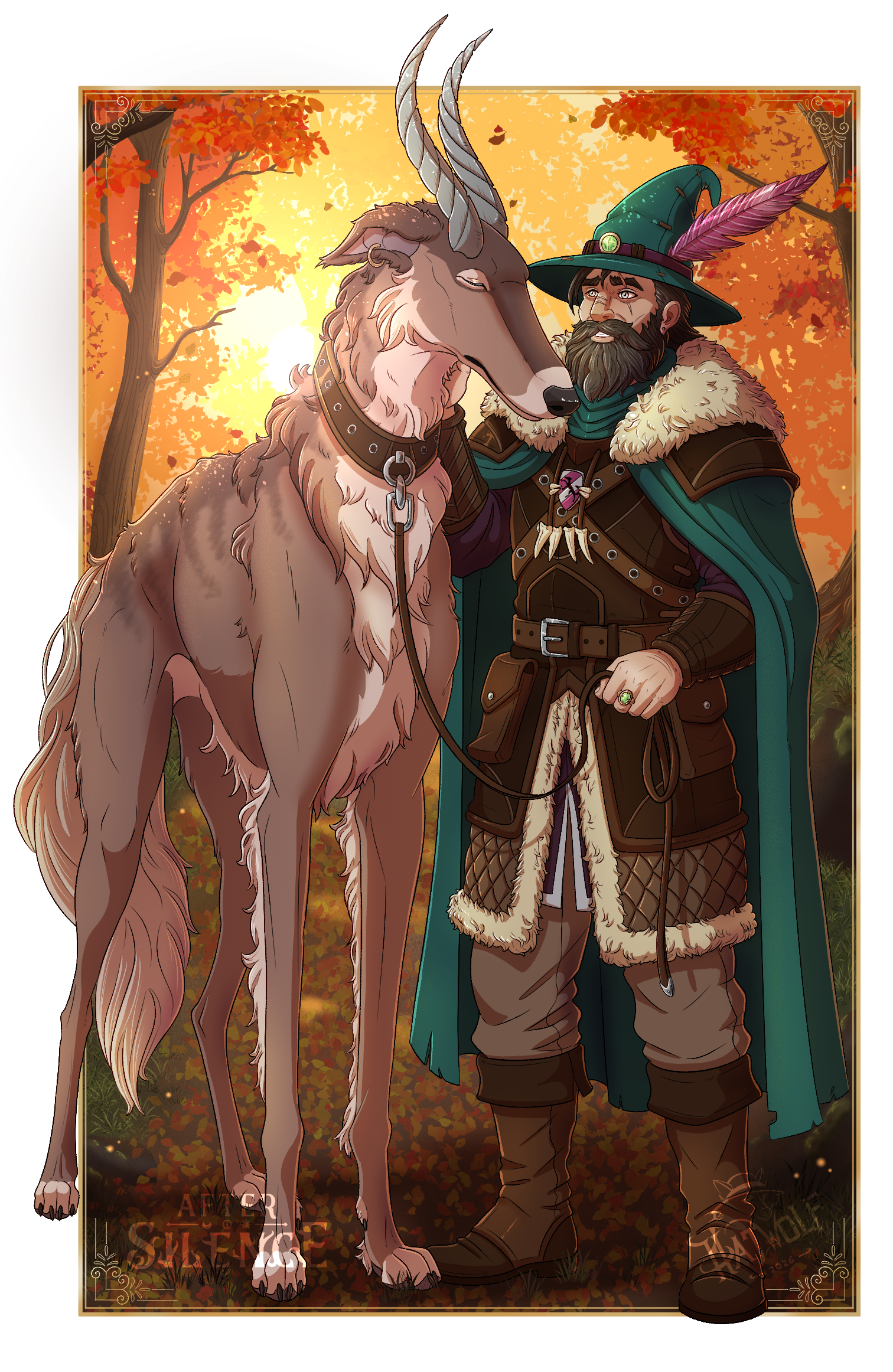
Outside the borders of Morvathia, Brindlehounds are rarely legal to purchase or own without special authorization. This restriction is the result of several overlapping concerns, foremost among them their documented capacity for minor spellcasting. Under the definitions set forth by the Bureau of Arcane Oversight (B.A.O.), any being capable of exerting magical influence, however limited, may be classified as a rogue spellcaster. While the Bureau itself lacks the power to enforce law, its standards are widely adopted across Netherdyn.
As a result, many realms require prospective Brindlehound owners to hold a B.A.O.-certified license, a process that is deliberately stringent. Morvathian witches traveling abroad may apply for temporary travel permits for their hounds, and such requests are generally approved, if closely monitored. For non-Morvathians, however, the process is far more restrictive, often involving arcane evaluations, political vetting, and assurances regarding containment and oversight. In practice, this has ensured that Brindlehounds remain overwhelmingly concentrated within their native Witchrealm.
Witchblood in the Wild
Beyond legal classification, there exists a far more tangible concern: ecological impact. The introduction of witchblood into non-contained environments is widely regarded as hazardous, with consequences that are difficult to predict and harder still to reverse. A frequently cited example occurred in Morvathia's northern county, Firnland, where several Brindlehounds escaped confinement and integrated into the surrounding wilderness.
Evidence suggests that these hounds successfully interbred with local wolf populations, introducing diluted witchblood into the lineage. Within a few generations, sightings were reported further north, in the Silverwild of Thaldrune, of unusually large wolves bearing horn growths. These creatures, now commonly referred to as Brindlewolves, exhibit not only increased size and intelligence, but also the ability to produce minor obscurism spells — manipulating shadow and light to create concealment or crude illusions. Combined with the natural cunning of wild wolves, these traits have rendered Brindlewolves a growing threat to settlements and trade routes in the region. Efforts to cull or contain them have met with limited success, and the incident is now widely used in arcane and political discourse as a prime example of Morvathia's hubris and negligently regulations concerning dark magic, augmentations on living beings and creation of chimeras. This certainly gave the people of Thaldrune another reason to despise their witching neighbours.
For this reason, strict controls on Brindlehound ownership and transport are broadly supported, even beyond Morvathia’s borders.




Whose a good boy
They are! Probably!
At the end of everything, hold onto anything.