

VRESH'KARAL DUR (VRESH-kah-ral DOOR )
Folk Figure · Grakh'tor Confederacy · Grakh'vol Fen, western foot of the Caldera · Sightings substantially increased since 1197 A.P.
Do not go to the Fen alone, and do not go to the Fen at all if you cannot answer for what you have done. The Bent Old One will not ask you what you have done. She will already know. What she will ask you is what you would do again, and whether you would do it differently, and you had better have thought about the question before you arrive.
Vresh'karal Dur, the Bent Old One of the Fen, is the central and most persistent supernatural figure of Grakh'tor folk tradition, believed by some to be a genuine and ancient inhabitant of Grakh'vol Fen and dismissed by others as a purely folkloric construct that has served the confederacy's cultural purposes for at least thirteen centuries. She is old, hunched, clanless, and reputedly wise beyond any confederation of seasons a Grakh'tor life should permit. She lives (or is said to live) in a specific dwelling at the western edge of the Fen, receives visitors on terms she alone determines, offers counsel to those she judges worthy of it, and imposes specific consequences on those who arrive at her door with intentions she finds inadequate. She has appeared in the confederacy's oral tradition since at least the reign of Vrak'thun Mor'zhaal and possibly earlier.
Roman scholarship on the Bent Old One is limited. Plinius has never visited Grakh'vol Fen; the Fen sits within the specific zone that Vor'keth permission would be required to enter, and the permission has not been extended to any Roman scholar in any period. What Plinius can offer is a systematic account of the folk tradition, drawing on Uzrul Ironteeth's transmission of specific stories from his own grandmother's account (which itself drew on stories from her grandmother, and so on, in the specific way that Grakh'tor oral tradition preserves multi-generational continuity within families), together with the more limited body of border market testimony from Grakh'tor traders whose relatives have made pilgrimage to the Fen. He offers the account without personal endorsement of the Bent Old One's existence as a specific individual, while noting that the specific consistency of the tradition across thirteen centuries is unusual by ordinary folk-tradition standards and might repay further scholarly attention.
DM ONLYPhysical Description
General Physical Condition
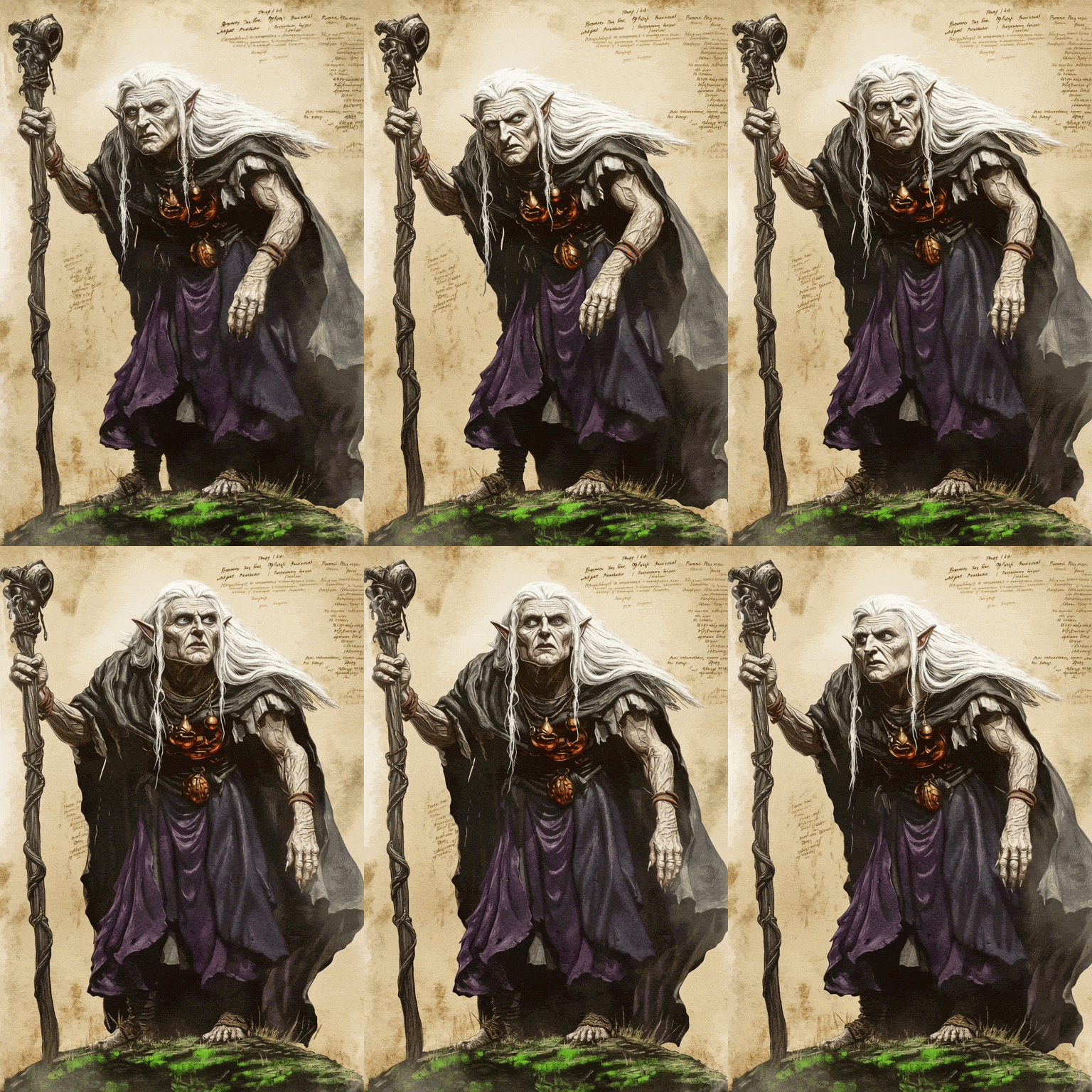
Folk tradition consistently describes an old woman of specific and unusual physical qualities. She is thin, hunched, and moves with the specific slowness of great age. She is also, in the specific reports of visitors who have encountered her at unexpected moments, capable of movement that is not consistent with the ordinary age she otherwise presents. The tradition does not reconcile these accounts. It presents both as accurate.
Body Features
Her posture is the specific stoop of great age, or in some reports a deliberate stoop that she can straighten when circumstances require. Her gait is slow and shuffling in most accounts; specific accounts of her moving at speed exist but are not consistent about how the speed is achieved. Her hands are described as long-fingered and specifically strong, with a grip that visitors have found substantially more powerful than her apparent frailty would suggest.
Facial Features
Her face is described in folk tradition as deeply lined, with the specific weathered texture that Grakh'tor tradition compares to bog-oak bark. Her eyes are described as reflective and dark, with a specific quality that visitors have consistently found difficult to meet directly. Her mouth is described as thin and specifically expressive: her smile, when it appears, is described in folk tradition as either the specific reassurance a visitor most needs or the specific warning a visitor most does not want, depending on the encounter's circumstances. Her teeth are described as intact and specifically sharp for a Grakh'tor of her apparent age.
Identifying Characteristics
The single most striking thing a visitor remembers, according to folk tradition and to the specific border market accounts Plinius has collected, is her voice: a specific rasp that resembles the vocal quality of Vor'grak'vel survivors, described as unmistakable and as producing a specific quality of authority that visitors find difficult to disregard. A visitor asked to describe her an hour after departure invariably describes the voice first, then the eyes, then the specific way she seems to already know what the visitor has come to say.
Physical quirks
Specific physical habits documented in the tradition include: a slow and deliberate manner of rising from her seat (which folk tradition attributes both to age and to a specific ceremonial character the specific way she holds objects offered to her (in both hands, examining them from multiple angles before either accepting or setting them aside a specific habit of tilting her head to one side when a visitor speaks, which observers have described as attentive and unnerving in equal measure; and a specific slow tapping of the fingers against her walking staff during silences, which the tradition treats as a sign that she is weighing what has been said.
Special abilities
Folk tradition attributes to her a specific capacity to know things about her visitors that they have not disclosed to her, which the Grakh'tor cultural framework treats as neither supernatural nor natural but as a specific quality that she simply has. Beyond this, she is not credited in traditional accounts with the specific dramatic abilities that Roman folklore assigns to comparable figures: she does not fly, shape-shift, command elements, or raise the dead. What she does, in the specific traditions that exist about her, is know, understand, and speak. The specific effect of her speech on visitors who receive an audience of substantial length is described in folk tradition as producing lasting changes in their subsequent conduct that go beyond ordinary counsel.
DM ONLYApparel & Accessories
Folk tradition consistently describes her clothing as a specific dark grey robe of heavy weave, worn long over a simpler undergarment of the same colour, gathered at the waist with a plain leather cord. The robe is described as worn but not ragged, showing the specific weathered texture of long use rather than the specific tears and repairs of poverty. She carries a walking staff of dark wood, described as approximately as tall as she is when standing upright, with the specific handle worn smooth by long use. No visitor has recorded her wearing jewellery, ornament, or any of the specific markings that Grakh'tor tradition associates with clan affiliation.
Specialized Equipment
Folk tradition attributes to her a specific set of implements associated with her dwelling and her counselling practice: a copper pot of substantial age said to be used for the specific preparations she offers visitors; a set of clay bowls of similar antiquity; specific herbs and preserved materials whose provenance and preparation are not documented; and a specific box or chest, described variously in different accounts, in which she is said to keep the specific offerings that visitors have brought her over the centuries. None of these implements has been described in sufficient detail to permit identification, and none has ever left the Fen in any account Plinius has heard.
Mental characteristics
Personal history
Folk tradition provides no account of her early life, her origins, or the circumstances that brought her to Grakh'vol Fen. She is described, in every tradition that discusses the question at all, as having been at the Fen for as long as the tradition itself extends. The Krul'dent Dur genealogical memory, which is the specific source for the earliest documented reference to her, treats her as already ancient at the time of the earliest documented encounter (approximately mid-Keth'dural Grak, ~-880 A.P.). Subsequent traditions treat her as continuously present through the intervening thirteen centuries, without documenting any change in her apparent age or her described character. Whether this reflects genuine continuous presence or the specific way folk tradition preserves consistent figures across generations is the question this article's Belief and Skepticism section addresses at length.
DM ONLYEducation
Folk tradition offers no account of formal education. She is described as knowing what she knows without reference to who taught her. The specific knowledge she demonstrates in her counselling (of Grakh'tor history in specific detail, of herbal preparations whose compositions are not otherwise documented, of the specific personal histories of individual visitors) is presented in the tradition as intrinsic rather than acquired. Whether this reflects genuine autodidacticism, the specific transmission of knowledge through channels the folk tradition does not recognise, or a specific quality of knowledge whose acquisition happened outside the ordinary Grakh'tor educational framework, is not resolved by any account available.
Employment
None. She has no institutional role, no clan-marked responsibility, and no documented occupation. She is not a Vor'keth shaman, is not a clan elder, is not a healer of any recognised practice, and does not participate in the confederacy's ordinary economic life. What she does at the Fen, she does on her own terms and for reasons the folk tradition has not been able to reduce to any Grakh'tor institutional category. This absence of employment is one of the specific characteristics that marks her as outside the confederacy's ordinary social framework.
Accomplishments & Achievements
Folk tradition credits her with a specific set of consequential accomplishments across the confederacy's history: the specific counsel to a mid-Keth'dural Grak war-marshal that is said to have influenced the war's disengagement; the specific counsel to the sixth-century Vor'keth reformer whose reforms established the current inner-council structure; the specific counsel to specific frontier warriors of the eleventh and twelfth centuries whose subsequent careers are said to have been shaped by their audiences with her. Each of these accomplishments is contested in the specific sense that folk tradition treats them as her doing while the affected institutions treat them as internal developments; the specific pattern of her attributed accomplishments is one of the more instructive features of the tradition. She has not, in any account, sought credit for the accomplishments attributed to her, which is one of the specific features that distinguishes her from Grakh'tor folk figures who are more clearly aspirational constructs.
Failures & Embarrassments
Folk tradition contains no documented accounts of her failures. The absence is itself specifically instructive: folk figures who are constructed by tradition typically accumulate stories of failure that serve specific pedagogical purposes, and her tradition does not. Whether this reflects genuine consistency of judgement across thirteen centuries, the specific pattern of who is permitted to become a folk figure in Grakh'tor culture (only those whose reputations have been genuinely consistent), or the specific institutional care that Vor'keth transmission of her tradition has taken to preserve her reputation, is not resolved.
Mental Trauma
Folk tradition documents no specific trauma in her past, which is itself an unusual absence for a figure of her dramatic weight in the confederacy's cultural memory. Comparable Grakh'tor folk figures typically accumulate specific stories of formative wound or loss that serve to explain the specific character they have become. Her tradition does not. Whether the absence reflects a genuine absence of formative trauma, a specific reticence within her tradition, or the specific quality of her existence that ordinary Grakh'tor psychological categories cannot readily accommodate, is one of the several questions this author has not been able to resolve.
Intellectual Characteristics
Folk tradition presents her as thinking in a specific manner that has been consistently characterised across the centuries: patient, comprehensive, and specifically concerned with the underlying character of the person or situation she is examining rather than with the surface presentation. She is described as attending to what is said and what is not said with equal specificity, drawing conclusions that visitors have described as accurate and as arrived at through channels the visitor cannot reconstruct. She is not, in any account, described as thinking quickly; she is described as thinking slowly and correctly, which the Grakh'tor cultural framework treats as a specific and admirable intellectual quality distinct from the specifically faster intellectual style associated with the Vor'grak's council.
Morality & Philosophy
Her behaviour reveals a specific and consistent ethical framework that folk tradition has documented without fully reducing to formal principles. She weights sincerity heavily; she treats arrogance as disqualifying; she requires specific self-knowledge as prerequisite to receiving her counsel; she distinguishes between what a person has done and what a person is, in the specific formulation Uzrul offered ('she weighs what the person is, not what the person did'). Her judgements do not track ordinary Grakh'tor moral categories cleanly. She has received warriors who confessed to killings that Grakh'tor law and Vor'keth theology both accept, and has refused audience to warriors who confessed to specific offences the same authorities would have considered trivial. The specific pattern has been discussed for centuries without reduction to formal principle, which suggests that her ethical framework is either subtler than Grakh'tor ethical philosophy has been able to articulate or oriented to considerations that the confederacy's ordinary moral vocabulary does not include.
DM ONLYTaboos
Folk tradition documents specific things she is said never to do: leave the Fen (no tradition places her outside its boundaries in any period accept material payment (offerings of specific character are received, but coin, wealth, and traded goods are consistently refused intervene directly in confederacy politics (her counsel is offered to visitors, but she does not travel to consult with clan or Vor'keth authorities, does not attend moots, and does not participate in any of the confederacy's ordinary political processes or address a visitor by clan affiliation (she addresses visitors by their given name if she uses a name at all, and does not acknowledge the clan-markers that structure ordinary Grakh'tor social interaction). Each of these taboos is a specific pressure point for a player character seeking to engage with her: the specific taboos would need to be respected in any approach, and their specific violation would produce specific consequences the tradition has not fully documented.
Personality Characteristics
Motivation
Folk tradition offers no clear account of her motivations. She is described as engaging with those who approach her but not as pursuing specific goals outside those encounters. She is not, in the traditional accounts, a figure who seeks to influence broader confederacy events, to gather wealth, to acquire followers, or to accomplish any specific objective that folk tradition can name. She simply is where she is, receives whom she receives, and continues. This absence of documented motivation is one of the specific characteristics that has led some Roman commentators to conclude that she is a purely folkloric construct.
DM ONLYSavvies & Ineptitudes
Folk tradition credits her with specific savvies: knowledge of the Fen's geography and its specific dangers; knowledge of herbal preparations whose specific compositions have not been reproduced by any Vor'keth or Roman practitioner; knowledge of the confederacy's history in specific detail that no living Grakh'tor scholar could match; and the specific capacity to know things about her visitors that they had not disclosed to her. Folk tradition credits her with correspondingly few ineptitudes; the absence is itself telling. She does not appear to lack knowledge she requires. She does not appear to misjudge situations she encounters. She does not appear to be surprised by visitors, by events, or by the specific developments of confederacy history. Whether this reflects genuine comprehensive capability or the specific tradition's polish of an accumulated legend is not resolved.
Likes & Dislikes
Specific likes documented in folk tradition include: the specific herbs and stones that visitors bring as appropriate offerings (which are received with what visitors have described as visible satisfaction the specific quality of a visitor's genuine self-examination (which is treated as the specific prerequisite to substantive counsel and, in the specific accounts of longer audiences, the specific quiet that follows the departure of a visitor who has received what they came for. Specific dislikes include: visitors who arrive with material goods rather than the specific offerings appropriate to her; visitors who approach her for entertainment or as a specific trophy of frontier adventurousness; visitors who address her by any form of the Vor'keth's honorifics; and the specific quality of arrogance that assumes an audience with her can be secured through reputation or connection rather than through the specific self-examination her tradition requires.
Virtues & Personality perks
Fair-observer assessment of her virtues, drawing on the specific pattern of her behaviour rather than on any self-report she has offered, identifies: patience with those who approach her genuinely (which the tradition consistently confirms and which has been noted by multiple independent visitor accounts consistency of judgement across successive visitors and across generations (which folk tradition treats as one of her defining features the specific willingness to give counsel that a visitor did not want but needed (which the traditional formulation captures as her preference for the answer the visitor did not know to ask for and the specific absence of self-interest that the folk tradition documents through her refusal of material payment and her non-participation in confederacy politics. These virtues are, in Plinius's assessment, unusually well-attested for a folk figure and constitute one of the specific pieces of evidence for genuine continuous character rather than accumulated legendary construction.
Vices & Personality flaws
Fair-observer assessment of her virtues, drawing on the specific pattern of her behaviour rather than on any self-report she has offered, identifies: patience with those who approach her genuinely (which the tradition consistently confirms and which has been noted by multiple independent visitor accounts consistency of judgement across successive visitors and across generations (which folk tradition treats as one of her defining features the specific willingness to give counsel that a visitor did not want but needed (which the traditional formulation captures as her preference for the answer the visitor did not know to ask for and the specific absence of self-interest that the folk tradition documents through her refusal of material payment and her non-participation in confederacy politics. These virtues are, in Plinius's assessment, unusually well-attested for a folk figure and constitute one of the specific pieces of evidence for genuine continuous character rather than accumulated legendary construction.
DM ONLYPersonality Quirks
The specific behaviours that a visitor describes when telling someone else about her, drawing on the accumulated tradition and on the specific border market accounts, include: the slow tapping of her fingers against her walking staff during silences; the specific way she tilts her head when a visitor speaks; her habit of examining offered objects in both hands from multiple angles before either accepting or setting them aside; the specific pause she takes before responding to a direct question (which visitors have described as substantial and unnerving and the specific way she rises from her seat with what appears to be effort but is completed with a specific fluidity that suggests the effort may be performative rather than genuine.
Hygiene
Folk tradition consistently describes her as clean, in a manner appropriate to the specific conditions of Fen residence. Her hair is described as unbound but not matted; her clothing is described as worn but not soiled; her hands are described as clean in a specific way that has been noted by visitors as unusual for someone living in the described environment. Whether this reflects specific care taken with her appearance or a specific quality of her presence that the ordinary consequences of Fen residence do not apply to is not resolved.
Representation & Legacy
The Bent Old One's public image, as constituted by folk tradition, is of a specific and consequential figure whose visits from confederacy notables have shaped confederacy history at multiple critical moments. Her private reality, as an active continuing presence at Grakh'vol Fen who receives and refuses visitors according to her own judgement, is broadly consistent with the public image, which is unusual for folk figures of comparable cultural weight. Her legacy is preserved primarily through the specific transmission of her tradition through Grakh'tor family memories (the Krul'dent Dur genealogy is the most detailed, but other clan traditions preserve their own accounts), through Vor'keth institutional memory (whose specific content is not accessible to outside scholarship), and through the specific ongoing pilgrimage practice that continues to produce fresh encounter accounts across the generations.
Social
Contacts & Relations
Her documented contacts are, per folk tradition, exclusively her visitors, and specifically those visitors she has chosen to receive. She has no ongoing relationships with named Grakh'tor figures of any generation; she has no correspondence, no institutional membership, and no participation in any of the specific networks that structure Grakh'tor social life. Her only sustained relationship of any kind, per the specific inner-council institutional record that Plinius has not been permitted to see but that Uzrul has cautiously indicated exists, is with the Vor'keth order itself, whose institutional accommodation of her presence has been maintained across thirteen centuries through specific channels the order has not disclosed. Her relationship with the Vor'keth is characterised in the specific fragments of tradition available as mutual respect combined with mutual non-interference; neither party attempts to constrain the other, and neither party formally acknowledges the other's authority in any public setting.
DM ONLYFamily Ties
None. Clanless. She has never been documented as having, or claiming to have, any family relationship of any kind. The specific absence is one of her defining social characteristics and one of the specific reasons the confederacy has treated her as outside the ordinary Grakh'tor social framework.
Religious Views
None. Clanless. She has never been documented as having, or claiming to have, any family relationship of any kind. The specific absence is one of her defining social characteristics and one of the specific reasons the confederacy has treated her as outside the ordinary Grakh'tor social framework.
DM ONLYSocial Aptitude
Within the specific context of her Fen and her audience-granting practice, she operates with substantial social skill: reading her visitors accurately, calibrating her responses to their specific state, and producing outcomes that visitors have described as consequential and appropriate. Outside her Fen, she has no documented social existence to assess. Her charisma, in the specific sense of capacity to influence her interlocutor, is substantial and is described in the tradition as central to her effect on visitors; her social ease, in the specific sense of comfort in Grakh'tor social settings outside her own, is not documented and cannot be assessed. The gap between her public folkloric persona and her actual private practice is difficult to assess, since her public persona is largely constituted by the accounts of visitors who have experienced her actual practice, and the two do not diverge in the way that public and private personas typically diverge for figures in ordinary social life.
Mannerisms
Her habitual social patterns, distinct from the physical quirks documented earlier, include: a specific slowness in beginning conversations, in which she permits the visitor to sit for some time before addressing them (which visitors have found unnerving but which the tradition treats as a specific ceremonial function the specific manner of her direct address, which is characterised by the use of the visitor's given name without honorifics and without reference to clan; the specific pattern of her questioning, in which she typically states what she has understood about the visitor and requires the visitor to confirm or correct rather than asking direct questions; and the specific quality of her silences, which are long, deliberate, and treated by the tradition as substantive parts of the audience rather than as pauses within it.
Hobbies & Pets
Folk tradition documents no companion animals in her dwelling and no ongoing pursuits beyond her practice of receiving and refusing visitors. She has not been observed with animals of any kind in any account this author has been able to consult, which is itself specifically notable: Grakh'tor tradition typically associates figures of her cultural weight with specific animal companions (the raven, the wolf, the specific breed of hunting cat that the western coast tradition favours), and her tradition does not. The absence is consistent with her broader pattern of non-attachment to the specific relationships that structure ordinary Grakh'tor life. What she does at the Fen when no visitor is present is, on every account this author has heard, simply what she does: she waits, she listens, and she attends to the specific matters that folk tradition has not documented.
Speech
Her voice carries the specific rasp of Vor'grak'vel survivors, which is one of the specific details that has attracted this author's scholarly attention. Her Grakh'tor is described as archaic in register, with specific vocabulary and phrasing that visitors have found unusual and that the more scholarly among them have identified as consistent with the specific dialect documented in the earliest Krul'dent Dur genealogical fragments (approximately Vrak'thun era). She speaks slowly and deliberately, in the specific pattern documented under Mannerisms. Folk tradition claims she can also speak Zrek'vali (which if genuine would be unusual for any Grakh'tor of any period) and a specific further language that visitors have not identified and that some accounts characterise as older than any of the recognised primary continent languages.
Wealth & Financial state
Not applicable in any conventional sense. She has no documented economic assets, does not accept material payment for her counsel, and lives in a specific dwelling whose material construction does not suggest wealth in any recognised Grakh'tor category. Whether the specific collection of offerings accumulated across twelve centuries (which folk tradition claims she keeps in a specific chest or box in her dwelling) would constitute wealth if valued in ordinary Grakh'tor terms is a question that cannot be assessed without access to the collection itself, which no external observer has ever documented. Her actual condition might, in specific respects, be described as beyond wealth rather than as impoverished.
Documented Appearances in Confederacy History
The Bent Old One's appearances in Grakh'tor history are folk tradition rather than documented event. She is first mentioned in the specific oral tradition preserved through the Krul'dent Dur clan's genealogical memory in a fragment relating to Vrak'thun Mor'zhaal's period, in which a specific war-marshal of the mid-Keth'dural Grak is said to have consulted her regarding the specific decision to accept the war's disengagement. Whether the consultation happened, whether it influenced the decision, and whether the tradition is historically reliable are all open questions. The tradition places her existence prior to Vrak'thun's rise (approximately -930 A.P.), which if taken literally would place her in the Fen for at least thirteen centuries.
Subsequent traditions place her in specific interactions with named Grakh'tor figures across the confederacy's history: with the specific Vor'keth reformer of the sixth century whose reforms established the current inner-council structure; with a specific Vor'grak of the ninth century whose reign was cut short by an unexpected illness that the tradition attributes to her judgement; with specific frontier warriors of the eleventh and twelfth centuries whose subsequent careers are said to have been shaped by her counsel. The traditions vary in specificity and reliability. Together they establish a specific pattern of periodic significant engagement with confederacy figures across thirteen centuries, in a manner consistent either with genuine continuous existence or with a folk tradition that has adopted her as a specific narrative device for retrospectively explaining consequential Grakh'tor decisions. See Annales Mundi for the specific documented events with which folk tradition associates her presence.
Reputation
Her reputation across the Grakh'tor Confederacy is specific and consistent. In the central highlands and the western coast, she is understood as a genuine figure whose Fen it would be unwise to visit without preparation and unwise to mock in any circumstance. In the eastern frontier clans, whose contact with the Fen is less direct, she is treated with a specific respectful skepticism that acknowledges her cultural weight without committing to her literal existence. Among the Vor'keth, her reputation is not publicly discussed; her name is not invoked in any documented Vor'keth ritual and her existence is not referenced in the surface content of any Grakh'shen Dal passage available to Uzrul's account. Roman scholarship, to the extent that it engages with her at all, treats her as a folkloric figure comparable to the specific wilderness-witches of Roman rural tradition.
Within Grakh'vol Fen and its immediate surroundings, her reputation is more specifically operative. Local Grakh'tor communities do not enter the Fen without specific reason. Local Vor'keth stations receive offerings on her behalf without formally acknowledging their purpose. Local frontier clans who trade at the Caldera-adjacent border markets carry specific stories about her that are more detailed and less folkloric than the wider tradition would suggest.
DM ONLYBelief and Skepticism
The question of whether the Bent Old One exists as a specific individual, whether she has existed continuously for thirteen centuries, and whether the specific figure encountered by pilgrims at Grakh'vol Fen today is the same specific figure encountered by warriors under Vrak'thun's reign, is not resolved by any tradition available to this author. What can be established is that Grakh'tor pilgrims continue to arrive at Grakh'vol Fen with specific offerings; that offerings left at the Fen's western edge are consistently taken; that a substantial proportion of pilgrims return from the Fen reporting specific encounters whose details are broadly consistent across the reporting population; and that the current pre-Rift XIII window has produced a specific and measurable increase in both pilgrimage attempts and reports of encounters.
Roman scholarly assessment of comparable folk traditions in Roman rural culture would suggest that the specific consistency of the Bent Old One's tradition, the specific consistency of the encounter reports, and the specific persistence of the pilgrimage practice constitute evidence for something continuous at the Fen that has been accurately observed by successive generations of visitors. Whether that something is a specific individual, a specific institutional practice, a specific perceptual phenomenon associated with the Fen's geothermal features, or a specific reality of a kind Roman natural philosophy does not have vocabulary for, is not resolved by the assessment. Plinius considers the question open, considers the specific consistency of the tradition remarkable, and considers the recent intensification of reports one of the more scholarly-interesting phenomena of the current pre-Rift XIII window.
Vresh'karal Dur (Grakh'tor common)
The Bent Old One
The Fen-Grandmother
Kral'thun Vrel (Grakh'tor formal, rare)
The Old Grakh'vol Woman (Roman colloquial).
'You have come here for the answer. You have come here for the wrong answer. Sit down. I will give you the answer you did not know to ask for.' (Traditional, attributed.)
Grakh'tor (fluent, with an archaic register visitors find difficult)
olk tradition claims she can also speak Zrek'vali and something older.
Baba Yaga (Slavic folk tradition), adapted to Grakh'tor cultural context.

Comments