
MONS FERREUS
The Iron Mountain City · City · Provincia Montium Ferri
"I have spent more time in Provincia Montium Ferri than in any other province, and I will tell you what I have concluded about it. The Romans who live here are not harder than other Romans in the sense of cruelty or indifference. They are harder in the sense of material — denser, less compressible, formed by conditions that the interior provinces do not produce. The winters are longer. The roads are worse. The neighbours are dwarves, which means the neighbours are measuring you against a standard of capability and patience that twelve centuries of mountain life has refined in them to an extraordinary degree. The mountain Romans have risen to this standard. Mons Ferreus is the result. It is the most competent provincial capital in the Empire and the one that receives the least credit for this, because competence without drama is invisible from the Senate floor.
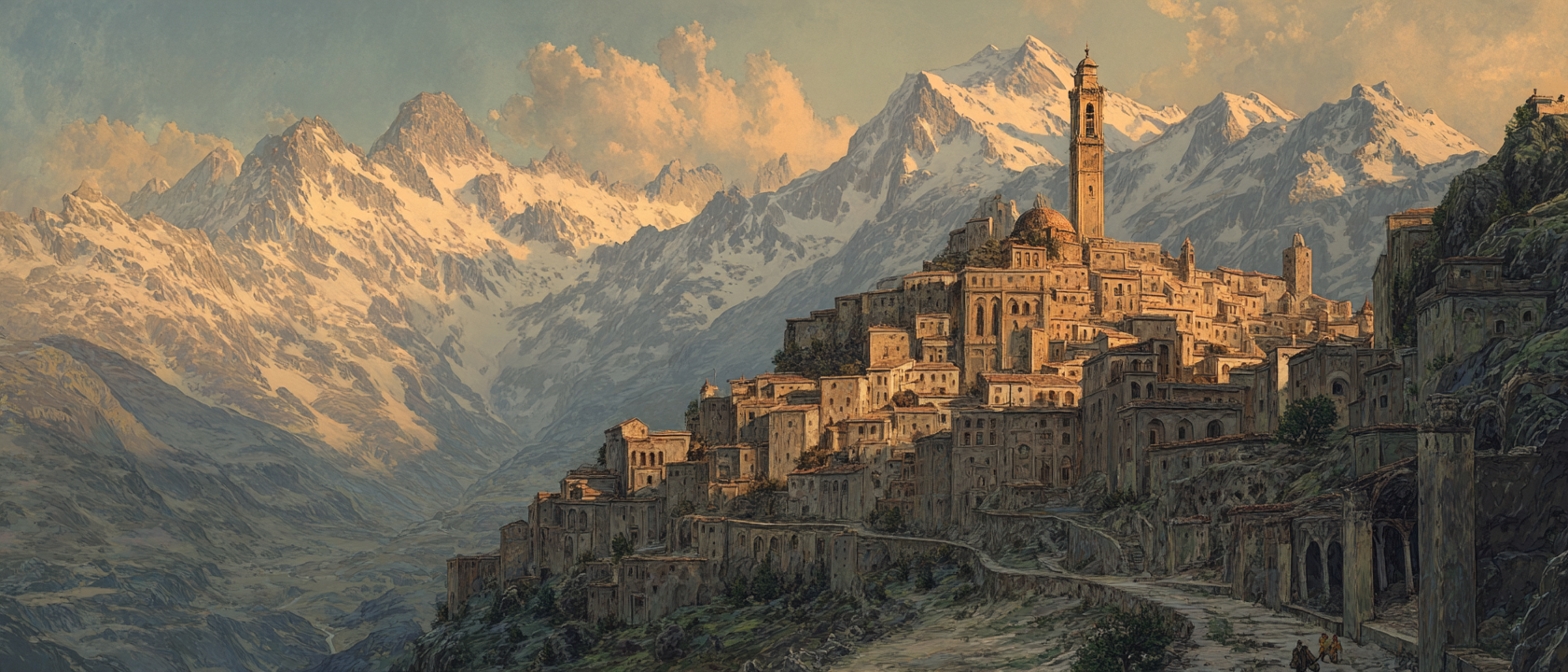
Mons Ferreus is the provincial capital of Provincia Montium Ferri and the Empire's primary interface with the dwarven Holds: the city from which Mercatus Viridis, the single mountain pass trading post, is administered, through which the dwarf goods that enter the Roman economy are priced and distributed, and at which the Hold-licensed factor's office maintains the only dwarf-authorised commercial presence in any Roman city. It sits on elevated ground above the foothills plain, its position giving it command views of the pass approach and the mountain wall of the Iron Spine behind it. Forty-five thousand people live here in the specific manner of a city that has been doing something difficult and important for twelve centuries and has organised every institution around doing it correctly.
The city's relationship with the Holds is unlike any other inter-civilisational relationship in the Empire. The dwarves are not subjects, not enemies, not quite allies in the conventional sense: they are neighbours of comparable sophistication whose engagement with Rome has been conducted through protocols so precisely defined and so consistently maintained that the protocols themselves have become the relationship. What moves through Mercatus Viridis on the mountain approach above the city has been governed by arrangements established nine centuries ago that both parties have found more useful to observe than to revise. The Mons Ferreus that has grown up administering this arrangement has become, in the process, the most protocol-literate civilian administration in the Empire. Its provincial clerks understand the trading post agreement with a specificity that would embarrass the Senate's external affairs committee.
"Mons Ferreus sits on a ridge above the foothills plain with the Iron Spine filling the northern horizon from east to west — a wall of peaks, permanently white above two thousand metres, the three pass mouths visible as notches in the ridge line when the light is right and the weather permits. I have stood on the city's northern wall at dawn and watched the peaks catch the first light while the plain below is still dark, and I have understood, in the specific way that direct experience produces understanding where description cannot, why the people who have been living here for twelve centuries look at those mountains differently from how I do. They are not impressed. They are acquainted."
Demographics
Forty-five thousand residents with the character Plinius describes: dense, competent, and formed by proximity to a civilisation that has been measuring them for twelve centuries. The mountain families are the city's core — Romans whose ancestry here extends ten, eleven, twelve generations, who learned Dwarvish as children not as a scholarly accomplishment but as a practical necessity, and who have developed the specific social calibration that sustained contact with dwarves produces: a preference for precision over eloquence, a discomfort with the kind of social performance that the capital considers sophistication, and a patience that the interior provinces mistake for slowness and that is in fact the opposite.
The commercial community attracted by the dwarf goods trade is more varied: merchants from Lacusum and the capital, factors representing southern trading houses, the specialist craftspeople who work dwarf-made materials into finished goods and who have clustered here for proximity to the source. The Academy's mountain station staff represent a smaller but intellectually significant presence. The factor operating the Hold-licensed office, Gaius Ferrum Montanus, who has held the license for thirty years and whose loyalties are the province's standing subject of gossip, occupies a category of his own.
Government
Governor Aelia Cava Montana, in her sixth year, is the most experienced mountain province administrator currently serving in the Empire. She was born in the province — the first Governor of Montium Ferri in four generations with provincial origin — and her administration has the specific quality of someone managing a situation she has understood since childhood rather than learning it in post. Her relationship with the post prefect at Mercatus Viridis is direct and unambiguous: she served as post prefect there herself for nine years before her appointments progressed. She has opinions about the current prefect. About the Mercatus Viridis situation — the railway survey, the eight months of visible dwarf engineering activity on the other side of the exchange line — she has opinions that she has shared with the Senate in reports and that the Senate has not adequately processed.
The Hold-licensed factor's office operates outside the Governor's administrative authority in ways that are technically specified in the original trading post agreement and practically contested in every budget cycle. Gaius Ferrum Montanus reports to the Holds' commercial directorate in Thalgrimm, not to the Governor's office. He operates within Roman law in all formal respects. He has been in the city for thirty years and knows more about the practical functioning of the trading post protocols than any Roman official including the Governor. Montana finds this arrangement professionally unsatisfactory and has not found a legal basis for changing it.
DM ONLYDefences
A Legion cohort of six hundred soldiers, larger than Agropolis's garrison and significantly smaller than Castellum Magnum's, with the specific operational profile that a mountain province produces: patrol capability in difficult terrain, pass security during the open season, and the emergency protocols for pass closure that the provincial administration maintains year-round regardless of current conditions. The garrison commander, Centurion Primus Durus Lapidus, has been in the posting for eight years and is the most experienced mountain military officer in the Empire. His primary concern in 1200 A.P. is not any military threat — the mountains and the dwarf relationship preclude conventional threats — but the railway survey's implications for his emergency protocols, which were designed for a world in which the Iron Spine was three weeks from Nova Romae and are not calibrated for a world in which it might be four hours.
Industry & Trade
The dwarf goods market is the city's economic foundation and its most distinctive commercial feature. Every piece of dwarf-made metalwork, precision instrument, architectural element, and refined material that enters the Roman economy passes through Mercatus Viridis and arrives in Mons Ferreus as its first Roman market. The goods are not cheap — the protocols set exchange rates that reflect the Holds' assessment of their goods' value, and the Holds' assessment is not modest — but they are incomparable in quality, and the premium that Roman craftspeople, military officers, and wealthy consumers will pay for dwarf-made work has supported the province's economy since the engineering partnership began nine centuries ago.
The Hold-licensed factor's office on the forum's northern edge is where the Holds' commercial directorate's pricing guidance is transmitted to the Roman market: Gaius Ferrum Montanus translating the Holds' catalogue into Roman commercial terms, advising buyers on what is available and at what price, and managing the flow of Roman goods that the exchange protocols require to move in the other direction. His thirty years in the role have made him the single most commercially authoritative figure in the dwarf goods market, and his assessments of specific goods' quality and value are treated by the Lacusum banking houses as the reference standard. This authority is entirely informal. It is entirely real.
DM ONLYInfrastructure
The Via Montium is the province's primary road and the Empire's most technically demanding maintained road: the switchback ascent to the ridge, the pass road above, the southern descent to the agricultural plain, all maintained by the provincial engineering corps to the standard that keeps the Mercatus Viridis connection open for as much of the year as the mountain weather allows. The pass closes for approximately three months in winter; the precise timing varies with conditions and is monitored by the Signal Tower's observers and the post prefect's weather reports. The provincial engineering corps has been working with dwarf engineering consultation since the third century, and the road quality reflects this: the upper sections of the pass road are built to standards that Roman engineering alone could not have produced at this altitude.
The Signal Tower's relay system connects the city to Mercatus Viridis with a speed that compensates for the road distance. A message from the post reaches the Governor's office in approximately twenty minutes by signal; by road the same journey takes half a day. The system has been the administrative backbone of the province's pass management for nine centuries and is the infrastructure that allows the city to effectively administer a frontier installation half a day's ride away. The dwarf side of the post has its own internal communication system whose nature and speed are not known to the Roman administration.
Districts
Mons Ferreus organises naturally around its ridge position. The Forum District occupies the ridge's flat central summit: the administrative core, the Governor's offices, the principal temples, the most formally Roman part of the city and the one that most clearly expresses what the province considers its proper relationship to the capital. The Market District is the commercial heart, its dwarf goods warehousing and resale operations the city's most economically significant activity, and the district where the mountain families' commercial knowledge and the southern merchants' capital meet with the specific friction that produces the city's most interesting commercial negotiations. The Factor's Quarter is the specialist district that has grown up around Gaius Ferrum Montanus's licensed office, housing the commercial support infrastructure the dwarf goods trade requires: assayers, translators, documentation specialists, and the small community of Roman citizens who have made careers in the gap between the two commercial systems. The Mountain Families Quarter is the oldest residential district, its buildings the deepest-rooted in the ridge and its population the most generationally established, and the one district that visitors from the interior provinces consistently find difficult to read. The Academy Station occupies the ridge's eastern end, its observation instruments pointed at the Iron Spine with the specific intent of understanding the mountain that the mountain Romans have stopped finding remarkable.
Guilds and Factions
The mountain families' informal collective, the commercial community of dwarf goods traders, the Academy's station staff, and Gaius Ferrum Montanus as a faction of one constitute the city's four significant power concentrations. The Governor's administration is the formal authority over all of them and the practical authority over three. Its relationship with the factor's office is the province's defining political tension, less dramatic than comparable conflicts elsewhere in the Empire because both parties are too competent for drama, but equally structural: two authorities operating in the same space with overlapping and contested jurisdictions, each knowing precisely where its mandate ends and declining to acknowledge that the other's begins there.
DM ONLYHistory
Mons Ferreus was founded in the second century as the administrative centre for the province that grew behind the trading post — the post preceded the city, the city grew to manage it. The engineering partnership with the Holds began in the third century, the road improvements above the city the first joint project. The Signal Tower was built in the third century. The Mountain Families' Assembly Hall's foundation is third-century. Gaius Ferrum Montanus received his license in 1170 A.P. The railway survey at Mercatus Viridis began eight months ago. For full chronological detail, see: Annales Mundi.
Points of interest
The Signal Tower's observation platform (city's highest point, accessible to the public during daylight hours when not in active signal use) — the position from which the Iron Spine's full extent is most completely visible: the pass mouth in the ridge line, Thalgrimm's surface gateway visible as a dark geometric form in the cliff face on clear days, the permanent snow line above two thousand metres. The observation roster, maintained continuously for nine centuries, is the single most complete weather record in the Empire. The current roster-keeper has noted, in the past eight months, a pattern of signal activity from the dwarf side of Mercatus Viridis that does not correspond to any category in the established signal protocol documentation.
The Ferrum Montanus Factor's Office (forum's northern edge, ground floor publicly accessible for catalogue and pricing consultations) — the most politically significant commercial premises in the province and the one whose contents are least accessible to the Governor's administration. The office's ground floor is the public-facing operation. The upper floor is where Gaius Ferrum Montanus works, sleeps, and conducts the communications with the Holds' commercial directorate that constitute the Holds' continuous low-level assessment of the Roman market. The thirty years he has been in the building are, by his own account, the most interesting thirty years available to a person of commercial inclinations in this world. He does not specify interesting in which direction.
The Mountain Families' Assembly Hall (oldest street in the Mountain Families Quarter, foundation stones third-century, not a formal institution) — the informal governance space of the population that has been here longest. The assembly meets irregularly and without official notice, typically when something is happening in the province that the mountain families consider requires their collective assessment. It has met three times in the past year. The Governor's office is aware of all three meetings. The Governor's office does not know what was decided at any of them.
The Pons Ferreus (the Iron Bridge, spanning the Rivus Ferri at the city's northern edge, 743 A.P.) — the finest single piece of Roman engineering in the frontier provinces, built with dwarf consultation on the foundation work after eleven years of construction. It carries the northern road across the Rivus Ferri toward Kharak-Duun. The dwarves inspected it at completion and said nothing. The chief engineer had it noted in the provincial record that they had inspected it twice. Mountain Romans consider this the most significant professional review in the province's history. Visitors from the interior consider the bridge impressive. Mountain Romans consider the visitors' assessment of the bridge approximate.
Tourism
The province receives scholars interested in the dwarf relationship, merchants with business at Mercatus Viridis, and occasional visitors who have come specifically for the mountain environment. It does not receive pilgrim traffic or agricultural observers. The mountain families are polite to visitors who demonstrate competence in the practical requirements of being in a mountain province in winter and less polite to visitors who do not. This is not rudeness; it is an accurate assessment of risk. The Governor's office produces a visitor's advisory document. The mountain families consider it adequate and insufficient simultaneously, which is their assessment of most documents produced by people who have not spent a winter above two thousand metres.
Architecture
The city's buildings are in the foothills granite that characterises the province: darker and heavier than the limestone of the interior, cut to tolerances that reflect nine centuries of working alongside dwarven construction standards without matching them. The Forum District's public buildings are the most formally Roman in the province, their columns and pediments correct by the capital's standards and slightly over-engineered by the mountain families' instinct. The Market District's warehousing is purely functional, built for the specific stress loads of heavy dwarf-made goods stored in quantity. The Mountain Families Quarter's buildings are the oldest and the most idiosyncratically adapted to the ridge's specific conditions: deep foundations, steep roof pitches, the specific window orientations that the mountain families developed over generations for the winter light angle.
Geography
The city occupies a natural ridge formation approximately three hundred metres above the foothills plain, its northern face looking directly at the Iron Spine's first significant peaks and its southern face looking down at the agricultural land that connects the province to Provincia Septentrionalis below. The pass road to Mercatus Viridis descends from the city northward into the upper valley, where Thalgrimm's surface gateway lies beyond the exchange line, before continuing south as the Via Montium toward the interior. The ridge's natural defensibility made it the obvious settlement site; the command view of the pass approach made it the obvious administrative site.
Two rivers define the province's geography and both converge near the city. The Rivus Ferri begins deep in the mountain interior, winding west through the high valleys before reaching Mons Ferreus, where the Pons Ferreus — the Iron Bridge, built in 743 A.P. after eleven years of construction with dwarf consultation on the foundation work — carries the northern road across it into Kharak-Duun. The dwarves inspected the bridge at completion and said nothing. The chief engineer had it noted in the provincial record that they had inspected it twice. The Fossa Magna rises on the far side of the Iron Spine, cuts through a ravine of considerable drama before descending to the Inland Sea, and receives the Rivus Ferri north of the city. The gorge the Fossa Magna has carved through the foothills is the province's most dramatic natural feature; the garrison soldiers stationed near it have developed a phrase for the reactions of first-time visitors that does not translate well into formal Latin. The Via Montium climbs the ridge's southern face in a series of engineered switchbacks, built with dwarf engineering consultation in the fourth century and maintained to the standard that reflects the commercial and military significance of keeping the pass connection open.
Climate
Cold, hard, and longer in its difficult seasons than any other province except the frontier. The ridge position moderates the worst of the mountain weather for the city itself, but the pass roads above experience conditions that the plains Romans find difficult to imagine: the passes close for three months not because of administrative convention but because they become genuinely impassable. The mountain winter is the condition against which the mountain Romans' character is annually tested, and the specific quality of competent acceptance that characterises them is the product, in part, of this testing. The summers are short, clear, and the light above two thousand metres has a quality that artists from the interior provinces have been attempting to paint for three centuries with results the mountain Romans consider approximate.
Natural Resources
The foothills' granite is the building material that gives the city its character. The province's mineral deposits — iron, copper, specific rare earths that the Holds' manufacturing requires and that the trading post exchange includes in the Roman-to-dwarf flow — are the resource base that made the province commercially viable before the dwarf goods trade existed and that remains significant. The mountain timber, from the pine forests below the permanent snow line, is the province's agricultural equivalent: slower to harvest than lowland crops and more valuable per unit. The province does not produce food surplus; it produces everything else.
Military
Six hundred soldiers, Centurion Primus Durus Lapidus commanding — mountain specialist posting
Economy
Dwarf goods trade (foundation)
Mountain mineral extraction
Specialist craftwork
Via Montium commerce
Connections
Nova Romae: Via Montium south through Septentrionalis, ~22 days
Passus Primus: half day north
Passus Secundus: three-quarters day north-northeast
Passus Tertius: full day northeast
Thalgrimm surface gateway: one day beyond Passus Primus

Comments