

KHAR-VULM
Land, rail · Khazadum Dwarven Holds · Deep-mining locomotive class · Primary industrial service throughout the Spina Ferri Magna
The Voice is not, strictly speaking, a machine that a Roman engineer could not have imagined. What a Roman engineer could not have imagined is the willingness to spend three hundred years refining a single design. We have spent three hundred years replacing our designs. The dwarves have spent three hundred years perfecting theirs. The result is what happens when you commit that consistently to that trajectory. I have stood in the outer receiving hall at Kharak-Duun with a Khar-Vulm class engine idling twenty paces from me, and I will confess without further hedge that the sound it makes is the closest thing to a genuine mechanical religious experience I have had in fifty-eight years of scholarship.
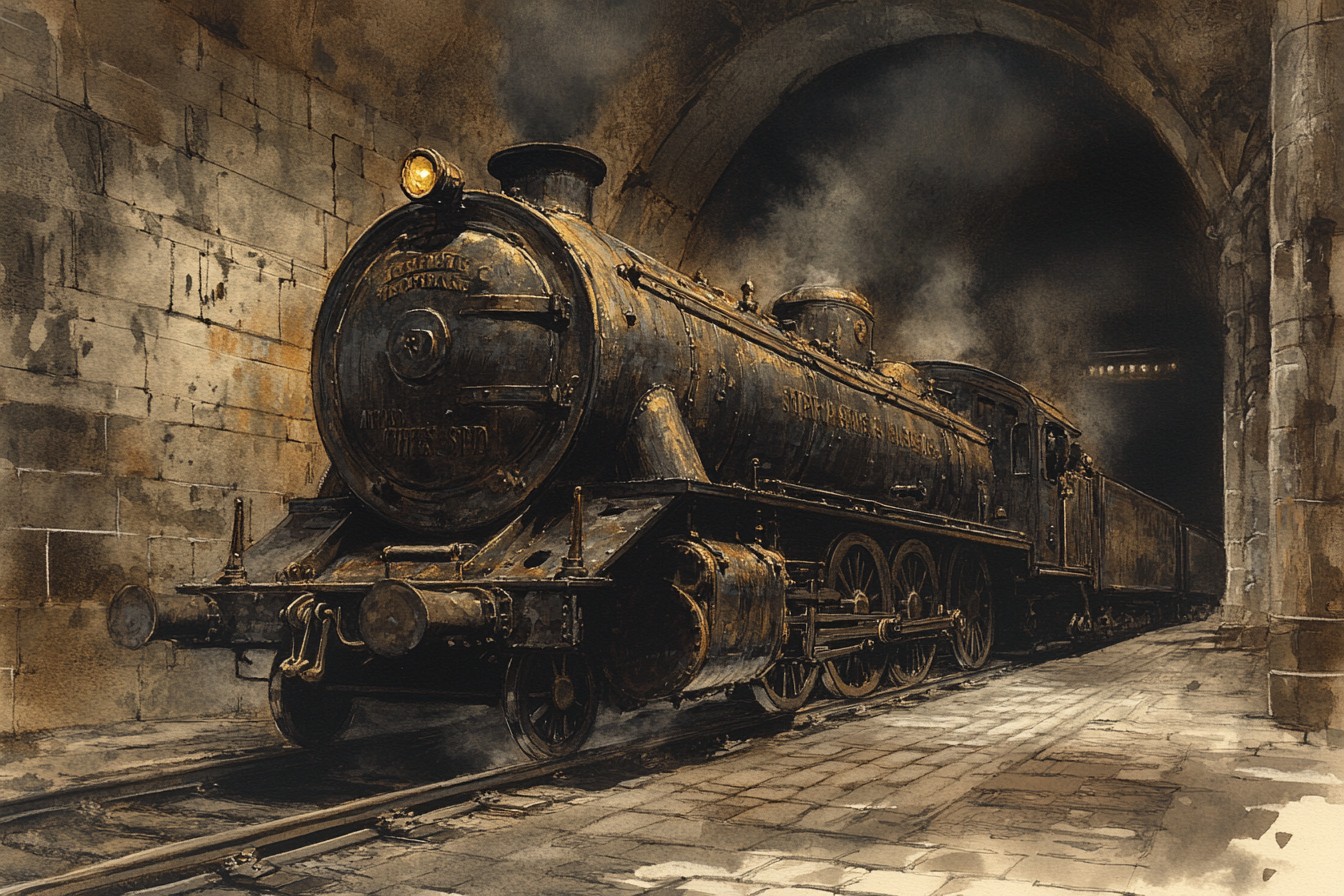
The Khar-Vulm, rendered in Roman scholarship as the Currus Vaporis Khazadum and commonly known throughout the frontier as 'the Voice,' is the mature deep-mining locomotive class of the Khazadum Engineer's Guild, in continuous service throughout the tunnel networks of all three Iron Spine holds since approximately 1050 A.P. It is the industrial machine that made the current scale of Khazadum deep-mining operations possible, and it is, in this author's assessment after fifty years of Roman engineering scholarship, the single most impressive mechanical achievement documented anywhere on the primary continent.
The class is not a Roman machine, was not produced by a Roman engineering tradition, and has never been examined by a Roman engineer at close quarters. What Plinius has been able to describe is the observable behaviour and general character of Class III units at approximately twenty paces' distance in the outer receiving hall at Kharak-Duun during the Foedus Khazadum renewal visits of 1178 A.P. and 1187 A.P., together with the more extensive access he has had to the Transitus Ferri passenger service (a distinct downstream application of the same underlying technology, on which Plinius has been a passenger repeatedly across the past two decades). The internal mechanism of the Khar-Vulm remains, as of 1200 A.P., proprietary to the Guild, protected by dwarven institutional practice that Roman engineering has not found any way to circumvent, and unlikely to be shared with Rome under any anticipated circumstances short of catastrophic institutional change on either side.
The Khar-Vulm's development history is a matter of dwarven internal recordkeeping to which Plinius has been granted limited but useful access through his correspondence with Thane Bera Khar-Thul of Karneth. The class's operating principles Plinius understands in general outline and no more specifically than that; the metallurgy that makes the class possible he understands not at all. What he can attest to is what the machine does, which is to move approximately twenty-four tonnes of ore per rake through the deep-mining networks at working speeds and pressures that Roman industrial engineering has, to date, only theorised.
DM ONLYPower Generation
The Khar-Vulm class generates its motive power through a steam system whose operating principle Plinius understands in outline and whose specific implementation he does not. Water is heated to steam under pressure in a boiler mounted on the forward third of the locomotive unit; the steam drives a reciprocating mechanism whose motion is converted to rotary motion at the drive wheels through a linkage system that Plinius has observed in operation but has never examined at rest. The general character of the mechanism is not unknown to Roman engineering; the specific execution is proprietary.
What distinguishes the Khar-Vulm class from any Roman engineering equivalent (theoretical or hypothetical, as no Roman equivalent has ever been built) is the fuel source. The class does not burn wood, charcoal, or coal to heat its boiler. It draws heat directly from geothermal sources within the Iron Spine Magna, delivered to the boiler through a system of insulated conduits that the Guild has developed over three centuries and that constitutes the technology's fundamental constraint on external replication. The Khar-Vulm cannot operate outside the Iron Spine Magna's geothermal network. It cannot be shipped to Rome and set running. Its power depends on the specific geological character of the mountain range in which it operates, and its production and operation are consequently permanently confined to that range.
Show SpoilerPropulsion
The Khar-Vulm class is a rail vehicle. It runs on a fixed gauge track (2.1 metres between rails, a dwarven standard maintained across all three holds and matched by the external Transitus Ferri routes) laid in the deep-mining tunnels and, in the external passenger service, along maintained surface and shallow-tunnel routes across dwarven-controlled territory. The class is not steerable in the Roman road-vehicle sense; it goes where the track goes and turns where the track turns. Route selection at junctions is managed by switching points controlled from station towers along the routes, following a signalling protocol that Plinius has observed as a passenger and considers well-conceived.
The reciprocating steam mechanism drives four wheels on each side of the locomotive unit (eight drive wheels total), with the drive delivered through a coupling rod that Plinius has seen from the platform on multiple occasions and considers a genuinely elegant piece of mechanical engineering. Braking is delivered through a friction system applied to the wheels themselves and, on descending grades, supplemented by a secondary compression braking system that returns exhaust steam to the boiler and increases boiler pressure. Plinius has experienced a Transitus Ferri passenger unit engaging its compression braking on a descending grade near Karneth and reports that the experience was 'more interesting than I had reason to expect and considerably less alarming than it deserved to be, on reflection.'
Communication Tools & Systems
Khar-Vulm units communicate with their operating stations and with other units on shared track through a signalling system that combines fixed track-mounted flag positions (the primary long-distance signalling method within the tunnel network), a bell system for shorter-range coordination at stations and junctions, and the machine's own characteristic whistle for warnings and route acknowledgements. The whistle is powered by boiler steam and, when sounded at full pressure, is audible along the tunnel network for a distance that Plinius has been unable to establish precisely but which he estimates as several kilometres in the deep tunnels. The whistle's specific frequency is designed to carry through the tunnel environment rather than to be pleasant, and it is not pleasant.
Between-hold communication for the class's operating status is coordinated through the Guild's separate administrative signalling network, which does not use the locomotives themselves as messengers but rather the standard dwarven inter-hold communication system whose specific implementation is not documented in any source available to Plinius. The Transitus Ferri external routes use a supplementary flag-code system between stations that Plinius has documented in his passenger notes and considers a well-designed protocol.
Sensors
The Khar-Vulm class carries no formal sensor system beyond the crew's own observation. The forward observer position provides sightline along the track ahead; a secondary observation position at the rear of the locomotive unit monitors the trailing rake of ore trucks. Deep tunnel conditions provide poor visibility even with the class's forward lantern (a large oil lamp mounted above the boiler, augmented in the Class III design with polished reflectors that increase its useful throw), and the crew's ability to detect obstacles or tunnel damage ahead of the machine at working speed is limited. The Guild's operating protocols compensate for this by mandating substantially reduced speed in any tunnel section with recent activity indicators or in any section without confirmed clearance from the ahead station.
A more interesting sensor question concerns the class's ability to detect tunnel structural change during operation. Class III units carry an integral vibration monitoring system that, per Bera's careful indication in a 1191 A.P. conversation, gives the crew warning of imminent tunnel collapse conditions with sufficient time to reduce speed and prepare emergency braking. How this system works, whether it is mechanical or involves some dwarven engineering technique that Roman engineering does not have, and how reliable it is in practice, are questions Plinius has raised with Bera and to which Bera has, characteristically, provided answers that are polite, brief, and not particularly informative.
Additional & auxiliary systems
The Khar-Vulm class incorporates several auxiliary systems that support its industrial function. The coupling mechanism between the locomotive and its haul rake uses a standardised dwarven pin-and-loop system that allows rapid coupling and uncoupling by two crew members and permits the same locomotive to service multiple ore trucks in sequence at a mining head. The braking system extends throughout the haul rake through a linkage that engages ore truck brakes simultaneously with the locomotive's own brakes, providing coordinated deceleration across the full train. The oil lubrication system, essential to the class's continuous operation under working pressure, is fed from a reservoir on the locomotive unit and requires refilling at intervals that Plinius has been told but has not been permitted to record.
The Class III variant includes a cargo-handling assistance system at the ore truck end: a mechanical tipping mechanism that permits rapid unloading of ore trucks at the mining head processing stations. Plinius has observed this system in operation at the Kharak-Duun outer receiving hall and reports that it works quickly, quietly, and with a mechanical certainty that Roman industrial engineering has rarely matched. The specific mechanism is proprietary to the Guild and has not been externally documented.
History
The Khar-Vulm class's development history spans approximately three and a half centuries from the earliest documented prototype work in the mid-ninth century A.P. to the current Class III units in continuous production and service. The class emerged from a specific problem: the deep-mining operations of the ninth-century Khazadum were expanding to depths that made manual ore transport increasingly costly in labour and time, and the Guild's engineering leadership of that period committed to the development of a mechanical solution that could serve the emerging deep-mining networks without requiring animal or dwarven muscle for haulage. The earliest Class I prototypes were produced at Thalgrimm between approximately 840 and 860 A.P., under the direction of a Guild Master whose name Plinius has been told and has agreed not to publish.
Class I entered limited service in the mid-ninth century and remained in production for approximately a century, with continuous refinement of the boiler, drive mechanism, and rail infrastructure through this period. Class II superseded Class I in production from approximately 950 A.P. and introduced the geothermal fuel system that has defined the technology ever since; earlier Class I units had used conventional fuel with substantial operational limitations at depth. Class II entered widespread service across all three holds during the tenth and early eleventh centuries and made possible the current scale of Khazadum deep-mining operations. Class III entered production from approximately 1050 A.P. and represents the mature form of the technology, with production ongoing to the present day and no successor class currently announced by the Guild.
The class's external appearances have followed a specific pattern. Plinius has been unable to identify a single documented instance of a Class II or Class III unit operating outside dwarven-controlled territory, with one exception: the Transitus Ferri passenger service, which was introduced in 1092 A.P. as part of the Foedus Khazadum renewal of that period, and which operates modified Class II units (retained in the passenger service rather than superseded by Class III) on the specific external routes agreed under the treaty. The Transitus Ferri service is the only sustained Roman-accessible experience of the underlying technology; Plinius has ridden it on approximately eleven occasions across the past two decades and considers it, in the ways that have been made available to him, an authentic and reliable experience of what the dwarven engineering tradition has produced.
DM ONLYNotable Vessels
The Guild does not name individual units. Each Class III locomotive carries a serial designation (T-series for Thalgrimm production, K-series for Karneth production, V-series for Varakh production) and a production year, but no proper name. Specific units of historical note within the class's service history include the following, drawn from Bera's translated summaries of the Guild's internal records:
T-047 (constructed 1063 A.P., decommissioned 1187 A.P. after tunnel collapse recovery). Longest continuous service life documented for a Class III unit; served 124 years primarily on the Thalgrimm north-tunnel network. Recovered from a collapse event in 1187 A.P., examined by the Guild for possible return to service, and formally retired following the examination. The recovered unit is preserved at Thalgrimm as a heritage installation and is one of the few Class III units that outside visitors have been permitted to view at close quarters, though not to examine mechanically. Plinius saw T-047 in its heritage placement in 1187 A.P. and describes the experience as 'the closest a Roman scholar of my generation has come to standing next to the machine that has been shaping continental politics for a century and a half without the continent quite realising it.'
K-112 (constructed 1141 A.P., in current service). The primary Karneth deep-north route unit for approximately fifty years and the machine on which Bera has ridden most frequently in his own official capacity. Bera has spoken of K-112 to Plinius on three occasions with the specific mild affection that a dwarven official reserves for a machine he has come to know personally. The machine is entirely unremarkable within the class; Bera's affection for it is the specific dwarven emotional response to sustained working relationship, and is characteristic of the Guild's operating culture in a way that Plinius considers under-appreciated in Roman intelligence assessments.
V-023, V-024, V-025 (constructed 1088 A.P., all currently in modified passenger service on the Transitus Ferri southern route). The three original Transitus Ferri units, modified from Class II industrial specification for passenger operation and retained in service since the route's introduction in 1092 A.P. These are the specific units on which Plinius has ridden and on which most Roman passengers experience the underlying technology. Plinius has spoken with the Transitus Ferri operating crews of V-023 on multiple occasions and considers them among the most professionally impressive railway operators he has encountered in any context.

A great article as always!
Your freind,
The Graiffe
Working hard at Summercamp 2026