

GRAK'SHOR
Rift-Adapted Flora · Grak'mor Volcanic Zone · Status as of 1200 A.P.
The Vor'keth do not permit outsiders to hold a Grak'shor plant. They permit outsiders to hold a prepared seed. There is a distance of ceremony between the two conditions that took me thirty years to understand and that I am still not certain I have understood correctly. What I do know is that the plant does not survive being taken elsewhere, and that six centuries of experiment by every people with a reason to try have not produced an exception to this rule. Whatever the Grak'shor is, it is a thing of that specific soil, that specific warmth, that specific mountain, and it will not be anything else.
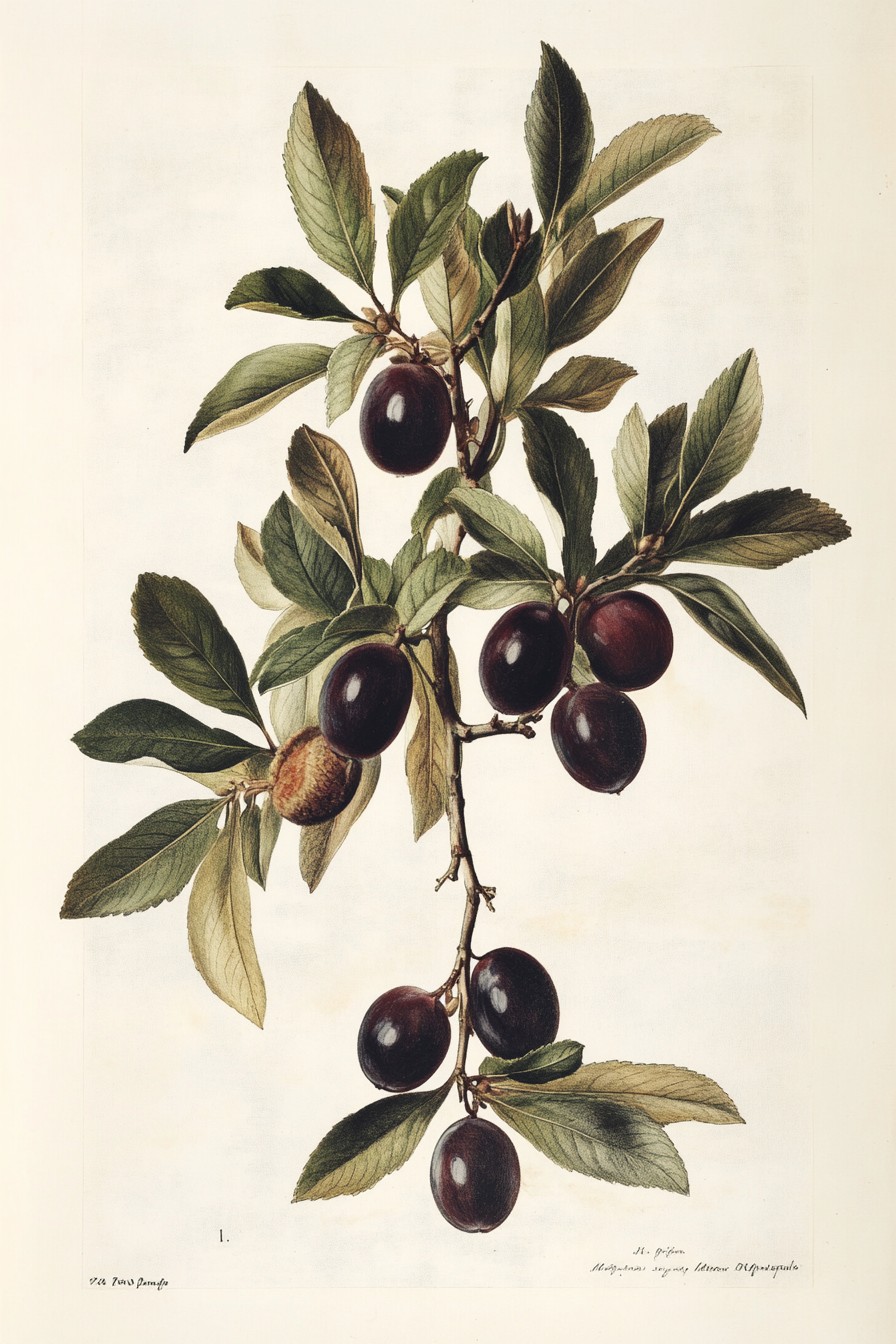
The Grak'shor, rendered by this author in scholarly Latin as Pomum ignitum, is a low woody shrub cultivated exclusively on the volcanic slopes of the Caldera of Grakh'vol, within the Grak'mor agricultural zone administered by the Vor'keth. The plant produces small dense fruits in tight clusters, ripening to a deep red-black colour that the Grakh'tor liken to banked coals. The fruit itself is moderately toxic if eaten raw in quantity; the harvested and prepared seed, following the specific roasting process the Vor'keth control, is the valued portion, used in confederacy ceremonial food and, in tiny measured quantities, as a stimulant that the Vor'keth are known to take during extended ritual observation. It is one of two things this author is aware of that the Vor'keth genuinely will not permit to leave orc territory in living form. The other is a member of the order.
Plinius examined the plant in 1195 A.P. during his visit to the outer boundary of the Grak'mor zone. He was permitted to observe a fruiting cluster from a distance of approximately three metres, was not permitted to handle a living plant or an unprepared fruit, and was given, at the conclusion of the day's observation, a single prepared seed as a gift from the resident Vor'keth station. He has kept the seed. He has not consumed it. He acknowledges that the temptation to do so has, on more than one occasion, been substantial.
Basic Information
Anatomy
The Grak'shor is a woody perennial shrub reaching between 90 and 140 centimetres at maturity, with a dense, compact growth habit and a taproot that extends considerably deeper than the plant's above-ground dimensions would suggest. Plinius examined a specimen tree ring section provided by the Vor'keth station (from a plant that had died naturally at approximately 55 years) and observed that the root system extends approximately three times the height of the visible plant, reaching depths of between three and four metres in the mature specimen. The taproot terminates in a fine network of feeder rootlets distributed through the warm subsurface layer of the Grak'mor volcanic soil.
The stem is single and woody at the base, branching into approximately twelve to fifteen primary branches at heights of 20 to 40 centimetres above ground level. Bark texture is finely fissured, dark grey with reddish tones visible in the deeper cracks. Leaves are small, thick, waxy, and oval, arranged opposite along the branches, with a matte dark grey-green upper surface and a slightly paler undersurface. The plant flowers briefly in mid-spring; the flowers are small, four-petalled, and cream-white, with a faint scent that Plinius could not identify but that Uzrul Ironteeth describes, with a specificity that suggests genuine familiarity, as being similar to the smell of hot iron just before it is drawn from the forge.
Biological Traits
The Grak'shor is a woody perennial shrub reaching between 90 and 140 centimetres at maturity, with a dense, compact growth habit and a taproot that extends considerably deeper than the plant's above-ground dimensions would suggest. Plinius examined a specimen tree ring section provided by the Vor'keth station (from a plant that had died naturally at approximately 55 years) and observed that the root system extends approximately three times the height of the visible plant, reaching depths of between three and four metres in the mature specimen. The taproot terminates in a fine network of feeder rootlets distributed through the warm subsurface layer of the Grak'mor volcanic soil.
The stem is single and woody at the base, branching into approximately twelve to fifteen primary branches at heights of 20 to 40 centimetres above ground level. Bark texture is finely fissured, dark grey with reddish tones visible in the deeper cracks. Leaves are small, thick, waxy, and oval, arranged opposite along the branches, with a matte dark grey-green upper surface and a slightly paler undersurface. The plant flowers briefly in mid-spring; the flowers are small, four-petalled, and cream-white, with a faint scent that Plinius could not identify but that Uzrul Ironteeth describes, with a specificity that suggests genuine familiarity, as being similar to the smell of hot iron just before it is drawn from the forge.
Genetics and Reproduction
The Grak'shor reproduces by seed. Individual fruits contain a single large seed each, protected by the fleshy outer layer of the fruit body. In natural conditions the fleshy layer breaks down through the actions of the small beetle species that has co-evolved with the plant (Coleoptera cinerea , documented by Plinius in the same 1195 A.P. observation), releasing the seed into the warm subsurface soil where germination proceeds over the following spring. Seedlings that emerge outside the specific soil conditions of the Grak'mor zone do not survive their first season; seedlings within the zone survive at rates the Vor'keth manage through selective thinning.
Cross-pollination between plants is essential to seed viability. The plant is not self-fertile. This produces the pattern that Plinius observed in the outer Grak'mor: mature groves are extensive and interconnected, with plants of varying age growing in overlapping clusters that maintain the genetic exchange necessary for continued seed production. Isolated plants, even within the zone, do not produce viable seed. The oldest continuously cultivated grove at the Vor'keth's primary Caldera station has been in production for a minimum of six centuries and probably longer; the Vor'keth's oral tradition on this point extends further back than their written record supports.
Growth Rate & Stages
Seedlings emerge in late spring and grow slowly for the first three to four years, reaching approximately 30 centimetres in height and establishing the taproot. Woody growth accelerates from the fifth year, with the shrub reaching mature dimensions at approximately fifteen to eighteen years and producing its first significant fruit crop in the eighth to tenth year. Mature plants remain productive for between thirty and fifty years, with the most productive years occurring between years twenty and forty. Individual plants have been documented reaching sixty years of age; beyond that point, productivity falls sharply, and the Vor'keth remove and replace older plants systematically.
The plant flowers once per year, in the mid-spring transition period, with fruit ripening across the summer and reaching harvestable condition in late summer to early autumn. The annual harvest window is short, approximately three weeks, and its timing is fixed to a solar and volcanic-signal combination that the Vor'keth interpret and communicate to the harvest teams. The precise interpretation method has not been documented by outside scholars. Uzrul Ironteeth describes the timing as 'when the Caldera says it is ready,' which Plinius considers a shorthand for a more technical determination that Uzrul either does not fully understand himself or is not at liberty to explain.
Ecology and Habitats
The Grak'shor exists only within the Grak'mor agricultural zone, a strip of volcanic soil extending approximately twelve kilometres from the base of the Caldera of Grakh'vol along its western and southern slopes. Within this zone the plant is one of a small number of species that thrive; outside it, the plant does not survive. The zone boundary is precise: Plinius paced approximately 200 metres of it during his 1195 A.P. observation and found the transition consistent to within three to four steps, with Grak'shor plants growing on one side of an invisible line and not on the other. The soil characteristic that defines the boundary is the warmth of the subsurface layer; how the boundary maintains itself against gradual thermal diffusion over six centuries of continuous existence is one of several questions Plinius has been unable to answer, and about which the Vor'keth have offered no explanation.
Within the zone, the plant coexists with a small suite of co-adapted species: the beetle Coleoptera cinerea (essential to seed release), a specific ground-dwelling ant that farms the plant's root aphids in a mutualist arrangement, and several small bird species that feed on the beetle and provide a further layer of pollination assistance during the flowering period. The whole assemblage is characteristic of the Grak'mor zone specifically and does not exist elsewhere. Roman naturalists have documented the beetle and one of the bird species; the ant and the aphid have not been previously described, and Plinius's 1195 A.P. account remains the only Roman scholarly source.
DM ONLYDietary Needs and Habits
The Grak'shor draws water and nutrients from the warm subsurface soil through its extensive taproot system. It is not fertilised in the Roman agricultural sense; the Vor'keth's maintenance of the zone involves selective thinning of old plants, replacement seeding of gaps, and management of the co-adapted ant population, but does not include the deliberate addition of nutrients. The volcanic soil provides the plant's mineral requirements directly, and the plant appears to have specific and unusual mineral needs that only the Grak'mor soil satisfies. Roman agronomists who have examined soil samples from the outer boundary (samples that Plinius carried out in 1195 A.P., without asking whether he was permitted to do so) have identified the crystalline mineral inclusions characteristic of the zone as containing several compounds not present in typical volcanic soils elsewhere. The specific compounds have not been named; the Academy chemists Plinius consulted described them as 'unfamiliar,' with the professional restraint that Roman chemistry uses when it is out of its depth.
Biological Cycle
The plant's annual cycle is closely coupled to the Caldera's activity in ways the Vor'keth understand better than any outside observer. The mid-spring flowering coincides with a small and predictable increase in the Caldera's channel-response frequency (documented by Plinius from the Vor'keth's public records where those records are available for outside consultation), and the late-summer harvest window coincides with a similar seasonal pattern. Whether the plant is responding to the Caldera's activity or the Caldera is responding to the plant's activity, or whether both are responding to a common underlying seasonal signal, is a question that Roman scholarship has not resolved. The Vor'keth's position on this question is that the distinction Plinius is drawing is not meaningful in their theological framework, and that the coupling is the point rather than a puzzle to be explained away.
Behaviour
The Grak'shor is a plant and does not behave in the sense that motile organisms behave. It does, however, exhibit two responses to environmental stimuli that Plinius found sufficiently unusual to record separately. First, the fruit clusters increase their thermal output measurably in the twenty-four hours preceding a significant Caldera channel response, in a pattern that the Vor'keth harvest teams use as an early warning of imminent geological activity. Second, plants adjacent to a newly created lava channel from a Caldera eruption tend to survive the immediate heat and re-establish more rapidly than would be expected of ordinary volcanic-slope vegetation. The mechanism of this survival is not documented. The Vor'keth's oral tradition treats the phenomenon as one of the plant's most sacred characteristics.
Additional Information
Uses, Products & Exploitation
The prepared Grak'shor seed is used in three principal ways within the confederacy. It is consumed as ceremonial food at the major Vor'keth-administered rituals, including the Vor'grak investiture at the Caldera and the Grak'thun Vor'thek dedication ceremony at Keth'voral. It is used as a stimulant by the Vor'keth themselves during extended ritual observation, taken in tiny measured quantities (a small fraction of a seed at a time, from Plinius's inference; the Vor'keth have not confirmed the dosage). And it is distributed through the confederacy's ceremonial tribute network to the clan leaders as a mark of the Vor'grak's recognition, in quantities determined by the recipient clan's standing in the current pledge structure.
A small trickle of prepared seeds reaches the border markets, generally through Vor'keth-authorised channels for reasons the order has not explained publicly. In the border markets, a single prepared seed sells for a substantial sum, typically to Roman collectors who acquire the seed as a curiosity or as a demonstration of frontier contact rather than for consumption. Plinius considers this the more likely correct use for a Roman with no ceremonial training; the seed is a mild stimulant even in the small quantities the Vor'keth take, and the effect on someone consuming a full prepared seed is not documented in any Roman source available to this author.
The unprepared fruit is not consumed. Roman parties who have obtained fresh fruit at the border markets (against Vor'keth practice, and in small quantities) have documented symptoms of moderate toxicity ranging from gastrointestinal distress to a more prolonged effect resembling a slow fever. There are no documented Roman deaths from unprepared Grak'shor fruit; there are seven documented cases of prolonged illness following consumption, all in the second and third centuries A.P. before the toxicity of the fruit was widely understood.
DM ONLYGeographic Origin and Distribution
The Grak'shor is known only from the Grak'mor agricultural zone on the western and southern slopes of the Caldera of Grakh'vol, in Terrae Ferae Occidentalis. The plant has been continuously cultivated there for at least six centuries, and probably longer. Whether the plant existed in its current form before Grakh'tor arrival is a question the Vor'keth have not answered, and one that this author considers, on balance, an open question of some scholarly interest. The plant's specialised adaptation to the Grak'mor soil suggests a long co-evolutionary history with the volcanic zone; the confederacy's cultural centrality of the plant, and the elaborate ceremonial infrastructure surrounding its harvest, suggest a relationship that predates the current forms of Grakh'tor religious practice. The plant may be older than the confederacy that cultivates it. Plinius suspects it is.
Attempts to establish the plant elsewhere have failed without exception. Documented Roman attempts include a series of transplantation experiments conducted by the Imperial Academy's botanical wing in the second, third, and seventh centuries A.P.; a covert acquisition and cultivation programme mounted by a private consortium in the ninth century (which produced no viable plants and terminated at the sponsor's death and a somewhat more recent Vor'keth-authorised gift of five viable seedlings to the Ael'vari Triumvirate in the eighth century, following a diplomatic exchange whose specific terms have not been made public. The five seedlings did not survive their first season in Sylvanmere. The Triumvirate's response to their failure has not been recorded. Plinius considers this the most interesting documented transplantation attempt in the plant's history, both for what it suggests about Vor'keth-Ael'vari communication and for what the failure suggests about the plant itself.
Perception and Sensory Capabilities
The plant exhibits at least two documented sensitivities to environmental conditions. The first is thermal: the plant's growth, flowering, fruiting, and thermal output are all closely coupled to the temperature and activity of the Grak'mor volcanic soil, in ways that suggest the plant is receiving and responding to information about subsurface geological conditions that surface-dwelling observers cannot directly access. The second is the coupling to Caldera activity described in the Biological Cycle section: the plant's condition tracks the Caldera's channel-response frequency at seasonal and, apparently, event-level timescales, with the pre-eruption thermal increase in fruit clusters providing a reliable twenty-four-hour early warning that the Vor'keth harvest teams rely on operationally. Whether these constitute 'perception' in a philosophically meaningful sense is a question Plinius considers ill-suited to the plant's evident competencies, and which the Vor'keth consider trivially answered in the affirmative.
0.9 to 1.4 metres (mature shrub)
Individual fruit: 12 to 18 grams.
Individual seed after preparation: approximately 4 grams.
Low woody shrub; dense compact form; deep taproot
Low woody shrub; dense compact form; deep taproot

Comments